All posts by David McLachlan

Lean CX Score – Good Customer Experience Is Worth More Than 140%

Lean CX ScoreThis is an excerpt from "The Lean CX Score."  Get your copy now and start creating disruptors that completely annihilate your competition.

Oh and good news!  You'll be improving the speed, morale and engagement of your teams at the same time.  Get the Lean CX Score now.

Good Customer Experience is Worth More Than 140%

If getting more approval from your customers isn’t enough, a study in the Harvard Business Review also found that customers who had the best customer experiences spent up to 140% more than those who received a poor customer experience *8.  This means that Customer Experience has a significant effect on your profit as a company, and your success as a team.

The same Harvard research found that customers who gave the poorest ratings for customer service had a much lower chance of staying as customers in the following year.  Fewer than half of customers who rated a company poorly stayed with that company, and overall they only stayed for a year on average *9.

On the other hand, customers who rated their experience the highest were way more likely to remain as customers the following year (31% more, to be exact), and on average had a likelihood of staying for six years *10.

A customer staying for one year, or six years.  Which would you prefer?

It’s not just about customers staying with you a long time.  Keeping customers can also significantly improve your bottom line and profit.  Research done by Frederick Reichheld (the inventor of the Net Promoter Score) found that increasing customer retention by just five percent, increased profit to the company by over 25% *11.

Isn’t that amazing?  Keep an extra five percent of your customers instead of letting them leave, and your profit could go up by 25%.  Most companies would be ecstatic with a 25% jump in profit.  Why was there such a difference?

Well, existing customers of a company tend to spend more over time.  The trust is already there – there is less of a need for the “hard sell”.  And the cost to acquire them as a customer has already been spent, a figure that for brand new customers can be quite large when adding up the cost of marketing, advertising, sales teams, service teams and more to get them on board.

Keeping your customers is even more powerful than you think, and good Customer Experience is the key that unlocks that power for you.

More chapters from The Lean CX Score book:

Lean CX ScoreThis is an excerpt from "The Lean CX Score."  Get your copy now and start creating disruptors that completely annihilate your competition.

Oh and good news!  You'll be improving the speed, morale and engagement of your teams at the same time.  Get the Lean CX Score now.

Lean CX Score – A New Way To Tell If What You’re Doing Works

Lean CX ScoreThis is an excerpt from "The Lean CX Score."  Get your copy now and start creating disruptors that completely annihilate your competition.

Oh and good news!  You'll be improving the speed, morale and engagement of your teams at the same time.  Get the Lean CX Score now.

A New Way to Tell If What You’re Doing Works

By now I hope you’re coming on this journey and you’re keen to improve your Customer Experience.  But how do we tell if what we’re doing works?  Well, let’s break it down.

What works?  You could say that if your product is selling, it works.  If customers are not complaining, it works.  If customers are coming back time and time again with a smile on their face, it works (that’s true for old bricks-and-mortar businesses and disruptive new products – they all need customers).  And, if your team is happy and productive, it works.  That sounds fair, right?

But how do we get there?  That place where customers are lining up to buy from us?  Let’s break it down further.

A Bad Customer Experience – Ever Had One?

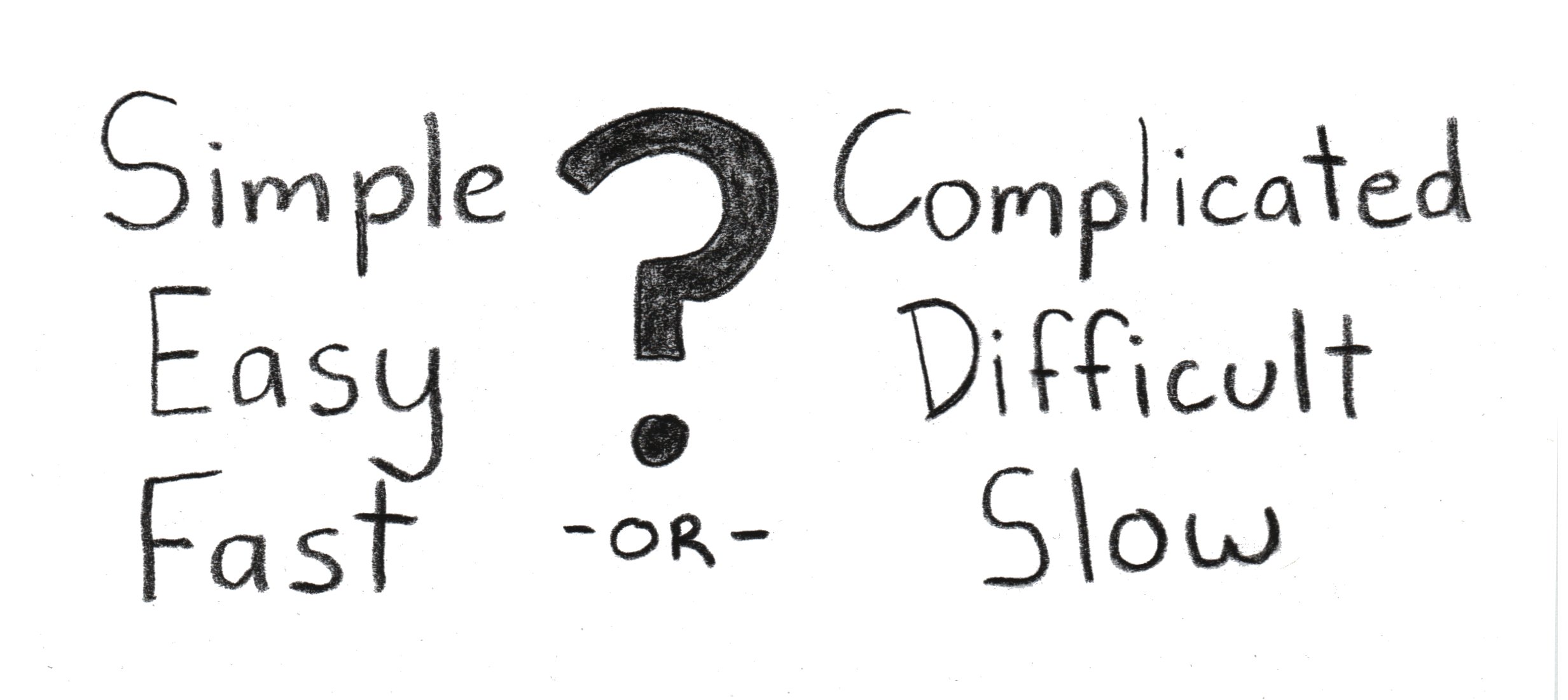
Businesses that fail at Customer Experience make it complicated, slow, or difficult.  Which means that logically, good CX is exactly the opposite.

After all, have you ever had a bad customer experience?  Silly question, I know.  Of course you have.  Like that time you tried buying something, but the experience was so bad it just ended up being too much hassle?  These days it can seem as though many interactions we have are like this.  Maybe the store clerk was bored, or just didn’t care.  Maybe the call centre operator was particularly rude.  Maybe the website didn’t have enough information, or the wait time to be served was 10 times longer than you wanted.

So in our imaginary example, if you did manage to buy it, the experience was tainted and you would be unlikely to return.  Most people simply give up and go somewhere else (i.e. to the competition).

Now if you had a choice between these, which would you choose?

Simple, Faster, and Easy to Do

We’ve seen what good CX isn’t.  So let’s flip it around and look at what it is.

If something is simple and easy to do, then the natural path is for people to do it.  If your work process is easy to do, you’ll probably get it done.  After all, why wouldn’t you do something that’s easy?

If a product is easy to use, then people will use it.  If it’s easy to buy, then they are more likely to buy it.  In other words, if “slow and complicated” are a good reasons to leave a business, then “Simple, Fast and Easy to do” are good reasons to stay.

So that becomes our aim in creating an incredible CX.

We’ve already looked at simple, but why should it be fast?  Time is quickly becoming one of the most precious commodities on earth, with people used to getting instant gratification for the things they want.  In fact, time is so precious that people will pay other people to walk their dogs for them, go shopping for them, and would rather jump online to order something and have it delivered if it means they can save the time and effort of getting dressed and going out.

Another way of saying this is: If your product or service takes a long time, your customer will be looking at their watch and heading for the door (i.e. to your competition again.  Getting the picture?).  Simple, Fast and Easy to do are all equally important.

Sure, “Simple and Easy” Sounds Good, But How Can I Actually Put It Into Practice?

That’s a good question.  Like any of these new terms, the idea of “Simple, Fast and Easy to Do” can easily lose its meaning.

That’s why the Lean CX Score was created.

The Lean CX Score is a single score for your business or team, taken from the absolute best parts of the most customer-centric improvement system discovered in the past century.  It’s easy to do, and it’s fast.  You can quickly see if you’re winning or failing, and you can also see exactly what to do about it.

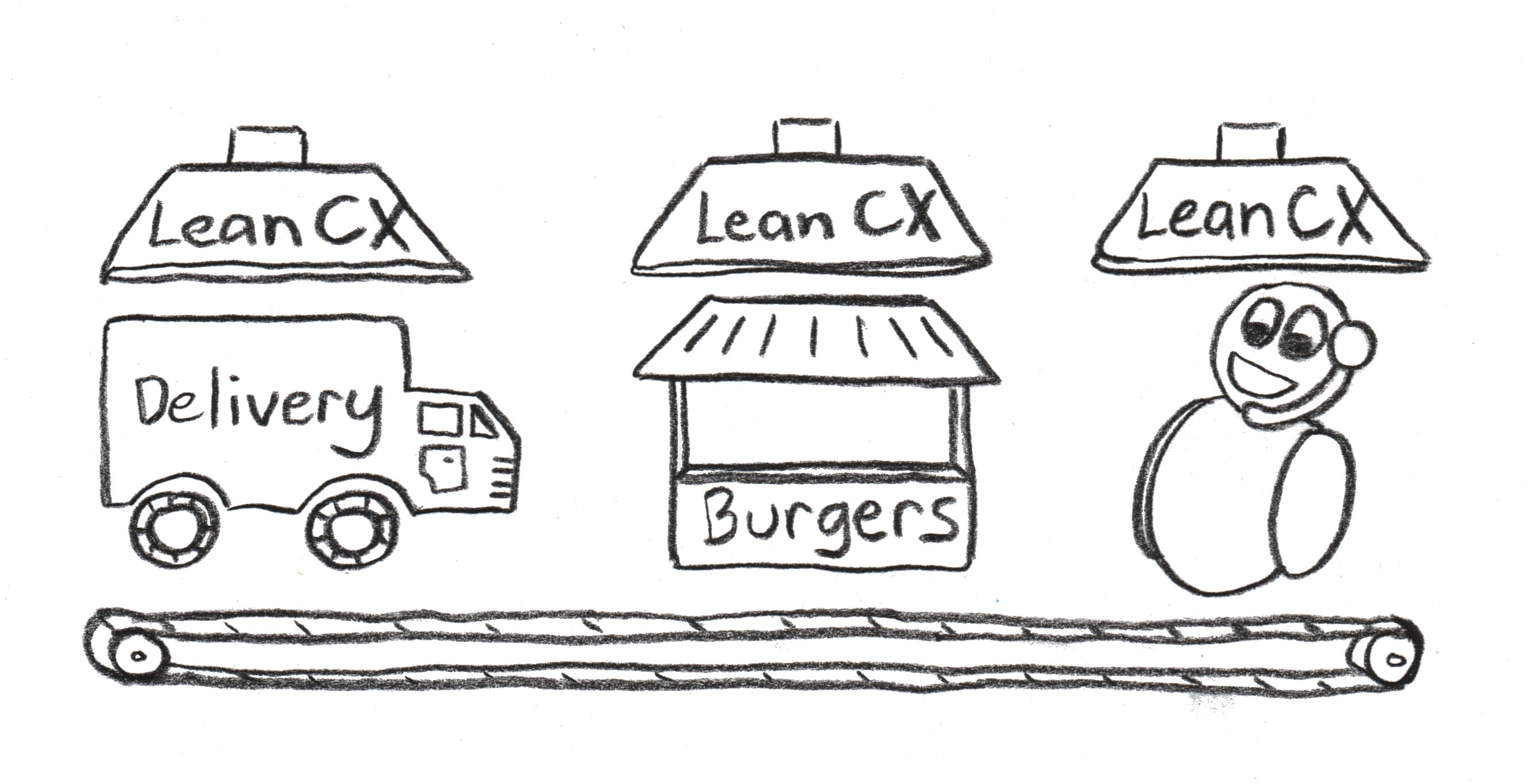
Because every business has customers, and you need them to keep coming back so you can stay in business, the Lean CX Score fits seamlessly over any company you can think of.

The Lean CX Score fits in any business

As we go through this book and you learn more about the Lean CX Score, you’ll see that by putting the steps into practice you will be making things easy for your customer to do, and easy for them to buy.

In fact, removing anything that is wasteful – that doesn’t add value to a customer experience – is our true aim.  As you will see in the coming examples and stories, by doing this we automatically compel our customers to work with us.

More chapters from The Lean CX Score book:

Lean CX ScoreThis is an excerpt from "The Lean CX Score."  Get your copy now and start creating disruptors that completely annihilate your competition.

Oh and good news!  You'll be improving the speed, morale and engagement of your teams at the same time.  Get the Lean CX Score now.

The Lean CX Score Story – The Wise Man And The Emperor

Lean CX – The Emperor And The Wise Man

Lean CX ScoreThis is an excerpt from "The Lean CX Score."  Get your copy now and start creating disruptors that completely annihilate your competition.

Oh and good news!  You'll be improving the speed, morale and engagement of your teams at the same time.  Get the Lean CX Score now.

By now you may have heard about the Lean CX Score, and are wondering to yourself “What’s all the fuss about?”  So let’s cut to the chase.  Below are the six separate, actionable steps in the Lean CX Score.  Each one by itself can create incredible growth, profit and scalability in your team, your startup, your business and your life.  But together, they are truly the greatest secret to creating disruptive products and services in any industry – new or old.

The six Lean CX Score steps can be remembered with the acronym ROVE CP (at least that’s how I remember it).

  1. Repeatable Process
  2. One Step Flow
  3. Visual (and Audio) Management
  4. Error Proofing
  5. Check and Stop
  6. Problem Solve for Exponential Growth

The steps also become six questions, which you can use to get your point for that step.  The questions look like this:

  1. Is my customer experience the same great experience every time?
  2. Did it take only one step for my customer to get what they wanted?
  3. Can my customer understand what to do first time, without having to ask?
  4. Is it impossible to make a mistake?
  5. Is there a check to see if my customer got what they wanted?
  6. (How) do we use feedback?

If they don’t make much sense now, don’t worry.  By the time you’ve been through the stories and real life research in this book, you will be an expert on them.

Which brings us to a quick note on reading this book.  Some people may be tempted to think that they know all about these steps just by seeing the headings, or to skip ahead to the last chapter and see how their business measures up.  That’s not necessarily a bad thing – different people learn in different ways, and sometimes getting an overview (such as in Chapter Seven) can help you learn more quickly.

Just remember that each chapter has the finer details you’ll need to take things to the next level, and in skipping ahead you may miss some of those things.  Also remember that these are not the same tools you may have seen before.  I’ve made the process simpler, faster, and easier to use with a few adjustments – adjustments I’ve made by seeing the results on the actual front lines of customer service and CX over many years.  If you approach this book with an open mind, you will see some amazing things begin to happen.

You may have heard the story of the Emperor who asked the advice of the wisest man in his kingdom.  When the wise man appeared he did not speak, and instead asked for a cup, together with a saucer and some tea.  He poured the tea into the cup with great poise as the court watched with amazement, but even when the cup was full he kept pouring until tea was spilling down the sides and onto the table.

Finally the Emperor could take it no longer and yelled “Stop, stop you crazy old man!  Can’t you see that the cup is full?”

It was then the wise man stopped pouring and said: “You are like this cup – I cannot pour my wisdom because your cup is already full.  If you truly seek my council, your cup must first be empty.”

Your cup must first be empty.

If you genuinely want incredible results, start this journey with a “beginner’s mind”, where you leave your pre-conceptions at the door and your cup is able to be filled.  In the beginner’s mind there are many possibilities, in the expert’s there are few.

So read the chapters to get a full understanding, read the stories of people who have done it before, and read how they used it to win.  At the end of the book you’ll see how to rate your own business or team, and start to see the incredible rewards that good CX can bring.

Let’s do it!

More chapters from The Lean CX Score book:

Lean CX ScoreThis is an excerpt from "The Lean CX Score."  Get your copy now and start creating disruptors that completely annihilate your competition.

Oh and good news!  You'll be improving the speed, morale and engagement of your teams at the same time.  Get the Lean CX Score now.

Get the Lean CX Manifesto here:

Lean CX Manifesto

Five Minute Lean – Introduction

Five Minute LeanThis is an excerpt from the book "Five Minute Lean", by David McLachlan - a wonderful book that blends teaching of the tools, culture and philosophy of traditional Lean with a modern-day Lean parable.

You can get the whole book on Amazon here and enjoy your own copy.

Introduction

This book was created for you.

In fact, if you are working either as an employee or as a business owner there’s a good chance you have run into your fair share of frustration over the past year.  A recent study found that nearly 87% of employees are “disengaged” in their jobs*, feeling unhappy and stuck with the work they do every day, and I know at times we would probably even use a stronger word for it than that.  With the average age of retirement currently in the high sixties and rising, that could be a very long time to spend doing something that you don’t enjoy.

This feeling is not just for the majority of employees in the work force either.  Small business owners often find themselves working 12-hour days in their business, with no clear process and no way to make things easier for the future.  Does any of this sound familiar to you?  Perhaps you know someone who is going through the same thing or even someone who feels the same way.  Have you ever come home exhausted because your job makes things more difficult than they should be?  Maybe you’ve been trying to do good work but seem to be blocked at every turn and you think to yourself, “If only there was a better way.”

Well here is the good news: There is a better way, and you’re about to learn it.

What you are about to learn will help make your job easier, faster, and more enjoyable.  It will give you an incredibly simple view of your job or your business and improve it so much that work becomes a pleasure again (or maybe even a pleasure for the first time).  It will help you to think like a leader, and people who think and act like leaders tend to get paid more on average than those who don’t.

Award winning research** has proven that the best of these leaders, in the most outstanding companies around the world, all have the following four capabilities in common:

  1. They know how to reveal problems & opportunities in their work
  2. They solve the root cause of these problems, building new knowledge
  3. They share any knowledge learned throughout the organisation
  4. They develop the first three capabilities in others

This book will give you the means to achieve all four of these leadership qualities.

It All Starts With a Standard Process

As you will soon discover for yourself, Lean transformations can see incredible results.  Process and delivery times can be cut in half (or more), and it is not uncommon for quality to improve in the area of over 100%.  But it all starts with a standard process.

Although it might be hard to believe at first, everything in life has a process, whether that process has been properly articulated or not.  And where there is a process, it can be improved.

Because of this, I am 100% certain this book can help you, no matter what industry or area you work in.

Top athletes train a very specific way each day to gain the success they enjoy in their field – they have a standard, repeatable process to get results.  Restaurants such as McDonalds have built themselves into multi-billion dollar businesses, and are run primarily by 16 year olds at the front line.  They can produce food the same way every time, because they have a method that is trained the same way each time to young people on the job.

But it also goes deeper than that.

Surgeons following a process checklist in a study from the New England Journal of Medicine saw death rates drop by almost half (47%).  Serious complications also dropped by around 36%.  A huge and positive impact, all by following a standard process.

How about music?  Surely that is a creative industry, and can’t be put in a “standard process” box?

Well, when Lou Perlman started Trans Continental Records in the 1990s, he studied a previously successful band called New Kids on the Block, and discovered that the use of five part harmonies in a certain way resulted in a large number of Top 10 hits.  He then used that very same process on the Backstreet Boys, *NSync, Take 5 and O-Town, creating a variety of boy bands from scratch and selling well over 200 million albums between them.  It was standard and repeatable and it made him many millions of dollars.

There are many ways standard processes help people to succeed.  Starting with your current process and using the methods in this book to improve it has been proven to be extremely effective.

This Book Itself is a Standard Process

To make your experience as easy as possible, you’ll notice that this book itself is a standard process, which you can reference quickly, depending on where you are on your journey.

Each chapter title is actually one of five individual steps that you can use and see at a glance, based on the five step Lean implementation process at the Lean Enterprise Institute.  These steps are “Specifying Value, Map, Flow, Pull, and Perfection”.  The five sections within each of these chapters are also titled as more detailed instructions for you to reference quickly.  Laying out the book in this way ensures that you and your team-mates have the power to learn and share Lean improvement methods in under five minutes, and it also makes it easier for you to get started and learn by doing, instead of spending time trying to find all of this information yourself.

Included at the beginning of each chapter is also an ongoing story – it is the story of someone improving their job so much that they enjoy it again.  As you read this story some parts may seem unusual at first, but please know that they have been carefully crafted to embed in your subconscious the Lean tools and practices.  Using a book in this way, with a summary and a story means that people with different learning styles can learn quickly and in the way that they most prefer.  Those who prefer a summary can read the summaries, those who prefer a story can read the stories, and those who want it all can read both.

While traditional Lean improvement tools were used in manufacturing companies, in Five Minute Lean we will also use them further in the world of office processes, food, finance, technology and dozens of other industries.  They can – and should – be used everywhere, from the home kitchen or work-shed through to building a home kitchen or work-shed, from a hotel doorman through to a hotel CEO.

Everyone has the power to improve their work, no matter what that work is.

Teach and Share to Build an Incredible Culture

Five Minute Lean is designed to make it easier for every one of your team-mates to improve their job.  This not only makes the job better and less burdensome on themselves, but it benefits customers with improved quality and delivery speed, and shareholders with increased profits and lowered costs as well.

By teaching Lean to all levels of a company, you can achieve amazing things.  This is because when management is on-board and well versed in job-improving tools, they can support and drive change.  When front-line team-mates learn these problem solving skills, they can often see quick ways to improve their job as they already know the process well.

Lean is the common language that when everyone has, ties this all together.

To quickly implement this common language, there is a key underlying principle of Lean, which is “respect for people”.  Respect for people means that we see problems as an opportunity to improve the process; we don’t consider it as a failing of the people.  Seeing it this way and improving a process also has lasting results – a legacy, even if people come and go.

While we are improving the process, we are also building our people.  This means growing the team-mates you work with and bringing them on the journey with you.  Every time you improve your work, you can share and teach these problem solving tools as well.  With more people around you who can discover and solve real problems quickly, work can become more and more pleasurable over time – even (believe it or not) fun.  This combination of front-line expertise and Lean problem solving ability cannot be bought with money, it must be grown within your business, which is why no one is ever “let go” as a result of a Lean transformation – only grown into new positions.

Finally, the steps in this book will give you and your team huge benefits in your personal lives.  Proof has emerged* that shows it is not always extrinsic rewards like money that increases motivation and happiness, but more intrinsic rewards or motivators.

These intrinsic motivators are:

1.  Autonomy

Where we are given free rein in solving a problem

2.  Mastery

Where we can work continuously toward mastering a worthy skill

3.  Purpose

Where we are contributing to something greater than ourselves

A Lean initiative, when taught to every level of a company, can give you all three.  By putting this book in everyone’s hands, you not only have the power to improve your job, but dramatically increase the engagement of your team-mates across the board as well.  Then, not only will work become a pleasure again, but great financial rewards will begin to flow.

Five Minute LeanThis is an excerpt from the book "Five Minute Lean", by David McLachlan - a wonderful book that blends teaching of the tools, culture and philosophy of traditional Lean with a modern-day Lean parable.

You can get the whole book on Amazon here and enjoy your own copy.

Check out these selected chapters from the teachings within Five Minute Lean:

Selected chapters from the story within Five minute Lean:
Five Minute Lean – The Power of Incentives – What is Measured and Rewarded Improves

Five Minute LeanThis is an excerpt from the book "Five Minute Lean", by David McLachlan - a wonderful book that blends teaching of the tools, culture and philosophy of traditional Lean with a modern-day Lean parable.

You can get the whole book on Amazon here and enjoy your own copy.

The Power of Incentives – What is Measured and Rewarded Improves

‘If you want to change how someone acts, change what you measure and reward to reflect it.’

When you’re effecting change in an organisation you should be aware of one of the most powerful influences of a person’s behaviour:

Incentives – but it’s not what you might think.

Billionaire Warren Buffett’s business partner Charlie Munger famously said that he continually underestimates the power of a person’s incentives.  Think about the global financial crisis in 2008 – it was caused in large part by institutions financing thousands of terrible loans – simply because their incentives were married to how many they sold and not the quality of the loans themselves.  Seems so simple now, doesn’t it?  But it made no difference to the salespeople if the loans went bad (which they eventually did), and it ended up causing widespread financial havoc.

So our last step when implementing a change in our company or organisation is this:

  • To change how our team members work and act, change how they are measured and rewarded.

This doesn’t have to mean monetary rewards either – it might simply be the difference between pleasure and pain in a task.  If a task is extremely difficult or painful to do the right way, it subtly makes the incentive for our team-mates not to do it.  If doing a task the wrong way is easier, the unspoken incentive is actually to do it that wrong way.

Changing what we measure has a similar result.  If you want team members to stop passing on mistakes or unfinished products downstream (to the next step in the process), then stop measuring them by the amount they do and start measuring them on the quality instead.  Make the focus on zero defects, and tie bonuses or Key Performance Indicators (KPIs) to quality or adherence to a standard process, with the amount they do as a secondary consideration.  The same works for any other process output you are trying to change, in business and in life.

If you want better customer service, create a standard process around your customer service interactions then change what you measure and reward to reflect it.  Feedback (both good and bad) for these things is best given as soon as possible – the longer you wait the less powerful it becomes.

Understanding the effect of incentives on team-mates’ every day decisions can truly change your business and your life.

Selected chapters from the story within Five minute Lean:

Check out these selected chapters from the teachings within Five Minute Lean:

Five Minute LeanThis is an excerpt from the book "Five Minute Lean", by David McLachlan - a wonderful book that blends teaching of the tools, culture and philosophy of traditional Lean with a modern-day Lean parable.

You can get the whole book on Amazon here and enjoy your own copy.

Five Minute Lean – Put it Together With Design for Ease of Use

Five Minute LeanThis is an excerpt from the book "Five Minute Lean", by David McLachlan - a wonderful book that blends teaching of the tools, culture and philosophy of traditional Lean with a modern-day Lean parable.

You can get the whole book on Amazon here and enjoy your own copy.

Put it Together With Design for Ease of Use

‘The most successful companies have products that are easy for customers to use, and processes that are easy to create them with.’

Design for Ease of Use (DFEU) is the idea that both our product and our process should be designed as simply as possible, so that anyone can use and understand it.

Truly, the more people that can use your product, the more opportunities you have to sell it.  And the more employees that can perform your process, the easier it will be to find quality, capable staff.

It is no mistake that an average two year old can find their way around an Apple iPad, and that Apple as a result has been an immensely successful company.

This is why Design for Ease of Use is so very important.

The first step is asking our customer, “What is it you are trying to do?”  The reason we ask, is because value is always determined by the customer (1.1).  Whatever their answer is, we can ensure that our process gets them to that outcome more easily, by answering for ourselves the DFEU questions below:

1.  How many steps are in the process?

Can these steps be reduced?

2.  Is Value added at each step?

Can we remove non-value added steps?

3.  How many wasteful activities take place at each step (3.1)?

Can we remove this waste?

4.  How long should each step take?

Can we make them faster, and does it meet customer demand?

5.  Why is the step necessary?

What would happen if it was eliminated?

6.  Are there any queues or stops?

How long does the process stop for, and can we remove these queues?

7.  What can go wrong at each step? Is it possible to make a mistake?

Can we use Error Proofing (4.2) to avoid mistakes?

8.  If the mistake cannot be prevented, can it be detected before it goes to the next step (4.2)?

And finally, the big one:

9.  Would customers be willing to pay for this step if they knew about it?

To quote a phrase that is attributed to Albert Einstein – “Everything should be made as simple as possible, but not simpler.”  Making things easy to use is the pillar behind any great product.

Five Minute LeanThis is an excerpt from the book "Five Minute Lean", by David McLachlan - a wonderful book that blends teaching of the tools, culture and philosophy of traditional Lean with a modern-day Lean parable.

You can get the whole book on Amazon here and enjoy your own copy.

Selected chapters from the story within Five minute Lean:

Check out these selected chapters from the teachings within Five Minute Lean:

Five Minute Lean – Work Towards One-Piece-Flow (and Reducing Silos or Batching)

Five Minute LeanThis is an excerpt from the book "Five Minute Lean", by David McLachlan - a wonderful book that blends teaching of the tools, culture and philosophy of traditional Lean with a modern-day Lean parable.

You can get the whole book on Amazon here and enjoy your own copy.

Work Towards One-Piece-Flow (and Reducing Silos or Batching)

‘One Piece Flow allows us to create our product or service smoothly and to customer demand, one piece at a time, reducing inventory, queues and work in process.’

One Piece Flow is where, instead of many different departments or processes creating large amounts of material or work, it is done in as close to the one place and at the same time as possible.

It also means that our product moves from step to step continuously, one piece at a time and with no build-up of work in between.  In our Line Balancing example (3.4) there would always be one piece (and only one piece) working for each step, and those steps would be balanced to customer demand (Takt time).

One of the main ideas behind this is that by only working on one piece at a time until completion, if anything stops or holds up the process it becomes very clear, as the process simply cannot continue.  It reveals problems, which is good as they are opportunities for us to improve, and we can then look at these problems as they arise instead of pushing them aside for later.

Performing the work in the same place and time, whether it is a physical space or using a single computer program, significantly reduces wait time between processes, reduces unnecessary people or tasks, saves on space, machines and resources and gives an opportunity for simpler management.

One piece flow is also opposed to “batch processing”, where items build up in a process causing larger inventories, longer queue times and rework.

Many of the eight wastes (3.1) will affect one piece flow.  Unnecessary movement, transport, additional process steps or unevenness in a process can all slow things down.  We can use our value stream map to see some of this waste, then root cause analysis to get to the real problem, and Line Balancing to see any variation in timings and balance the process to customer demand.

A Pull system, including Supermarkets and FIFO lanes and Kanban triggers in the next chapter (4.1) can also greatly assist with implementing one piece flow.  Before we finish this chapter let’s look at one last thing:

SMED and Quick Changeovers

Just a quick note on Single Minute Exchange of Dies (SMED), which is another way of saying “quick changeover” techniques.  Sometimes our process might have long wait times as we change between processes, people, machines, systems or tools.

While it is easy to see how a quick changeover can apply to a manufacturing machine creating two different items, it can apply to an office environment in the form of changing between people or processes as well.  Brainstorming ways to change over quickly, based on the instructions below can help reduce this wait time.

The method for quick changeovers is based on two types of changeover operations which should be separated from each other:

  1. Internal, or “hidden” operations, which can only be done separately and when the person, process or machine is stopped, and;
  2. External, or “visible” operations, which can be done in parallel while the person, process or machine is still going.

The aim is to reduce any waste (3.1) in the changeover, and then to:

  1. Convert any Internal (hidden) changeover operations to External (visible) changeover operations.
  2. Perform these changeover steps in parallel to each other (at the same time) or while the process is still running.

Can a client’s details be filled out by someone, in parallel, while they are having their consultation?  Or could a person changing roles within an organisation complete some of the changes themselves by making an internal, or hidden process, external and accessible?  With a little imagination, we can transform our job and make it easier, which is why our first step would always be to “go and see” at the Gemba.  Front-line team-mates often have great ideas on how to make hidden processes visible and complete changeover steps in parallel.

By putting all the steps in this chapter together we are reducing blockages, wait time, employee and customer confusion and unnecessary steps.  Just doing this alone has the potential to add massive value to your company, department or business, and there are still more ways in the last two chapters to help you improve your work even further.

Five Minute LeanThis is an excerpt from the book "Five Minute Lean", by David McLachlan - a wonderful book that blends teaching of the tools, culture and philosophy of traditional Lean with a modern-day Lean parable.

You can get the whole book on Amazon here and enjoy your own copy.

Selected chapters from the story within Five minute Lean:

Check out these selected chapters from the teachings within Five Minute Lean:

Five Minute Lean – Add Important Data to Your Map

Five Minute LeanThis is an excerpt from the book "Five Minute Lean", by David McLachlan - a wonderful book that blends teaching of the tools, culture and philosophy of traditional Lean with a modern-day Lean parable.

You can get the whole book on Amazon here and enjoy your own copy.

Add Important Data to Your Map

‘Including the right information on your process map allows you to see areas where you can improve straight away.’

The last step in “Map” is adding the right information to our Value Stream Map so we can reveal problems and improve the process.  This data includes:

  1. Rework or defects
  2. Additional problems or ideas called out by front-line staff
  3. Non-value added steps
  4. Process and customer timing

Let’s look at each one in turn, and then an example at the end.

Rework Percentages

Rework can also be known another way as “First Pass Yield” or “First Time Right”.  Basically, this is how many times you need to go back through the previous steps to get additional information or fix a defect, for example a car that needs repainting, or a form that is not filled out correctly and needs more information from the previous department.

If our item goes through correctly 70% of the time, then we have a “First Pass Yield” of 70%.  Or, if you prefer, you can note it as rework, which is one of the wastes we go into in (3.1) and in which case it would be reworked 30% of the time.

Kaizen Bursts

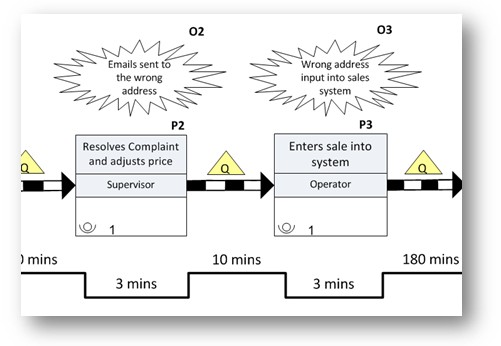
You will notice in our Value Stream Map icons that there is an icon called Kaizen Burst.  A Kaizen Burst icon is a great way to write down additional ideas or problems called out by our front-line team-mates.

We can then delve deeper into these additional problems and solutions when we move into root cause analysis (3.3) and brainstorming solutions.

value stream map kaizen bursts

 Figure 10: Examples of using Kaizen Bursts to call out opportunities for improvement.  Note that we number opportunities to correspond with the process step they relate to.

Value Add / Non Value Add Steps

If the process task improves the product, or the experience of the customer and it is something our customer is willing to pay for, we consider it Value Add (VA).  Almost everything else is Non-Value Add (NVA) or waste that we can seek to reduce.

We can also note NVAR or “Non-Value Add Required” steps, that might include things like regulatory approvals or audits that don’t add value but are necessary to perform.

Timing our Processes

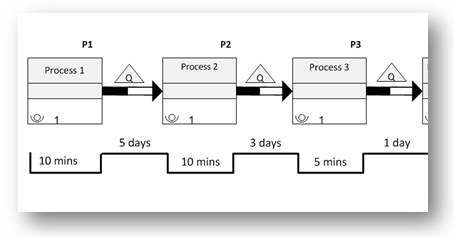
We can display these value add (VA) and non-value add (NVA) steps with a process timing band.  In a Value Stream Map, the timings for our NVA steps stand out on the peaks, and the timings for the VA steps stay in the valleys underneath our map, shown in Figure 11.

value stream map non value add timing

Figure 11: An example of Value Add (process boxes) and Non-Value Add (queues) in a process map, shown by the timing band underneath each process.  Value Add steps are shown in the valleys, while Non-Value Add steps stand out on the peaks.

When gathering the timings for our process it is a good idea to time a process at least 10 times, then use the “lowest repeatable time” as the standard – the lowest time that appears three times or more.  You may need to time more for fast processes and slightly less for slow processes, but 10 is often a good place to start.

There are also three main types of timings that we need to reveal:

  1. Cycle Time, which is the time of a single process. This is noted underneath the process step.
  2. Lead Time, which is the total time to create and deliver a product or service. This can be noted at the end.
  3. Takt Time, which is the rate of items required as determined by the customer, for each shift.

To get our Takt time, we take the average items sold (or serviced) and divide it by the hours worked.  For example if Lisa’s customers called through 40 times a day (per operator) and she worked eight hours (480 minutes), her customer demand would be one every 12 minutes (480 minutes, divided by 40 calls = 12 minutes a call).

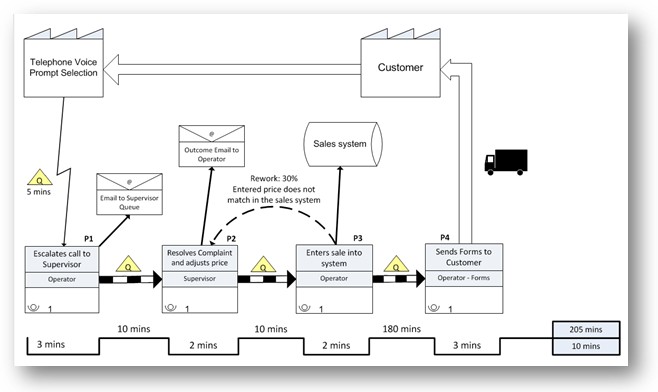
Of course, all of these timings relate to “Delivery” in our Customer Driven Metrics (1.2).  Now that we have all this information, let’s add it to our Value Stream Map and see what it looks like:

value stream map with data

Figure 12:  A Value Stream Map of our Shoe Emporium process, now with rework, process timing separated into Value Add and Non-Value Add as well as the other common icons.  The Takt time can be added separately.

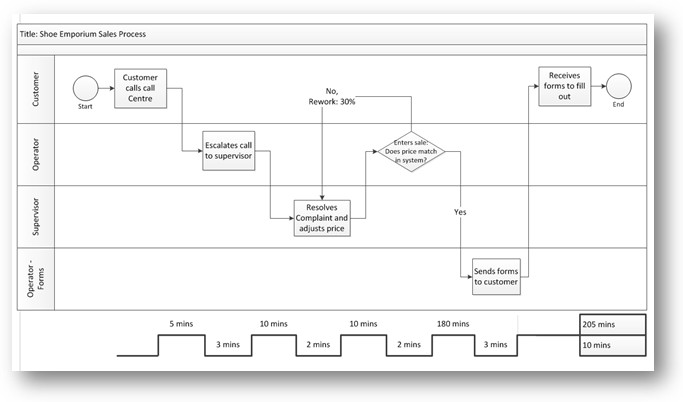
swim lane flow chart timings

Figure 13:  A Swim Lane Flow Chart of our Shoe Emporium process.  Although it is uncommon for a map like this, the important NVA times (the top times) and VA times (the bottom times) are also noted, with the totals on the right. 

So well done!  There is a lot to take in in this chapter, but you did it.

On your journey you will notice that different people and organisations might lay out their maps slightly differently.  As long as there is an agreed standard within your company, then including the information listed in this chapter at a minimum will give you enough insight to start making improvements.

If you are doing all of this for the first time, it can be a truly eye-opening experience.  There might have been something that annoyed you in your job or business that you just couldn’t put your finger on – but when you map it all out you can actually see it.  You can see where the hold ups are, the rework, bottlenecks in the process and more.  It’s amazing, and it can really improve your work and your life.

Five Minute LeanThis is an excerpt from the book "Five Minute Lean", by David McLachlan - a wonderful book that blends teaching of the tools, culture and philosophy of traditional Lean with a modern-day Lean parable.

You can get the whole book on Amazon here and enjoy your own copy.

Selected chapters from the story within Five minute Lean:

Check out these selected chapters from the teachings within Five Minute Lean:

Five Minute Lean – Use Feedback to Fix and Guarantee

Five Minute LeanThis is an excerpt from the book "Five Minute Lean", by David McLachlan - a wonderful book that blends teaching of the tools, culture and philosophy of traditional Lean with a modern-day Lean parable.

You can get the whole book on Amazon here and enjoy your own copy.

Use Feedback to Fix and Guarantee

‘Fixing and guaranteeing the things our customer finds annoying is an immensely powerful way to gain raving fans.’

Many industries will have their pet hates – things that have become almost clichés as they annoy customers in that industry the most.  Perhaps you’ve had the cable technician who never turns up on time, or the call centre operator who moves slower than a glacier.  Great companies and businesses that survive the longest are ones that take this into consideration and do something about it.

One of the most simple and powerful methods we can use here is to:

1.  Find out what annoys the customer most

Discover what annoys your customers by using the Net Promoter Score “Dissatisfiers”, and collecting customer complaints.  Examples of this step might include a tradesperson that doesn’t show up, clothes bought from an online store that don’t fit, or food that is cold when it’s delivered.

2.  Fix it

Imagine if your tradesperson actually did show up right on time, every time?  Or your clothes were either the right size or you could exchange them?  Or your food really was delivered hot and fresh for every order?  We can fix what annoys customers the most using the tools in this book.

3.  Then guarantee it

Now imagine if your tradesperson showed up on time, guaranteed?  Or your clothes were the right size or you could exchange them for free, guaranteed?  Or your food was delivered hot and fresh guaranteed, or it’s free?

These three steps are truly one of the fastest ways to get yourself raving fans, and raving fans turn average earnings into outstanding earnings.

The examples above were not just chosen at random either – they are real life examples of outstanding companies.  Domino’s Pizza implemented the idea of pizza delivered in 30 minutes or it’s free, guaranteed and the company has gone from strength to strength in business and in its stock price since.

Zappos is an online clothing and footwear company that implemented a 365 day return policy (effectively a satisfaction guarantee), and has grown from a small online store to turning over more than a billion dollars a year.

And lastly, local tradespeople who show up on time, guaranteed, have more work than they need and can often charge more than the average as well.

When you combine all of the five steps in “Define Value” you have a quick and easy way to get insight into what brings your customer value and what they would be willing to pay for.  This is truly powerful information, and can save you a lot of heartache down the track, whether you are just starting a business or improving an existing one.

Five Minute LeanThis is an excerpt from the book "Five Minute Lean", by David McLachlan - a wonderful book that blends teaching of the tools, culture and philosophy of traditional Lean with a modern-day Lean parable.

You can get the whole book on Amazon here and enjoy your own copy.

Selected chapters from the story within Five minute Lean:

Check out these selected chapters from the teachings within Five Minute Lean: