
All posts by David McLachlan

White Collar Lean – Jidoka in the Philippines

The Philippines is a beautiful place, with beautiful, friendly people.  It has clear waters that are just made for sailing, peppered with idyllic islands to visit.  Perfect for a holiday?  You bet.

For better or worse, it is also a place with comparatively cheap labour and an English speaking population, which has resulted in many companies off-shoring their call centres or service departments there.  I say for better or for worse, because of the following story:

Dodo mobile and Internet, in Australia, was one of these very companies.  They used the Philippines for their call centre staff, and instead of making things simpler, they received a fine in 2008 from the ACMA for breaching the Privacy act.  So I was not looking forward to calling them, even when I found out I was paying too much for my internet service.  I thought that perhaps it would just be easier to keep paying the $10 extra a month and be done with it.

But then something wonderful happened.  It started with a visit to their website.

On their “Contact Us” page, there was something I’d never seen before.  It was the current call wait time – displayed plainly for all to see – right next to the number to call.  It also showed the historical average.  Both times were lower than the average call centre, at around 1 minute.

Visual Managment_Dodo_Sales Centre

I thought – “Oh my God.  This is Visual Management!”  In a call centre, on a website!  And it’s actually information that is extremely useful to me!  Based on the wait time displayed, I called the number.  They picked up in less than a minute.  This alone would have been worth the price of admission, but the Lean experience didn’t stop there.

The staff member was friendly, polite, and did exactly what I needed.  But it was what they did next that nearly made me the happiest man on the planet.  The staff member asked if she had met my requirements for the call – I said “yes”, and she then reminded me to stay on the line so I could rate her service.  When she hung up, I was automatically put through – this is perfect one piece flow – no additional steps required.  The message that played asked me to rate a “Five” if she had completed my requirement for the call, and a “Four or below” if she had not.

And I thought “Oh my God” again.  This is Jidoka.  It’s the principle of “Stop and Notify” if something is wrong.  If I selected a four or below, they said, it would put me through immediately to a senior staff member to get more information about why the call was bad.  In other words – they would stop immediately, swarm around the problem using their senior staff and try and get an immediate fix.  While I didn’t get to see it as I rated her a hearty “five”, I imagine that they log the reasons for their “Four or belows”, so they can fix those for the future as well.  They would have to – their service certainly reflects it.

It was absolutely brilliant.  And it was obviously paying dividends – the staff were very good at their job, and were keenly aware that their process was good, fast and effective, but also that they would be rated every single time.  In Lean, we fix our Process, and we build up our people.

But here is the kicker – the payoff isn’t just happy customers.  The payoff is financial, pure and simple.  Happy customers mean sales, and more sales create a booming business.

M2 Group, who owns Dodo, has a share price that has almost doubled in the last year.  Not many companies can say that.  And yes, at the time of writing, I happen to own some 🙂

Yours in change,

David McLachlan

Disclaimer:  At the time of writing, David McLachlan owns shares in M2 Group.

Get the Leadership Card Deck or the Five Minute Lean Book:

Leadership CardsView All The Leadership Cards (48)

- or - Have the Leadership Cards delivered for your next meeting
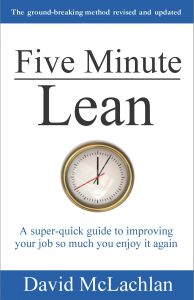
 

Want to learn about Lean? Get the book "Five Minute Lean", by David McLachlan - a wonderful book that blends teaching of the tools, culture and philosophy of traditional Lean with a modern-day Lean parable. You can get the whole book on Amazon here and enjoy your own copy.

Avoid This Deadly Trap Of Failed Lean Transformations

Everything Has a Honeymoon Period

When companies begin a Lean transformation, there is often an air of excitement that surrounds it.  After all, you already know (and if you don’t a quick Google search will reveal) the huge benefits a business can gain from going through Lean process improvement, namely:

  • Improved quality
  • Reduced defects and rework
  • Improved lead times and faster processes
  • Less burdensome work and happier employees

The potential can seem so great, that anything touched by the hand of Lean during the honeymoon period can seem to do no wrong.  But what happens when Lean has been a part of your company for two years?  Five years?  What about 10 years?  Employees know  lip-service when they see an idea with a distinct lack of follow up, and it doesn’t take long for them to brand your potential improvements as “just another fad”.  When this happens, it can be very very hard to bring back your improvement initiative from the brink.

And here’s the real kicker: it’s not your fault.  You had the best of intentions.  You thought you were doing all the right things.  You read the books, you hired the “gurus”, you attended the seminars.  But you didn’t know about the one deadly trap that you absolutely must avoid during your Lean transformation.

The Deadly Trap: Educate To The Lowest Level Of Your Company Or You Will Fail

The simple fact is you need to teach Lean from the very top to the very bottom of your organisation, or your initiative will fail.  You need management to be well versed and on board, otherwise projects will find it hard to get off the ground.  You also need front line staff – team-mates from the Gemba – to know the improvement methods so they can use it to improve their job and your business every day.  This is extremely powerful stuff.

Teaching it company-wide gives you passionate business-improvers at all levels of a company.  You now have people working in the Gemba who know how to map and improve their process as part of their job.

You see, the power of Lean is in its simplicity.  Yes, there are things to learn and yes you will need to think differently, but in the end the message is simple: Map your process, reduce wasteful steps, use a Pull system, build in quality or error proofing and experiment in a controlled space until you win.  This means that:

  • Lean can be easy to explain to others
  • When it is easy to explain, it is easy to share
  • When it is easy to share, it is easy to teach
  • When it is easy to teach, it is easy for many people to take advantage of the tools and lessons

And that is the power of Five Minute Lean.  A simple message with a simple “toolbox” of improvement techniques that fit seamlessly together.

We Want Momentum, Not Inertia

Teaching Lean to all levels of a company also helps us build momentum for our change initiative.  Momentum has a habit of growing, like a snowball rolling down a hill gathering speed.

On the flip side, for every person who doesn’t understand Lean properly, you can consider each one an anchor thrown over the side of your boat, slowing you down until you are forced to stop all together.  They will either passively or actively dismiss your Lean transformation, and both are extremely dangerous.

Find A Way To Teach Others Easily

If you can find a quick, simple, waste-free way to teach and get your team-mates involved on your Lean journey, you will win.  In fact, everyone will win, as processes become easier, faster and less burdensome.  A great place to start is my book – Five Minute Lean – where the chapter titles double as a standard process checklist that anyone can use and learn from.  Having this in the hands of each of your team-mates can do amazing things.

Yours in change,

David McLachlan

Get the Leadership Card Deck or the Five Minute Lean Book:

Leadership CardsView All The Leadership Cards (48)

- or - Have the Leadership Cards delivered for your next meeting


Want to learn about Lean? Get the book "Five Minute Lean", by David McLachlan - a wonderful book that blends teaching of the tools, culture and philosophy of traditional Lean with a modern-day Lean parable. You can get the whole book on Amazon here and enjoy your own copy.

Lean Analogy: The Doctor and the Pharmacy

Many companies, when first embarking on their Lean journey, will employ a handful of Lean tools around the business in an effort to make it look as though they are doing something.
I call this “busy work”, instead of “smart work”.  It looks as though things are getting done, after all – people are busy, right?  But really, nothing is getting done, or rather, nothing that truly matters.

The Lean Pharmacy

These tools of Lean are like a pharmacy.  You can go and choose which tool you want.  There are many to choose from, some quick and painless, others more involved.

The trouble with a pharmacy is, you still need the expertise of a Doctor to ensure you are picking up the right things.  A doctor is there so you don’t accidentally buy a chemical cocktail that ends up being more dangerous than if you had done nothing at all.

The Lean Doctor

The Lean Doctor is the person with the expertise of Lean.  Typically at least five transformations or projects under their belt, the Lean doctor is both familiar with the tools, and knows when to use them.

She might prescribe a certain way of problem solving, utilising the methods she deems best, and in the process can stop a team from making things worse.  In fact, she can instead improve the situation with her guidance, often by more than 100 percent.

Use the Doctor, and the Pharmacy

So when you are implementing Lean, use the Doctor, and the Pharmacy.  Teach the tools to your team-mates – after all, the Lean tools and methods are how they learn to frame problems in the Lean way.

But keep a “Doctor” on hand – someone who can prescribe the right mix of tools for you to use so as to keep yourself out of trouble.

Yours in change,

David McLachlan

Get the Leadership Card Deck or the Five Minute Lean Book:

Leadership CardsView All The Leadership Cards (48)

- or - Have the Leadership Cards delivered for your next meeting


Want to learn about Lean? Get the book "Five Minute Lean", by David McLachlan - a wonderful book that blends teaching of the tools, culture and philosophy of traditional Lean with a modern-day Lean parable. You can get the whole book on Amazon here and enjoy your own copy.

How Henry Ford Proves You Don’t Need to Know it All

Believe it or Not: You Don’t Need to Know it All To Succeed

Many people believe that they need to have all the answers to have success in life.  When asked a question they don’t know, they will come up with any answer, even if it is not correct, so as to avoid what they believe will leave them looking foolish.

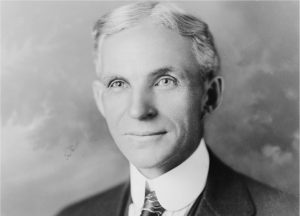
The problem with this approach is that the majority of the worlds richest people know that they don’t need to have all the answers in order to gain success, and what’s more, they use it to their advantage.  They may have a certain specialised knowledge in their field, but as Henry Ford proved in his libel trial after the first word war, having a solid team of people who round out your knowledge is far more important than having all the answers.

An “Ignorant Pacifist”

A Chicago paper published a series of articles after World War I, claiming that Henry Ford was an “ignorant pacifist”.  Mr Ford objected to the statements and brought a libel suit against the paper, taking the extraordinary move of putting himself on the witness stand to prove that he was not, after all, ignorant.

The attorneys peppered Henry Ford with a range of questions, ranging from “Who was Benedict Arnold?”, through to “How many soldiers did the British send over to America to put down the Rebellion of 1776?”.  It was obvious that Mr Ford did not know the answers, and soon grew tired of this line of questioning.  His reply to the last question was, “I do not know the exact number of soldiers the British sent over, but I have heard that it was a considerably larger number than ever went back.”

As the questions became more and more outrageous, Henry Ford pointed his finger at the lawyer who had asked the question, and spoke a simple sentence that floored the court and ended the hearing in an instant:

“If I should really WANT to answer the foolish question you have just asked, or any of the other questions you have been asking me, let me remind you that I have a row of electric push-buttons on my desk, and by pushing the right button, I can summon to my aid men who can answer ANY question I desire to ask concerning the business to which I am devoting most of my efforts. Now, will you kindly tell me, WHY I should clutter up my mind with general knowledge, for the purpose of being able to answer questions, when I have men around me who can supply any knowledge I require?”

No one could argue against this simple answer from the founder of the Ford Motor Company.  Although Henry Ford did not have *all* the answers, he could at any time summon an answer with the simple push of a button, and use this to his advantage to win the day.

You Too Can Be Like Henry Ford

Have you ever Googled something because you didn’t know the answer?  Henry Ford did not have this luxury in the early 1900s, instead he went about creating his own form of “Google” – a group of people who could answer any question he pleased.

We now live in the greatest time to be alive.  We have answers at our finger tips.  We have answers on the smart phones in our pockets.  We can gain any knowledge we please within seconds if we wish.

The only thing that separates us now, is the action we take with that knowledge.  So I will leave you with this parting thought:

“What action are you taking today to reach the achievement of your goals?”

And if you haven’t got any goals, well, when would now be a good time to make some?  If knowledge can be gained more easily, then it is up to you to make the action, the real magic, happen.

Yours in change,

David McLachlan

How The Methods of Lean Interrelate With Each Other

Lean is Not Just a Handful of Tools

The methods of Lean have been used to significantly reduce process times in a vast array of businesses, while at the same time increasing quality and reducing costs.  A continuing theme when a company wants to implement a Lean transformation, however,  is that they only use a few of the tools (or even just one – “5S for everybody!”) so they can feel satisfied straight away and report back to their shareholders saying, “We’ve done it!”

The problem with this approach is twofold:

  • The results they will get are pitiful, and will probably turn them off a proper Lean implementation in the future.
  • All of the Lean methods are interrelated, from the culture to the tools to how they are measured.

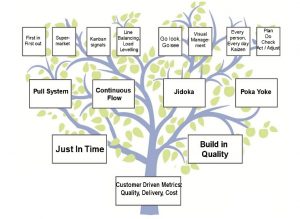
This article will show you a quick rundown on how different Lean methods are related, so hopefully you can use them all and gain the true effect of implementing Lean.

It All Comes Back To The Customer Driven Metrics

In Lean, Value is always determined by the customer.  To measure whether value is being delivered, we use the customer driven metrics based on “Quality, Delivery, and Cost”.

Below, you will see the customer driven metrics and how the many Lean methods relate to them.

  • Quality: Quality is improved, and defects are reduced with Jidoka (stop and notify), Error Proofing, everyday Kaizen or continuous improvement which includes the “Plan, Do, Check, Act and Adjust” cycle and A3 problem solving that stems from it, revealing problems with a Value Stream Map and going to the Gemba (the actual place).  It is improved by using 5S while eliminating the wastes of “Rework” or defects, “Over Production” which results in idle “Inventory”, and awkward or excessive “Motion”.  Visual Management assists with Jidoka in the form of an “Andon” so team-mates can stop when there is a problem, and of course a Standard Process for the work will reduce defects further.
  • Delivery: Process times are first affected by improving “Quality”.  They are further reduced by working towards one-piece or continuous flow, using Line Balancing to balance times to customer demand (takt time), eliminating the wastes of “Waiting”, unnecessary “Motion” or “Transport”, and using Heijunka or Load Levelling to ensure different items are done on time.  A Pull system using First in First out or Supermarkets to ensure Just in Time delivery will affect it, as will a Kanban trigger when product is pulled or requested.  Visual Management or controls centred on how much is required and by when will assist.  And of course, it is better to do all this with a Standard Process.
  • Cost: By reducing waste, delivery times and defects, cost in many areas goes down.

So there you have it!  At least to get you started.  There are possibly may more ways that Lean is interrelated (if I’ve missed any, feel free to add them in the comments below) and I truly believe that if you train your team-mates in each of the tools and the know-how you can achieve spectacular results.

Yours in change,

David McLachlan

How Apple Used “DFEU” to Make Billions of Dollars

Design for Ease of Use, or DFEU is a term in Lean that is used to create the simplest and most easy-to-use product or process possible.

Why would anybody want to make a simple product?  Well, creating a product that is extremely easy to use makes it more likely to be used, and by more people.  The more people who use your product, the more customers you are likely to have.  The more customers you have, the more money you are likely to make.  The more money you make, the more successful your business can become.

Knowing and understanding DFEU is one of the most powerful business ideas you are ever likely to come across in your lifetime.  Just ask Steve Jobs.

The iPad: Used by Two Year Olds Everywhere

The not-so-humble Apple iPad was not the first tablet on the market.  Some might say it still isn’t even the best tablet on the market.  But it does have one massive thing going for it, which has also made it the biggest selling tablet on the market, ever.  And that is Design for Ease of Use.

You see, an average two year old can find their way around an Apple iPad.  They can unlock it.  They can find their way into games and apps.  And they can do more advanced things more quickly than their parents (yes, my kids are better at technology than me), as they grow older.

“What Are You Trying to Do?”

It all stars with a simple question, and a simple answer: What are your customers trying to do?  For Apple it was entertainment.  It was music.  It was work.  All of these things in a slim, easy to carry device.  Steve Jobs knew what his customers were trying to do.  The real magic was in making it easier to do than anybody else.

How can I make the process for doing it as simple as possible?

The designers at Apple did a stellar job of making it easy – almost everything is a simple touch or a swipe away, from installing apps to the features they provide.

But what about your product?  You might be thinking that you’re not an “Apple”, or you’re not in technology.  The good news is that by answering the questions below, you can get your product closer to the DFEU ideal, and the rewards it brings, as well.  While they might seem fast and simple, do not be fooled – they are also extremely powerful.

Here are the questions:

  • How many steps are in the process?  (Can they be reduced)
  • Is Value added at each step? (If not, we should remove non-value added steps)
  • How many wasteful activities take place at each step? (We should remove this waste)
  • How long should each step take? (Can we make them faster)
  • Why is the step necessary? (Can we combine it with others or eliminate it altogether)
  • Are there any queues or stops?  (We should remove the queues)
  • Is it possible to make a mistake? (We should error proof)
  • If the mistake cannot be prevented, can it be detected before it goes to the next step?

And finally, the big one:

  • Would customers be willing to pay for this step if they knew about it?

Going through these is actually like a mini Lean transformation in itself.  You can see things like error proofing, reducing non-value added steps, reducing waste, queues, and moving towards one-piece flow.

And in doing them all, perhaps you too can make a product that strikes a chord with people everywhere, and makes you a billionaire like Steve.

Yours in change,

David McLachlan

The Elusive Eighth Waste: What You Absolutely Must Know

The seven deadly wastes from the Toyota Production System (Lean) are one of the first things people learn on their improvement journey.  And there is great debate in Lean circles as to how to how to build a Lean culture in an organisation, and not just throw the tools at everybody and expect them to use it.

The good news there is something that can help and remind you to teach both the tools and the culture, and increase the speed of your Lean transformation at the same time.

That something is the eighth waste.

The Appearance of the Eighth Waste

A good friend of mine was a great Lean sensei in England, and made the bold move to Australia with his family to live.  He told me that when he boarded the plane in England, there were the seven standard wastes of the Toyota Production System, and when he arrived in Australia, everywhere he went, there had magically appeared an eighth waste!  As funny as the story sounds, the addition of the waste itself has serious implications for your business.

The waste that appeared is “Non-Use of Team-mates’ Time and Talent”.  In other words, ensuring our team-mates are taught the Lean problem solving tools, and are using them when they can, to improve their job.

The eighth waste makes sense from a few perspectives.  First, it makes the “wastes” much easier to remember, because we can use the acronym “DOWNTIME”, or Defects, Over production, Waiting, Non-Use of Team-Mates’ Time and Talent, Transport, Inventory, Motion and Excessive Processing.

If that reason seems too arbitrary, there is a far more important reason: That of building a problem solving culture within your organisation.  When we use the time and talents of our people to solve problems in our process, every single day, the compounded results can be astounding.  In fact, if you are familiar with the theory of compounding and the ability to turn something very small into something very large and powerful, the results can be beyond astounding.

Avoiding the eighth waste means teaching your people the Lean tools and methods, so they can use them to reveal problems that were hidden (but still painful).  It allows them to frame problems in the Lean way and solve them efficiently.  Fixing your process, and building your people, are two of the most important pillars of building a Lean culture.

And it’s all done with the knowledge of the eighth waste.

Sound simple enough?  Now, how about your company?  Is your organisation guilty of the eighth waste?  What can you do ensure your team-mates  have the power to fix their process?  If you have any wins or challenges, I’d love to hear from you.

Yours in change,

David McLachlan

Every Time You “Fix Your People”, a Baby Kitten Dies

There is an old principle in management called the “Peter Principle”.

The Peter Principle says that employees and managers will get promoted throughout their career, until they reach their level of incompetence.  In other words, until they reach a job that they actually can’t perform that well, and end up doing themselves, and the employees they serve (yes, I said serve: more on this later), a disservice.

If you are reading this, I think it’s fair to say that you are the type of person who is taking charge of your own path in life.  So don’t let the Peter Principle happen to you!  To avoid it, follow this Lean principle instead.

The Principle of Lean Management

There is a very simple principle in Lean Management that says we must improve our process, or way of work, and build our people.  Think about it.

Most managers, bosses, even employees themselves do it the other way around – they try and fix the people they serve instead, and build the processes they perform.  Not only is it ridiculously non-efficient to try and fix individual people, but building process upon process merely results in waste and inefficiencies, making the work harder to do.  As an example, you might have harsh words with one employee, only to see them leave, ignore you, or even get promoted (probably to their level of incompetence).  And yet, this method is the knee-jerk reaction many bosses have.

Fixing the Process

Counter this with the Lean principle of fixing the process instead.  When we improve a process, it improves it for everyone.  Having an accepted, trained standard way of performing the work, that is made visible at the work station or desk so anyone can see if it is being followed or not is a great place to start with improvements.

We must also support the standard process with a problem solving culture.  To do this, Charlie Munger recommends matching the incentives to the outcome that we want.  For example, measuring Key Performance Indicators (KPIs) based on zero rework, instead of simply churning through as many items as possible with no regard for customer or quality.  It may seem simple but it’s extremely powerful stuff.

Once we have looked at fixing our processes, we can build our people.

Building our People

This means we teach them the problem solving tools of Lean, enable them to use it, and support it with leaders who are happy to follow the methods as well.  It will sometimes involve stopping when there is a problem (instead of sweeping it under the rug) so you can swarm around it and fix it close to when it happens.  This builds a culture that solves problems close to the source will give you results 1000 times better than trying to fix it three weeks or even three months down the track, when information is hazy and there are other fires to put out.

Doing it the Lean Way Will Change Your Life

Think about your own life, and when something goes wrong don’t blame the person.  Look at the process they are following (and if one doesn’t exist, then now would be a very good time to buy yourself another copy of Five Minute Lean) and the incentives that surround it.  The funny thing is, when you stop blaming your people, they will be more likely to look at doing the right thing by you as well.

Yours in change,

David McLachlan

Lean and the Zen Master’s Story

There is an old saying in Zen, originally formulated by Qingyuan Weixin, and later translated by D.T. Suzuki in one of the first books on Zen to reach the western world. 

It goes like this:


“Before I had studied Zen for thirty years, I saw mountains as mountains, and rivers as rivers.

When I arrived at a more intimate knowledge, I came to the point where I saw that mountains are not mountains, and rivers are not rivers.

But now that I have got its very substance I see mountains once again as mountains, and rivers once again as rivers.”


This saying might seem paradoxical at first (just like a lot of Zen might) but in truth it makes complete sense and applies itself to Lean perfectly well in the form of Lean Tools, and Lean Culture.

How the Zen Story Applies: Lean Tools vs Lean Culture

You see when a man or woman first starts down the path of Lean, it is all about the Tools.  They see the wonderful tools, the amazing things they can do in making their job better, reducing lead times, improving quality by leaps and bounds, and they are excited.

After many years of studying and applying Lean, it becomes about the Culture.  They say that only the culture matters, one of Lean Management and enabling people to swarm problems and solve the root cause, building people to be proficient in the Lean problem solving skills.

Then after many more years, when they finally get it, it is all about the Tools in the end.  This is because the tools are how you actually teach your people.  The tools are how you frame a problem in a way that helps you solve it efficiently.  The tools are what you use every time you are building that capability in your team-mates.

So there you have it: Mountain, not-mountain, mountain again.  Keep learning and applying Lean and I know you will see the mountain again in your own life.

Yours in change,

David McLachlan

Why Ten Percent of People Will Hate What You Do

Have you ever gone through a period in life where you just can’t seem to win, no matter what you do?  You might seem to be surrounded by people who block you at every turn or seem to be intentionally  on your case, all the time.

The good news is, you’re not alone.  The better news is, with this simple rule, you can move through it and on to bigger and better things.

The Rule of 10, 80, 10

There’s a rule in business and change management that reads “10, 80, 10”.  What it means is that when you are putting something out there, whether it is an idea for change, a better way of doing things, a new product or even a change in your personal style, there will be 10 percent of people who hate it.  It’s just the way it is.  Not everyone is going to love your stuff, and the sooner you know it, the sooner you can move on.  Thankfully though, the tale doesn’t end here.

This is because there will also be 80 percent of people who are indifferent to your idea, and will simply ebb and flow with the tide depending on how well you work with them.  Sure, that’s a lot of people, but realise that they have their own worries, their own lives and their own agendas.  It can’t all be about you.  Some of it can, though, which brings us to the last part of the equation.

This is where there will be 10 percent of people who absolutely love it.  They will “get” your passion, your idea, and the way you do things.  And they will love YOU.  They will be your raving fans.  They will help to spread your message, and will do it with a smile because they feel as though it’s right.

Look at Where You Are Now

So take a look at where you are now.  Are you surrounded by detractors, or raving fans?  Sure, sometimes it might feel as though nobody likes what you do –  but it’s simply an illusion, because you are merely surrounded, at this point in time, by the 10 percent of haters.  When you move around, move on, or keep working into other areas and meeting new people, you will meet the indifferent 80 percent.  Keep going a little further, and you will meet the loving 10 percent.

So don’t be discouraged.

Know that you can change and move, and there is a “10 percent” of raving fans waiting out there, just for you.

Yours in change,

David McLachlan