Tag Archives: Lean CX

Lean CX Score – They’re All Moments Of Truth

Lean CX ScoreThis is an excerpt from "The Lean CX Score."  Get your copy now and start creating disruptors that completely annihilate your competition.

Oh and good news!  You'll be improving the speed, morale and engagement of your teams at the same time.  Get the Lean CX Score now.

They’re All Moments of Truth

Many of these same consultants we noted earlier will tell you that “Moments of Truth” are only those touch points where a customer interacts with you or your company.  Wrong.  In the Lean CX Score, they’re all moments of truth.  Every.  Single.  Step.

Now surely I don’t mean photocopying, filling out paperwork, or other mundane things?  Yep.  Every tiny action we take in a customer experience journey, whether we interact directly with the customer or not, is a moment of truth.  Because – and this is important – bad experiences that are hidden from view, lead to bad experiences that are within the customer view.

Let’s say Joan is having a bad day.  She just spent an hour filling in the paperwork for a customer, going back and forth between departments to get the answers she needed, and having to beg her manager for approval because she didn’t have the authority herself.  By the time it’s all done and she’s ready to call the customer, her energy is low, and her tone is short.  She may not really mean it, but right in this moment, she hates her job.  Unfortunately it’s in this moment where the call to the customer is made.  The conversation goes badly, and at the end of it our customer is a lot less happy than they were and makes moves to leave the company as soon as they can.

Lean CX Every Moment of Truth

Every person in a business has an effect on someone else, whether it’s positive or negative, and at the end of all of those interactions is the customer.  The CEO affects the managers, the senior technician affects the junior technician.  It’s all related, and your customers are always judging, either consciously or subconsciously.  Whether they know it or not, they are weighing up the pros and cons of continuing to do business with you.  If you don’t make it easy to get the things they want fast, there’s a good chance they’ll be heading for the door.

More chapters from The Lean CX Score book:

Lean CX ScoreThis is an excerpt from "The Lean CX Score."  Get your copy now and start creating disruptors that completely annihilate your competition.

Oh and good news!  You'll be improving the speed, morale and engagement of your teams at the same time.  Get the Lean CX Score now.
Lean CX Score – Using The Waste Basket

Lean CX ScoreThis is an excerpt from "The Lean CX Score."  Get your copy now and start creating disruptors that completely annihilate your competition.

Oh and good news!  You'll be improving the speed, morale and engagement of your teams at the same time.  Get the Lean CX Score now.
Using the Waste Basket

If you’ve read anything about Lean or the Toyota Production System before, you will likely have heard mention of removing “wasteful” steps in your work to improve profit, speed, morale and more.  In the old-world Lean, there were eight Wastes listed for you to remove and improve your business.

We’re not going to use the traditional Wastes, because they often don’t fit in a modern business and there’s a good chance you’re not a car manufacturing plant from the 1970s.

Instead I’m going to give you something better.  Much better.

In our new method of Lean CX, we will look at waste from the Customer Experience point of view – remembering that customers are anyone that we, or our business, serves.  The new Lean CX Wastes are also more streamlined, simpler, faster, and guaranteed to improve your Customer Experience once they are removed.

So what are these so-called CX Wastes that we can refer to quickly, to see if our process is winning or lagging behind?  An easy way to remember them is with this handy acronym:  NEWER.

  1. Not getting what I want
  2. Excessive Steps
  3. Waiting
  4. Excessive hand-offs
  5. Rework

Let’s go through them in a bit more detail, starting with my favourite first.

Waiting

First of all, waiting is the devil when it comes to Customer Experience.  You are more likely to lose a customer before you have even begun if they can’t get what they want quickly.  With the rise of “digital natives”, those born into an era of technology and encouraged to use it from a young age, we have a whole generation of people used to “getting it now”.  And here’s a hint – they’re not going to wait around for you.

As you’ll see in some of the stories coming up, there are companies in traditional industries where waiting is the norm (like call centres or product deliveries) which are coming up with ways to give an amazing customer experience by using the Lean CX Score and removing this waste.

Excessive Steps

Part of working with customers who “want it now” means removing excessive steps or actions to getting what they want.  If something takes more than one “step” for a customer to get what they want, I can guarantee you that they will be looking for better alternatives.  Not to mention having excessive steps or actions paves the way for other wastes to creep into the process too.  Things like rework, hand-offs, queues or waiting are all things that drive your customer away.

Excessive Steps is also a closely related cousin of Excessive Hand-Offs, and it has just as high an impact on your Customer Experience.

Excessive Hand-offs

Have you ever played Chinese Whispers?  It’s an old schoolyard game, but the results of the game are usually well known.  For those of you who haven’t played it, you sit in a circle and whisper a message to the person on your right, who then whispers it to the person on their right – continuing until it comes all the way back to you.  The final message is usually quite distorted from your original message, because different people mishear and change the words ever so slightly with each hand-off.

It is the same with this Waste – if you have too many hand-offs or people, departments or companies being a part of your customer’s experience, then you risk losing things, misinterpreting things, queueing for things, having to redo things and much more.

If the thing they want is not done in the same place and time, there’s a good chance more CX Waste will appear to scare your customers away.

Rework

Have you ever filled out a form on a website from top to bottom, only to have the webpage time out so you had to refresh it instead of submitting it?  Then when you reloaded the page the form was empty again.  What a pain.

While this scenario is the cause of many angry cat pictures screaming at their monitors (and maybe some real-life angry people too), the effects of this kind of rework on your customer experience is devastating, and highly likely to send your customers packing (you guessed it – right across to your competition).

Rework also allows things like queues or waiting, excessive hand-offs and excessive steps to creep into your work.

Not getting what I want

Here is the final and most important one of all – your customer not getting what they actually wanted.  Even with the fastest, most streamlined, most friendly, incredible customer experience it’s all for nought if your customer didn’t get what they really wanted!

You could have the fastest shipping in the world, but if you’re not shipping what the customer wants, forget it.  And you simply don’t know if your customer got what they wanted unless you ask them.

Research shows that a full 96% of customers won’t tell a company they had a bad experience *17, they will simply leave and take their business elsewhere (and then tell all their friends how horrible that business was when they next meet).  This is absolutely crucial to remember.  If your customers are not getting what they want and getting it quickly, easily, without fuss and preferably in a way that makes them feel good, then they are just one cold-call away from leaving your company behind.

So there you have the Lean CX Wastes.  As you start to remove these CX wastes in your own business you will see a dramatic rise in customer and employee happiness, and both of those things have an impact on your bottom line.  Removing the Lean CX Wastes is exactly what the steps in this book are designed to do.

More chapters from The Lean CX Score book:

Lean CX ScoreThis is an excerpt from "The Lean CX Score."  Get your copy now and start creating disruptors that completely annihilate your competition.

Oh and good news!  You'll be improving the speed, morale and engagement of your teams at the same time.  Get the Lean CX Score now.
Lean CX Score – Good Customer Experience Engages Your Team By More Than 25%

Lean CX ScoreThis is an excerpt from "The Lean CX Score."  Get your copy now and start creating disruptors that completely annihilate your competition.

Oh and good news!  You'll be improving the speed, morale and engagement of your teams at the same time.  Get the Lean CX Score now.
Good Customer Experience Engages Your Team by More Than 25%

Good customer experience also engages your team, and increases retention and productivity of your team members by a significant amount.

Now you might be thinking, “Surely that can’t be true.”  After all, it’s easy to see how CX can affect the end customer, but improving our team engagement and retention too?  It certainly can.  If anyone you provide a service to is your “customer”, then that means the people you work with all have experiences that can be improved too.

Here’s a quick example.  One of the key steps in the Lean CX Score, as you will soon see, is “Check and Stop”.  Check and Stop means we get feedback quickly and we use it just as fast.  One report by the Gallup Business Journal found that a key factor of highly engaged team-mates was receiving feedback at least once a week *12.

It helped them to know if what they were doing was working; they could adjust where necessary, and it made them want to stay and do a good job.

Compare this with team members where there was no regular check-in.  The research showed they were 97% more likely to be disengaged in their work *13.

Increasing your team’s engagement doesn’t just benefit you if you’re a leader.  Having engaged team-mates has been a huge focus of powerhouses like Google over the past few years because engaged team-mates are happier, have more workplace friends, generally enjoy their lives more and also perform way better than teams that aren’t engaged.

You may have heard the study from Gallup International that found 70% of employees are disengaged at work *14.  But what you may not have heard is that disengaged team members are at least six times more likely to leave their job than team members who are engaged in their work *15.  If you think it’s expensive to acquire customers, it’s extremely expensive to find and hire good staff.  It’s much easier to keep them engaged in the first place.

Engaged team members will also make you more money.  A separate study by the firm Kenexa found that businesses with highly engaged employees achieved twice the annual net revenue on average than businesses with lower engagement scores *16.  That’s a 100% difference in percentage terms of revenue.

All of this comes from just one step in the Lean CX Score.  Can you imagine what will happen when you put them all together?

More chapters from The Lean CX Score book:

Lean CX ScoreThis is an excerpt from "The Lean CX Score."  Get your copy now and start creating disruptors that completely annihilate your competition.

Oh and good news!  You'll be improving the speed, morale and engagement of your teams at the same time.  Get the Lean CX Score now.
Lean CX Score – 80% of CEOs Believe They Provide Superior Service: Just 8% of Customers Agree

80% of CEOs Believe They Provide Superior Service

Remember how 85% of people think they are above average, and better drivers than everyone else on the road?  This effect extends to companies and CEOs too.  Bain & Co surveyed 362 companies and found that 80% of those companies’ CEOs believed their company provided a superior customer experience to their peers. *7

However, when customers of those companies were asked the same question, only 8% believed that the company provided a superior customer experience.  CEOs versus customers.  80% versus 8%.  That’s quite a difference!

The Lean CX Score will actually help you get an 80% score from your customers (who ultimately pay your bills by buying your product or service), and not just your managers at the next board meeting.

More chapters from The Lean CX Score book:

Lean CX ScoreThis is an excerpt from "The Lean CX Score."  Get your copy now and start creating disruptors that completely annihilate your competition.

Oh and good news!  You'll be improving the speed, morale and engagement of your teams at the same time.  Get the Lean CX Score now.

Lean CX Score – Good Customer Experience Is Worth More Than 140%

Lean CX ScoreThis is an excerpt from "The Lean CX Score."  Get your copy now and start creating disruptors that completely annihilate your competition.

Oh and good news!  You'll be improving the speed, morale and engagement of your teams at the same time.  Get the Lean CX Score now.

Good Customer Experience is Worth More Than 140%

If getting more approval from your customers isn’t enough, a study in the Harvard Business Review also found that customers who had the best customer experiences spent up to 140% more than those who received a poor customer experience *8.  This means that Customer Experience has a significant effect on your profit as a company, and your success as a team.

The same Harvard research found that customers who gave the poorest ratings for customer service had a much lower chance of staying as customers in the following year.  Fewer than half of customers who rated a company poorly stayed with that company, and overall they only stayed for a year on average *9.

On the other hand, customers who rated their experience the highest were way more likely to remain as customers the following year (31% more, to be exact), and on average had a likelihood of staying for six years *10.

A customer staying for one year, or six years.  Which would you prefer?

It’s not just about customers staying with you a long time.  Keeping customers can also significantly improve your bottom line and profit.  Research done by Frederick Reichheld (the inventor of the Net Promoter Score) found that increasing customer retention by just five percent, increased profit to the company by over 25% *11.

Isn’t that amazing?  Keep an extra five percent of your customers instead of letting them leave, and your profit could go up by 25%.  Most companies would be ecstatic with a 25% jump in profit.  Why was there such a difference?

Well, existing customers of a company tend to spend more over time.  The trust is already there – there is less of a need for the “hard sell”.  And the cost to acquire them as a customer has already been spent, a figure that for brand new customers can be quite large when adding up the cost of marketing, advertising, sales teams, service teams and more to get them on board.

Keeping your customers is even more powerful than you think, and good Customer Experience is the key that unlocks that power for you.

More chapters from The Lean CX Score book:

Lean CX ScoreThis is an excerpt from "The Lean CX Score."  Get your copy now and start creating disruptors that completely annihilate your competition.

Oh and good news!  You'll be improving the speed, morale and engagement of your teams at the same time.  Get the Lean CX Score now.

Lean CX Score – A New Way To Tell If What You’re Doing Works

Lean CX ScoreThis is an excerpt from "The Lean CX Score."  Get your copy now and start creating disruptors that completely annihilate your competition.

Oh and good news!  You'll be improving the speed, morale and engagement of your teams at the same time.  Get the Lean CX Score now.

A New Way to Tell If What You’re Doing Works

By now I hope you’re coming on this journey and you’re keen to improve your Customer Experience.  But how do we tell if what we’re doing works?  Well, let’s break it down.

What works?  You could say that if your product is selling, it works.  If customers are not complaining, it works.  If customers are coming back time and time again with a smile on their face, it works (that’s true for old bricks-and-mortar businesses and disruptive new products – they all need customers).  And, if your team is happy and productive, it works.  That sounds fair, right?

But how do we get there?  That place where customers are lining up to buy from us?  Let’s break it down further.

A Bad Customer Experience – Ever Had One?

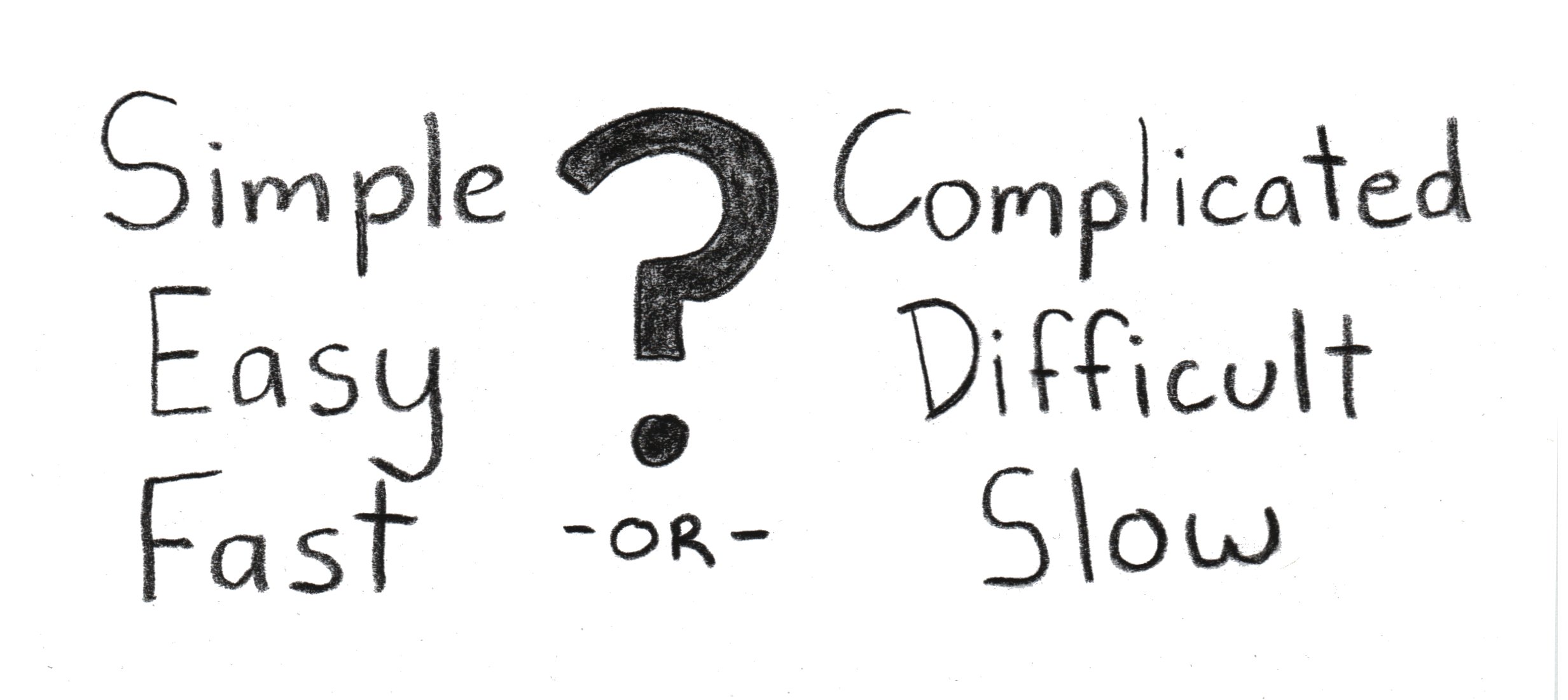
Businesses that fail at Customer Experience make it complicated, slow, or difficult.  Which means that logically, good CX is exactly the opposite.

After all, have you ever had a bad customer experience?  Silly question, I know.  Of course you have.  Like that time you tried buying something, but the experience was so bad it just ended up being too much hassle?  These days it can seem as though many interactions we have are like this.  Maybe the store clerk was bored, or just didn’t care.  Maybe the call centre operator was particularly rude.  Maybe the website didn’t have enough information, or the wait time to be served was 10 times longer than you wanted.

So in our imaginary example, if you did manage to buy it, the experience was tainted and you would be unlikely to return.  Most people simply give up and go somewhere else (i.e. to the competition).

Now if you had a choice between these, which would you choose?

Simple, Faster, and Easy to Do

We’ve seen what good CX isn’t.  So let’s flip it around and look at what it is.

If something is simple and easy to do, then the natural path is for people to do it.  If your work process is easy to do, you’ll probably get it done.  After all, why wouldn’t you do something that’s easy?

If a product is easy to use, then people will use it.  If it’s easy to buy, then they are more likely to buy it.  In other words, if “slow and complicated” are a good reasons to leave a business, then “Simple, Fast and Easy to do” are good reasons to stay.

So that becomes our aim in creating an incredible CX.

We’ve already looked at simple, but why should it be fast?  Time is quickly becoming one of the most precious commodities on earth, with people used to getting instant gratification for the things they want.  In fact, time is so precious that people will pay other people to walk their dogs for them, go shopping for them, and would rather jump online to order something and have it delivered if it means they can save the time and effort of getting dressed and going out.

Another way of saying this is: If your product or service takes a long time, your customer will be looking at their watch and heading for the door (i.e. to your competition again.  Getting the picture?).  Simple, Fast and Easy to do are all equally important.

Sure, “Simple and Easy” Sounds Good, But How Can I Actually Put It Into Practice?

That’s a good question.  Like any of these new terms, the idea of “Simple, Fast and Easy to Do” can easily lose its meaning.

That’s why the Lean CX Score was created.

The Lean CX Score is a single score for your business or team, taken from the absolute best parts of the most customer-centric improvement system discovered in the past century.  It’s easy to do, and it’s fast.  You can quickly see if you’re winning or failing, and you can also see exactly what to do about it.

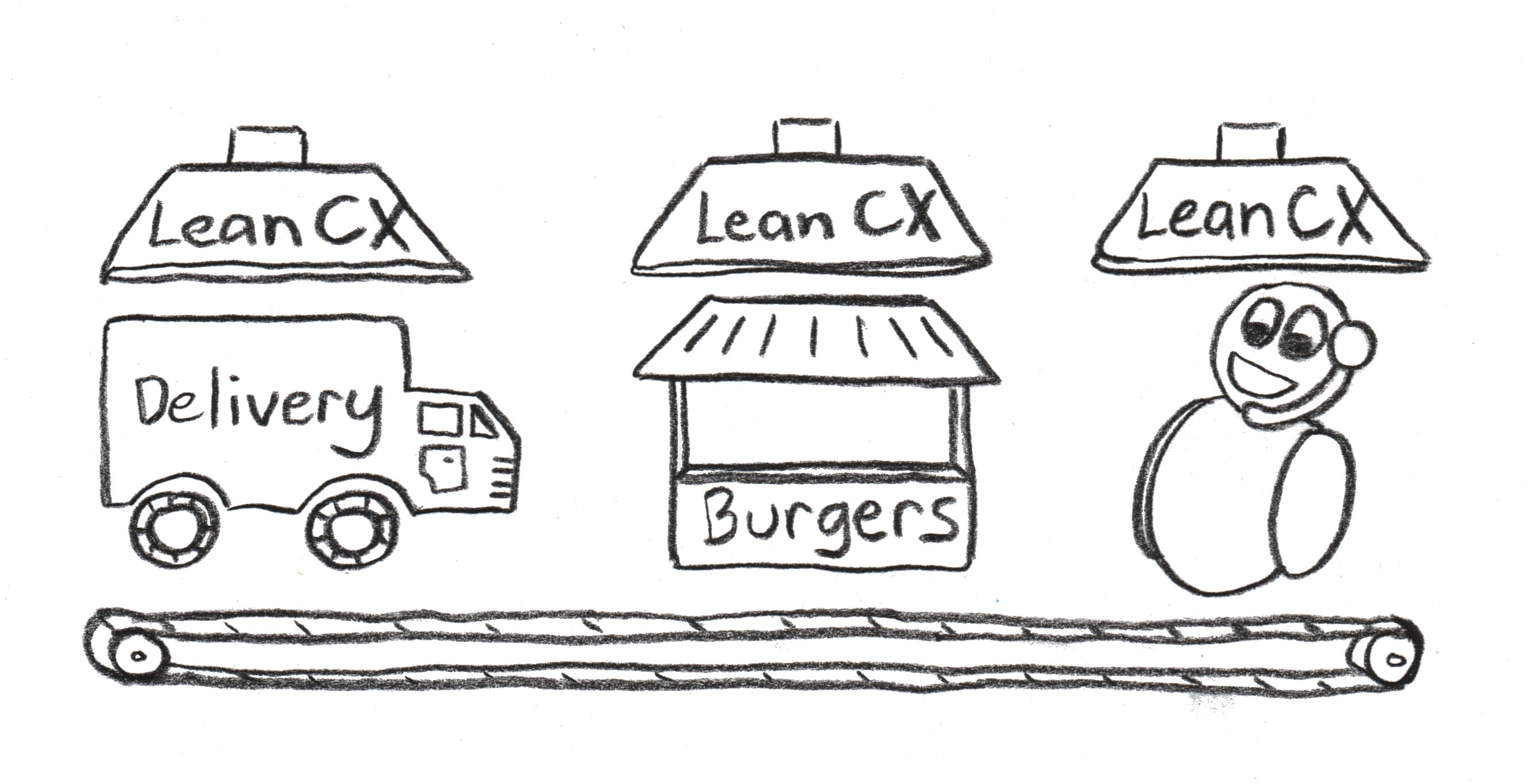
Because every business has customers, and you need them to keep coming back so you can stay in business, the Lean CX Score fits seamlessly over any company you can think of.

The Lean CX Score fits in any business

As we go through this book and you learn more about the Lean CX Score, you’ll see that by putting the steps into practice you will be making things easy for your customer to do, and easy for them to buy.

In fact, removing anything that is wasteful – that doesn’t add value to a customer experience – is our true aim.  As you will see in the coming examples and stories, by doing this we automatically compel our customers to work with us.

More chapters from The Lean CX Score book:

Lean CX ScoreThis is an excerpt from "The Lean CX Score."  Get your copy now and start creating disruptors that completely annihilate your competition.

Oh and good news!  You'll be improving the speed, morale and engagement of your teams at the same time.  Get the Lean CX Score now.

The Lean CX Score Story – The Wise Man And The Emperor

Lean CX – The Emperor And The Wise Man

Lean CX ScoreThis is an excerpt from "The Lean CX Score."  Get your copy now and start creating disruptors that completely annihilate your competition.

Oh and good news!  You'll be improving the speed, morale and engagement of your teams at the same time.  Get the Lean CX Score now.

By now you may have heard about the Lean CX Score, and are wondering to yourself “What’s all the fuss about?”  So let’s cut to the chase.  Below are the six separate, actionable steps in the Lean CX Score.  Each one by itself can create incredible growth, profit and scalability in your team, your startup, your business and your life.  But together, they are truly the greatest secret to creating disruptive products and services in any industry – new or old.

The six Lean CX Score steps can be remembered with the acronym ROVE CP (at least that’s how I remember it).

  1. Repeatable Process
  2. One Step Flow
  3. Visual (and Audio) Management
  4. Error Proofing
  5. Check and Stop
  6. Problem Solve for Exponential Growth

The steps also become six questions, which you can use to get your point for that step.  The questions look like this:

  1. Is my customer experience the same great experience every time?
  2. Did it take only one step for my customer to get what they wanted?
  3. Can my customer understand what to do first time, without having to ask?
  4. Is it impossible to make a mistake?
  5. Is there a check to see if my customer got what they wanted?
  6. (How) do we use feedback?

If they don’t make much sense now, don’t worry.  By the time you’ve been through the stories and real life research in this book, you will be an expert on them.

Which brings us to a quick note on reading this book.  Some people may be tempted to think that they know all about these steps just by seeing the headings, or to skip ahead to the last chapter and see how their business measures up.  That’s not necessarily a bad thing – different people learn in different ways, and sometimes getting an overview (such as in Chapter Seven) can help you learn more quickly.

Just remember that each chapter has the finer details you’ll need to take things to the next level, and in skipping ahead you may miss some of those things.  Also remember that these are not the same tools you may have seen before.  I’ve made the process simpler, faster, and easier to use with a few adjustments – adjustments I’ve made by seeing the results on the actual front lines of customer service and CX over many years.  If you approach this book with an open mind, you will see some amazing things begin to happen.

You may have heard the story of the Emperor who asked the advice of the wisest man in his kingdom.  When the wise man appeared he did not speak, and instead asked for a cup, together with a saucer and some tea.  He poured the tea into the cup with great poise as the court watched with amazement, but even when the cup was full he kept pouring until tea was spilling down the sides and onto the table.

Finally the Emperor could take it no longer and yelled “Stop, stop you crazy old man!  Can’t you see that the cup is full?”

It was then the wise man stopped pouring and said: “You are like this cup – I cannot pour my wisdom because your cup is already full.  If you truly seek my council, your cup must first be empty.”

Your cup must first be empty.

If you genuinely want incredible results, start this journey with a “beginner’s mind”, where you leave your pre-conceptions at the door and your cup is able to be filled.  In the beginner’s mind there are many possibilities, in the expert’s there are few.

So read the chapters to get a full understanding, read the stories of people who have done it before, and read how they used it to win.  At the end of the book you’ll see how to rate your own business or team, and start to see the incredible rewards that good CX can bring.

Let’s do it!

More chapters from The Lean CX Score book:

Lean CX ScoreThis is an excerpt from "The Lean CX Score."  Get your copy now and start creating disruptors that completely annihilate your competition.

Oh and good news!  You'll be improving the speed, morale and engagement of your teams at the same time.  Get the Lean CX Score now.

Get the Lean CX Manifesto here:

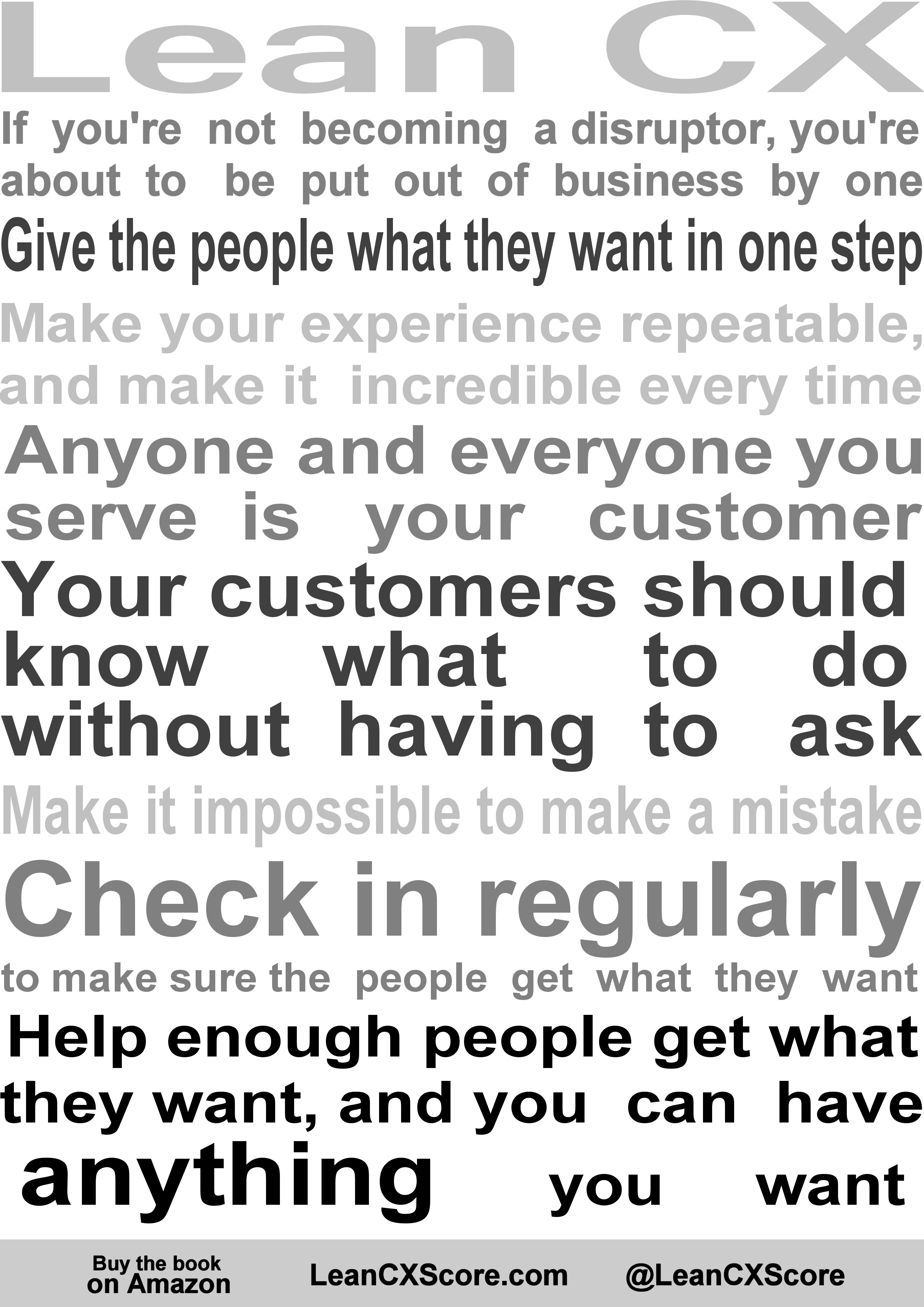
Lean CX Manifesto