 Many companies, when first embarking on their Lean journey, will employ a handful of Lean tools around the business in an effort to make it look as though they are doing something.
I call this “busy work”, instead of “smart work”. It looks as though things are getting done, after all – people are busy, right? But really, nothing is getting done, or rather, nothing that truly matters.
The Lean Pharmacy
These tools of Lean are like a pharmacy. You can go and choose which tool you want. There are many to choose from, some quick and painless, others more involved.
The trouble with a pharmacy is, you still need the expertise of a Doctor to ensure you are picking up the right things. A doctor is there so you don’t accidentally buy a chemical cocktail that ends up being more dangerous than if you had done nothing at all.
The Lean Doctor
The Lean Doctor is the person with the expertise of Lean. Typically at least five transformations or projects under their belt, the Lean doctor is both familiar with the tools, and knows when to use them.
She might prescribe a certain way of problem solving, utilising the methods she deems best, and in the process can stop a team from making things worse. In fact, she can instead improve the situation with her guidance, often by more than 100 percent.
Use the Doctor, and the Pharmacy
So when you are implementing Lean, use the Doctor, and the Pharmacy. Teach the tools to your team-mates – after all, the Lean tools and methods are how they learn to frame problems in the Lean way.
But keep a “Doctor” on hand – someone who can prescribe the right mix of tools for you to use so as to keep yourself out of trouble.
Yours in change,
David McLachlan
Get the Leadership Card Deck or the Five Minute Lean Book:
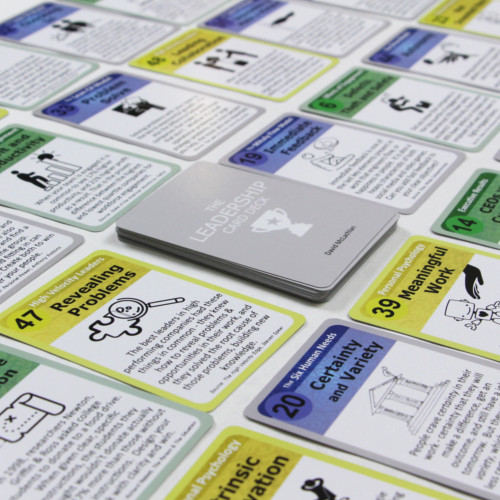 View All The Leadership Cards (48)
- or - Have the Leadership Cards delivered for your next meeting
 Want to learn about Lean? Get the book "Five Minute Lean", by David McLachlan - a wonderful book that blends teaching of the tools, culture and philosophy of traditional Lean with a modern-day Lean parable.
You can get the whole book on Amazon here and enjoy your own copy.
Want to learn about Lean? Get the book "Five Minute Lean", by David McLachlan - a wonderful book that blends teaching of the tools, culture and philosophy of traditional Lean with a modern-day Lean parable.
You can get the whole book on Amazon here and enjoy your own copy.
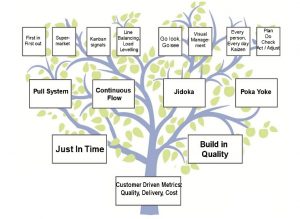 The methods of Lean have been used to significantly reduce process times in a vast array of businesses, while at the same time increasing quality and reducing costs. A continuing theme when a company wants to implement a Lean transformation, however, is that they only use a few of the tools (or even just one – “5S for everybody!”) so they can feel satisfied straight away and report back to their shareholders saying, “We’ve done it!”
 Design for Ease of Use, or DFEU is a term in Lean that is used to create the simplest and most easy-to-use product or process possible.
 The seven deadly
  There is an old principle in management called the “Peter Principle”.
 There is an old saying in Zen, originally formulated by Qingyuan Weixin, and later translated by D.T. Suzuki in one of the first books on Zen to reach the western world.
 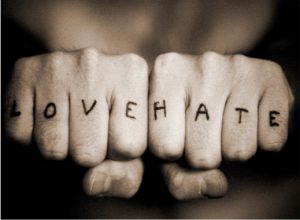 Have you ever gone through a period in life where you just can’t seem to win, no matter what you do? You might seem to be surrounded by people who block you at every turn or seem to be intentionally on your case, all the time.
 Describing Lean to people can be both extremely easy, and extremely hard.
 Game of Thrones is one of my favourite shows. Sure, you have to send the kids to bed before you click that play button on the DVD player, but it’s a great reminder of the cool things you can do as an adult. Like watch a lady-knight and a man-knight kick each other in the groin. Ok – cool, and slightly disturbing.