All posts by David McLachlan

Five Minute Lean – Create a New Standard Procedure and Checklist for Quality Control

Five Minute LeanThis is an excerpt from the book "Five Minute Lean", by David McLachlan - a wonderful book that blends teaching of the tools, culture and philosophy of traditional Lean with a modern-day Lean parable.

You can get the whole book on Amazon here and enjoy your own copy.

Create a New Standard Procedure and Checklist for Quality Control

‘When your process can be performed easily by someone straight off the street, then chances are you have an excellent Standard Operating Procedure.’

And now finally we come to the point of it all!  A standard, repeatable process that anyone can learn, teach to others, and quality check.

You will find that most businesses, even ones you have worked for, do not have clearly written, standard, repeatable processes for the work that they do.  This means that the work is often “hidden”, finishing very differently from person to person and relying on large amounts of expensive training, experience or even highly paid experts.  Therefore, by simply articulating a standard process (making it visible) first, and then using the knowledge in this book to improve it, you can see some incredible rewards.

Taking our future state process and ensuring we have tested it well, we can now create a new Standard Operating Procedure (SOP) for people to carry out the same way every time, or use as a new baseline for future improvements.

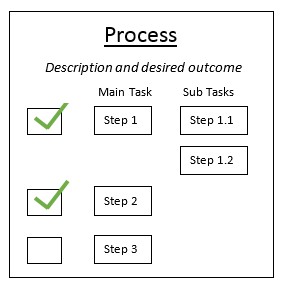
The most common inclusions are a set of main tasks, and then sub tasks – simple step by step instructions from the beginning to the end of the process.  A good process checklist will also include the takt time, or the rate required as per customer demand, the lowest repeatable cycle time (2.5), and relevant pictures, safety and risk notes.

When team-mates are using the same checklist as the person who is measuring their KPIs (Key Performance Indicators), then everyone is on the same page and their job is made that much better, easier and enjoyable.  There is nothing worse than trying to do a good job while being judged or monitored on different rules (or rules that are always changing or are not clearly defined).  This step truly has the power to fix these inconsistencies in an organisation.
lean process checklist

Figure 30: A checklist for your standard procedure doesn’t have to be complicated.  Keep it simple so anyone can create and follow it.  Many people separate their SOPs into a handful of main tasks, and then sub tasks next to each related main task.

It’s a good idea to keep your standard checklists in a central location where everybody has access to them, in addition to making them visible at the workstation and rolling them out to the people performing the process, the people training the process and the people monitoring the process.

Five Minute LeanThis is an excerpt from the book "Five Minute Lean", by David McLachlan - a wonderful book that blends teaching of the tools, culture and philosophy of traditional Lean with a modern-day Lean parable.

You can get the whole book on Amazon here and enjoy your own copy.

Selected chapters from the story within Five minute Lean:

Check out these selected chapters from the teachings within Five Minute Lean:

Five Minute Lean – Organise Your Process with Five S

Five Minute LeanThis is an excerpt from the book "Five Minute Lean", by David McLachlan - a wonderful book that blends teaching of the tools, culture and philosophy of traditional Lean with a modern-day Lean parable.

You can get the whole book on Amazon here and enjoy your own copy.

Organise Your Process with Five S

‘Organising a workplace with Five S reduces risk, increases safety, makes it easy to reach and find things and know when they are running out.’

In Lean, Five S (also “5S”) is a method used to create an organised, clean and safe work area where things are visible, easy to reach and easy to find.  This can also help in reducing waste, cycle times, overburden and stress and help implement your Pull system.

It doesn’t just have to be a physical space either – in the world of technology it can mean reducing different and unnecessary programs, sorting out unnecessary fields in your software or forms, or reducing the many folders or areas we keep work, results, forms or code.

The five S’ are:

1.  Sort

Sort out and remove any unnecessary items.

2.  Straighten

Organise the remaining essential items so team-mates can find materials quickly and reach them easily.

3.  Shine

Clean the area and work tools.

4.  Standardise

Make the standard process and the designated places for each item clearly visible for all to see.

5.  Sustain

Put into place regular sorting and review of the necessary items and the implementation, for continuous improvement.

In other words, we have a place for our necessary things, and our necessary things in their place.

A nice example of 5S in a physical space is a “Shadow Board” – where shadows of the tools are put behind tools hanging on a wall so you know what goes where and can always see if something is missing.  This idea can also relate to a Kanban trigger (4.1) to replenish an item.  If the marked space is empty, this might trigger the upstream process to produce and place a new item there.

Item “footprints” are a similar idea – outlines and labels to show where items belong.  All items should be close at hand, requiring minimal movement.

shadow board visual management

Figure 25:  An example of a shadow board, where the shadow behind the tool makes it easy to see what goes where, and when a tool is missing.  Great visual management that can be seen at a glance.

Implementing 5S

“Red tagging” items to begin our 5S is one of the easiest ways to start.  We tag items with red tags or post it notes, and take them off if the item is used.  This way it becomes clear if we have any items that we don’t need, and can “Sort” them out.  Doing a tally of how often fields are used in a software program (if at all) is another good way to tell if the field is truly necessary or not.

After we sort, “Straightening” an area can mean clear labels on storage boxes that help keep things in their proper place, and having items or tools within arm’s reach so a team-mate doesn’t have to move far to get them.  This helps improve speed and quality.

When we want to “Standardise”, it is also a great idea to show the standard process clearly on the wall of the area, making it visible for everyone to see (4.1).  For example, you could place instructions for keeping an area clear or for storing things that come in, or the steps of the actual process performed in this area.

“Sustaining” a 5S effort is often done by making a roster clearly visible, with the date 5S was last performed and the date and name of the next person to perform it.

Five Minute LeanThis is an excerpt from the book "Five Minute Lean", by David McLachlan - a wonderful book that blends teaching of the tools, culture and philosophy of traditional Lean with a modern-day Lean parable.

You can get the whole book on Amazon here and enjoy your own copy.

Selected chapters from the story within Five minute Lean:

Check out these selected chapters from the teachings within Five Minute Lean:

Five Minute Lean – Help Your Process Flow with Line Balancing

Five Minute LeanThis is an excerpt from the book "Five Minute Lean", by David McLachlan - a wonderful book that blends teaching of the tools, culture and philosophy of traditional Lean with a modern-day Lean parable.

You can get the whole book on Amazon here and enjoy your own copy.

Help Your Process Flow with Line Balancing

‘A Line Balancing chart shows you where you can combine or split processes, to save wait time, reduce hand-offs and ensure you meet customer demand, all at a glance.’

Lisa might use this once she has done her Value Stream Map (2.4) with timings, and wants to see if she can make the experience faster for the customer. Line balancing is where we improve Flow by balancing out the steps in our process, so that they are faster than the rate of customer demand, or Takt time.  This can mean combining steps where possible to eliminate queues or wait time, or splitting steps into smaller parts so they can be performed more quickly than our customer demands.  A Line Balancing Chart helps us visualise it so we can see where we can improve.

As usual, a picture is worth a thousand words – let’s look at the process steps we started with in our SIPOC (2.3):

lean line balancing chart

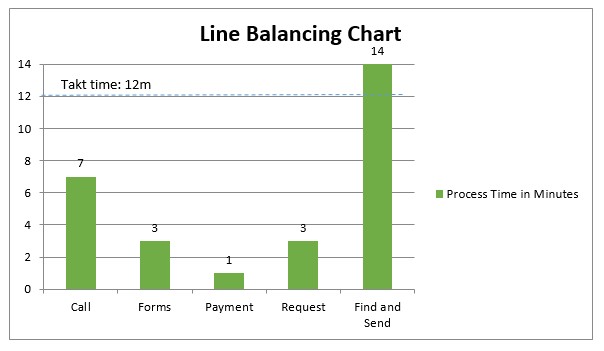
Figure 16: Example of our initial line balancing chart, where each process step is being performed at the same time as they move along a “production line” that is always full.

In the example above we have a service that needs to be produced once every 12 minutes to meet customer demand.  In other words, 12 minutes is our Takt time.

To create this service, we have five process steps.  Our timings look like this in minutes:  7, 3, 1, 3, 14.  Every step is always working, as items constantly move through the creation process.

Our two longest processes are 7 minutes and 14 minutes each.  We also have a problem, because if one step is taking 14 minutes and we need one every 12 minutes, we won’t meet our customer demand.

So how do we balance this workflow?

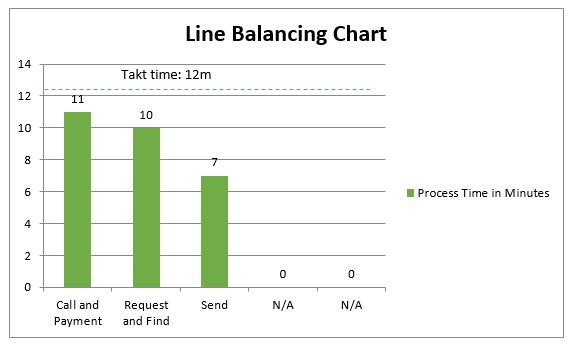
We can see that the second longest process (step one, “Call”) is 7 minutes.  Steps two and three after it, however, only add up to four minutes (3 + 1).  So we have the opportunity to combine the first three steps to reduce the number of total steps, with the added benefit of eliminating queues or wait time in between.

Step 5, however, is 14 minutes – 2 minutes over our Takt time.  We can split this step into two, or add some of it to another step in order to bring it under 12 minutes.

Doing this and balancing out our process steps, we have a much more streamlined process with less wait time, fewer handoffs and that we know meets customer demand.

lean line balancing chart

Figure 17: Example of our process after performing line balancing – some steps are combined, reducing queues in between, and one step is split up, ensuring our longest process is still under Takt time.

Using a Line Balancing Chart to Start Initiatives

Using a Line Balancing chart to start an improvement initiative is easy – we just need to reveal the right things.

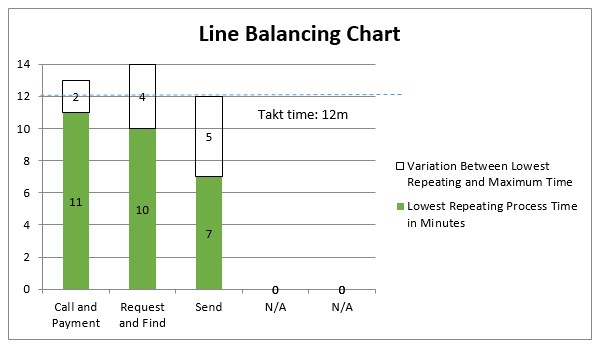
Remember, when timing a process we do so a minimum of ten times and use the lowest repeating time (2.5).  However, we can also draw in the maximum time for each step.  This will show us the lowest repeatable time versus the maximum time, with the time between them revealing any variations in time when performing the process.  And what causes these variations?  You guessed it – waste (3.1) and not having or following a standard process (5.4).  This variation can be a good opportunity to focus a Lean initiative on.

This is why problems are such great opportunities.  Once the process is improved, we can create a new standard process based on the changes, and then improve it again.

lean line balancing chart

Figure 18: An example of a Line Balancing chart showing variation in times when performing a process.  This variation is the perfect opportunity for a Lean improvement initiative.  

We could potentially reduce this variation and the time of any remaining steps as well.  Getting rid of NVA steps or processes (2.5), getting rid of the Eight Wastes (3.1), using quick changeover techniques (3.5) or adding error proofing and Autonomation (4.2), using 5S to organise work-stations and keep items close at hand (4.4) can all help reduce and balance out our remaining total Lead time even further.

Five Minute LeanThis is an excerpt from the book "Five Minute Lean", by David McLachlan - a wonderful book that blends teaching of the tools, culture and philosophy of traditional Lean with a modern-day Lean parable.

You can get the whole book on Amazon here and enjoy your own copy.

Selected chapters from the story within Five minute Lean:

Check out these selected chapters from the teachings within Five Minute Lean:

Five Minute Lean – Map the Value Stream to Reveal Opportunities

Five Minute LeanThis is an excerpt from the book "Five Minute Lean", by David McLachlan - a wonderful book that blends teaching of the tools, culture and philosophy of traditional Lean with a modern-day Lean parable.

You can get the whole book on Amazon here and enjoy your own copy.

Map the Value Stream to Reveal Opportunities

‘Mapping the process in this way, you can see your entire process at a glance, including any blockages or sticking points to fix.’

A Value Stream Map (VSM) is a map of the flow of steps for creating our product or service.  It can be done at a high level, between departments or a low level, in a single task.  Because of this, mapping the value stream is a good way to create a standard operating procedure (5.4), if one doesn’t already exist.  This is also the method that Steve taught to Lisa and encouraged her to try with her teammates, and in doing so they revealed a number of problems and opportunities.

In fact that is the reason we map our value stream: to reveal opportunities in our process for us to improve.  Things like long process times, many queues, having to redo work, or information travelling between too many departments.  All of this is referred to as “waste”, which we go into in more detail in (3.1).

You should know that there is a lot of information packed into the next two sections, and learning how to make a value stream map can seem daunting at first.  However, at the end you will be able to see your process at a glance, and it is a very powerful tool.

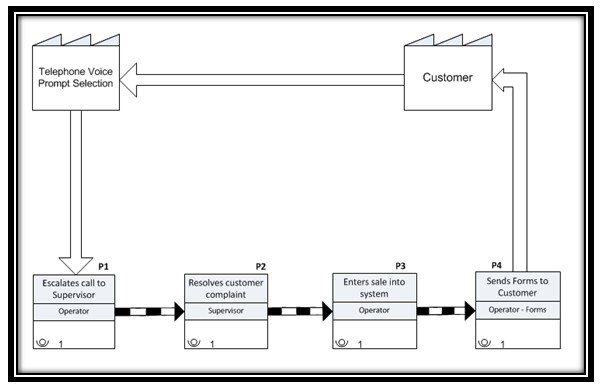
When creating a VSM, the easiest part to grasp is noting the process steps down the bottom, in order from left to right.  Before that, the customer is noted in the top right hand corner, and the supplier is noted in the top left hand corner.

Let’s take a look at something simple to start with – our first “SIPOC” step, or Lisa taking a sales call at the Shoe Emporium.

lean value stream map basic

Figure 5:  A basic start of a Value Stream Map for the Shoe Emporium sales process.  The stream “supplier” is in the top left, the steps are bottom left to right, and we ultimately deliver to the customer again in the top right, completing the cycle.

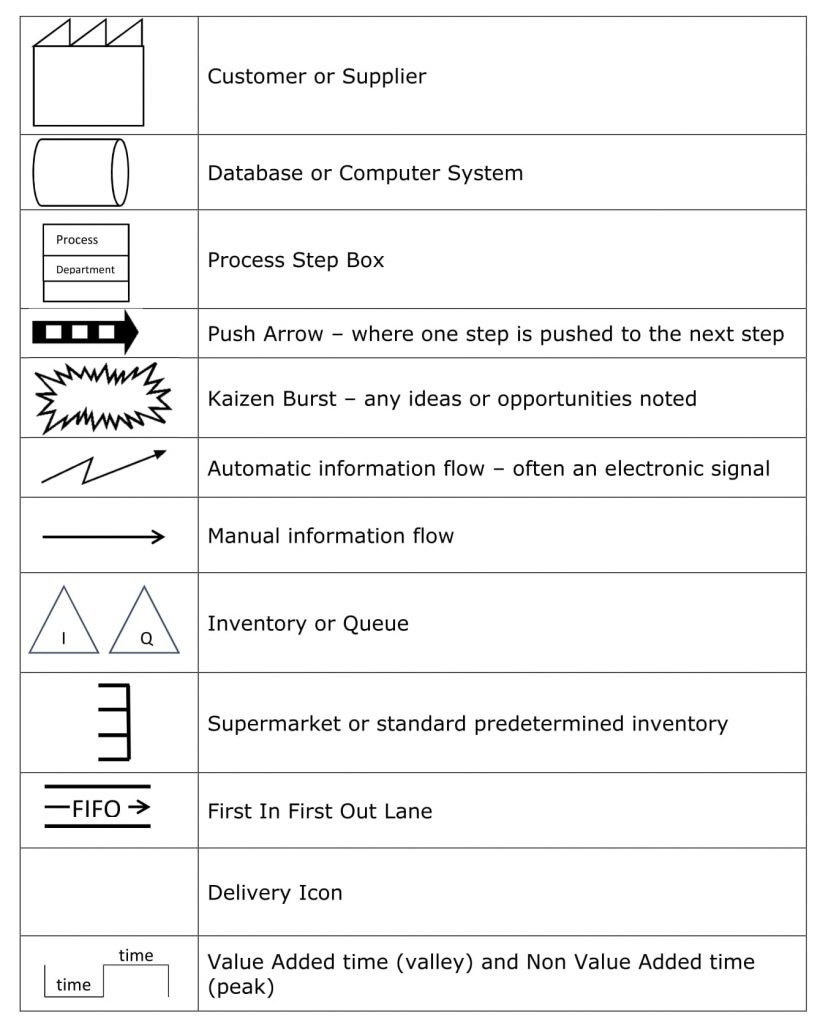
As you go through the chapters in this book all of this will make more sense to you.  Below are a few of the common icons you might come across in a Value Stream Map for you to reference as we progress.

lean value stream map icons list

Figure 6: Some of the main Icons to help show your process clearly when creating a Value Stream Map.

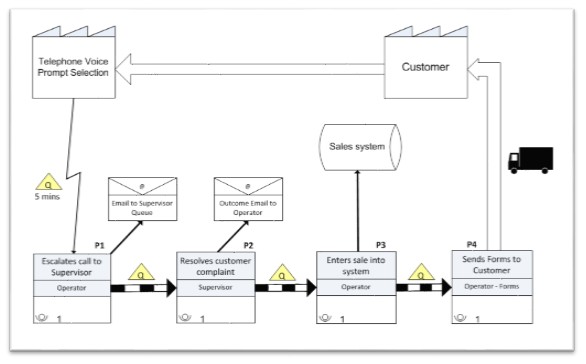
A picture says a thousand words, so let’s add some of these icons in where they belong, and we can see how they work in our Value Stream Map.

lean value stream map example

Figure 7: Our Value Stream Map with added systems, email communication, queues and delivery.  With a little experience a map like this will be second nature to you.

We now can see queues in between our processes, an email communication, an automatic transfer of information from the telephone prompt, databases or systems for where our information is stored, and a truck icon at the end, showing the delivery of the forms to our customer to end this part of the process.

Swim Lane Flow Charts

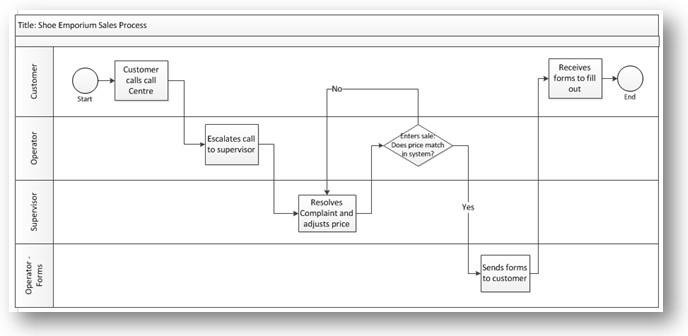
For those of you who are not yet comfortable with a Value Stream Map, another way of mapping a process is to use a Swim Lane Flow Chart.  Also known as a Business Process Map (BPM), it’s called a Swim Lane Chart because it looks like an Olympic swimming pool – but don’t be deceived by how simple it seems.  This method of mapping a process is also extremely powerful.

Different departments or stations are noted on the left from top to bottom with their lanes extending to the right.  It’s in these lanes that each step is noted, and the steps move up or down the lanes depending on who is performing the step.  A picture will help:

lean swimlane flowchart

Figure 8: A basic example of a swim lane flow chart, used to map our value stream.  The departments are vertical (up/down) and the process steps are horizontal (left to right).

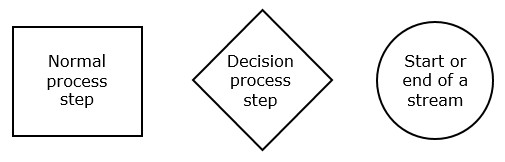
The main difference is in the process boxes, where a square is a normal process, a diamond is a decision box (often posed as a “yes or no” question) with one or more pathways and a circle is the start or end of a value stream.

lean swimlane icons

Figure 9: The three main types of process boxes in a Swim Lane Flow Chart.  A decision process step is often posed as a “yes or no” question, with the answer influencing where the process goes from there.

You can often get a good idea of the process at a glance using this method.  It is also very easy (once you have the hang of it) to quickly jot a Swim Lane Flow Chart down on a napkin or piece of paper over a cup of coffee with front-line team-mates.  Next, we add some more information to our map so we can see any opportunities to improve at a glance.

Five Minute LeanThis is an excerpt from the book "Five Minute Lean", by David McLachlan - a wonderful book that blends teaching of the tools, culture and philosophy of traditional Lean with a modern-day Lean parable.

You can get the whole book on Amazon here and enjoy your own copy.

Selected chapters from the story within Five minute Lean:

Check out these selected chapters from the teachings within Five Minute Lean:

Five Minute Lean – Make Feedback Meaningful with Kano Analysis

Five Minute LeanThis is an excerpt from the book "Five Minute Lean", by David McLachlan - a wonderful book that blends teaching of the tools, culture and philosophy of traditional Lean with a modern-day Lean parable.

You can get the whole book on Amazon here and enjoy your own copy.

Make Feedback Meaningful with Kano Analysis

‘By discovering what delights our customers we can do more of it, by discovering what dissatisfies our customer we can fix it.’

Alternatively to the Net Promoter Score, we can ask the following two questions to discover what delights or dissatisfies our customer:

  • What did you love about your experience?
  • What did you hate about your experience?

This gives us enough information to be able to separate the answers into three sections:

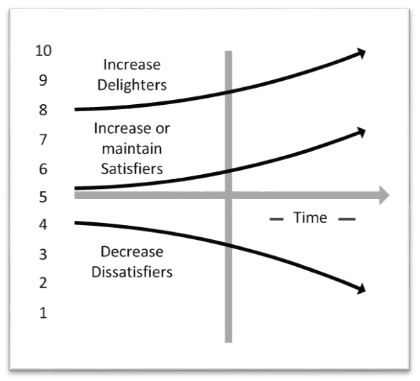
  1. Delighters (things customers love, or anything mentioned with an NPS score of eight or above),
  2. Satisfiers (NPS scores between five and eight), and;
  3. Dissatisfiers (things customers hate, or NPS scores of four or below).

Where traditional Kano analysis focuses on basic needs, expected needs and exciting needs of the customer, quantifying customer feedback using an actual number (NPS) and broadening the scope to include things the customer dislikes gives us much more room for improvement.  The aim over time then becomes to increase the things that delight customers, continue doing the things that satisfy them and reduce the things that dissatisfy them.

lean kano analysis

Figure 1:  Slightly different to traditional Kano analysis, separating the “Voice of the Customer” into Delighters, Satisfiers, and Dissatisfiers using the Net Promoter Score results can give us more information to improve.  The aim becomes, over time, to increase Delighters, maintain or increase Satisfiers, and reduce Dissatisfiers.

You will probably notice that the answers we get in general will also fall into our three Lean “Customer Driven Metrics”, which are things that improve on Quality, Cost or Delivery times.

The next section focuses on the one most people would rather avoid – customer “Dissatisfiers” – and how we can actually use these to our advantage.

Five Minute LeanThis is an excerpt from the book "Five Minute Lean", by David McLachlan - a wonderful book that blends teaching of the tools, culture and philosophy of traditional Lean with a modern-day Lean parable.

You can get the whole book on Amazon here and enjoy your own copy.

Selected chapters from the story within Five minute Lean:

Check out these selected chapters from the teachings within Five Minute Lean:

Five Minute Lean – Implement With Agile for Fast Iterations and Feedback

Five Minute LeanThis is an excerpt from the book "Five Minute Lean", by David McLachlan - a wonderful book that blends teaching of the tools, culture and philosophy of traditional Lean with a modern-day Lean parable.

You can get the whole book on Amazon here and enjoy your own copy.

Implement With Agile for Fast Iterations and Feedback

‘Structure everything as an experiment first.  Agile is the perfect tool for releasing your change while keeping risk to a minimum.’

Agile is another methodology that can be used in conjunction with Lean to great effect, especially during implementation.  It is primarily based on releasing things in short, quick “iterations”, (implementations or experiments) to get feedback as quickly as possible.  Iterations usually last from a few days to a few weeks before feedback is gathered, changes are made and the next iteration begins.

Additionally, we also want to release the changes we make in a controlled environment as a “pilot”, where possible.  For example, making changes on one machine instead of 50 machines, or with a small group of call centre consultants instead of the full floor.

Implementing in this way has many benefits.  With no large rollout the risk is minimised.  With faster feedback we are also getting rid of opinions and cutting through to the hard data – we can see if something is working or not.  We don’t have to put a lot of time and money into it to know if it works, and it also becomes easy to see if we have affected a downstream or upstream process adversely.

In Lean terminology this method of experimenting iteratively and gathering feedback is also called “Improvement Kata”, and again relates to the “Plan, Do, Check, Act & Adjust” cycle.  Using Agile simply gives that cycle a solid framework.

Step 1: Prioritising a Backlog

The first step for the team, before an iteration begins, is to prioritise and display the work that must be completed during that iteration.

For example, team-mates would meet and write down all known and upcoming work (the “backlog”), put it in order of priority and place it on a card in the first lane of their Kanban board (below), giving them a “prioritised backlog”.  Doing this, team-mates can see what needs to be done for them to succeed.  This backlog of work may evolve as new ideas or problems come to light.

Cards for a Kanban board are usually written as a story, for example: “As a _____, I want to _____,” but they can also be in any format that is agreed within the team.  In Steve’s business, when he was improving it and making changes, he might write, “As a car cleaner, I want to have all my cleaning tools in one easy to reach location,” for one particular change.

Step 2: Using a Kanban Board

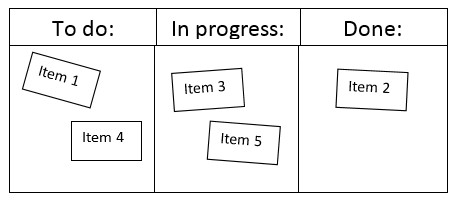
A Kanban board is used to show us at a glance the pieces of work and who they are assigned to as they move from “To Do”, “In Progress”, though to “Done”.  Remember Kanban literally means “signboard”, and a Kanban board on a wall that is easy to see is also good Visual Management (4.1).

lean kanban board

Figure 29:  An example of a Kanban Board, also good Visual Management.  This style of Kanban is often used in software development, but can also be used in implementing a Lean project or anywhere there are multiple tasks to complete.

You can have more columns if you need them, and name them to suit the phases of work or departments within your own business.  The possibilities are up to you.

Step 3: Using Stand-Ups

A “stand-up” in Agile terms is a short meeting of 5 to 15 minutes where the participants stand up, usually around a Kanban Board.  Cards on the board are updated or moved as each person speaks about the ones assigned to them and they have the opportunity to raise any issues or “blockers” that might be stopping them from completing the work.  If a blocker cannot be resolved within the short timeframe of the stand-up, then the decision is made to “take it offline”, or discuss the issue afterward and make steps to solve it.

Standing up helps keep people focused and the meetings short, and meeting regularly allows us to call out blockers close to when they first occur, so we can fix them close to the source.  This is one of the principles behind Jidoka (4.2) and also one of the capabilities of outstanding leaders, which we saw in the introduction of this book.

At the Shoe Emporium, Lisa might catch up quickly, once a day with her team-mates who are trialling new methods, to see if they are working or if they need help.

Because we are releasing in short iterations, we don’t have time for long meetings that happen once a month.  Instead, we have short meetings daily, or weekly, and we can see all the information we need at a glance using the principle of Visual Management via the Kanban Board.

Step 4: Using Retrospectives

A “retrospective” in Agile happens when we have completed an iteration.  This is where our team asks the following four questions to gain feedback on our experiment.

  1. What went well?
  2. What didn’t go well?
  3. What have we learned?
  4. What still puzzles us?

You might have many short iterations, named and numbered from one upwards, and it is great practice to stop and gather feedback during and after each one.

Knowing When it’s Time to Pivot

One of the main themes from The Lean Startup by Eric Ries is knowing when to “pivot”, or stop going down the path you are going during an implementation and pivot into a new direction, a new fix, experiment or even product.  In other words, “Adjust”-ing our course in the Plan, Do, Check, Act and Adjust cycle.

How do we know if it is not working?  If it’s not immediately obvious in the experiment we are performing then we should measure the metrics or outputs (1.2) associated with the process or the product we are changing.  As you can see, this brings us full circle as we go back to chapter one and gather feedback on whether we are meeting value as defined from our customer’s point of view.

We can also ask the retrospective questions above for feedback on our internal process, or the Net Promoter Score (1.3) questions for our external customer.

When we are satisfied with our changes in a small area, we can release it to the wider business.  And what do we do when we’ve improved our process and implemented successfully?  We can monitor it and then go through the improvement process again as we strive continually for perfection.

Five Minute LeanThis is an excerpt from the book "Five Minute Lean", by David McLachlan - a wonderful book that blends teaching of the tools, culture and philosophy of traditional Lean with a modern-day Lean parable.

You can get the whole book on Amazon here and enjoy your own copy.

Selected chapters from the story within Five minute Lean:

Check out these selected chapters from the teachings within Five Minute Lean:

Five Minute Lean – Heijunka: Level the Workload when Demand Fluctuates

Five Minute LeanThis is an excerpt from the book "Five Minute Lean", by David McLachlan - a wonderful book that blends teaching of the tools, culture and philosophy of traditional Lean with a modern-day Lean parable.

You can get the whole book on Amazon here and enjoy your own copy.

Heijunka: Level the Workload when Demand Fluctuates

‘When demand for our product or service fluctuates, we can use Load Leveling, or “predictive Pull”, to keep our workload level.’

In a perfect world, we would know in advance what our orders or requests for service might be, so that we could have enough people or resources ready.

Unfortunately, in the real world, requests often come through in different amounts and at different times, with different items being requested.  Most companies’ response to this is to either constantly be behind in orders or requests (while their customer suffers), or constantly have too much inventory or people in a desperate effort to meet demand, creating all kinds of waste (3.1).

We have already seen how to balance the Cycle times of our process with Line Balancing (3.4), but we can also balance our workload when demand fluctuates using Load Levelling, or “Heijunka”.  By using information of previous orders (or demand), combined with information of upcoming orders (or demand), we can smooth things out considerably using the following techniques.

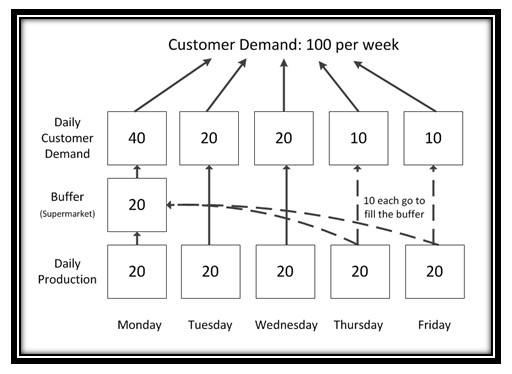
Let’s say a company regularly receives orders, for any type of item or service, for 100 items a week, but demand fluctuates from day to day (for example 40 on Monday, 20 on Tuesday, 20 on Wednesday, 10 on Thursday and 10 on Friday), we could use a small buffer of finished goods (like a Supermarket, 4.1) to respond to Monday’s high demand, then level production at 20 per day, meeting our 100 per week demand.

In Lisa’s case, if call volumes at the Shoe Emporium fluctuate from day to day, Lisa might get this information by checking the historical volumes from the last week, month and year.  She might recommend having more people working on a Monday (a buffer, like the example above) who would assist in smoothing demand.

lean load levelling heijunka

Figure 23:  An example of Load Levelling, where daily demand fluctuates.  We can use a buffer, or “supermarket” on Monday to meet demand, then smooth production at 20 per day. 

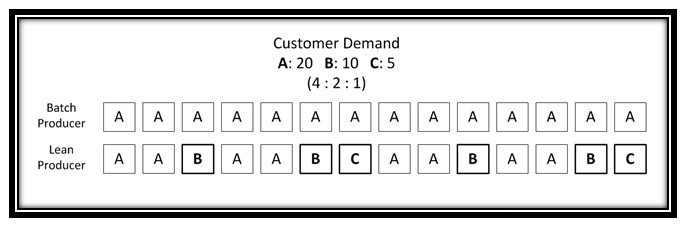
Alternatively, we can also level the type of item we work on.  Imagine a company has three types of products (products A, B and C), with daily demand being 20 for Product A, 10 for Product B and 5 for Product C, or a ratio of 4 : 2 : 1.  Instead of simply lumping (or batching) the production of each item together at the same time or with the same operator, we can level it out so there is an even number being produced at all times, allowing us to respond to fluctuating demand more readily.

lean load levelling heijunka

Figure 24:  An example of Load Levelling, where the types of requests are different.  Producing the Lean way, especially when we have one piece flow, we ensure there is an even number being produced at all times.

This is the type of thing that Lisa might use at the Shoe Emporium, if she got different types of sales and service requests by email.  Instead of only one person performing one type of request, they can be spread across her team and ensure the requests are completed evenly instead of batching them together.  This way there is less waiting while the one person completes their workload, and less chance of a single point of failure.

Five Minute LeanThis is an excerpt from the book "Five Minute Lean", by David McLachlan - a wonderful book that blends teaching of the tools, culture and philosophy of traditional Lean with a modern-day Lean parable.

You can get the whole book on Amazon here and enjoy your own copy.

Selected chapters from the story within Five minute Lean:

Check out these selected chapters from the teachings within Five Minute Lean:

Five Minute Lean – Solve the Real Cause of the Problem

Five Minute LeanThis is an excerpt from the book "Five Minute Lean", by David McLachlan - a wonderful book that blends teaching of the tools, culture and philosophy of traditional Lean with a modern-day Lean parable.

You can get the whole book on Amazon here and enjoy your own copy.

Solve the Real Cause of the Problem

‘Using a Fishbone diagram and the 5 Whys is a fast and easy way to get to, and solve, the real cause of a problem.’

Implementing solutions to problems in our job or business often takes time and money to do.  Many people spend this time and money only to discover they were solving the wrong thing – addressing only the symptoms and not the actual cause.  Using the power of Root Cause Analysis can help us discover and solve the real problem and avoid this waste.  Problems are also wonderful opportunities – if we can solve the real problem it can make our job easier and far more enjoyable.

When we have a specific problem that we need to solve, it is extremely important that we:

  • Clearly define the problem we are working on, before we begin.

This means we “go and see” the problem, directly where the work is done (at the Gemba, 2.2) and hopefully as soon as it happens (with Jidoka, 4.2).

It also means articulating the problem specifically as a gap from where we are to where we want to be, based on something measurable like our customer driven metrics (Quality, Delivery, Cost or Sales, 1.2) or reducing one or more of the eight wastes (3.1).

For Lisa this might mean reducing wait time in a queue from 10 minutes (where she is) to five minutes (where she wants to be) instead of just saying “less queue time”.  Defining a problem in this way also makes it easy to know when you have succeeded – you are not chasing a vague concept.  And because you have defined the problem as a measurable gap, it is also easier to present a clear view from the problem, to a solution.

During our Kaizen meetings, while mapping our process, or even when walking the Gemba, we may need to get to the real cause of these problems we reveal.  To do so we use a Fishbone diagram and the “Five Whys”.

Fishbone or Ishikawa Analysis

A Fishbone diagram is used to get a quick idea of where the cause of our problem might lie by separating ideas into categories.

The four categories are:

  1. People
  2. Information
  3. Process
  4. System

An easy way to remember them is “PIPS”.

In Manufacturing, the four categories can also be known as the “Four M’s”: Man and woman, Materials, Method, or Machine.

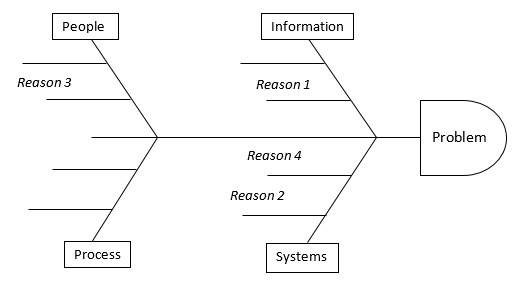
To use a Fishbone diagram, Lisa would note her clearly defined problem at one end, the “head” of the fish.  She could then have her team-mates call out reasons why they believe the problem is happening.  These reasons would be noted under any of the four categories, depending on where the cause lies.

As usual, a picture says a thousand words:

fishbone diagram

Figure 15: An example of a Fishbone or Ishikawa diagram, noting reasons under People, Information, Process and Systems.  Once complete, we can group similar problems or reasons together and then perform the Five Whys.

Once she had a few reasons, Lisa could group them together further.  For example, there might be a few reasons that relate to how people are trained, or others that always come back to a certain department.  This allows her to narrow down her causes effectively into one or two main reasons, and she can then delve even deeper with the Five Whys.

The Five Whys

Once we have an idea of where our problem lies using a Fishbone diagram, we can use the Five Whys to delve deeper into any of the main reasons that we have come up with, if we need to.

To perform the Five Whys, we ask “Why” this is happening, and with each new answer ask why again until the answers have been exhausted or we need to gather more data.

Let’s say that in one of the process steps at the Shoe Emporium Lisa identified that there is a high rework percentage, perhaps 50%.  Maybe it’s a form that doesn’t get filled out correctly and needs to be re-done.

The conversation might go a little like this:

Why does the form come back for rework 50% of the time?

 1.  The customer doesn’t fill it out correctly

Why?

2.  They don’t feel like they have to, or they don’t understand it

Why?

3.  We haven’t explained the importance of the form or how to fill it out

Why?

4.  We don’t focus on building in quality when gathering the information, and it is too easy to make a mistake.

In this scenario we didn’t need all five “whys” – this is OK.  The main point is to keep asking until the answers have been exhausted, or we need more information.  We also know our Five Whys are working when we can go back up the line of questions and replace “Why” with “Therefore”.

For example:

4.  We don’t focus on building in quality when gathering information

Therefore:

3.  We haven’t explained the importance of the form or how to fill it out

Therefore:

2.  Our customers don’t understand it

Therefore:

1.  Our customer doesn’t fill it out correctly and it comes back 50% of the time.

Once you have narrowed down your answers, you can add the real problems into your Value Stream Map as Kaizen Bursts, and brainstorm solutions with your team-mates.

When you are brainstorming solutions, you can use ideas from Chapters Three, Four and Five to help you.  This will give you tools such as having a standard process, error proofing or stopping when a defect is found, working towards one-piece flow, then changing how people are measured or rewarded and making information, process steps, queue times or other things visible, which can all have a huge impact.

It is also a good idea to use the 5 Whys on our processes – as in “Why do we do this step?”  In many cases a process may have been created long ago and things have changed or moved on, leaving the process unnecessary.  If the only reason for doing something is because “this is the way it’s always been done,” then thank goodness you are going through a Lean transformation!

Five Minute LeanThis is an excerpt from the book "Five Minute Lean", by David McLachlan - a wonderful book that blends teaching of the tools, culture and philosophy of traditional Lean with a modern-day Lean parable.

You can get the whole book on Amazon here and enjoy your own copy.

Selected chapters from the story within Five minute Lean:

Check out these selected chapters from the teachings within Five Minute Lean:

Five Minute Lean – Get Your Map Started with a SIPOC

Five Minute LeanThis is an excerpt from the book "Five Minute Lean", by David McLachlan - a wonderful book that blends teaching of the tools, culture and philosophy of traditional Lean with a modern-day Lean parable.

You can get the whole book on Amazon here and enjoy your own copy.

Get Your Map Started with a SIPOC

‘A SIPOC shows you the basic process steps, as well as your customers, requirements and handover points, all at a glance.’

One of the fastest ways to get started in mapping a process is with a SIPOC.  This kind of map gives us a very simple, high level view to help us begin.  If you want a more detailed view, you can use a Value Stream Map (2.4).

SIPOC stands for Suppliers, Inputs, Process, Outputs, and Customer.  It allows us to see the basic process flow, the suppliers and customers, and the inputs and outputs for each step.  This information can be extremely useful, for example:

  1. We can quickly see the connections between our process steps
  2. We can see what is needed to perform our steps correctly
  3. We can also manage risk efficiently, as we are seeing interacting points that might be affected by any changes we make.

In other words, when our SIPOC is filled out, we can see a large amount of information about our process at a glance.

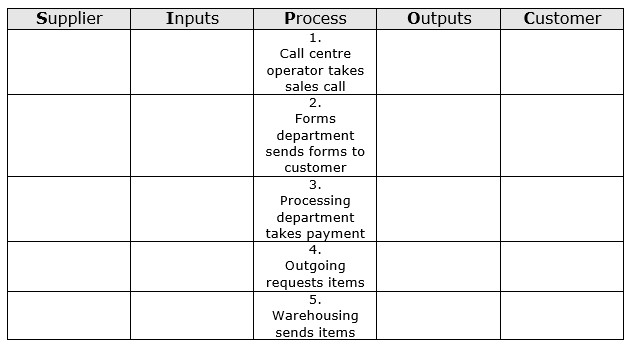
The first thing we do in our SIPOC is a high level process flow – the main steps we perform to create our product or service.  For the sake of continuity, let’s use the process flow from the Shoe Emporium in our story:

SIPOC example

Figure 3:  The basic process flow outlined in our SIPOC, based on the Shoe Emporium sales process.

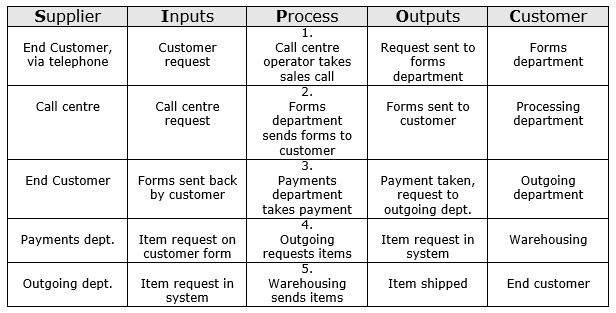
In a SIPOC we are describing only the main steps – as you would if you were telling someone you just met at a barbeque, about your job.  Once we have a high level process flow, we can add the Supplier, Input, Output and Customer for each step as well.  Remember – our Supplier can be any step before the current one, and our Customer can be any step after our current one.

SIPOC example

Figure 4:  Our SIPOC with the additional information included so we can see our inputs and outputs at a glance.

We can also add “Customer Requirements” (which are the required outputs of the process), and “Measures”, or how the process is measured so we know when it is successful or completed.  This additional information is also very useful, and would make our diagram a SIPOCr+M.

Now that we have a high level view of our process, we discover problems in our work with a Value Stream Map.

Five Minute LeanThis is an excerpt from the book "Five Minute Lean", by David McLachlan - a wonderful book that blends teaching of the tools, culture and philosophy of traditional Lean with a modern-day Lean parable.

You can get the whole book on Amazon here and enjoy your own copy.

Selected chapters from the story within Five minute Lean:

Check out these selected chapters from the teachings within Five Minute Lean:

Five Minute Lean – Collect and Measure Feedback With the Net Promoter Score

Five Minute LeanThis is an excerpt from the book "Five Minute Lean", by David McLachlan - a wonderful book that blends teaching of the tools, culture and philosophy of traditional Lean with a modern-day Lean parable.

You can get the whole book on Amazon here and enjoy your own copy.

Collect and Measure Feedback With the Net Promoter Score

‘The Net Promoter Score is a great way to discover and measure customer value.’

The Net Promoter Score (NPS) was outlined in a book called “The Ultimate Question 2.0” and is a great way to determine customer feedback and what they truly value.

It is a simple question we can ask when we want to gather direct feedback, typically after the product or service has been delivered.

1.  On a scale of one to 10 how likely would you be to recommend us to a friend?

Let’s say a customer says a “six”.  The next question works both because of its simplicity and its results:

2.  What would it take to make it a 10?

When a customer answers this question for us, it prompts them to give more detail on what would bring them enough value to compel them to recommend our services.  This question can be used in a survey, or as a follow up call to the customer to ensure we try and fix the problem straight away.

Using the NPS in this way is a great start in finding out what delights and what dissatisfies our customer, which brings us to Kano Analysis in our next section.

Five Minute LeanThis is an excerpt from the book "Five Minute Lean", by David McLachlan - a wonderful book that blends teaching of the tools, culture and philosophy of traditional Lean with a modern-day Lean parable.

You can get the whole book on Amazon here and enjoy your own copy.

Selected chapters from the story within Five minute Lean:

Check out these selected chapters from the teachings within Five Minute Lean: