All posts by David McLachlan

Lean Parable – Where Lisa Makes a Change

Five Minute LeanThis is an excerpt from the book "Five Minute Lean", by David McLachlan - a wonderful book that blends teaching of the tools, culture and philosophy of traditional Lean with a modern-day Lean parable.

You can get the whole book on Amazon here and enjoy your own copy.

Where Lisa Makes a Change

“I’m going to quit my job.”

There was silence on the other end of the phone.  Lisa was walking at a brisk pace, as she normally did during her lunch hour.  It was a great way to enjoy the bay side and escape the office, not to mention giving her a break from the unrelenting phone calls in the call centre that had made her life so difficult over the last few years.

When Lisa joined the Shoe Emporium five years ago it had seemed like a dream.  After all, she was working in a job that paid her to talk about one of her favourite topics – shoes, and it was a small business with an owner who was passionate about the things he created.  When they came to work every day, she truly felt like they were changing the world.

Now, as the company grew larger, it was less like a family and more like a business.  She shared the floor with more than 300 employees, while shareholders and board directors controlled most, if not all of the decisions.  More often than not they were decisions that cut costs and reduced the quality of service to the customers that Lisa had once loved so dearly.   It had made service queues horrendously long and these days it took forever to get anything done, let alone delivered.

So now, there really seemed to be no other choice.

“Hello?  Steve, did you hear me?  I said I’m going to quit.”

Lisa was answered by the sound of loud clanging, grinding and shouting – certainly not what she was expecting.  It sounded as though Steve was driving, but if that was the sound of his engine it was clear he wasn’t going to get very far.

“Lisa, I heard you,” Steve shouted. “But I thought you loved that job?  Can you meet for coffee?  I’m three blocks away.”

“No, I – “

“I’ll see you there.”  Lisa looked at the ended conversation on her phone and rolled her eyes.  Steve was not going to talk her out of this one.  But one coffee couldn’t hurt.  Could it?

*

By the time Steve’s beautiful, shiny car limped into the parking lot of their local café, Lisa had already ordered them both cappuccinos and was seated at a table overlooking the bay.

Steve leapt out of the car, brushed himself off as though he was ridding himself of the experience he just had, and sat down.  He was a fair looking man with a mop of light brown hair, perhaps in his late forties but wearing an outfit of someone in their late twenties, and with an impossible smile permanently plastered on his face.

Steve had owned a car detailing and tinting service for many years, but it was only recently that things seemed to be going extremely well for him.  Which was obviously the reason for the new ride.

“Wow, what a car!” he said. “I’ll have to remember that it doesn’t seem to like driving over 120 miles per hour on a dirt road, though.”

Lisa smiled and shook her head.

Before she had time to respond, a shiny new van pulled up next to Steve’s car, and out popped a man in overalls.  He looked around, spotted Steve, gave a quick wave as though they’d done this all before and then headed under the hood of Steve’s clanging monstrosity that had only just made it into the car park.

Ignoring Lisa’s slightly perplexed look, Steve put down his coffee and said: “But more importantly, did I hear you correctly?  You said you are quitting your job?”

Lisa’s face sunk a little.  “I just can’t do it anymore, Steve.  I know I used to love this job, but with all the cost cutting they’ve done it’s nearly impossible to give my customers a good experience.  Some people I’ve known for years have told me they love talking to me on the phone, but they just can’t put up with the poor product and terrible delivery times any longer.”

Steve nodded as she spoke.

“Believe it or not, I know exactly what you mean,” he said. “In fact that’s the reason I wanted to meet – I may have a way to help you.”

“Steve,” said Lisa, with a serious tone, “I hardly think you detailing cars is the same as me selling shoes.”

“They might seem different,” considered Steve.  “But it wasn’t too long ago that I hated the work I did as well.  I was doing 12-hour days, constantly having to stay back to fix the work my employees did during the day, cleaning cars and tinting their windows.  Customer complaints were also through the roof.  It was really terrible!

“Thankfully, that’s not where my story ended.  The owner of the car sales desk we work with approached me one day and asked if I wanted to ‘improve my business so much that I enjoyed it again’.  Of course, my answer was yes.  I was on my twenty-first straight day and was more than a little delirious.”

Steve laughed at himself, and it made Lisa feel better too.  He did look a lot happier, she thought, and that made her curious.

“The sales owner showed me a way – a way of streamlining things, making them easier, and standardising them so anyone can do it.  I cannot begin to tell you what a huge difference it made.  Most of my employees started working with the new streamlined standard, and the ones that didn’t, left.  It even cost me less per car, so I could reduce my prices a little and beat my competition.  Now I even get home on time, every day.  It’s wonderful!”

Lisa beamed at her old friend.  “Steve, that’s great!” she said. “But how does that apply to me?  I don’t tint or detail cars.  I just sell shoes in an online store call centre.  And I don’t have employees – I’m not even the boss where I work.”

“That’s true Lisa, but there is one thing both our companies share, and that’s a process for doing things.  The sales desk owner told me that everything has a process, and even though the processes are different, the way we fix them is the same.

“Besides, you can’t quit your job.  What about your bills, your mortgage, and your family?  I know you want to leave, but other jobs aren’t always easy to find.”

Lisa’s face sunk as he said the words, and reality slowly crept in.  She was behind on most bills as it was.  As much as she thought she wanted it, being unemployed wasn’t really an option.

Steve gave her a sympathetic smile.  “If this works, it could really change your life for the better.  What do you think?  Do you want to give it a try?”

Lisa nodded.  “Well if I can’t quit my job, Steve, I might as well improve it.”

“Great!” And the look on Steve’s face seemed to make the day brighter already.  He paused for a moment in thought.

“You know, there are a few things we can do to get started straight away,” he said.

“How did I know you were going to say that?” Lisa said, and she smiled slightly and shook her head.

“I wouldn’t usually start so soon, but if we’re going to improve your job, we really need to know what your product is.”

“Well that’s easy,” said Lisa.  “You already know I sell shoes.  Wouldn’t that be my product?”

“Not always,” said Steve.  “You see, your product is what brings value to your customer.  And to find out what truly brings them value, you have to ask.  Most people think they know, but when they ask their customer they often find a different answer altogether.

“Let me show you what I mean,” Steve continued, and he looked over his shoulder and shouted to the van mechanic under his car that he seemed to know so well.

“Hey Nathan!”

“Yeah?” the mechanic yelled back from under the hood of the car.

“What sort of flowers should I get for my daughter’s wedding?”

Nathan stopped what he was doing and looked out from under the hood.  “How should I know?” he said, a little bewildered, and got back to work.

“Exactly,” said Steve pointedly as he turned back to Lisa with a smile.

“You wouldn’t ask a mechanic what to do for your wedding.  And to find out what value means to your customer, you need to ask your customer.”

Lisa nodded her head as she took all this in.  “Ok, Steve.  I get your point.  You know, I talk to enough customers during the day so I’m sure it won’t be too hard to ask them one more question, and find out what value means to them.”

Steve smiled. “And once we know that, we can really get started.”

Lisa looked down at her watch, and wrinkled her nose. “Time to get back,” she said.

“But you’ll give it a shot?” asked Steve.

“I’ll give it a shot,” Lisa nodded.

“Great!” said Steve, and he downed the last of his coffee in one gulp.

Five Minute LeanThis is an excerpt from the book "Five Minute Lean", by David McLachlan - a wonderful book that blends teaching of the tools, culture and philosophy of traditional Lean with a modern-day Lean parable.

You can get the whole book on Amazon here and enjoy your own copy.

Selected chapters from the story within Five minute Lean:

Check out these selected chapters from the teachings within Five Minute Lean:

Lean Parable – Where Lisa Discovers a New Way

Five Minute LeanThis is an excerpt from the book "Five Minute Lean", by David McLachlan - a wonderful book that blends teaching of the tools, culture and philosophy of traditional Lean with a modern-day Lean parable.

You can get the whole book on Amazon here and enjoy your own copy.

Where Lisa Discovers a New Way

Lisa sat at her keyboard, enjoying a bagel before her shift started at 7am.  As she flicked through her dozens of emails, meeting requests and other things that never got looked at or finished, she saw one that caught her eye:

>To: All Service Centre Employees

>Subject: Urgent Notice Regarding Your Employment

“As you all know, at the Shoe Emporium we have strived to be the first choice for passionate shoe buyers over the past five years.

Unfortunately, to remain cost competitive in a tough market, the board of directors have made the difficult decision to cease the employment of all northern service centre employees by the 14th of next month.

If you are receiving this email, then this decision relates to you.”

Lisa stopped reading and put down her bagel.  “Cease the employment?”  She was being downsized!  Lisa had known things were bad at the Shoe Emporium, but being put out of a job like this was the last thing she had expected, and the 14th was less than four weeks away.

Lisa checked her watch, picked up her phone and dialled a number.  If she timed it just right she would have 20 minutes before the call centre opened.  The phone only rang once.

“Hi you’re on the phone with Steve,” said the perpetually cheerful voice on the other end.

“Hi Steve,” Lisa said, trying to keep her voice steady.  “They just announced something big here.  Can I meet you at the boardwalk?”

“You can, because I’m actually here right now,” said Steve, but he didn’t get to finish before Lisa hung up her phone and quickly headed down to meet him.

At the boardwalk near the bay, the people were blissfully unaware of Lisa’s news.  As she made her way through the holiday makers strolling leisurely about, she saw Steve standing by a large sign, there as promised.

“These things are just fantastic,” said Steve as Lisa approached, and she looked up to see that the large sign he was looking at was in fact a map of the bay area.

“Steve, they’ve just announced they’re cutting costs,” said Lisa, slightly out of breath.  “All the bay area call centre employees are going to be losing their jobs in four weeks, including me.”

“Cost cutting eh?” Steve furrowed his brow for a moment in thought. “Never a good sign.  And even worse, I suppose, when you’re not on the end doing the cutting,” he added sympathetically.

“Steve, what am I going to do?”

Steve was silent for a moment, lowered his chin and looked across at her solemnly.

“Well, Lisa, you know we were both going to be doing this process improvement anyway,” he said.  “If we were going to do it before, would you be willing to still do it now to save your job?”

Lisa paused to let the words digest.  This certainly wasn’t the option that first came to mind.  Save her job in four weeks?  Surely it could not be possible.  But… what was the alternative?

“Well,” said Lisa. “I guess I have no choice but to say yes.”

“You always have a choice, Lisa,” said Steve.  “I know it might sound crazy, but I’ve seen this thing work wonders.  There is a lot I have to teach you, but I think together we could do it.”

“Well I’ve got about five minutes now,” said Lisa, a smile finding its way to her face. “Will that suit?”

Steve laughed a deep, warm laugh.  “Five minutes eh?” he said, obviously up to the challenge.  And then seeming to remember something, he said: “Well we can start here, with this map.”

He looked again at the large map of the bay area.  Printed down the bottom were the words: “YOU ARE HERE” next to an arrow in bold.

“This was the next thing I was going to teach you, Lisa,” said Steve.  I came here for a reason, you see.  Because if we want to get anywhere worth going, we first need to know where we are.”

Lisa looked at him sceptically.  “Doesn’t that sound like something a monk might say, not a business owner?  No offense Steve, but I’m about to lose my job here and I’m almost late for work.”

Steve laughed.  “I promise, you will love this.  Let’s head back to your building while we talk.

“You see most businesses don’t know or haven’t articulated their current processes – they just let their employees work and hope for the best.  They can’t improve their business because they don’t even know where they currently are.

“You might say they are lost without a map.”

Lisa’s brow unfurrowed a little as she warmed to the idea.  “A map,” she said, half to herself.  “But what kind of map?”

“A process map, Lisa.  A map of the things you do that bring value to your customers.”

“Oh, of course.  And we all know value is determined by the customer,” said Lisa, in a mock sing-song voice.

“Aha!  The perfect student – you remembered!”  Steve smiled his unstoppable smile.

“You know how I remember that?” asked Lisa.  “I actually took your advice and asked my customers what they like and want more of.  And you know, I found out a few things I wouldn’t have if I’d just assumed.”

“Oh?”  Steve raised an eyebrow, even more interested.

“I found out a lot of my customers would be willing to pay for faster shipping,” Lisa continued.  “So that would add value.  They would also pay for a longer return period.  The majority of my customers tended to shop with us because we had access to really special, niche brands that others didn’t.  But the main process, of course, was selling shoes.”

“That’s great!  Wow, you’ve done a great job so far.  And for all of those valuable processes, we can create a map.”

They sped up slightly as they passed a small boat at the dock.  A young crew dressed in white polo shirts were passing boxes of inventory along a gang plank to each other onto the boat.  It was a simple process, left to right, left to right until it got to the end.

“Take that boat crew for example,” Steve pointed to the crew.

“When we are creating our map, just like that boat we need all our team-mates to be on board or our boat won’t run.  In other words, we need to include our team-mates from the front lines.  And see how they’re passing those boxes along to each other?  That is exactly how we draw in our processes – moving along from station to station, from process step to process step until it is delivered at the end to the customer.”

“I think I get it,” said Lisa, and she looked at her watch.  Time was running out before the call centre opened and she needed to start work.

“Maybe it would be easier if you could see one,” said Steve.  “If you’ve got a few minutes and a spare whiteboard, I’ll show you how to make a map now if you like?”

Lisa hesitated just a little.  “OK, Steve, but we need to hurry.”  And they entered the building.

*

Fifteen minutes later, the two were totally engrossed in the rough process map on the whiteboard they had drawn in a spare meeting room at the Shoe Emporium.  It seemed simple enough.  There was a box with a pointy roof on the left, an arrow moving down and then a row of boxed process steps from left to right.

A few arrows here or there indicated “redoing” a few of the steps, and underneath it all were some rough timings of the steps and queues in between.

“It’s amazing,” said Lisa, slightly slouched in her chair.  “I can see the process.  You know, Steve, this might actually help.”

“I guarantee it will,” said Steve.  “But remember, include your team-mates and help get them on board.  An important part of Lean is to take them on the journey with you and pass on your knowledge as you make changes.  Also, you never know when you will need their support.”

Lisa gave him a worried look.  “That’s the hard part.  I don’t know anyone who cares enough about their job here to spend time on the process with me.  Most of the people are out the door the second their shift is over.”

“That may be true, but you must find a way, Lisa.”

It was heartening, even if she didn’t quite believe it.  And for a moment Lisa felt as though it could work.  But the moment was broken by the door being flung open – no knock, just a loud crash as it hit the adjacent wall.

“WHO… IS… THIS?” said an overweight, red-faced man pointing directly at Steve.  He needed no introduction to Lisa – his name was Robert, and he was Lisa’s boss.

Steve turned to the large man without missing a beat and smiled.

“I’m the repair man, your process is broken,” he said, arm outstretched for a handshake.

Looking slightly perplexed, Robert pushed aside his open palm and stepped out of the doorway.

“Get out of this office, NOW!” he yelled.  And then directing his anger at Lisa, he said: “You are 20 minutes late, the phone lines opened at seven!”

Oh my God, Lisa thought.  The time must have slipped away while they were doing their process map.

As they walked out of the office Robert said – voice still well above normal volume – “And you can make up the time tonight.  We’ll be rounding it UP to an hour with no pay!”

The storm that was Robert the Boss then whisked away to berate someone else.

“I am so sorry about that,” said Lisa, as she quickly walked Steve out of the building.  “But he’s right, I am late.  I have to get back.”

She managed a half smile.  “Thanks for meeting me.  There’s a lot to take in but I’m sure it will help,” she said, not sure at all.

“You can do it, Lisa,” Steve said warmly.

With that, they said their goodbyes.

But as Lisa made her way back to her desk, her worry grew.  With a boss like Robert constantly around to block any changes she tried to make, what could she do?

She would need some more skills if she was going to succeed.

Five Minute LeanThis is an excerpt from the book "Five Minute Lean", by David McLachlan - a wonderful book that blends teaching of the tools, culture and philosophy of traditional Lean with a modern-day Lean parable.

You can get the whole book on Amazon here and enjoy your own copy.

Selected chapters from the story within Five minute Lean:

Check out these selected chapters from the teachings within Five Minute Lean:

Lean Parable – Where Lisa Performs a Balancing Act

Five Minute LeanThis is an excerpt from the book "Five Minute Lean", by David McLachlan - a wonderful book that blends teaching of the tools, culture and philosophy of traditional Lean with a modern-day Lean parable.

You can get the whole book on Amazon here and enjoy your own copy.

Where Lisa Performs a Balancing Act

At the call centre for the Shoe Emporium, Lisa got in extra early for her shift.  There was no taking any chances today – she didn’t know if there would be any more crazy announcements, and she definitely didn’t want a repeat of the other day.  The last thing Lisa needed was to give Robert the Boss an excuse to make her last three weeks here more miserable than they were already.

Lisa dialled in to her phone, looked at the phone queue and got ready for the onslaught of calls.

“Hello Lisa, guess who?” said a rather cheery voice in her ear.

“Oh my God!” she jumped up from her chair, nearly spilling her coffee over the desk.  “Steve, how in the world did you get on the other end of my phone?”

There was laughter on the other end, and Lisa took a moment to compose herself.  “That’s not funny!” she added.

Steve replied between chuckles. “I called your service number and had one of your team-mates put me through to you,” he said.  “Did you know it took me five minutes just to press all the options and get on to a real person?”

“I know,” groaned Lisa. “Believe me, I hear it from my actual paying customers every day,” she added, with a grin.

“I’ll be quick, I promise,” said Steve, taking the hint.  “There’s some stuff I really need to tell you to help you on your journey, especially as you’re running out of time.”

Lisa grabbed a notebook and looked around the office to see if anyone had noticed her unusual antics.

Steve continued.  “Yesterday I noticed your office kitchen bin was overflowing.  In fact, there was a lot of extra waste in it.”

Lisa looked over her shoulder to the kitchen bin.  It was still unemptied, a few flies had made it their home and it was starting to smell.  Yuck, she thought.

“Yes, and there still is,” she confirmed.

“Perfect, because that’s exactly what has happened in the company you work for,” continued Steve.  “Each process you perform for your customers has so much extra waste in it that it’s becoming unpleasant for them to stick around any longer.  They have no choice but to leave and shop elsewhere.”

“What are you saying, our process is like last night’s leftovers?” said Lisa half joking, half trying to understand.

“It’s a different kind of waste,” said Steve. “There are eight types of waste you see in businesses every day.  But the most common ones for your business are having to redo work, waiting on work from other processes, navigating uneven workloads and having too many non-value added process steps.”

Lisa was writing furiously as Steve spoke.

“So think about those things when you do your first Map.  Especially, make sure you add in timings of your process and things that don’t add value to your customer, like queues or wait time. You can use these to reduce that wait time later on.  When you add them all in you can see where you need to improve.”

“Steve, I love talking to you, but sometimes our conversations make my head feel like it’s about to explode.”

Steve laughed.  “I know it can be a lot to take in.  Maybe you could use a little sugar-hit?  Look around your desk.”

Lisa looked to the side of her desk and there was a box of donuts, fresh from the boardwalk.  She looked around the call centre and her friend Jerry gave her an enthusiastic wave.

“Steve, how did you…?”

“It’s amazing what your colleagues will do with a little bribery,” said Steve, obviously glad his ploy had worked.  “Jerry, I think his name was?

“But I got those for you for another reason.  Notice how each of those donuts is labelled clearly and separated into its own section within that box?”

Lisa opened the lid, and sure enough the layout was immaculate.  Each flavour had a clear label and a separate spot, appearing to be much nicer than donuts from a regular store.

“When you are reducing the eight wastes, a good place to start is with a thing called ‘Five S’ to organise your workplace, just like that donut box.  Five S is where we Sort out any unnecessary items, Straighten and arrange them so they are easy to reach and have a clear, visible home, Shine and tidy regularly, ensure it becomes the new Standard with labels and clear outlines and then Sustain it by redoing it regularly.”

“Very clever Steve,” said Lisa.  “Sort, Straighten, Shine, Standardise and Sustain.  I can think of a few places I might use Five S already.  And just so you know, I am going to use those donuts.  Jerry is about to have lunch, and I know if he helps me with the map, then others will come and help too.”

“Perfect!” said Steve warmly.  “Now I’d better go.  We wouldn’t want to get old red-face involved again.”

Lisa laughed.  “Goodbye Steve.”

She looked over at Jerry and picked up her box of donuts.  Jerry smiled, and gave a longing look at the beautiful box – it seemed as though in bringing them to her he had gotten a taste, and he wouldn’t take much convincing after all.

It was time for them to make a map.

*

Half an hour later, with two more friends Anne and Ron who agreed to help in return for a donut or two, Jerry and Lisa had mapped out their process over lunch.  In fact, while they had been sceptical at first, there was a definite buzz in the air as they left the meeting room with a rough Value Stream Map firmly in hand.

“I can actually see the process!” said Jerry, waving his hands around excitedly.  “The delays and rework, why it is so frustrating, everything!”

Even Lisa was chuffed.  They had even found a few process steps that weren’t really necessary and could be combined to help make the process faster.

But as they spoke excitedly and walked back to their desks, they were interrupted by a loud, grating voice.

“Does the name Sarah Stephenson ring any bells to you?”  It was Robert the Boss, his red face creased in a frown, and Jerry, Anne and Ron suddenly made themselves scarce.  Lisa looked up at Robert and nodded, but remained silent.

“Her wedding shoe order from three weeks ago never arrived, and her wedding is tomorrow.  Now she is asking for a refund that this company can’t afford to make.  This is your order Lisa.  Fix it or it’s coming out of your pay!”

Lisa’s heart sank.  She knew Sarah, she was her best customer.  Lisa watched as the boss stormed off past the “outgoing items” department in the middle of the floor and groaned.  Sorting through the items in that department to try and find Sarah’s order would be like finding a needle in a haystack – the place was truly a mess.  This was not going to be easy.

“Robert, wait!”  Lisa called and hurried after him.

“Maybe I have something that can help.  My customers told me that they want overnight shipping.  If we brought this in perhaps we could use it to get Sarah’s shoes to her in time?”

Robert looked back at her sceptically, but said nothing, so Lisa continued.

“They also said they’d be willing to pay more for our niche brands and longer return periods as VIP customers.  I was thinking, these are all things that could give the call centre more time.”

Robert was silent for a moment.

“OK,” he said in his gruff voice, “but don’t think this lets you off the hook.  I still want that order found!”  And he stormed back into his office.  Lisa breathed a sigh of relief.  It was time for some fresh air.

*

Stepping out onto the boardwalk, Lisa felt it had been a busy morning already.  As hard as she worked on the Lean tools she was learning, sometimes it still seemed as though there was a long way to go.

“Nice day for a walk, isn’t it?”  A familiar mop of light brown hair was warming himself on a park bench in the sun.

“Steve!  I should have known you’d be here,” and even though she was relived, she added, “Don’t you ever do any work?” and grinned.

“With the good standard processes I have in place, Lisa, I don’t have to,” Steve countered.  “My employees have everything they need.

“How did you enjoy the donuts?” he asked.

“They were great, Steve.  In fact my team-mates ended up enjoying helping out – we even found a few processes we can combine to get rid of queues and wait time.”

“That’s great, Lisa!” Steve smiled.  “I was actually just passing through, but I did want to show you something while I’m here.  Look at this.”  He motioned across the boardwalk and leaned in so he could talk quietly.

A young girl and her mother were having a “discussion” near the ice-cream stand, although discussion was hardly the right word.  For every time the mother told her child that she couldn’t have an ice-cream, the young girl simply asked “why”.  Over and over and over again.

“Kids sure are persistent,” noted Lisa.

“And that girl is asking the right question,” said Steve.  “In our business, if we want to get to the real reason behind something we ask “Why?”, and we continue to ask it until we get to the root cause of the issue.  I think you’ll need that in the next few days, as you run into problems in your process that you need to fix, and try to define it properly with your team-mates.”

Lisa nodded.  “I think I will too.  And it looks like “why” is either going to get that young girl an answer, or an ice-cream,” she laughed.

“Exactly,” said Steve.

Lisa turned towards her building.  “Thanks, Steve.  I’m glad you’re here,” she said.  But now, it was time to get back to work.

*

There was a large commotion on the call centre floor as Lisa made her way back to her desk.  Many of the call centre employees had gathered, and in front of them was Robert the Boss, microphone in hand, already speaking to the crowd.

“…So that is why I recently came up with the idea of overnight shipping on items, and up-selling the niche brands that our customers have grown to love.  Because of this, the board of directors have decided to put off the closing of our call centre by one week.  Thanks to me, we just might have a chance.”

There was applause and relief from the crowd, but Lisa couldn’t believe what she’d heard.  Did he just say he came up with those ideas?  The ideas that she had literally only given him a short while earlier?  Lisa’s fists clenched together, her nails digging into her skin as Robert the Boss finished off his speech to more applause from her team-mates.

As the crowd dispersed, Robert lingered a little and caught her eye.  He flashed a knowing smile at Lisa before turning around, and disappeared back into his glass office.

Sitting down in stunned silence, Lisa looked over at Anne to find some support.  Anne saw her, but her eyes widened, and she looked away.

That’s strange, thought Lisa.

She looked over at Jerry and gave him a small wave.  But Jerry pretended not to see her, staring straight ahead and then slouching so he was out of view.

Something was going on, she thought.

The rest of the afternoon was a blur to Lisa.  It seemed as though her job, her ideas, and now even her team-mates were being taken away from her, but Lisa could still do what she did best.

The afternoon turned into evening, and Lisa took call after call, helping person after person with their varied needs around shoes.  The more people she helped, the better she felt.  By the time she hung up on her last call of the day, Lisa knew what she had to do.

If she was going to find Sarah’s missing order, she would have to brave the outgoing mail area that looked like a bomb had hit it.  Only now she had the perfect tool – the Five S that Steve had taught her.  She was sure that if she tidied it up, used labels, marked areas and put things close at hand, she could also save the people who worked there many hours of work each day.  Sort, Straighten, Shine, Standardise and Sustain.

It was dark outside and there was no one left on the floor as she had worked so late, and as she began sifting through the mountains of paper and boxes Robert the Boss came past as he left for the night.

“What are you still doing here?” he asked, genuinely surprised.

Lisa gritted her teeth.  “Just doing more things for you to save the company with,” she replied, with more than a hint of sarcasm in her voice.

“Yeah well, make sure you lock up on your way out,” he said, and looking over his shoulder he added: “They’re not going to keep this call centre, you know.  That stuff about the board of directors, I was making that up.  They’re meeting in three weeks to decide whether to offshore the rest of this company after this centre goes.  It’s just a matter of doing the numbers.”

Lisa’s anger grew.  “What?  Why would you tell me that?  These people are counting on you, Robert!” she said, raising her voice.

“Because I know you would never do anything to hurt your beloved Shoe Emporium,” replied Robert the Boss, with a goading grin.  “Of all the people I could tell in this place, you are my safest bet.”

And without another glance, he left.

Lisa kicked a few of the boxes out of her way in disgust, and they scattered in a pile around her.  As she sat down and looked through the pile, a label caught her eye.  It read:

“Sarah Stephenson: URGENT”

Oh my God, thought Lisa.  It was the missing order!  It had never even left the outgoing department, the place was so cluttered.

Lisa didn’t know whether to laugh or cry – the whole process at the Shoe Emporium was obviously broken.  At least now, with Robert using her idea of overnight shipping, she could make sure that Sarah got her shoes before her big day.

Robert the Boss’ horrible attitude had only served to make her more determined.  Lisa knew what she had to do, and with each passing day she was getting the tools to do it.  She knew she could make a difference.

What she didn’t know was why her team-mates were acting so strangely.  Although, she was about to find out, and when she did, it would turn everything she had done so far upside-down.

Five Minute LeanThis is an excerpt from the book "Five Minute Lean", by David McLachlan - a wonderful book that blends teaching of the tools, culture and philosophy of traditional Lean with a modern-day Lean parable.

You can get the whole book on Amazon here and enjoy your own copy.

Selected chapters from the story within Five minute Lean:

Check out these selected chapters from the teachings within Five Minute Lean:

Lean Parable – Where Lisa Pulls the Trigger

Five Minute LeanThis is an excerpt from the book "Five Minute Lean", by David McLachlan - a wonderful book that blends teaching of the tools, culture and philosophy of traditional Lean with a modern-day Lean parable.

You can get the whole book on Amazon here and enjoy your own copy.

Where Lisa Pulls the Trigger

Something strange was going on at the Shoe Emporium.  Lisa had barely seen Anne, Jerry or Ron ever since they had mapped out their process and found so many places for improvement.  If she didn’t know better she would have thought they were avoiding her.

But now they were all seated together at the coffee station, and Lisa took a deep breath and walked down to see them.

“Hi Jerry, hi Anne and Ron,” said Lisa, mustering the biggest smile she could as she approached.

Jerry looked around hesitantly.  Realising they couldn’t just leave, Jerry, Anne and Ron simply stopped what they were doing and stared wide eyed in her direction.

“Guys – have I done something wrong?” Lisa asked.  “We were making so much progress.  If we kept at it I know we could make a huge difference here.”

Jerry slumped a little as he spoke.  “We’re not supposed to be talking to you, Lisa.  It’s Robert.  A few days ago he sent us an email saying that if he ever caught us trying to help you again, he would fire us on the spot.”

Lisa’s jaw dropped slightly as she looked at Jerry, stunned.  “Robert did that?” she said.  She had expected bad things from Robert the Boss, but even this seemed a little too much.

Jerry looked away.  “I need this job, Lisa.  I wish we could help, but…”

And with that they walked away, leaving Lisa alone.

Making her way back to her desk, Lisa thought hard about what she could do next.  She had come so far already – fixing up the outgoing department, mapping the Shoe Emporium process.  But without her team-mates, she was stuck.

As she sat back into her chair Lisa felt someone standing next to her desk.

“Excuse me, but are you Lisa?”

Lisa looked up to see a well dressed woman in a skirt, shirt and suit jacket, neatly pressed and looking at her with a questioning look and a deep focus.  She was quite obviously a woman of power.  Despite her intensity, however, she gave Lisa a warm smile.  Lisa instantly smiled back.

“Yes, I’m Lisa,” she said, only slightly taken by surprise.

“Fabulous!” said the well-dressed lady.  “I wanted to come and thank you personally.”

Lisa could hardly think of what to say, so the well-dressed lady continued.

“I’m the manager for our incoming and outgoing items, and part of my team is the mail area over there.”  She gestured to the mail area, which until a few days ago had looked like a disaster.  Now, the space was neatly arranged, labelled, and it not only seemed more organised, it seemed calmer.

“The changes you made have had a huge impact on our team,” said the lady.  “I’ve been able to move three of my staff on to other duties and train them up to help in other areas.  They are over the moon, but as well as that our orders have never come in and gone out faster.  We’re saving days at a time.”

“Really?” said Lisa.  “It helped you that much?  But, how did you know it was me?”

“It’s my job to know these things,” said the lady, and she winked, adding:

“I see big things for you, Lisa.  Keep this up, and you’ll be telling me what to do someday.  Assuming we don’t all lose our jobs, of course.”  And with that, the well-dressed lady disappeared.

Lisa let out a deep breath, looked up at the ceiling and smiled.  Finally, something had gone her way.

She pulled up her emails and immediately a new message appeared on screen.

It was from Steve, and it simply said: “Yacht club after work?”

*

The sun was warm on her skin as Lisa made her way down to the yacht club that afternoon.  Looking around the entrance, she certainly felt out of place here, and under-dressed.  This was obviously a place for big earners – it looked like the place a CEO might hang out, not someone who worked in a call centre.

Thankfully, an energetic wave from across the entrance caught her eye, and she immediately felt more at home.  Despite his zany sense of humour and sometimes ragged style, Steve seemed to fit into this environment as though he was born into it.  Of course, Lisa knew that he had come from humble beginnings, much like where she was now.

“Hi Lisa!  Are you ready for your next lesson?  I chose this place especially,” said Steve, bounding over.

“Lesson?  And here I was thinking we were going to enjoy a nice meal,” Lisa said with a smile.

“Oh, this is going to be much better, I promise.  Besides, I can’t stand the food here.  Give me a burger and fries any day.”

Steve handed his ticket to the valet who radioed for Steve’s car to come around.  While they were waiting another car pulled up – a beautiful red convertible – and two people who were just as beautiful got in and drove away.

“Do you see what’s happening here?” asked Steve.

“What, you mean apart from the fact that everyone seems to be driving cars worth as much as my house?” joked Lisa.

“Well, apart from that.  Dig a little deeper – it’s to do with the process,” Steve said, and continued:

“The cars only come around when they are needed.  By giving this nice young man my ticket, I’ve triggered a call to action where they bring my car around.  In other words, they deliver to me – their customer – only when I request it.

“Can you imagine what would happen if they kept bringing cars around, whether we asked for them or not?”

“Well, they’d have a build-up of unwanted cars,” observed Lisa.  “I think things would get pretty crazy around here pretty fast.”

“Exactly,” said Steve.  “And here’s the kicker – most businesses are run like a valet bringing cars without a ticket.

“They create product without customers requesting it because they can’t make it on time and by request.  And they push work onto the next people in the process, regardless of whether they are ready for it and regardless of how much of it piles up.  And then everyone wonders why they have so much unused inventory left hanging around!  All of this results in waste.”

“And I’ve already seen first-hand how waste can ruin a company.  I’m working in it,” said Lisa.

“That’s right,” said Steve.  “So by using the tools you’ve already learned, you can make a process work quickly and work towards a Pull System, where you only create product or move work at the request of your downstream customer.”

The valet brought Steve’s car around and offered him the keys.

“Now,” said Steve as he got in and sat behind the wheel.  “Feel like something to eat?  I’ve got a craving for some French Fries.”

“Count me in!” said Lisa.

It wasn’t long before they were doing a very comfortable speed down the main road towards their local burger joint.  As old friends, it was easy to hold a good conversation.  The top was down and the wind in her hair gave Lisa a feeling of freedom.

“So I’ve been hearing some very disturbing things about your company,” said Steve.  “People are starting to talk as though it actually might not make it.”

Lisa sighed uncomfortably.  As hard as she wanted to believe that one person could make a difference, it truly seemed as though the odds were against her.

“It’s true Steve.  Robert the Boss told me a few days ago that what doesn’t get closed down in the next two weeks will probably be sent off-shore.  He said they are having one last meeting with the board of directors in two weeks’ time to decide.”

“Two weeks eh?” said Steve.  “Hey look, I know things are hard for you right now.  You’ve got problems with your team-mates, your job, but there are still a few more things we can do.  As far as Lean tools go, we’re just getting started.”

Lisa looked over at her friend, but found it hard to shake her worried expression.

“Steve, you mentioned using a Pull System before.  Is there more to it?  I’m still not quite sure I understand it completely.”  These daily lessons were a lot to take in, but Lisa was determined to learn as much as possible.

“Of course,” said Steve.  “The idea is simply that we don’t work on anything unless it is triggered by our downstream customer – whether it is the end customer or just the next “customer” of our process.  The most common way to do it is with a Kanban signal.  It’s a signal sent to your supplier to say that you’re ready for more product – often with the item details and amounts.

“Take this car for example.  When the car needs more fuel, the fuel light goes on.  This is a basic example of a Kanban – it is a signal given to me as the supplier, to replenish the fuel.”

A look of clarity came over Lisa’s face.  “That actually makes a lot of sense!”

“I just came up with that,” said Steve, looking pleased, and he paused for a moment as though he was filing it away in his memory so he could use it later.  “But, while we’re on it, there is something else in this car that I can show you.

“Do you see that USB port?  Many cars have them these days, and many computers.”  Steve gestured to the dash.

“Of course,” said Lisa.

“Well have you ever tried to put a different plug into a USB port?” continued Steve.

“No, that would be ridiculous, it simply wouldn’t fit,” said Lisa.

“Exactly!” smiled Steve, looking over but with one eye still on the road.  “They have made it impossible to make a mistake.  For us, we call this Error Proofing.  You’d be surprised at how many things in your job you can change so that it is impossible to make a mistake, and the results are incredible.”

“I can think of a few things already,” said Lisa.  “The payment forms our customers fill out often have mistakes on them, forcing us to call our customers back more than once.  I know some companies have drop down boxes that make sure they only choose the options available to them to save them time.”

“Yes!” said Steve.  “There you go!”

“But Steve, if you’re going to be teaching any more lessons this afternoon I am definitely going to need something to eat.  A full head and an empty stomach is not a good combination.”

“I agree, we’re almost there,” said Steve as he turned in to the burger drive-through. “I just love this place.  Burger and fries?”

Lisa enthusiastically nodded her approval.

They ordered their meal and drove through to the pick-up window.  Steve shifted in his seat and craned his neck to try and see inside.  “This is just the best thing,” he said.

“You must really like burgers, Steve,” said Lisa, her stomach grumbling.

Steve got back into his seat.  “I do, but I love their process of making burgers even more.  These guys have stores all over the country, and you know what?  The experience is the same no matter which store I visit.  Hot, fresh food delivered quickly.  Not only that, but almost the entire store is run by young men and women, often just out of school.  How is it that these people can make such a world-class experience in their company?”

Despite her hunger, Lisa’s brow furrowed in thought.  “You know, Steve, I never thought about it like that,” she said.

Steve continued.  “The difference is that they have a single standard process that they teach and enforce throughout their company.  Using this, it is done the same way every time.  They also make things very visual.  With the monitors, the beeps and alarms, it is fairly obvious if something is ready or is not working as it should, and everyone can do something about it.  And what’s more, the set timers for cooking each product are a great example of error proofing – it’s almost impossible to get it wrong.”

“Wow, Steve.  I’m kinda glad we didn’t eat at the yacht club now.  This is really an experience.”  Lisa’s mood brightened a little, and then brightened even more as the service staff brought their meal.

“Boy am I looking forward to this,” she said and, before they had even driven away, she was digging into a freshly cooked burger and fries.

*

It was late in the evening by the time Lisa walked through her door.  It had been another long day of hard work and hard learning but, despite how draining it should have been, Lisa had never felt more alive.

In fact, she felt as though she was working towards something worthwhile.  But the night wouldn’t stop here.  Lisa sat down at her computer, logged into her emails and began putting the finishing touches on her Value Stream Map.  As she worked and checked through her emails there were two that caught her eye.  One read:

>From: Jerry, Anne, Ron

>Subject: We’ll do it.  Count us in.

Lisa breathed a sigh of relief.  They were willing to help!  But at what cost, she didn’t know.  As long as Robert the Boss didn’t find out, Lisa hoped they would be OK.

But the other email read:

“Robert: Important Information Regarding Your Job”

I can’t imagine anything worse than another announcement, thought Lisa, and she clicked on the email from Robert the Boss.

But as the email opened and she began to read, Lisa realised something terrible.  She looked at the contents of the email – and she read it again because it just couldn’t be right.  It was worse than an announcement, much worse.

Life at the Shoe Emporium was about to take a terrible turn.

Five Minute LeanThis is an excerpt from the book "Five Minute Lean", by David McLachlan - a wonderful book that blends teaching of the tools, culture and philosophy of traditional Lean with a modern-day Lean parable.

You can get the whole book on Amazon here and enjoy your own copy.

Selected chapters from the story within Five minute Lean:

Check out these selected chapters from the teachings within Five Minute Lean:

Lean Parable – Where Lisa Sets a New Standard

Five Minute LeanThis is an excerpt from the book "Five Minute Lean", by David McLachlan - a wonderful book that blends teaching of the tools, culture and philosophy of traditional Lean with a modern-day Lean parable.

You can get the whole book on Amazon here and enjoy your own copy.

Where Lisa Sets a New Standard

Lisa read over the email again, and felt her blood boil.

In fact, she had read it many times over the past few days just to make sure she had gotten it right.  It was because of this email that she had been forced to work back an extra two hours every day, or risk losing her job when she needed it most.

Robert the Boss had seen her speaking with the manager of the outgoing department and somehow got permission from their CEO to offload some of his work on to her.

She read it again:

>From: Robert

>Subject: Important Information Regarding Your Job

“After speaking with our company CEO, and seeing as you obviously have time to chat with other managers, I am assigning you some additional work at his request.  If you do not want to complete this work, I will take it as the tender of your resignation.”

There was nothing she could do but stay back the extra hours each day to complete the work.  Lisa couldn’t lose her job, but she also couldn’t continue to work there without making some positive changes, and the board of directors were meeting in a week to decide the fate of 300 employees.

A sudden thump snapped Lisa out of her thoughts as a pile of paper slammed onto her desk.

“Got time for a catch-up?” It was Jerry, standing next to her with a big smile on his face.

In fact, he had been smiling like this ever since he’d agreed to help on Lisa’s journey.  Everything they did now was based on trying to reduce the waste in their process, and the results were starting to show.

They would carefully form an idea for change, noting and minimising the risks using the tools Steve had taught them, then try the new method themselves and if the change worked they documented it.  They felt like scientists, according to Jerry, and Lisa passed on all of Steve’s lessons faithfully as he taught them.

Ron joined them as well, and Jerry continued:

“I worked on them all night, Lisa.  I think this is it!  I turned our changes into a standard checklist of things to do, so that anyone can follow it.

“And I also did the numbers – if everyone on the floor follows the process this way, we will cut our process time in half.”

“Not to mention we could probably move two whole departments,” added Anne, as she sidled up to Lisa’s desk.  “Did I hear somebody say “catch-up”?” she smiled.

Anne wasn’t joking.  The way they did their job now meant that they left out two whole departments – payments and customer forms – as they were able to complete these on the initial phone call.  Even though changes like this were seriously above their pay-grade, they knew that based on the evidence they had gathered they could move those departments elsewhere, like sales or fulfilment, and bring much more value to the company.

It was beginning to be a typical type of meeting with Jerry, Anne and Ron, and Lisa smiled.  They were actually glad to be at work.

“I’ll take these down to see Steve now, guys.  He can check it to make sure we’re on the right track.

“I know it’s not ideal, but once they’re ready we will have to show them to Robert the Boss so we can try and save the company before next week’s board meeting.”

Jerry and Anne looked worried at this, but Lisa put on a brave face.

“I’ll meet you back here soon.”

She made for the elevator, pressed the button and waited.

As she did so there was a large commotion on the floor.  People began to get up from their desks and move towards the common area.  Not another announcement!  Lisa craned her neck to see.  These things never seemed to be good news.

The people around her moved faster and started to yell.

“They’re deciding today!” they said.  “The shareholder meeting is today!”

Did she hear them correctly?  The meeting can’t be today, they weren’t ready!

“I’m too late!”  Lisa thought, and a terrible feeling washed over her as she realised that she could lose her job, and all that she had worked so hard for.

There must be something she could do.  As Lisa struggled to think, there was a loud:

Ding!

The doors to the elevator opened, and standing to one side was a tall man, handsome and well-dressed apart from the fact that he looked like he had been awake for three days.  His shirt was crinkled, and it was only 10 in the morning but he had a dark five o’clock shadow across his chin.

He held the elevator doors.

“Going down, or coming up?” said the man, managing a half smile.

Going down or coming up – that was it.  Lisa realised she could go down the elevator, leave the building and never return to her job – or have no job to return to.  Or she could go up the elevator to the board meeting with the documents she held in her hand, and do everything in her power to save the employees and the company.  Considering how far she’d come already, there was only one real choice.

“I’m going up,” said Lisa, and the doors closed behind her.

As the elevator moved, the man leaned against the wall and sighed.  He looked as though he was having a very bad day.

“Is… everything ok?”  Lisa ventured cautiously.

“Let’s just say it’s been a long week, erm…” and he trailed off expectantly, waiting for a name.

“Lisa,” said Lisa.  “I work in the call centre.”

The man seemed to do a double take.

You’re Lisa?” he said, looking up and brightening a little.  Lisa was unsure of what to say, so she said nothing.  “You’re Lisa from the call centre, the one who has been making changes in my company?”

“Yes, I -” Hang on.  Lisa’s eyes widened.  His company?  Oh my God, thought Lisa, and her stomach turned.  The nice suit, the lack of sleep before a major board meeting, it suddenly clicked.

This was Michael Pilbury, company CEO and the man she had once so admired in the early days of the business.  By going up the elevator to the board meeting they had inadvertently chosen the same path.

“It was the only thing I could do.  I’ve… been trying to save my job.”

Michael Pilbury laughed a big, bellowing laugh.  “So have I, Lisa-from-the-call-centre, so have I.

“I’ve been hearing a lot about you, Lisa,” he continued.  “People are starting to talk.  I’ve heard about your group of high performers, and the changes you made to incoming and outgoing have made a huge difference to that department.”

Michael thought for a moment, and then said:

“And even though your boss Robert has taken the credit for the new sales initiatives, I have a feeling they are related to the other changes you’ve made.  Am I right?”

“That’s right,” said Lisa.

“Did you know that in the past week, your team has outperformed the others and sales have improved by ten percent?  Ten percent, Lisa.  That is huge!  I wanted to ask, how did you do it?”

Lisa looked down at the small pile of papers in her hand.

“It’s all in here,” she said.  “We were just about to finish them and show them to my boss in the hope that it could somehow save the company.”

Michael looked sceptical.

“I wouldn’t have too much faith in that approach, Lisa-from-the-call-centre, if Robert’s past behaviour is anything to go by.”

Lisa only nodded in response.  He was right.

“I’ve got a meeting with the board of directors right now.  They’re not waiting until next week to decide the fate of my company; they want to close up shop today.  Based on the changes you’ve made and the documents you have in your hand, I’d like to try and convince them to keep us here.  No downsizing, no offshoring, just improved service and growth.  What do you say?”

Lisa felt a sudden pang of doubt as she remembered:  “They’re not ready.”

“But they are all we have,” countered Michael.

There was no other way.  Lisa handed over the documents.  “There’s an A3 summary of the whole thing on the front page,” she said.  “That will help.”

The doors to the elevator opened.  Michael stepped out to a large room with polished wooden floors and two large oak doors at one end.  Lisa quickly reached out and held the lift.

“Wait – Michael, is this why you gave me all that extra work to do?” she asked.

Michael turned and looked over his shoulder.  “I didn’t give you any extra work Lisa,” he said with a sympathetic smile, and with that the doors closed behind him leaving Lisa alone to digest what had just happened.

So, it wasn’t him?  That means Robert the Boss had lied.  He had used the CEO as an excuse to get Lisa to do his dirty work, and Lisa had had no choice but to do it, or risk losing her job.  She clenched her fists, half in anger and half in determination, and gave a silent vow to herself to somehow make things right.

Her entire future was now based on a prayer and some only just finished documents.

Five Minute LeanThis is an excerpt from the book "Five Minute Lean", by David McLachlan - a wonderful book that blends teaching of the tools, culture and philosophy of traditional Lean with a modern-day Lean parable.

You can get the whole book on Amazon here and enjoy your own copy.

Selected chapters from the story within Five minute Lean:

Check out these selected chapters from the teachings within Five Minute Lean:

Lean Parable – Where Lisa Becomes a Leader

Five Minute LeanThis is an excerpt from the book "Five Minute Lean", by David McLachlan - a wonderful book that blends teaching of the tools, culture and philosophy of traditional Lean with a modern-day Lean parable.

You can get the whole book on Amazon here and enjoy your own copy.

Where Lisa Becomes a Leader

They had been in the boardroom under lock and key for over four hours – the highest paid people in the company undertaking a fierce debate on whether to close the call centre and offshore the other staff, or save the company and keep the jobs of 300 people.

The end of Lisa’s shift for the day had come and gone, as had the clock-off time for every other person at the Shoe Emporium.  But no one had left.  They had all come to the boardroom floor to await the announcement of their future and their life.

Security had been called in to guard the doors in case the announcement went bad – although nearly all of the people already expected the worst.  Then suddenly over the noise of the crowd, came the loud “click” of a door unlocking.

There was silence within a moment, and every eye turned towards the door.  It creaked as it opened, and out walked Michael Pilbury, CEO, taking his place in front of the crowd.

There was not a sound in the room as Michael declined a microphone to speak from.  He would deliver the news without it.

“Thank you for being here everyone,” said Michael.  “I’ve always known the people at the Shoe Emporium cared deeply about their jobs and the company, but now I can see it all with my own eyes.”  And he let out a deep sigh.  The pause seemed to last forever.

“It is with deep regret…” Michael started, but the crowd, sensing the worst, erupted in collective outrage and his voice was drowned by the noise.  Michael raised his hands and spoke in his deep resonant voice.

“Friends!” and the noise quietened.  “It is with deep regret, that I announce the resignation of one of our senior board members, Alan.”

Dead silence.  Board member?  Resignation?

“During our meeting today and based on some last minute information, the board has decided not only to postpone any offshore initiatives,” Michael paused again for effect, “but also at this stage to keep every single staff member of the Shoe Emporium employed in this fine company!  Yes there will be changes, and yes we have some work to do, but I believe that we can do it together.”

And the crowd could contain itself no longer.  Cheers and applause echoed through the floor, and didn’t stop even as the board members filtered out from the room and into the crowd.  Lisa caught the eye of Jerry, Anne and Ron and broke into a beaming smile.  “It worked!” she shouted above the noise.

Team-mates were hugging as the news sank in, some were even crying tears of relief and joy as they realised what it meant for them.  As nobody seemed to be leaving, pizza was soon ordered, bottles of champagne were bought and opened and the party really began.

But not everyone was in good spirits.  Over the noise of the crowd bellowed a voice that Lisa had been trying to avoid.

“LISA!  Did you finish that extra work I gave you to do?” Robert the Boss came storming into Lisa’s space and got so close she could smell his awful breath.  He took a hold of the pizza in Lisa’s hand and shook it as he bellowed.  “You don’t get to enjoy this until you’ve finished your work, SO GET BACK TO IT.”

Lisa stood her ground.  She looked Robert the Boss in the eye, let go of the pizza he was shaking and got ready to tell him exactly what she thought.  But she wasn’t alone.

“I think you mean your work, Robert,” it was the voice of Michael Pilbury, calmly but fiercely standing behind him.

“And she won’t be taking orders from you anymore,” he said.  Lisa looked over at Michael in surprise.  “In fact,” he continued, “You won’t have anything to do with this company at all.  You are fired!”

Robert’s face grew red.  He opened and closed his mouth like a fish, but no words came out.  Seeing that he had no allies here, he quickly ran out of the room.  And that was the last time anyone saw Robert the Boss.

“Which means there is a space for someone to be promoted,” said Michael, looking knowingly at Lisa.

“Do you mean me?  I couldn’t,” said Lisa.  “Michael I can’t.   I’m not a boss like Robert.”

“That’s right – you’re not a boss, Lisa.  You are a Leader.  Despite your title you still managed to lead the people around you.  The changes you’ve made and will continue to make have saved the jobs of over 300 of us here.  Which is why I would be honoured and grateful if you continued to work on and improve this company in your new role as manager.”

Lisa smiled.  In fact, she couldn’t think of anything she would rather do.  “Well… if you put it that way,” she smiled.  “You can count me in.”

Michael’s face broke into a beaming smile.

“I was hoping your answer would be yes,” said another familiar voice, and Lisa spotted a ragged mop of light brown hair bounding through the crowd.

“Steve?” Lisa nearly squealed with joy.  “What on earth are you doing here?”

“I heard about what was happening, and came right over,” said Steve.

“Steve happens to be a recent friend of mine,” said Michael with a grin.  “And he may have let it slip about some of the great things you’ve been doing,” he added.

“It’s amazing who you meet at the yacht club,” said Steve.  “Michael was very interested in what was happening at his company – very interested indeed.  Sometimes it’s easy to lose touch with the process, but with Lisa around somehow I don’t think that will be a problem anymore.”  Steve smiled and looked at Michael, who nodded.

Lisa looked accusingly at Steve.  “Why am I not surprised that you know my CEO?” she asked and then said half to herself, half to Michael, “Now I understand how you knew what I was trying to do here.”

“That’s right.  And thanks to you Lisa, I feel as though we could get back to the old days, when it was about our passion for shoes and it was fun to come to work.”  It seemed as though now it would be impossible to wipe the smile from Michael’s face.

Lisa nodded, and felt a swell of emotion and any words she wanted to say got caught in her throat.  Tears started to well around her eyes.

“Thank you!” she said and threw her arms around the CEO.  “And you!” she turned to Steve and gave him a hug.

Together they got another champagne, talked more about the way things could be and the impromptu party lasted long into the night.  People discussed their jobs, their lives, and the changes they could make, and the futures that awaited them.

As the party raged on, Steve slipped quietly into the background and away into the night.  He couldn’t stay out too late – after all, he had a meeting with an old friend over lunch tomorrow who was having trouble with their job.

Steve chuckled to himself.  It should be an interesting lunch.

Five Minute LeanThis is an excerpt from the book "Five Minute Lean", by David McLachlan - a wonderful book that blends teaching of the tools, culture and philosophy of traditional Lean with a modern-day Lean parable.

You can get the whole book on Amazon here and enjoy your own copy.

Selected chapters from the story within Five minute Lean:

Check out these selected chapters from the teachings within Five Minute Lean:

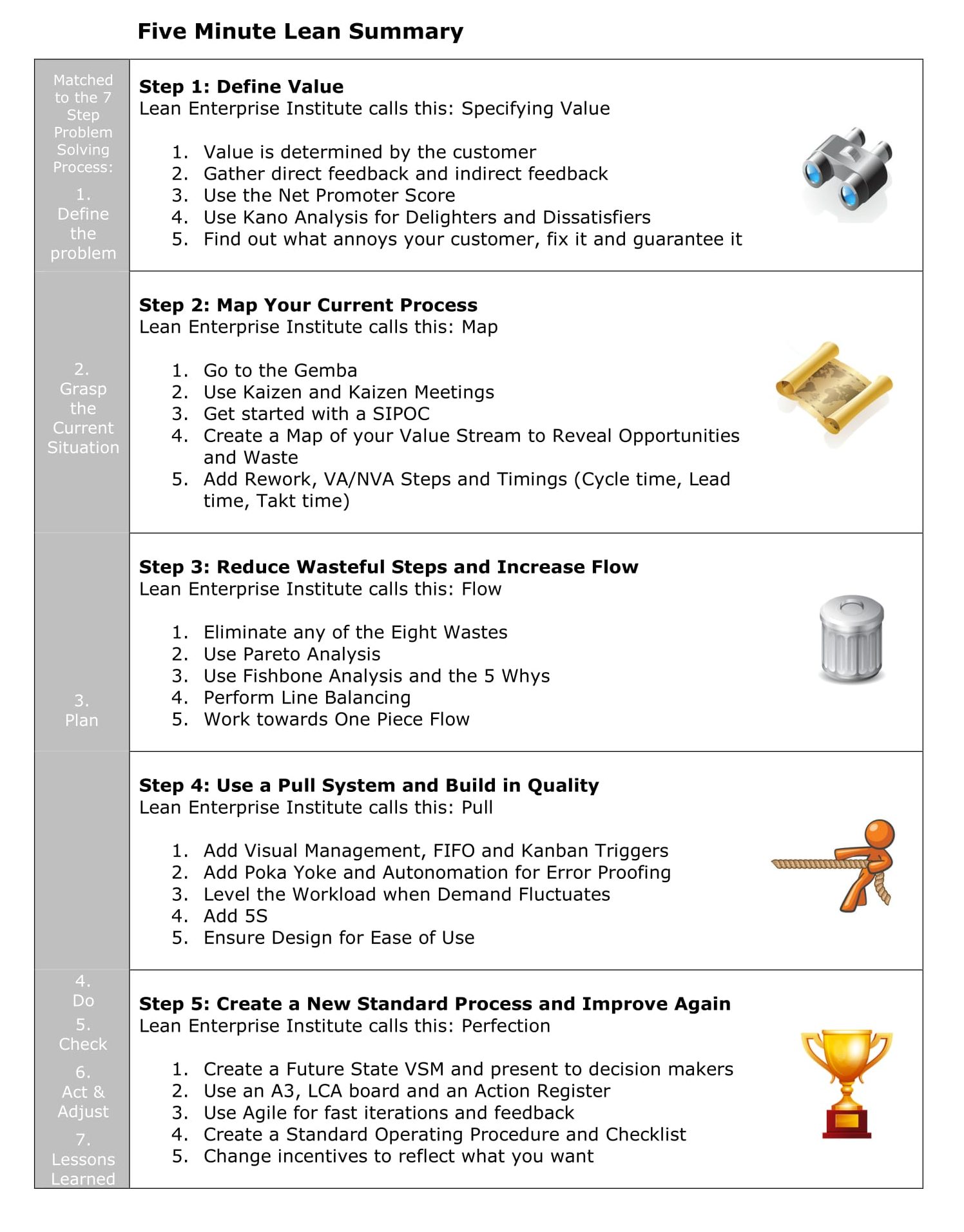
Five Minute Lean Summary

Five Minute LeanThis is an excerpt from the book "Five Minute Lean", by David McLachlan - a wonderful book that blends teaching of the tools, culture and philosophy of traditional Lean with a modern-day Lean parable.

You can get the whole book on Amazon here and enjoy your own copy.

Five Minute LeanThis is an excerpt from the book "Five Minute Lean", by David McLachlan - a wonderful book that blends teaching of the tools, culture and philosophy of traditional Lean with a modern-day Lean parable.

You can get the whole book on Amazon here and enjoy your own copy.

Selected chapters from the story within Five minute Lean:

Check out these selected chapters from the teachings within Five Minute Lean:

The Five Minute Catch-up

Five Minute LeanThis is an excerpt from the book "Five Minute Lean", by David McLachlan - a wonderful book that blends teaching of the tools, culture and philosophy of traditional Lean with a modern-day Lean parable.

You can get the whole book on Amazon here and enjoy your own copy.

The Five Minute Catch-up

One of the biggest challenges of a Lean transformation is getting everyone on the same page with the problem solving, job improving tools and methods, and creating a culture that supports it.

Having this book in everyone’s hands is a good start, but if you want to ensure things move along quickly, you can use the “Five Minute Catch-up” to keep the method front of mind and increase your Lean momentum further.

As a Leader, it simply involves catching up with your team-mates for five minutes, once a week, and asking the questions below.  The questions might seem simple, but they are designed with the “power of incentives” (5.5) in mind.  Remember, what we measure, tends to improve.  Asking these questions by catching up once a week is a friendly way to measure progress, and ensures the skills do not fade away.  In practice, this might mean stopping by our team-mates’ desk or workstation (the Gemba), or catching up at lunch or morning tea.

The questions are:

  1. Where are you up to in the book?
  2. What is your favourite part today?
  3. Which part puzzles you?
  4. What part(s) can you use currently to improve your own personal job?
  5. How can I help you do this?

Other options might be to make the questions visible (on the wall or workstation) so everybody knows what to expect.  Then team-mates, leaders, managers and even CEOs can stop by at any time and ask – everyone is on the same page.

If people aren’t reading the book, or say they find it annoying or distasteful, don’t worry!  Disagreeing with something is how we come to understand it.  Keep going routinely through the questions each week, and encourage team-mates to seek and discover answers for themselves.  The problem solving culture will form, and you will find that the biggest critics often evolve into the greatest supporters.

Five Minute LeanThis is an excerpt from the book "Five Minute Lean", by David McLachlan - a wonderful book that blends teaching of the tools, culture and philosophy of traditional Lean with a modern-day Lean parable.

You can get the whole book on Amazon here and enjoy your own copy.

Selected chapters from the story within Five minute Lean:

Check out these selected chapters from the teachings within Five Minute Lean:

Five Minute Lean: Glossary

Five Minute LeanThis is an excerpt from the book "Five Minute Lean", by David McLachlan - a wonderful book that blends teaching of the tools, culture and philosophy of traditional Lean with a modern-day Lean parable.

You can get the whole book on Amazon here and enjoy your own copy.

Five Minute Lean Glossary

5S

A method of organising a workplace to improve safety and efficiency.  The 5S steps are: Sort, Straighten, Shine, Standardise, and Sustain.

5 Whys

A method of getting to the root cause of a problem, where we keep asking “why” until the real issue is revealed.

8 Wastes

Also “Muda” in Japanese, the eight wastes note the most common forms of waste in company processes that increase costs and inefficiencies.  Our aim in Lean is to eliminate them all.  They are: Defects, Over Production, Waiting, Non-use of Time and Talent, Transport, Inventory, Motion, and Excessive Processing.  Two additional inefficiencies are Overburden (Muri) and Unevenness (Mura) in a process.

A3

An A3 is a single page that shows the details of a Lean implementation at a glance.  It will include a clearly defined problem, then items from the “Plan, Do, Check, Act” cycle with analysis such as root cause diagrams, process maps, action registers and metrics for determining if the implementation is having the desired effect.

A/B Testing or Split Testing

Split testing is the method of testing different versions of the same product, message or process at the same time and gathering the results to determine which works better.

Agile

Agile is a method of implementing a project or change based on short, quick iterations in order to gather feedback as quickly as possible.  This allows us to determine if our project is on the right track so we can either continue or adjust.

Andon

A Japanese term for “light” and a part of Visual Management, an Andon is where the status of a process or operation is shown at a glance, using a light, such as with green (for go) or red (for stop) signals.

Autonomation (Jidoka)

Where machines and/or team-mates have the ability to detect when something is wrong and immediately stop work, so the root cause can be found quickly and solved.

Batch Processing

The enemy of Lean and smooth flowing processes, this is a mass production approach where product is created regardless of whether it is required, and often results in overproduction and waste.

Capabilities, the Four

As defined by Steven Spear in “The High Velocity Edge”, the Four Capabilities were found to be in high performing leaders and are as follows: designing their work to reveal problems & opportunities, swarming those problems to solve them and build new knowledge, sharing that knowledge throughout the organisation, and developing the first three skills in everyone else.

Chunking

Chunking is the process of taking a large problem or project and breaking it into chunks to make it easier to solve or implement.

Customer

A “customer” in Lean terms is defined as any process downstream from the current one.  The end customer, of course, is the one who ultimately buys a product or service.

Cycle time

The total time it takes to complete a process step within our value stream.

FIFO Lane

First-In-First-Out lane, where items that come in first ultimately go out first.

Fishbone Diagram

Also known as an Ishikawa diagram, this is a method of getting to the root cause of a problem where you note the effect or problem at the “head” of the fish, then the causes you can think of under the “bones” of People, Information, Process or Systems.  Similar causes are grouped and whichever group has the most causes is typically looked at first.

Flow

The Flow of a process is how well it moves continuously from upstream to downstream processes.  Improving Flow involves reducing wasteful steps or interruptions and improving efficiency from the time a customer places an order to the time a product or service is completed and delivered.

Jidoka

See Autonomation

Gemba

The Gemba is the Japanese term for “Actual Place” and is often used as a single word to describe the front lines where the work is done.  In English it can also be spelled Genba.  “Walking the Gemba” is a large part of Lean which means we must go to where the work is done to get the real answers and not rely on reports or second hand information.

Just in Time

Just in Time is a system of production that makes and delivers only what is needed, when it is needed.  It combines five Lean elements for success: Takt time or customer demand, Continuous Flow, a Pull System, Line Balancing, and removing Waste.

Kaizen and Kaizen Events

Kaizen is the Japanese term for “Improvement” and is most often referred to in English as continuous improvement.  A Kaizen meeting or event, therefore, is an improvement meeting where we go through the “Plan, Do, Check, Act” process or the five steps outlined in this book.

Kanban

Literally “sign” or “sign-board” in Japanese, Kanban in its many forms is most used as a trigger for upstream suppliers to produce more product.

Kanban Board

Used in Agile, a Kanban Board is a visual way to manage work and consists of cards with small pieces of work on them assigned to a team-member and moved along columns such as “To Do”, In Progress”, and “Done”.  Columns can also be named depending on your own work phases or departments.

Kano Analysis

Kano analysis divides customer feedback (the Voice of the Customer) into Dissatisfiers, Satisfiers and Delighters where the aim is to increase Delighters and remove Dissatisfiers.

Kata

Brought to the world’s attention in “Toyota Kata” by Mike Rother, Kata involves three main steps:

  1. Grasping the current situation,
  2. Defining the desired situation, then;
  3. Moving toward that goal in iterations so as to uncover feedback or obstacles.

LCA Board

A Layered Check Act board is a method of visual management.  Usually a board will be at least one to two meters in diameter, and it shows the metrics of a current process measured against the proposed targets.  If the metrics are not meeting these targets, then countermeasures are added (often after a Lean initiative) to assist in bringing them into line.

Lead Time

The total time it takes to create your product or service from the moment the customer orders to the time it is delivered, including both Value-Add and Non-Value-Add time.

Line Balancing

Line Balancing is based on the premise that a process is only as fast as its slowest step.  Based on this, in many cases we can combine faster processes together, provided they are still faster than Takt time or customer demand.  This means we can also split longer steps up to ensure they are under Takt time.

Net Promoter Score

The Net Promoter Score is from the book “The Ultimate Question 2.0”, where we ask our customer “On a scale of 1 to 10, how likely are you to recommend our product / service to a friend?”  The results are often used in conjunction with Kano Analysis.

Overburden (Muri)

Overburden or Muri is where team-mates or equipment are required to work harder, faster or more than is necessary, often because of wasteful steps or processes.

Pareto Chart

A Pareto chart is based on the idea that 80% of results come from approximately 20% of the effort.  It shows item measurements in a bar chart, and the cumulative percentage in a line graph overlaying the chart.  In this way, we can see which items will have the greatest impact when fixed, and focus on these first.

Poka Yoke

“Error-Proofing” in Japanese, this means putting steps in place to make it impossible to make a mistake.  A USB cable and port, or an electric plug is a good example of this.

Problem Charter

Problem charters are often created at the beginning of a larger project.  They often include: The stated problem, the current situation, the impact it has, the stakeholders or problem owners and any team members assigned to the problem.

Pull

A Pull System is one where downstream departments signal their needs to upstream activities (often using a Kanban), allowing them to pull work in accordance with demand.

Push

The opposite of Pull, where upstream departments create product regardless of demand, and push it through to their downstream customers.  This can result in waste such as over-production, over-burden and over-processing.

Silo

A silo in a company is when a management system, process or department is cut off from the rest of the business or unable to communicate with other sources of company information.  This can result in misinformation, miscommunication, slower processes and lower morale.

SIPOC

A SIPOC chart shows the Suppliers, process Inputs, Process steps, process Outputs, and Customers.  We can also add Customer Requirements, and Measures of a process as well.  It gives a “high level” view of the process steps, and is a good foundation for other tools on larger projects, especially when we need to know the stakeholders involved.

SMED / Quick Changeover Techniques

Single Minute Exchange of Dies (SMED) is a process of changing over equipment (or people, stations, or anything else you might think of) from one to another in as little time as possible.  It is based on Internal changeover operations that can only be done when the process is stopped, and External operations that can be done while the process is still going.  The aim then becomes to convert all Internal changeover operations to External changeover operations to simplify and speed up the changeover process.

SOP

A Standard Operating Procedure (SOP) is a standard, repeatable way of carrying out a process.  Often in writing and better still in the form of a checklist, using a SOP ensures staff operate the same way.  It makes it easier to train, easier to quality check and helps reduce single points of failure if staff are sick or on holidays.

Spaghetti Diagram

A Spaghetti Diagram is a diagram of a production floor with lines following the product as it travels through the steps or workstations.  Often initially a diagram will look like cooked spaghetti as the product goes back and forth and around a workspace.  Simplifying this movement can significantly reduce waste.

Supermarket

A Supermarket in Lean terms is a predetermined standard inventory kept to supply a downstream process.  Keeping no more than is needed, when a supermarket is empty a Kanban is often sent to the supplier to replenish the standard inventory.

Supplier

Any workstation, department, person or company that is upstream from the current process.

Swim Lane Chart

A flow chart of process steps where departments or stations are noted vertically, and the steps are noted horizontally.  In this way, we can clearly see movement between departments and potential wastes.

Takt Time

The product demand time as determined by the Customer.  For example if a Customer buys 80 items in an 8 hour work day, our Takt Time is 10 items an hour.

TPM

Total Productive Maintenance (TPM) is a set of techniques to improve usability and longevity of machines.  It involves cleaning and repairing, performing error proofing, developing a maintenance database and a standard process for continuing maintenance in the future.

Unevenness (Mura)

Unevenness or “Mura” in an operation is when a process has excessive wait time followed by excessively busy periods.  In other words, team-mates are forced to “hurry and then wait”.  Not only does Unevenness in a process reduce morale, it is often a wasteful use of team-mates’ time and resources.  Unevenness can be reduced by using Line Balancing, working towards One Piece Flow, and reducing Rework in a process.

Value

Value is always defined by the Customer, and in its purest form it is something within a process that a Customer is willing to pay for.  For example making a product’s process simpler may not directly add value to a customer, however the cost reduction, speed of delivery, and increase in quality or savings to a customer will.

Value Stream

A Value Stream is the process of creating our product or service – it is the “stream” of process steps that create our product to bring value to the customer.

Value Stream Map

Also known as a VSM, this is the standard method of mapping out a process, often including the Suppliers and Customer, Systems, Process Steps, Process Timings, Rework and any other useful information.

A “Future State VSM” is created when you have analysed a current process and want to show the new process with added value and without the waste.

VOC

The Voice of the Customer (VOC) refers to data captured around customer metrics or feedback.

Work in Process

Also known as Standard Inventory, it is the minimum number of items or parts (including parts in machines or queues) needed to keep a workstation or department flowing smoothly.  A Supermarket is a good example of this.

Five Minute LeanThis is an excerpt from the book "Five Minute Lean", by David McLachlan - a wonderful book that blends teaching of the tools, culture and philosophy of traditional Lean with a modern-day Lean parable.

You can get the whole book on Amazon here and enjoy your own copy.

Selected chapters from the story within Five minute Lean:

Check out these selected chapters from the teachings within Five Minute Lean:

Passing the ASQ Lean Six Sigma Black Belt Exam, by a C Student in Maths

How a C Student Passed the ASQ Six Sigma Black Belt Exam

I nearly failed mathematics at school.  In fact, I was so bad at maths that the teacher “politely suggested” to my parents that I move to the other maths class – the one where all the below average kids go.

And I did.  Not thinking that I could do any better, I moved to the basic maths class and I still only just scraped by with a C (a D is a fail, in Australia).  It was a long time before I would ever look at a maths book again.

Fast forward a few years, and I am now a person who has passed the American Society for Quality (ASQ) Certified Black Belt exam, a marathon at four hours long and heavy on the math.

How did I go from a struggling, failing maths student who didn’t know how to study, to passing one of the most notoriously difficult examination combinations of statistics and project management in the world?  Well, there are a few things I did, and I’ll pass them all on here so you can use them for yourself if you want to.

First, I Got The Quality Council of Indiana Black Belt Primer

The Certified Six Sigma Black Belt Primer is the tome of knowledge that has most, if not all of the Black Belt Body of Knowledge (BOK).  You can get it from the Quality Council of Indiana, which is also affiliated with ASQ I believe.  After going through this book every night for four or more months, I can tell you there is a LOT of great stuff in here.  Not just statistics, but project management, process leadership, team building techniques, and design as well.

I also got the “Black Belt Memory Jogger” – a small book that is associated with the other major Six Sigma organisation – Six Sigma Academy.  This rounded out some gaps with Gage R&R, and was also an easy read on the Bus to work.

Second, I Got the Quality Council of Indiana Black Belt Practice Exam CD

The Practice exam, also from the Quality Council of Indiana, was worth every penny of the $70 or so it cost.  It has 1000 questions, and you can see the answer, with working, if you get it wrong.  You can do practice exams in 10, 25, 50, 100, or 150 question lots, and choose which chapters you want to test for.  This exam really helped me find my best way to study, which brings me to my last note:

Third, I Learned an Easy Way to Study That Suited Me

It wasn’t until I had been struggling with the thousand page tome of information for two months, that I realised in my life that: “I never actually learned how to study”.  I had simply breezed through High School, and studied things afterwards that didn’t require much effort.  This exam was completely different – with no knowledge of stats, or the crazy symbols they come with, or even basic mathematics, I had a huge gap to fill.

My beautiful wife gave me some suggestions on how to study, and I modified them to suit my needs.  Below is the outcome of what I did.

  1. I opened an Excel file, and wrote out every “section” heading within every chapter of the Black Belt Primer in a new cell.  This took about a week, every night after work.
  2. Then, I filled in the details with a quick summary of what that section was about, in my own words.  It wasn’t perfect, but it was a good first draft and it took about four weeks, again every night after work.

Now I had a means for “building” my knowledge, instead of simply reading something and forgetting it by the next day.  Everything I learned, I added under the appropriate section of my Excel sheet.

  • Finally, I took a practice exam (from the Indianna CD) of 25 – 50 questions every single night for the remaining six weeks.  When I got a question wrong, I read their reason why (this is provided – which is excellent!) and added any learnings to my Excel file notes.

In the last four weeks leading up to the exam, I would do a full practice exam (150 questions) on each day of the weekend.  This was quite exhausting, but turned out to be worth it in the end.  The real exam was still a mental marathon.

Doing the Actual Black Belt Exam

Doing the Black Belt exam in Australia requires someone to oversee it – a “proctor”.  Luckily, we had a spare room to sit the exam and a current Black Belt to act as the proctor, overseeing our exam.

Doing each question for the exam took longer than the practice CD, and I still had five questions out of the 150 to go at the end that I had to fill in on instinct.  I remember for the last hour I had to go to the bathroom so badly that I thought I was going to burst.  But there was no time to spare for a toilet break.

When it was over (and had been to the bathroom, thank goodness), I was slightly numb.  I had a bad feeling about the test – as though I had messed it up and would have to sit it again.  I went home angry with myself that I had wasted so much time, and questioned why I ever tried to do a project management exam with maths and statistics in it in the first place.  Even a glass of whiskey that night couldn’t take the edge off.

After that, it was a nervous two week wait.  Every day I would ask my colleagues if they had their results, and every day they would say no.  When they finally did come by email, I checked the result.  It said:

“Congratulations: You Have Passed!”

The Journey is Just Beginning

Using the things I’ve learned by becoming an ASQ Certified Black Belt will be a great reward in itself – now I have a lens I can see any business dealings through to reveal opportunities that others can’t often see.  I will have these skills for life.  And recertifying is much easier, if I have applied what I’ve been taught.

But the real lesson is: if I can do it, then anyone can do it.  When I started I didn’t have even the basic skills.  Now I can make control charts, design experiments, test distributions and much, much more.

Keep at it, study hard, and you can succeed too.

Yours in change,

David McLachlan

Get the Leadership Card Deck or the Five Minute Lean Book:

Leadership CardsView All The Leadership Cards (48)

- or - Have the Leadership Cards delivered for your next meeting


Want to learn about Lean? Get the book "Five Minute Lean", by David McLachlan - a wonderful book that blends teaching of the tools, culture and philosophy of traditional Lean with a modern-day Lean parable. You can get the whole book on Amazon here and enjoy your own copy.