Tag Archives: David McLachlan

The Secret to Answering Any PMP Question

Every PMP question, regardless of format, can be worked through using the same six-step method. Here is how it works.

Step 1: Read the End of the Question First

PMP questions are often long scenarios with a lot of detail. Before reading the whole thing, skip to the end to find out what is actually being asked. This gives you the context to read the scenario with purpose rather than getting lost in the detail.

Step 2: Identify the Key Words

Once you know what the question is asking, read through and highlight the important details. Look for the methodology (agile or waterfall), the phase of the project, the issue that is occurring and the stakeholders involved. These are the clues that point you toward the right answer.

Step 3: Spot the Real Issue

Strip away the noise and identify the core problem. Is it a people issue, a process issue or a documentation issue? Getting clear on this before looking at the answer choices makes the next steps much easier.

Step 4: Investigate Before Acting

Many questions require you to analyze the situation or consult the right stakeholders before taking action. Do not jump to a solution. Check whether the question has already given you the root cause or whether you need to identify it first.

Step 5: Eliminate the Clearly Wrong Answers

Work through the answer choices and remove the ones that are obviously incorrect. On the PMP exam, one common trap is answers that involve the project manager doing the team’s work for them. Another is answers that ignore the constraints stated in the question. If the scenario says there is no time for discussion, any answer involving extended collaboration is out.

Step 6: Choose the Most Correct Answer

With the wrong answers eliminated, select the best remaining option given the constraints of the scenario. Sometimes no answer will feel perfect. That is normal. Choose the one that most closely follows sound project management practice given the specific situation described.

Six steps, applied consistently, work for any question on the exam. Practice using them on every question you attempt and they will become second nature by exam day.

– David McLachlan

You can see what people are saying about David McLachlan here: REVIEWS

Navigate to Free Project Management and Leadership Articles through the links on the right (or at the bottom if on Mobile) 

PMI PMP 35 PDUs CourseThe Ultimate PMP Project Management Prep Course (35 PDUs)
Agile Certified Practitioner (PMI-ACP 28 PDUs)The Complete PMI-ACP Course: (28 PDUs) 
PgMP Program Management CourseLearn Program Management – the PgMP Prep Course
Full PMP Exams to Pass on the First TryFour Full PMP Practice Exams (180 Qs each) to pass your PMP on the First Try!
Scrum Master Course PSMScrum Master Course (PSM)
Product Owner Course PSPOProduct Owner Course (PSPO)
Business Analyst CourseBusiness Analyst Course

Also available are my Project Management Templates – they’re a great way to save 100s of hours when you’re first starting out:

50 Project Management Templates Gantt Chart Risk Matrix and more Excel50+ Project Management Templates in Excel and PowerPoint (Gantt Chart, Risk Matrix and more!)
Project Management Plan TemplatesPre-made Project Management Plan Templates: Save 100 HOURS!


The Complete PMBOK Guide 8th Edition: All 40 Processes Explained

If you are sitting the PMP after July 2026, this is the version of the PMBOK Guide that will be tested on your exam. The 8th edition returns to the process groups model, following a project from start to finish the way most project managers actually think about their work. Here is a high-level overview of what each phase covers.

Initiating

Two processes kick off the project. The first officially authorizes the project and produces the project charter, giving the project manager authority to use funding and resources. The second identifies all stakeholders who will be impacted and documents them in the stakeholder register. Both set the foundation for everything that follows.

Planning

Around half of the 40 processes live here. The team develops the project management plan, bringing together all the sub-plans into one coordinated document. From there, planning covers the sourcing strategy (previously procurement), stakeholder engagement, communications, scope, resources, schedule, cost and risk.

Notable changes in the 8th edition include scope and schedule being consolidated into fewer processes, and quality and procurement moving out of standalone performance domains. The work breakdown structure is now called Develop Scope Structure and developing the schedule absorbs what were previously four separate processes.

Executing

This is where the work gets done. Key processes include managing project execution, quality assurance, managing project knowledge and lessons learned, engaging stakeholders, acquiring and leading the team, and implementing risk responses. One distinction worth knowing for the exam: quality assurance is about auditing the process while quality control is about making sure the product meets specifications.

Monitoring and Controlling

Running in parallel with execution, this phase keeps the project on track across performance, change control, scope, resources, schedule, finances and risk. Two more terms worth knowing: verified deliverables have passed quality checks, validated deliverables have been formally accepted by the project sponsor.

Closing

The final phase confirms delivery, obtains formal acceptance, closes vendor contracts, captures final lessons learned, transfers the product to operations and archives all project documentation.

– David McLachlan

You can see what people are saying about David McLachlan here: REVIEWS

Navigate to Free Project Management and Leadership Articles through the links on the right (or at the bottom if on Mobile) 

PMI PMP 35 PDUs CourseThe Ultimate PMP Project Management Prep Course (35 PDUs)
Agile Certified Practitioner (PMI-ACP 28 PDUs)The Complete PMI-ACP Course: (28 PDUs) 
PgMP Program Management CourseLearn Program Management – the PgMP Prep Course
Full PMP Exams to Pass on the First TryFour Full PMP Practice Exams (180 Qs each) to pass your PMP on the First Try!
Scrum Master Course PSMScrum Master Course (PSM)
Product Owner Course PSPOProduct Owner Course (PSPO)
Business Analyst CourseBusiness Analyst Course

Also available are my Project Management Templates – they’re a great way to save 100s of hours when you’re first starting out:

50 Project Management Templates Gantt Chart Risk Matrix and more Excel50+ Project Management Templates in Excel and PowerPoint (Gantt Chart, Risk Matrix and more!)
Project Management Plan TemplatesPre-made Project Management Plan Templates: Save 100 HOURS!


The 14-Day Study Plan to Pass Your PMP

Feeling overwhelmed by everything you need to study for the PMP is common. This 14-day plan cuts through the noise and focuses on four key activities. Most of the resources you need are available for free.

Free Study Plan Download

One thing to sort before you start: you will need 35 contact hours of project management education completed before beginning this plan. If you have not done that yet, take the two or three weeks needed to complete it first and then come back here.

The Four Activities

1. Review the Exam Content Outline and Key Guides

Spend the first few days getting oriented. The exam content outline is available as a free download from PMI and shows exactly what the exam covers. Follow that with a review of three core guides:

  • the PMBOK Guide 8th edition (the step-by-step process guide),
  • the PMBOK Guide 7th edition (a useful high-level overview of project management) and the
  • Agile Practice Guide (agile makes up a significant portion of the exam).

PMI members can download the Agile Practice Guide for free. Video summaries of all three are linked in the free study guide if you want to move through them quickly.

2. Practice Questions Every Day

Once you have reviewed the guides, practice questions become your main focus. Aim for 20 to 30 questions a day and alternate between predictive (waterfall) and agile question sets. The most important habit here is reviewing every question you get wrong and going back to the source material to understand why.

3. Review the PMP Fast Track

Alongside your daily questions, work through the PMP Fast Track. This gives you the overall strategy for answering PMP questions, which is just as important as knowing the content.

4. Take Two Full Practice Exams

Before sitting the real exam, complete at least two full 180-question practice exams at the four-hour duration. The PMP is a marathon and building that stamina beforehand makes a real difference on the day.

One Bonus Tip: Use NET Time

NET time means no extra time. Fit study into time you already have: listen to a guide summary on a commute, take practice questions during a lunch break or swap an hour of Netflix for a quick review session. Small, consistent efforts across 14 days add up faster than you might expect.

The 14-day study plan is available as a free download and is linked at the top of this page. Fourteen days of consistent effort, four focused activities and the right resources. Then you can adjust it to be longer or shorter to suit your own personal style. You can do it!

– David McLachlan

You can see what people are saying about David McLachlan here: REVIEWS

Navigate to Free Project Management and Leadership Articles through the links on the right (or at the bottom if on Mobile) 

PMI PMP 35 PDUs CourseThe Ultimate PMP Project Management Prep Course (35 PDUs)
Agile Certified Practitioner (PMI-ACP 28 PDUs)The Complete PMI-ACP Course: (28 PDUs) 
PgMP Program Management CourseLearn Program Management – the PgMP Prep Course
Full PMP Exams to Pass on the First TryFour Full PMP Practice Exams (180 Qs each) to pass your PMP on the First Try!
Scrum Master Course PSMScrum Master Course (PSM)
Product Owner Course PSPOProduct Owner Course (PSPO)
Business Analyst CourseBusiness Analyst Course

Also available are my Project Management Templates – they’re a great way to save 100s of hours when you’re first starting out:

50 Project Management Templates Gantt Chart Risk Matrix and more Excel50+ Project Management Templates in Excel and PowerPoint (Gantt Chart, Risk Matrix and more!)
Project Management Plan TemplatesPre-made Project Management Plan Templates: Save 100 HOURS!


Studying This Way Actually Changes Part of Your Brain

Studying for the PMP while working full time, managing a family and keeping up with everything else life throws at you is genuinely hard. It turns out that is exactly the point.

The Anterior Cingulate Cortex

When you do hard things consistently, a part of your brain called the anterior cingulate cortex actually grows. This region is responsible for reward, anticipation, decision-making and emotional regulation. The more you push through difficult tasks, the more you strengthen it, like doing bench presses for your brain. The practical result is that you get better at regulating your emotions, delaying gratification and tackling hard things in the future. They become easier because your brain has physically changed.

Resilience Beats IQ

In her book Mindset, Carol Dweck found that students with average IQ consistently outperformed students with higher IQ when they had the resilience and grit to keep going through difficulty. Angela Duckworth later built on this research in her book Grit and a widely watched TED Talk. They came to the same conclusion: persistence through hard things matters more than raw ability or intelligence. That is good news for anyone grinding through PMP study on top of an already full life with family and work commitments. It’s hard, and that is ultimately what makes it so powerful.

You Will Become a Better Project Manager

Studying the hard way isn’t just about getting the credential. Studying the hard way embeds the knowledge deeply enough for you to use it and really make a difference in your career. Managing scope, schedule and cost. Keeping stakeholders aligned. Making good decisions under pressure. This is when exam topics transform into skills that directly make your work easier, and learning them thoroughly is what makes the difference between holding a certificate and actually being good at the job.

Doing hard things consistently changes your brain, builds resilience and makes future hard things easier. Studying for your PMP is one of those hard things, so study hard, lean into it and WIN!

– David McLachlan

You can see what people are saying about David McLachlan here: REVIEWS

Navigate to Free Project Management and Leadership Articles through the links on the right (or at the bottom if on Mobile) 

PMI PMP 35 PDUs CourseThe Ultimate PMP Project Management Prep Course (35 PDUs)
Agile Certified Practitioner (PMI-ACP 28 PDUs)The Complete PMI-ACP Course: (28 PDUs) 
PgMP Program Management CourseLearn Program Management – the PgMP Prep Course
Full PMP Exams to Pass on the First TryFour Full PMP Practice Exams (180 Qs each) to pass your PMP on the First Try!
Scrum Master Course PSMScrum Master Course (PSM)
Product Owner Course PSPOProduct Owner Course (PSPO)
Business Analyst CourseBusiness Analyst Course

Also available are my Project Management Templates – they’re a great way to save 100s of hours when you’re first starting out:

50 Project Management Templates Gantt Chart Risk Matrix and more Excel50+ Project Management Templates in Excel and PowerPoint (Gantt Chart, Risk Matrix and more!)
Project Management Plan TemplatesPre-made Project Management Plan Templates: Save 100 HOURS!


PMI’s New Project Management Mindset (and How It Helps You Pass the PMP)

The PMBOK Guide 8th edition introduces a set of project management principles that PMI calls the project manager’s mindset. Understanding these is useful for the exam because they give you a reliable framework for answering questions when you are unsure. When something is going wrong on a project, these principles point toward the right answer almost every time.

1. Adopt a Holistic View

Good project managers consider the bigger picture: organizational strategy, interconnected risks and diverse perspectives. If things are going wrong, do not rely on one person’s view. Brainstorm with the team and make sure everyone feels psychologically safe to speak up. Clear communication is essential and a communications style assessment can help identify how each stakeholder prefers to receive information.

2. Embed Quality into Processes and Deliverables

Quality means meeting customer requirements consistently, not just once. Reliable, uniform quality across the product and the process is the goal. Use retrospectives to continuously improve the team’s ways of working and earned value management to track project performance against the plan.

3. Be an Accountable Leader

The best single piece of advice for PMP exam questions is this: be direct and collaborative. Go straight to the source of the issue and work with people to solve it. Do not skirt around problems or pass them to someone else.
Leadership does not require authority or a title. Adapt your style to the situation. Directive leadership works in a crisis. Servant leadership supports the team’s growth and autonomy in most other situations. Psychological safety, emotional intelligence, integrity and humility all matter here.

4. Build an Empowered Culture

Help the team take ownership of their work rather than doing it for them. Clear roles and responsibilities (documented in a RACI chart), diverse perspectives, team agreements through a team charter and genuine organizational awareness all contribute to a team that can deliver without constant direction.

5. Focus on Value

Project completion is not the measure of success. Delivering organizational benefits is. Keep the focus on the value being created, not just the tasks being ticked off.

6. Integrate Sustainability

This is a new addition in the 8th edition. As you deliver project outcomes, consider the impacts on people, society and the environment. Where negative outcomes cannot be avoided, work to minimize them. Where possible, restore or compensate for any damage caused. This principle will appear on the exam so it is worth understanding.

These six principles form the new Project Manager’s mindset from PMI. When a PMP question has you stumped, ask yourself which of these principles points to the best answer. More often than not, it will.

– David McLachlan

You can see what people are saying about David McLachlan here: REVIEWS

Navigate to Free Project Management and Leadership Articles through the links on the right (or at the bottom if on Mobile) 

PMI PMP 35 PDUs CourseThe Ultimate PMP Project Management Prep Course (35 PDUs)
Agile Certified Practitioner (PMI-ACP 28 PDUs)The Complete PMI-ACP Course: (28 PDUs) 
PgMP Program Management CourseLearn Program Management – the PgMP Prep Course
Full PMP Exams to Pass on the First TryFour Full PMP Practice Exams (180 Qs each) to pass your PMP on the First Try!
Scrum Master Course PSMScrum Master Course (PSM)
Product Owner Course PSPOProduct Owner Course (PSPO)
Business Analyst CourseBusiness Analyst Course

Also available are my Project Management Templates – they’re a great way to save 100s of hours when you’re first starting out:

50 Project Management Templates Gantt Chart Risk Matrix and more Excel50+ Project Management Templates in Excel and PowerPoint (Gantt Chart, Risk Matrix and more!)
Project Management Plan TemplatesPre-made Project Management Plan Templates: Save 100 HOURS!


PMBOK 8th Edition Questions & Answers 11 to 20 – Pass your PMP and Learn the PMBOK Guide

We use the PMP Fast Track to answer PMP questions quickly and easily. Check it out!

Question 11 – Managing Quality on a Chip Fabrication Project A functional manager raises concerns about the quality of deliverables being passed to their department. How should quality be managed on the project?

Question 12 – Conflict Between Vendor Teams A conflict arises between vendor teams over shift allocations, creating tension and affecting productivity on a government mega project. How should the project manager address this?

Question 13 – Cost and Risk at the Start of a Project An executive raises concerns about increasing staffing costs and identified risks early in a refinery expansion project. What should you tell them about how cost and risk behave over the project life cycle?

Question 14 – Which Development Approach Is This? A drug development project operates in a highly regulated environment with phase-gate approvals, strict change control and extensive upfront planning. Which development approach is being used?

Question 15 – Short Iterations and One Person Responsible for Scope A mobile application team works in short iterations, delivers features regularly and refines their approach based on feedback. One person is responsible for the approved scope and its value. Which development approach is being used?

Question 16 – Combining Two Approaches A new enterprise platform has a software component with constantly evolving requirements and a data center infrastructure built using upfront planning and formal change control. Which development approach should be used?

Question 17 – Stakeholders Unavailable and Success Criteria Unclear On a CRM upgrade project, many stakeholders are unavailable, others are disengaged and the success criteria is unclear. What are these examples of?

Question 18 – Business Case Approved, What Comes Next? The business case for a new patient record system has been approved and key stakeholders have been identified. Senior leadership wants to start immediately. What should you do next?

Question 19 – Rising Costs and Stakeholder Concerns About Value During planning for a retail expansion, material costs rise significantly and stakeholders question whether the project is still worthwhile. What should you review?

Question 20 – What Will Elijah Not Do? Elijah is documenting initial cost and duration estimates for a data center expansion based on uncertain factors such as utility availability and vendor timeline accuracy. What will he not do with these uncertain factors?

Pep Talk

Twenty questions down and you have already worked through the Standard for Project Management and into the PMBOK Guide itself. The questions will keep getting trickier from here but so will your understanding. Keep going.

– David McLachlan

You can see what people are saying about David McLachlan here: REVIEWS

Navigate to Free Project Management and Leadership Articles through the links on the right (or at the bottom if on Mobile) 

PMI PMP 35 PDUs CourseThe Ultimate PMP Project Management Prep Course (35 PDUs)
Agile Certified Practitioner (PMI-ACP 28 PDUs)The Complete PMI-ACP Course: (28 PDUs) 
PgMP Program Management CourseLearn Program Management – the PgMP Prep Course
Full PMP Exams to Pass on the First TryFour Full PMP Practice Exams (180 Qs each) to pass your PMP on the First Try!
Scrum Master Course PSMScrum Master Course (PSM)
Product Owner Course PSPOProduct Owner Course (PSPO)
Business Analyst CourseBusiness Analyst Course

Also available are my Project Management Templates – they’re a great way to save 100s of hours when you’re first starting out:

50 Project Management Templates Gantt Chart Risk Matrix and more Excel50+ Project Management Templates in Excel and PowerPoint (Gantt Chart, Risk Matrix and more!)
Project Management Plan TemplatesPre-made Project Management Plan Templates: Save 100 HOURS!


PMBOK 8th Edition Practice Questions 1 – 10 – Pass your PMP and Learn the PMBOK Guide

We use the PMP Fast Track to answer PMP questions quickly and easily. Check it out!

Question 1 – How Should This Initiative Be Managed? Leadership at Stratus Innovations proposes a new customer platform involving multiple teams with a fixed release date. How should this initiative be managed?

Question 2 – Categorizing Project Benefits Daniel is preparing a business case for a mobile banking platform. Expected outcomes include increased transaction revenue and improved customer satisfaction. How should these benefits be categorized?

Question 3 – Accounting for External Influences While developing the project management plan for a new online banking platform, you identify regulations, organizational culture and IT infrastructure as factors that may influence the project. How should these be accounted for?

Question 4 – Classifying Templates and Procedures Rose’s PMO requires her to use standard project plan templates and follow established procedures from previous projects. How should she classify these templates and procedures?

Question 5 – What Type of Organizational Structure Is This? You are assigned as project manager with full authority over the project budget, resources and decision-making. What type of organisational structure are you working in?

Question 6 – No Budget or Additional Authority Liam wants to start a process improvement initiative using only his existing team members with no additional budget or authority. What type of organizational structure is he working in?

Question 7 – Which Function Is Not Associated with Projects? Sophia performs coordination, collaboration, expertise application and ongoing operational support on her project. Which of these functions is not associated with projects?

Question 8 – Who Performs This Role? An employee secures funding, provides strategic direction and removes organisational obstacles to ensure project success. What role is this person performing?

Question 9 – What Does the Project Management Team Do? Roy’s project management team collaborates with stakeholders and managers to align with organisational objectives and secure resources. Which of the following is something the project management team would do?

Question 10 – When Will the Project Deliver Value? A project sponsor asks when their cloud platform implementation will begin delivering value. What should you tell them?

Pep Talk

Ten questions down and you have already worked through the foundations of the PMBOK Guide. The questions get trickier from here but so does your understanding. Keep going.

– David McLachlan

You can see what people are saying about David McLachlan here: REVIEWS

Navigate to Free Project Management and Leadership Articles through the links on the right (or at the bottom if on Mobile) 

PMI PMP 35 PDUs CourseThe Ultimate PMP Project Management Prep Course (35 PDUs)
Agile Certified Practitioner (PMI-ACP 28 PDUs)The Complete PMI-ACP Course: (28 PDUs) 
PgMP Program Management CourseLearn Program Management – the PgMP Prep Course
Full PMP Exams to Pass on the First TryFour Full PMP Practice Exams (180 Qs each) to pass your PMP on the First Try!
Scrum Master Course PSMScrum Master Course (PSM)
Product Owner Course PSPOProduct Owner Course (PSPO)
Business Analyst CourseBusiness Analyst Course

Also available are my Project Management Templates – these don’t have a coupon code but they’re a great way to save 100s of hours when you’re first starting out:
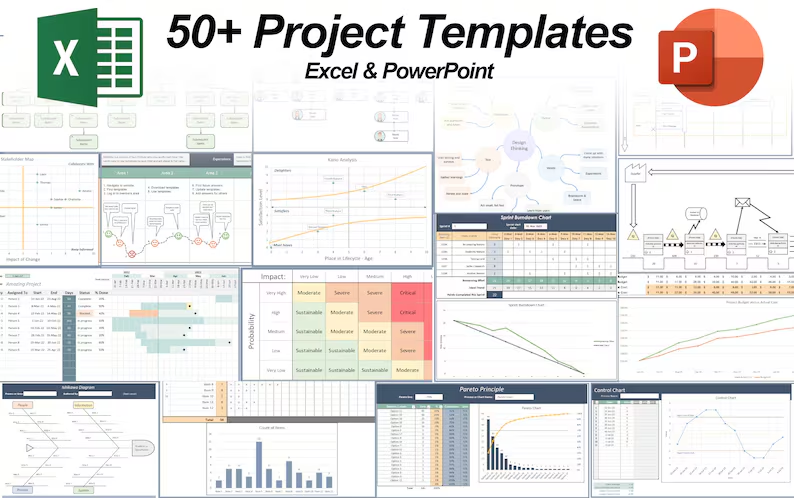
50 Project Management Templates Gantt Chart Risk Matrix and more Excel50+ Project Management Templates in Excel and PowerPoint (Gantt Chart, Risk Matrix and more!)
Project Management Plan TemplatesPre-made Project Management Plan Templates: Save 100 HOURS!


Everything You Need to Know About AI in the PMBOK Guide 8th Edition

The PMBOK Guide 8th edition includes a new section on artificial intelligence in project management. If you are sitting the PMP after July 2026, here is what you need to know.

What Is Artificial Intelligence?

AI describes technologies that simulate human behavior, allowing machines to learn from experience, adapt to new situations and perform tasks without being directly programmed.

There are three layers that build on each other:

  1. Machine learning trains models using past data to predict outcomes. It typically requires smaller, structured and labelled data sets.
  2. Deep learning is an advanced form of machine learning that uses multi-layered neural networks to learn from large, unstructured data sets like images or text.
  3. Generative AI uses large language models to create new text, images, audio and video. This is the layer that produces tools like ChatGPT.

Free versions typically limit prompts and data use while paid versions offer greater privacy protection, which matters for organizations handling sensitive project information.

How AI Is Used in Project Management

The PMBOK Guide 8th edition organizes AI use into three categories:
Automation handles low-complexity, repetitive tasks such as generating status reports, tracking activities, sending reminders and producing meeting summaries with action items.

Assistance supports analysis and decision-making. Examples include predictive analytics for budget forecasting, early warning signals based on patterns from similar projects and multi-criteria decision analysis.

Augmentation enhances strategic thinking. This includes analyzing historical data for trends, running trade-off analysis across scope, schedule and cost, and optimizing project portfolios with AI as a brainstorming partner.

These three categories apply across governance, risk, stakeholder management and scheduling.

For risk, AI can automate mitigation responses, assess impact on scope and cost, and use pattern recognition to adjust return on investment projections. For stakeholders, sentiment analysis can assess the tone of communications and meeting transcripts. For scheduling, dynamic scheduling tools can optimize for the shortest timeline or most balanced resource allocation.

Ethical Considerations

The guide also addresses responsible AI use. Key concerns include bias in data, data privacy and security, transparency around how decisions are made, accountability when outputs are wrong, copyright, reliability and environmental sustainability given the computing resources AI requires. These are not just theoretical concerns and are worth understanding for the exam.

New Tools and Techniques

Four AI-related tools and techniques appear in the 8th edition:

Genetic algorithms use a process inspired by natural selection to find optimized solutions. Random paths are tested, the best performers advance to the next round and the process repeats until an optimal outcome is reached.

Branch and bound finds optimal solutions by progressively eliminating paths that do not meet the desired criteria, similar to pruning a decision tree until only the best path remains.

Augmented reality overlays digital information onto a real-world view, useful for design reviews and prototyping.

Virtual reality simulates walking through a three-dimensional model, particularly useful for reviewing building or infrastructure designs before construction begins.

AI in project management is still evolving but the fundamentals covered in the 8th edition give you a solid foundation for both the exam and the work itself.

– David McLachlan

You can see what people are saying about David McLachlan here: REVIEWS

Navigate to Free Project Management and Leadership Articles through the links on the right (or at the bottom if on Mobile) 

PMI PMP 35 PDUs CourseThe Ultimate PMP Project Management Prep Course (35 PDUs)
Agile Certified Practitioner (PMI-ACP 28 PDUs)The Complete PMI-ACP Course: (28 PDUs) 
PgMP Program Management CourseLearn Program Management – the PgMP Prep Course
Full PMP Exams to Pass on the First TryFour Full PMP Practice Exams (180 Qs each) to pass your PMP on the First Try!
Scrum Master Course PSMScrum Master Course (PSM)
Product Owner Course PSPOProduct Owner Course (PSPO)
Business Analyst CourseBusiness Analyst Course

Also available are my Project Management Templates – these don’t have a coupon code but they’re a great way to save 100s of hours when you’re first starting out:

50 Project Management Templates Gantt Chart Risk Matrix and more Excel50+ Project Management Templates in Excel and PowerPoint (Gantt Chart, Risk Matrix and more!)
Project Management Plan TemplatesPre-made Project Management Plan Templates: Save 100 HOURS!


3 Myths About the New PMP Exam

There has been some misinformation circulating about the updated PMP exam. Here is what is actually true.

Myth 1: There Are Now 185 Questions

There are still 180 questions on the PMP exam. This has not changed according to the latest exam content outline from PMI. You do have 240 minutes now, instead of 230 minutes to complete the exam, which is great!

Myth 2: The Breaks Are Shorter

Some people are saying the two 10-minute breaks have been reduced to five minutes each. This is also incorrect. You still get two 10-minute breaks.

Myth 3: There Is a Lot of New Content to Study

This one is causing the most unnecessary stress. The business environment domain has increased from 8% to around 26% of the exam, which sounds significant. But the content that has moved into that domain, managing risk, managing issues, change control and delivering value, was already part of the project management process domain. It has been rearranged, not replaced.

There are minor additions around artificial intelligence and sustainable project management, both of which appear in the PMBOK Guide 8th edition. But these are small additions, not a major new study load.

Bonus Myth: There are a lot of New Question Types

The question types are almost exactly the same as they have been for the past 3 years, as PMI slowly introduced new question styles and types to the PMP Exam. There will be drag and drop, pictures matching to the right words, matching descriptions to the right artifacts etc.

But the main new question type will be a “Case Study” – a longer explanation with 3 questions about it. Students have reported while this sounded scarier, it was actually easier and faster as once you’ve read the case study the questions can be answered quickly in a row.

If you are preparing for the PMP exam, the fundamentals you have been studying still apply. The exam has evolved but it has not been reinvented.

– David McLachlan

You can see what people are saying about David McLachlan here: REVIEWS

Navigate to Free Project Management and Leadership Articles through the links on the right (or at the bottom if on Mobile) 

PMI PMP 35 PDUs CourseThe Ultimate PMP Project Management Prep Course (35 PDUs)
Agile Certified Practitioner (PMI-ACP 28 PDUs)The Complete PMI-ACP Course: (28 PDUs) 
PgMP Program Management CourseLearn Program Management – the PgMP Prep Course
Full PMP Exams to Pass on the First TryFour Full PMP Practice Exams (180 Qs each) to pass your PMP on the First Try!
Scrum Master Course PSMScrum Master Course (PSM)
Product Owner Course PSPOProduct Owner Course (PSPO)
Business Analyst CourseBusiness Analyst Course

Also available are my Project Management Templates – these don’t have a coupon code but they’re a great way to save 100s of hours when you’re first starting out:

50 Project Management Templates Gantt Chart Risk Matrix and more Excel50+ Project Management Templates in Excel and PowerPoint (Gantt Chart, Risk Matrix and more!)
Project Management Plan TemplatesPre-made Project Management Plan Templates: Save 100 HOURS!


The Lazy Man’s Guide to Passing the PMP Exam

Someone recently passed their PMP in four weeks and shared exactly how they did it, including what they studied each week and what helped most during the exam itself. Here is the full breakdown.

The Four-Week Study Plan

The Lazy Man_s Guide to Passing Your PMP (4 Week Guide)Week one was mostly procrastination dressed up as preparation. They made a study schedule, compiled resources and watched two videos: my complete PMBOK summary video on YouTube and Ricardo Vargas’ popular breakdown of the PMBOK Sixth Edition processes. Not a bad start, but mostly avoidance of the real work.

Week two was where the heavy lifting happened. The entire week was spent on one resource: my 150 PMBOK 7 scenario-based PMP exam questions and answers video on YouTube. The format mirrors the real exam closely, with two seemingly correct answers per question and a clear explanation of how to arrive at the right one. They skipped the 200 agile questions and 100 waterfall questions, feeling the PMBOK 7 set was comprehensive enough on its own.

Week three was a rest week. They acknowledged it was probably a mistake but took it anyway.

Week four was focused and practical. One day was spent speed-reading Third Rock’s study guide, which comes up frequently in PMP success stories. The rest of the week was dedicated to PMI Study Hall practice questions, reading the guide each morning and working through questions for the remainder of the day.

Four Study Tips

Start practice questions as soon as possible. This was the clearest theme across the entire four weeks. There is a scientific reason it works: retrieving information from memory strengthens the neural connections that hold it. Reading embeds information passively. Practice questions force active recall and that is what makes it stick.

Do not read the PMBOK Guide cover to cover if that is not how you learn. Watch a good summary video instead and move to practice questions quickly. The goal is not to memorize the book. It is to develop the right exam mindset.

Do not over-invest in the 35-hour education course. You need it to apply but do not treat it as your primary study tool. Use it to fulfill the requirement and then shift your focus to practice questions.

Do not stress about memorizing every framework, formula and diagram. Ishikawa diagrams, Tuckman’s ladder, earned value formulas: most of what you need to know will surface naturally once you start working through practice questions regularly.

Four Tips for the Exam Itself

1. Look before you leap.

Almost every PMP question presents multiple answers that appear equally valid at first glance. Slow down, follow the project management process (initiate, plan, execute, monitor and control, close) and talk to the relevant stakeholder before taking action. Gather information before making a move.

2. Stop making assumptions.

Even experienced project managers fall into this trap. Ten years in one organization can create blind spots. If something is not explicitly stated in the question, do not assume it is true. Ask yourself whether you are reading it in the question or bringing it from your own experience.

3. Know your role.

The project manager is not the sponsor, the product owner or the engineering team. The sponsor funds the project and handles escalations. The product owner prioritizes the backlog. The engineers do the engineering work and provide estimates. Do not answer questions by doing other people’s jobs for them.

4. Avoid the snaky answer.

If an option involves going around someone, ignoring a request or doing something that feels slightly underhanded, skip it. The right answer is almost always direct and collaborative. Go straight to the source, work with people and tackle problems head on.

Four weeks, one rest week included, and a pass. The formula was simpler than most people expect: get the mindset right, do the practice questions and trust the process.

– David McLachlan

You can see what people are saying about David McLachlan here: REVIEWS

Navigate to Free Project Management and Leadership Articles through the links on the right (or at the bottom if on Mobile) 

PMI PMP 35 PDUs CourseThe Ultimate PMP Project Management Prep Course (35 PDUs)
Agile Certified Practitioner (PMI-ACP 28 PDUs)The Complete PMI-ACP Course: (28 PDUs) 
PgMP Program Management CourseLearn Program Management – the PgMP Prep Course
Full PMP Exams to Pass on the First TryFour Full PMP Practice Exams (180 Qs each) to pass your PMP on the First Try!
Scrum Master Course PSMScrum Master Course (PSM)
Product Owner Course PSPOProduct Owner Course (PSPO)
Business Analyst CourseBusiness Analyst Course

Also available are my Project Management Templates – these don’t have a coupon code but they’re a great way to save 100s of hours when you’re first starting out:

50 Project Management Templates Gantt Chart Risk Matrix and more Excel50+ Project Management Templates in Excel and PowerPoint (Gantt Chart, Risk Matrix and more!)
Project Management Plan TemplatesPre-made Project Management Plan Templates: Save 100 HOURS!