Tag Archives: pmbok

Studying This Way Actually Changes Part of Your Brain

Studying for the PMP while working full time, managing a family and keeping up with everything else life throws at you is genuinely hard. It turns out that is exactly the point.

The Anterior Cingulate Cortex

When you do hard things consistently, a part of your brain called the anterior cingulate cortex actually grows. This region is responsible for reward, anticipation, decision-making and emotional regulation. The more you push through difficult tasks, the more you strengthen it, like doing bench presses for your brain. The practical result is that you get better at regulating your emotions, delaying gratification and tackling hard things in the future. They become easier because your brain has physically changed.

Resilience Beats IQ

In her book Mindset, Carol Dweck found that students with average IQ consistently outperformed students with higher IQ when they had the resilience and grit to keep going through difficulty. Angela Duckworth later built on this research in her book Grit and a widely watched TED Talk. They came to the same conclusion: persistence through hard things matters more than raw ability or intelligence. That is good news for anyone grinding through PMP study on top of an already full life with family and work commitments. It’s hard, and that is ultimately what makes it so powerful.

You Will Become a Better Project Manager

Studying the hard way isn’t just about getting the credential. Studying the hard way embeds the knowledge deeply enough for you to use it and really make a difference in your career. Managing scope, schedule and cost. Keeping stakeholders aligned. Making good decisions under pressure. This is when exam topics transform into skills that directly make your work easier, and learning them thoroughly is what makes the difference between holding a certificate and actually being good at the job.

Doing hard things consistently changes your brain, builds resilience and makes future hard things easier. Studying for your PMP is one of those hard things, so study hard, lean into it and WIN!

– David McLachlan

You can see what people are saying about David McLachlan here: REVIEWS

Navigate to Free Project Management and Leadership Articles through the links on the right (or at the bottom if on Mobile) 

PMI PMP 35 PDUs CourseThe Ultimate PMP Project Management Prep Course (35 PDUs)
Agile Certified Practitioner (PMI-ACP 28 PDUs)The Complete PMI-ACP Course: (28 PDUs) 
PgMP Program Management CourseLearn Program Management – the PgMP Prep Course
Full PMP Exams to Pass on the First TryFour Full PMP Practice Exams (180 Qs each) to pass your PMP on the First Try!
Scrum Master Course PSMScrum Master Course (PSM)
Product Owner Course PSPOProduct Owner Course (PSPO)
Business Analyst CourseBusiness Analyst Course

Also available are my Project Management Templates – they’re a great way to save 100s of hours when you’re first starting out:

50 Project Management Templates Gantt Chart Risk Matrix and more Excel50+ Project Management Templates in Excel and PowerPoint (Gantt Chart, Risk Matrix and more!)
Project Management Plan TemplatesPre-made Project Management Plan Templates: Save 100 HOURS!


Something VERY STRANGE Happened When I Passed The PMP

Something unexpected happens when you pass the PMP exam. It is not just a credential. It changes how you see the work you have been doing all along.

After months of study, working through the Project Management Body of Knowledge and grinding through practice questions, I did pass the exam but the real shift was what happened afterwards.

The best way to describe it is a scene from the 1999 film The Matrix. The main character discovers he has been living in a simulation and, by the end, gains the ability to see through the surface of everyday reality into the underlying structure of everything around him.

Or think of the moment in The Wizard of Oz when the curtain is pulled back and the machinery behind the illusion is finally visible. That is what the PMP does. Before passing, project work often felt like fumbling forward. Sometimes things worked. Sometimes they did not. There was no reliable framework to explain why.

After passing, the reasons became clear.

Looking back at old projects that had not gone well, I could now see the reasons why. On one project in particular, the deliverables were being met and the project was technically doing what it was supposed to do, but  the right stakeholders had not been identified. Senior executives with real influence over the project outcome were not being engaged, when they should have been engaged by me. The project eventually succeeded, but the personal outcome was a failure because stakeholder identification and engagement had not been handled properly.

That was hard to accept. But it meant the next project could go differently, if I applied my mistakes and the lessons I learned.

The same applied to other fundamentals: understanding why a project stalls without proper sponsor support, why resources and authority dry up when that relationship is not managed, why scope needs to be visible and accepted by the customer before work begins, and why a clear change control process matters whether you are working as a product owner on an agile team or managing a predictive waterfall project.

The PMBOK is like a lens. Once you have it, you cannot unsee what it shows you about how projects actually work and why they succeed or fail.

If you are still studying, do not rush past the material to get to the pass. Work through all of it. The process on a page from the PMBOK Guide Sixth Edition (or 8th Edition now) is one of the clearest distillations of project management thinking available. It will change over time, but the underlying logic it represents is worth understanding thoroughly.

– David McLachlan

You can see what people are saying about David McLachlan here: REVIEWS

Navigate to Free Project Management and Leadership Articles through the links on the right (or at the bottom if on Mobile) 

PMI PMP 35 PDUs CourseThe Ultimate PMP Project Management Prep Course (35 PDUs)
Agile Certified Practitioner (PMI-ACP 21 PDUs)The Complete PMI-ACP Course: (28 PDUs) 
50 Project Management Templates Gantt Chart Risk Matrix and more Excel50+ Project Management Templates in Excel and PowerPoint (Gantt Chart, Risk Matrix and more!)
Project Management Plan TemplatesPre-made Project Management Plan Template: Save 100 HOURS!


Five Free Videos to Pass Your PMP Exam on the First Try

Hundreds of thousands of people have used these five free videos to pass the PMP exam on their first try. They come up repeatedly in congratulations posts and resource lists shared by people who have already made it through. Here they are in one place.

1. 150 PMBOK 7 Questions and Answers

This video works through the PMBOK Guide Seventh Edition from start to finish using scenario-based questions in the same format you will encounter on the exam. Each question typically has two answers that both appear plausible, which mirrors the real exam experience closely. With more than a million views, the comments section is filled almost entirely with people sharing that they used it to pass.

2. PMP Fast Track

This one is built from more than a thousand PMI practice questions and distils a set of shortcuts you can default to when answering exam questions. Think of it as a cheat sheet for decision-making under pressure. If you are stuck on a question during the exam, this video gives you a reliable method for working through it. It consistently appears in the resources people credit when they share their results.

3. PMP Cheat Sheet

This video covers the exam content outline across the three domains: project management process, people and business environment. It runs for under 20 minutes and is designed to show you exactly what the exam tests and whether you have any gaps in your knowledge. It is one of the most efficient ways to check your readiness before sitting the exam.

4. 200 Agile Questions and Answers

This returns to the scenario-based question format with a focus on agile content, which makes up a significant portion of the current PMP exam. The questions follow the same style as the real exam and give you targeted practice in the agile domain.

5. 100 PMBOK 6 Questions and Answers

The PMBOK Sixth Edition is now known as the Process Groups Practice Guide and it remains highly relevant to the PMP exam. The core project management process has not changed significantly across editions. You will still be tested on initiating, planning, executing, controlling and closing a project or phase, and on managing scope, schedule and cost throughout. This video has been viewed more than a million times and the comments reflect how consistently it helps people pass.

If you finish all five videos and don’t want to lose study momentum, here are two bonus videos:

Bonus 1: Six Mistakes to Avoid on the PMP Exam

Bonus 2: 110 Drag and Drop Questions (Perfect Study Review)

63 project Management Tools for your PMP Exam

If you make it through all seven, you are doing more than most people ever will. Keep going, I know you will pass your PMP!

– David McLachlan

You can see what people are saying about David McLachlan here: REVIEWS

Navigate to Free Project Management and Leadership Articles through the links on the right (or at the bottom if on Mobile) 

PMI PMP 35 PDUs CourseThe Ultimate PMP Project Management Prep Course (35 PDUs)
Agile Certified Practitioner (PMI-ACP 21 PDUs)The Complete PMI-ACP Course: (28 PDUs) 
50 Project Management Templates Gantt Chart Risk Matrix and more Excel50+ Project Management Templates in Excel and PowerPoint (Gantt Chart, Risk Matrix and more!)
Project Management Plan TemplatesPre-made Project Management Plan Template: Save 100 HOURS!


Project Risk Management Video Course

 – See All The Project Management (PMBOK) Video Lessons Here – 

Below you will find videos on all the Project Risk Management sections from the PMBOK Guide.

If you want to see the “Key Concepts & Tools” for Project Risk Management, click here. Enjoy!

Project Risk Management Overview

Plan Risk Management

Identify Risks

Perform Qualitative Risk Analysis

Perform Quantitative Risk Analysis

Plan Risk Responses

Implement Risk Responses

Monitor Risks

Well done for improving your knowledge on Project Management! If you want to see the “Key Concepts & Tools” for Project Risk Management, click here. Enjoy!

 – See All The Project Management (PMBOK) Video Lessons Here – 

– David McLachlan

Project Communications Management Video Course

 – See All The Project Management (PMBOK) Video Lessons Here – 

Below you will find videos on all the Project Communications Management sections from the PMBOK Guide.

If you want to see the “Key Concepts & Tools” for Project Communications Management, click here. Enjoy!

Project Communications Management Overview

Plan Communication Management

Manage Communications

Monitor Communication

Well done for improving your knowledge on Project Management! If you want to see the “Key Concepts & Tools” for Project Communications Management, click here. Enjoy!

 – See All The Project Management (PMBOK) Video Lessons Here – 

– David McLachlan

Project Cost Management Video Course

 – See All The Project Management (PMBOK) Video Lessons Here – 

Below you will find videos on all the Project Cost Management sections from the PMBOK Guide.

If you want to see the “Key Concepts & Tools” for Project Cost Management, click here. Enjoy!

Project Cost Management Overview

Plan Cost Management

Estimate Cost

Determine the Budget

Control Costs

Well done for improving your knowledge on Project Management! If you want to see the “Key Concepts & Tools” for Project Cost Management, click here. Enjoy!

 – See All The Project Management (PMBOK) Video Lessons Here – 

– David McLachlan

Project Schedule Management Video Course

 – See All The Project Management (PMBOK) Video Lessons Here – 

Below you will find videos on all the Project Schedule Management sections from the PMBOK Guide.

If you want to see the “Key Concepts & Tools” for Project Schedule Management, click here. Enjoy!

Project Schedule Management – Overview

Plan Schedule Management

Define Activities

Sequence Activities

Estimate Activity Durations

Develop Schedule

Control Schedule

Well done for improving your knowledge on Project Management! If you want to see the “Key Concepts & Tools” for Project Schedule Management, click here. Enjoy!

 – See All The Project Management (PMBOK) Video Lessons Here – 

– David McLachlan

Project Management Integration – Project Management Video Course

 – See All The Project Management (PMBOK) Video Lessons Here – 

Below you will find videos on all the Project Integration Management sections from the PMBOK Guide.

If you want to see the “Key Concepts & Tools” for Project Integration Management, click here. Enjoy!

01 – Project Integration Management

Overview

Develop Project Charter

Develop Project Management Plan

Direct and Manage the Project Work

Manage Project Knowledge

Monitor and Control Project Work

Perform Change Control 

Close Project or Phase

Well done for improving your knowledge on Project Management! If you want to see the “Key Concepts & Tools” for Project Integration Management, click here. Enjoy!

 – See All The Project Management (PMBOK) Video Lessons Here – 

– David McLachlan

Project Estimating Techniques

Project Estimating Techniques

– See All Project Management Key Concepts –

Project Estimating Techniques

Project Estimating Techniques

You will definitely see project estimating techniques mentioned as part of the PMP exam, so it’s good to know the four main different types and the differences between them.

Throughout your project you’ll be asked to make those estimations of future performance, and that could be in your Schedule, it could be in the Cost of the project, it could even be in the quality of your project. The four main methods that you will come across as part of the PMBOK guide are:

  • Parametric estimating
  • Bottom up estimating
  • Analogous estimating, and;
  • 3-point estimating.

They might sound a little bit funny at first, so let’s go into them in more detail.

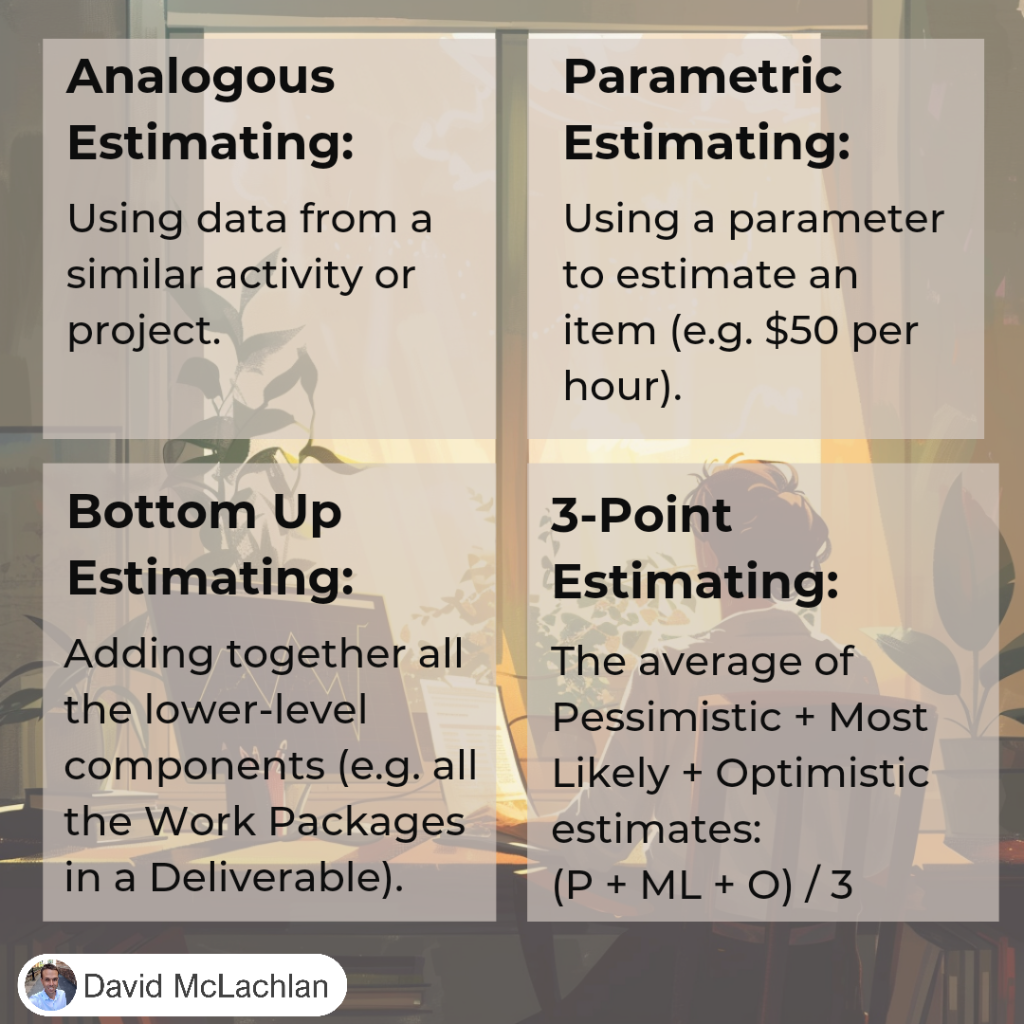
First of all we’ve got parametric estimating. This is where we’re actually using a parameter to estimate per item. So it’s a simple parameter, for example 55 meters or $55 per square meter or square foot. We might have a thousand dollars per roll of metal, or twenty days per delivery in our schedule for example, where it might take to get something to another country. We might be looking at two-week sprints per each feature that we’re delivering in a software project, or a team might take an eight-hour workshop to complete a risk assessment. All of these are parameters that we might assign to the activities so that we can estimate for those activities.

Next up we’ve got bottom up estimating. This is where we’re estimating project resources by assigning a value to the lower-level components of the Work Breakdown Structure. We’re starting from the bottom and we’re working our way up. And when we say the bottom we mean the the lower level tasks that have been assigned to our teams. Now these of course go up in the work breakdown structure to the larger tasks or features, and then to an overall delivered feature (and this is where we start getting into Agile potentially or Feature Driven Development) but the idea of that is that this team can estimate on their piece of work, this team can estimate on their piece of work or their single task or one or two tasks, and that might be say $10,000, this one might be $20,000, this one might be $5,000, and then we take all of those items and we bring them up into the feature so the total there could be $50,000 and then the total for the overall feature could be $100,000 for example. But the key is that we’re starting at the very lowest level of the activity, we’re starting from the bottom.

Next up we have Analogous estimating. This is where we’re finding an analogy, something similar to what we’re currently doing. We’re estimating the duration or cost of an activity or a project using historical data from a similar activity or a similar project. Of course this is frequently used to estimate project duration when there is a limited amount of detailed information, so we haven’t gotten down into the Work Breakdown Structure yet at the team level, we only have a really high-level idea. Using Analogous Estimating we can get a rough idea of how much it will cost, or how long it will take by looking at another similar project. It’s like an analogy, it’s similar to what we’re currently doing. Generally it’s less costly and less time-consuming than our other techniques, but also it is less accurate because we’re not really delving into the detail.

Last but not least there is 3-point estimating. This uses an average of three points – we might have the Optimistic estimate, the Pessimistic estimate, and the Most Likely estimate. The way that we end up working it out is: Let’s say our Optimistic schedule (O) is five days, our Most Likely (M) is seven days and then our Pessimistic (P) is ten days. We add each of them together and then we divide that by three, and that gives us the answer.

In fact here’s a better version that doesn’t take as much math or any decimals – let’s say we’ve got five, nine and ten divided by three – because 24 is a nice round number – we divide that by three and we get eight. And that’s how we do three-point estimating.

You might see a variation of this which is “Beta” or “PERT” (Program Evaluation Review Technique), where we’ve got Optimistic, then four times the most likely, and then our pessimistic as well, all divided by six instead.

And those are the project estimating techniques we will come across in the PMP Exam.

– David McLachlan

– See All Project Management Key Concepts –

Baselined Documents

– See All Project Management Key Concepts –

Baselined Documents PMBOKBaselined Documents in Project Management

When we’re developing the project management plan a lot of the time we’re going to need to create baselines.

Baselines are one of the key concepts that is really important, because they are a point in time where data or information is locked in place, with any changes needing to go through a formal change or configuration management process to be reviewed, approved and accepted.

There are multiple documents that require baselining in your project management plan, and most of those will relate to the key constraints in your project such as:

  • Scope – the scope that you are going to deliver.
  • Time or the schedule – you might have your Gantt chart or the locked-in schedule, and you don’t really want that to change because you’re delivering something at the end and your customers are relying on that to be delivered.
  • Cost – if someone is sponsoring this project or paying for this project then of course they don’t want that cost to change, at least not without the proper approval process.

So what are these documents that we’re talking about? Well the need to be baselined fairly early on in your project, during the initiation and planning of your project.

First of all we’ve got the scope baseline. This is the approved version of a scope statement, a nice simple statement of what you are delivering to your customer. Then you’ve got the associated work breakdown structure or WBS and its associated WBS dictionary. That’s basically the scope broken down into smaller parts.

Then ultimately the activities that we’ll need to to deliver those parts – all of those parts of your scope – we want to lock that in so that we know that we’re going to deliver it on time, and we know if we’re not going to deliver it on time.

Then there is the schedule baseline, which is the approved version of the schedule model (that can be your Gantt or even just dates and activities depending on how you outline that in your project management plan) and can be used as a basis for comparison to the actual results so once it’s locked in. For example, how are we actually tracking over time? Are we on track, or we not going well? That’s what we really want to know.

Lastly we’ve got the cost baseline. This is the approved version of the time based project budget where we’ve got our activities, the things that need to be completed and we’ve got the cost associated with those activities. All of the schedule and the scope – if any of that changes then obviously that will have a big impact on the cost of the project as well, so all of these things are interrelated.

Before a baseline is actually defined, all of these documents can be updated as many times as necessary. You’ll find that right at the beginning of your project, during the project charter and maybe just before you’ve locked in your project management plan, no formal process is required at that time. But once that baseline is locked in then they can only be changed through the “perform integrated change control” process which we’ll probably notice is around 4.6 in the PMBOK guide. Any stakeholder can raise a change request, that’s how this is done. Anyone related to your project, whether it’s someone impacted by the project or whether it’s the sponsor who’s sponsoring the project, whether it’s the people doing the the work packages in the team of the project, they can raise a change request for that to be looked at which will go through the change control process. That change control process is usually outlined in your project management plan as the configuration management plan.

What Does a Configuration Management Plan Process look like?

It will be different for each organisation and even each team you work in. Maybe the process for you is raising a change request to the project manager, the project manager checks it out with a few different stakeholders or the required information, or maybe that’s someone in the project management team who then goes through to the sponsor or to the associated steering committee for example. Depending on how your project is outlined, which of course relates to the enterprise environmental factors which you’ll see come up a lot in the PMBOK guide. This is how the company operates, and every company is different. There will be similarities, there might be templates, there might be different politics or different parts of the company that need to be approached, or maybe different parts of the company that don’t talk to each other at all. You need to be aware of these enterprise environmental factors in how to get work done and that will impact the configuration management plan, which is how to make changes to your project and your project baselines once they are locked in. And that is project Baselines.

 – David McLachlan

– See All Project Management Key Concepts –