Jira is one of the most widely used project management tools for agile teams. Here is everything you need to get from first login to sprint reporting.
Creating Your Account and First Project
Jira is free for teams of one to ten users. Once you are in, create a new project, select Software Development and choose the Scrum template. For most users, Team Managed is the right choice as it keeps your project self-contained. Company Managed is worth knowing about if you have multiple projects that need central administration by Jira admins.
Give your project a name and Jira will generate a short key that appears on every card.
Setting Up Your Epics
Your two main workspaces are the Backlog and the Board. Start in the Backlog.
Open the Epic panel by pressing E or clicking the option in the panel. Epics are your high-level features. Click Create Epic to add one and assign each a different color so you can track which work belongs where as the board fills up.
Building Your Backlog
With epics in place, start adding user stories by clicking Create. Each card can be typed as a story, bug or other work type. Custom types like risks or spikes are available through Manage Types.
Click any card to open its details. From there you can assign it to an epic, set its status, assign it to a team member and add story point estimates. Add a description to capture acceptance criteria and any supporting information.
Creating and Starting a Sprint
Click Create Sprint, set the duration and select a start date. Jira calculates the end date automatically. Add a sprint goal to give the team a clear focus.
Move cards into the sprint by dragging them from the backlog or right-clicking and selecting the target sprint. Keep an eye on story point totals and match them to your team’s velocity. When ready, click Start Sprint and your cards move onto the board.
Working the Board
The board displays your active sprint in columns. Add new columns by clicking the plus symbol on the right and dragging them into position. Custom filters through Manage Custom Filters use JQL (Jira Query Language) to adjust the board view. A simple filter showing only cards assigned to the current user is a good starting point.
Completing a Sprint and Reading Reports
At the end of the sprint, click Complete Sprint. Unfinished cards roll over automatically. Review your backlog, confirm priorities with the product owner and start the next sprint when the team is ready.
After two or three sprints, navigate to Reports to start tracking performance. The Velocity Report shows story points committed versus completed across recent sprints, giving you a reliable average to plan against. The Sprint Burndown Chart tracks work coming down over the course of a sprint against the ideal trend line, making it easy to spot if the team is falling behind mid-sprint.
Using the Timeline as a Roadmap
The Timeline view shows your epics and user stories laid out across time, similar to a Gantt chart. Drag items to adjust dates and use this view to communicate progress and upcoming features to stakeholders. It is one of the clearest ways to show where the product is heading and when things will be delivered.
Set up your epics, build your backlog, match your work to your velocity and use the reports to keep improving. It is a straightforward tool once you know where everything lives.
More than two million people have enrolled in the Google Project Management Certificate. It covers six courses, 27 modules and takes most people over 240 hours to complete. Here is the entire program distilled into a single read.
The Foundations
A project is a unique, temporary endeavor with a start and end date, designed to deliver value. That sounds simple enough until you are six months in, the scope has doubled and nobody can agree on what done looks like. Project management exists to prevent exactly that.
Core responsibilities include gathering requirements, developing a plan, tracking progress, communicating milestones and managing the budget. Career paths run from junior project manager through to program and portfolio manager. In agile environments, the scrum master and product owner are the key roles to understand.
Two broad methodologies dominate the field. Waterfall follows a sequential order of phases and works best when scope is clearly defined. Agile delivers in short iterations of one to four weeks, gathers real customer feedback after each and adjusts course. Lean Six Sigma rounds things out with a focus on reducing defects and waste through DMAIC: define, measure, analyze, improve and control.
Initiating a Project
Every project starts with a problem or an opportunity. Before anything else, a cost-benefit analysis confirms it is actually worth solving. Goals should be SMART: specific, measurable, attainable, relevant and timebound. The difference between “improve customer experience” and “reduce checkout time by 10% within six weeks” is the difference between a project that drifts and one that delivers.
The project charter formalizes the goals, scope and resources and gives the project manager authority to proceed once the sponsor signs off. Without it, you are running on goodwill.
Planning
Good planning is not bureaucracy. It is what separates projects that succeed from ones that quietly fall apart. Build a work breakdown structure, map milestones to a Gantt chart, assign resources and involve the team in estimating durations. They know their work better than anyone.
Build in buffers, identify risks early and rate each one by multiplying probability by impact. Plan a response for the ones that matter most. A communication plan that defines what gets shared, with whom and how often is not optional: some practitioners argue communication is 90% of the job.
Executing and Closing
Execution is where plans meet reality. Track everything: tasks, milestones, costs, scope changes and risks. A weekly status report with a red, amber or green indicator keeps stakeholders informed without overwhelming them. Hold retrospectives regularly to surface what is working and fix what is not before it compounds.
When closing, get formal sign-off, archive documentation and produce two things: a project closeout report (planned versus actual) and a project impact report showing the real value delivered. Executives respond to metrics and visuals. Give them both.
Agile and Scrum
Agile was formalized in 2001 and scrum is now used by 72% of agile teams. The product owner prioritizes the backlog, the scrum master removes blockers and the team decides how the work gets done. Keep user stories small, match sprint capacity to velocity and use retrospectives to keep improving. When agile works well, it really works.
Project management is one of the most transferable skills in any industry. This is the foundation.
The Myers-Briggs Type Indicator (MBTI) is a widely used psychological assessment designed to help individuals understand their personality preferences and how they interact with the world. Based on Carl Jung’s theory of psychological types, the MBTI categorizes people into 16 distinct personality types across four dichotomies:
Extraversion vs. Introversion,
Sensing vs. Intuition,
Thinking vs. Feeling, and
Judging vs. Perceiving.
By identifying where you fall within these categories, the MBTI aims to provide insights into your natural tendencies, strengths, and potential areas for growth, ultimately fostering better self-awareness and more effective communication with others.
The Barnum Effect
The Barnum Effect on the other hand, is a cognitive bias where people believe vague, general statements about themselves are highly accurate and uniquely descriptive of themselves.
Named after the famous showman P.T. Barnum (made famous in the movie “The Greatest Showman”), the Barnum Effect explains why people might find personal horoscopes, personality descriptions, or fortune-telling surprisingly convincing. The Barnum Effect highlights how general statements can be interpreted as being uniquely specific to us as a person.
It shows our tendency as human beings to seek personal validation in open or general feedback.
Myers Briggs versus the Barnum Effect
So you can see that in getting a “personality assessment” or profile such as Myers Briggs Type Indicator, we might just be projecting our own personality onto the vague or general descriptions provided. But as long as we know that – let’s have some fun and get our own MBTI personality type!
Choose a single letter from each section to get four letters in total, then find your personality type at the bottom.
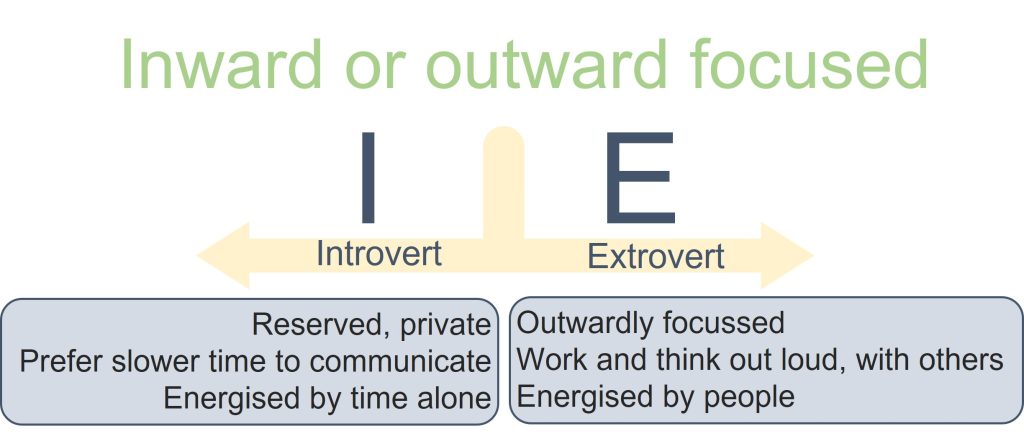
Introvert or Extrovert?
Select I or E – which ever you are MOST like:
Introvert: Reserved, private. Prefer slower time to communicate. Energized by time alone.
Extrovert: Outwardly focused, Work and think out loud, with others. Energized by people.
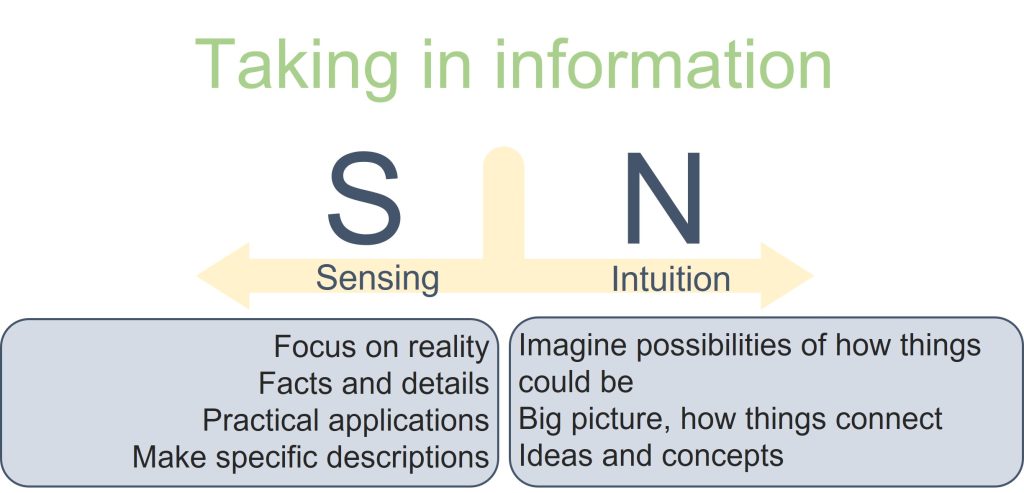
Select S or N – which ever you are MOST like for “Taking In Information”.
Sensing: Focus on reality, Facts and details, Practical applications, Make specific descriptions
INtuition: Imagine possibilities of how things could be, Big picture, how things connect, Ideas and concepts.
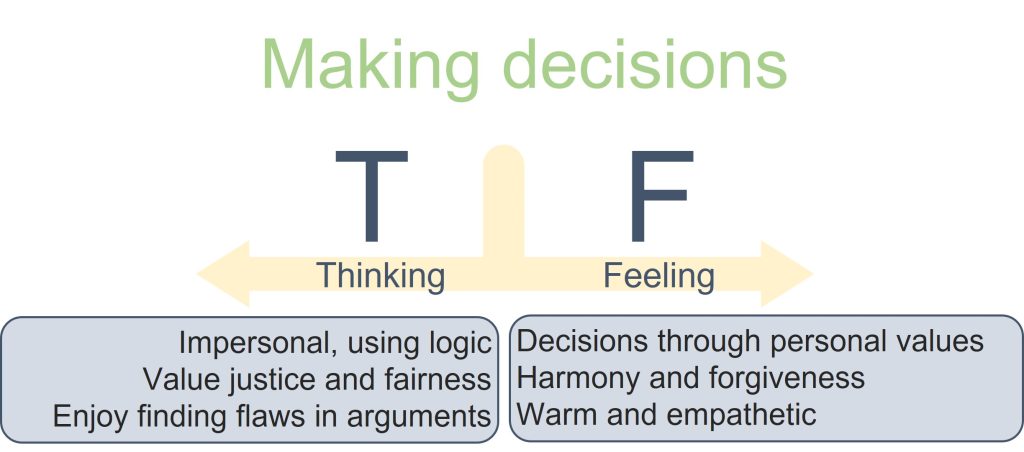
Select T or F for how you “Take in Information”:
Thinking: Impersonal, using logic, Value justice and fairness, Enjoy finding flaws in arguments
Feeling: Decisions through personal values, Harmony and forgiveness, Warm and empathetic
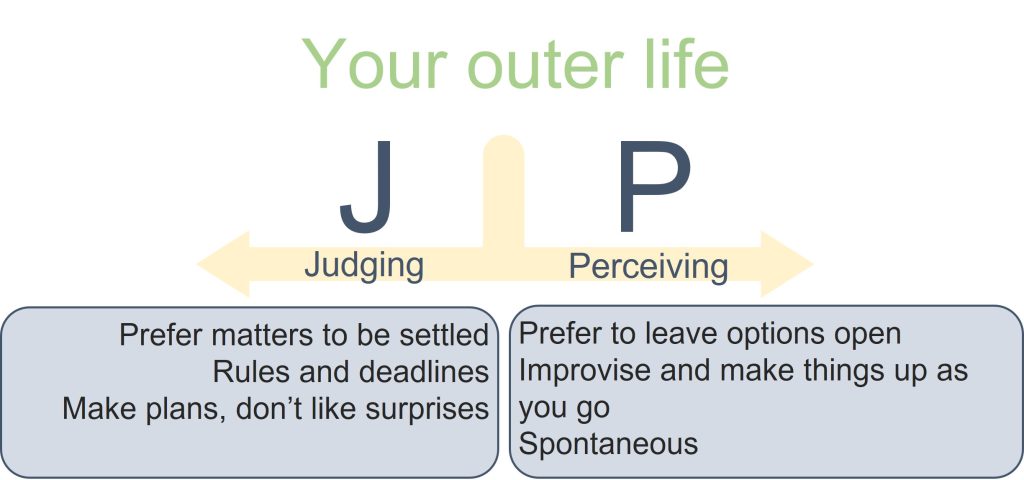
Select J or P for how you view your “Outer Life”:
Judging: Prefer matters to be settled, Rules and deadlines, Make plans, don’t like surprises
Perceiving: Prefer to leave options open, Improvise and make things up as you go
Spontaneous
Now you should have a four letter combination, such as INTP or ESFJ. Find your combination below for your MBTI personality type!
ISTP – The Mechanic
Strengths: You can remain calm while managing a crisis, quickly deciding what needs to be done to solve the problem.
Development Areas: You’re focused so much on what needs to be done immediately that you fail to see the big picture.
Characteristics: Analytical, practical, realistic but also logical and adaptable.
ISFP – The Creative
Strengths: You’re a creative visionary who enjoys providing practical help or service to others, as well as facilitating and encouraging cooperation.
Development Areas: You sometimes put off making decisions, in the hope that a better opportunity will come along.
Characteristics: Cooperative, modest and adaptable and also gentle and loyal.
ESFP – The Performer
Strengths: You’re adaptable, friendly, and talkative. You enjoy working with others and experiencing new situations.
Development Areas: You have trouble meeting deadlines, and do not always finish what you start.
Characteristics: Tolerant and spontaneous as well as playful, enthusiastic and resourceful.
ESTP – The Doer
Strengths: You apply common sense and experience to problems, quickly analyzing what is wrong and then fixing it.
Development Areas: Being so focused on immediate problems may lead to you ignoring long-term systematic problems.
Characteristics: Analytical, outgoing and enthusiastic as well as logical.
ISTP – The Duty Fulfiller
Strengths: You enjoy working within clear systems and processes.
Development Areas: You can become set in your ways and can sometimes be seen as rigid and impersonal.
Characteristics: Thorough, conscientious, realistic but also systematic and reserved.
ISFJ – The Nurturer
Strengths: You apply common sense and experience to solving problems for other people.
Development Areas: You may be overly cautious, and risk basing your decisions on what you think will please others.
Characteristics: Organized, practical and patient, but also dependable and loyal.
ESTJ – The Director
Strengths: You drive yourself to reach your goal, organizing people and resources in order to achieve it.
Development Areas: You tend to be so focused on the objective pursuit of your goal that you ignore the ideas or feelings of others.
Characteristics: Responsible and efficient but can also be assertive as well as logical and realistic.
ESFJ – The Caregiver
Strengths: You’re sociable and outgoing, understanding what others need and express appreciation for their efforts.
Development Areas: You are overly influenced by what you think others want, and may find it difficult to adjust plans in response to unexpected opportunities.
Characteristics: Warm and appreciative as well as outgoing and supportive.
INFJ – The Protector
Strengths: You enjoy finding a shared vision for everyone, inspiring others and devising new ways to achieve the vision.
Development Areas: You’re private and may do your thinking in a vacuum, resulting in an unrealistic vision that is difficult to communicate.
Characteristics: Compassionate, idealistic as well as imaginative and visionary.
INFP – The Idealist
Strengths: You enjoy helping others with their growth and inner development to reach their full potential.
Development Areas: You struggle to speak up in meetings, leading others to believe you have nothing to contribute.
Characteristics: Flexible, spontaneous as well as reflective and contained.
ENFJ – The Giver
Strengths: You’re able to get the most out of teams by working closely with them, and make decisions that take into account the values of others.
Development Areas: You often talk a lot, and may become discouraged if you do not receive a lot of feedback from others.
Characteristics: Warm, collaborative and supportive and organized.
ENFP – The Inspirer
Strengths: You’re willing to consider almost any possibility and often develop multiple solutions to a problem.
Development Areas: You may not follow through on decisions or projects, and risk burning out from over-committing or following every possibility.
Characteristics: Friendly and expressive as well as innovative and energetic.
INTJ – The Architect
Strengths: You’re able to define a compelling, long-range vision, and can devise innovative solutions to complex problems.
Development Areas: You may come across as cold and distant when focusing on the task in hand.
Characteristics: Strategic and conceptual as well as innovative, independent and logical.
INTP – The Thinker
Strengths: You can adopt a detached and concise way of analyzing the world, and often uncover innovative approaches.
Development Areas: You may struggle to work in teams, especially with others who you perceive to be illogical or insufficiently task-focused.
Characteristics: Independent and detached, as well as skeptical and innovative.
ENTJ – The Executive
Strengths: You’re able to efficiently organize people and resources in order to accomplish long-term goals.
Development Areas: You may overlook the contributions of others and the needs of the people who implement your plans.
Characteristics: Structured and challenging, they also tend to be strategic and questioning.
ENTP – The Visionary
Strengths: You enjoy developing strategy and often spot and capitalize on new opportunities that present themselves.
Development Areas: You avoid making decisions and may become excited about ideas that are not feasible because of constraints on time or resources.
Characteristics: Emergent and theoretical as well as imaginative and challenging.
Do you know how to pick and hire the BEST Project Managers?
Here are the three skills all the best Project Managers and Leaders have:
➡️ The Project Management Process
🏆 Knowing the right steps to take is so, so important. Find your Stakeholders, write or approve a Project Charter, then Plan Requirements, Scope, Schedule, Cost, Quality, etc. Miss a step and it could spell disaster. Know them all and win. The good news is you can learn the PM Process if you need to.
➡️ Knowledge of the Business
🏆 Having industry, system or business process knowledge will make things easier for you when managing change. You can sense-check decisions, costs, team-members, or vendors. You can help your team solve problems. The good news? There are ways to map out Business Knowledge if you’re starting from scratch.
➡️ People and Communication Skills
🏆 Knowing the first two is no good if you leave a trail of chaos in your wake. Know how to bring the best out of people. Know how to communicate effectively, how to influence and negotiate without being creepy. Know yourself, and know the arena you’re playing in. The good news is you can learn these skills too.
Use these three skills together to find the best Project Managers and win.
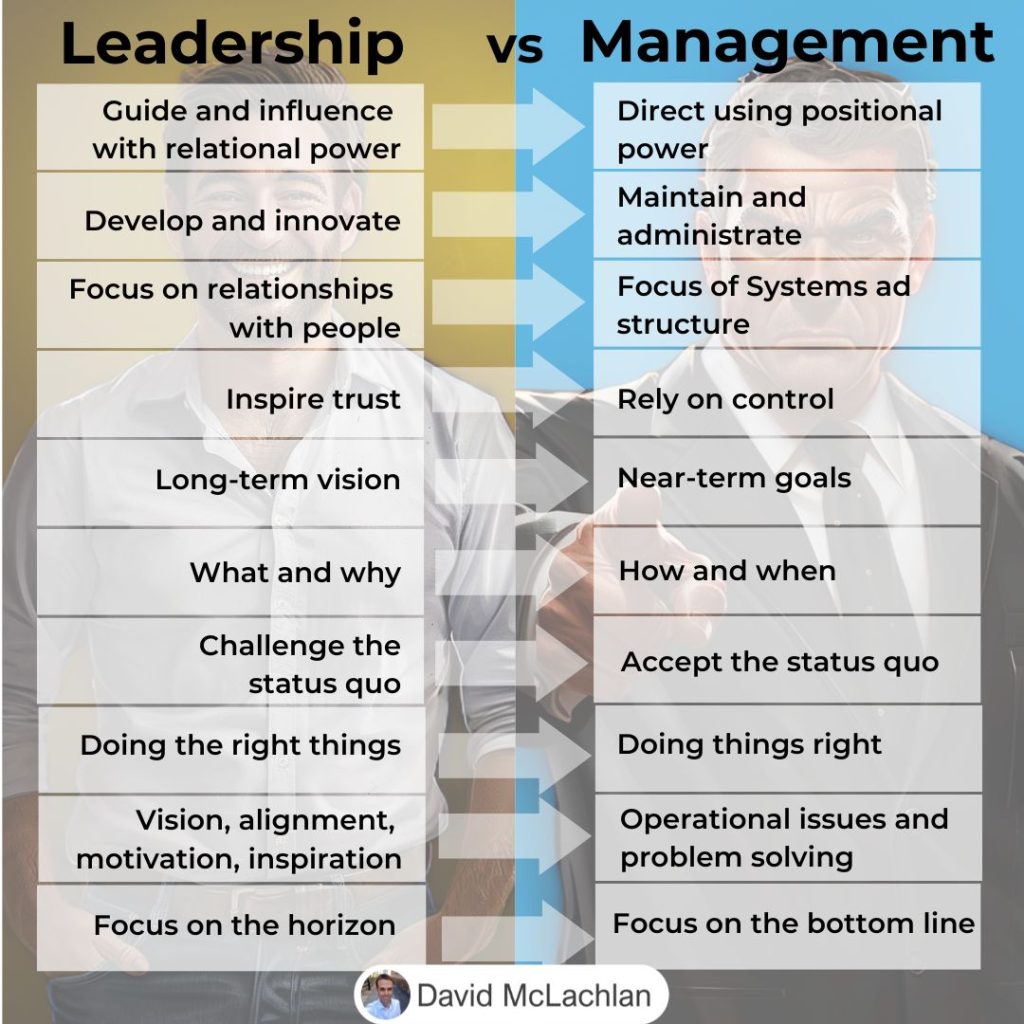
Many people say you should focus on being a Leader, instead of a boss or a Manager. But when you look at the definitions for each you will begin to realize that you need both Leadership and Management in your skillset in order to get things done.
What a Leader Does
A Leader will focus on people and improvement with things like:
✅ Inspiring trust in their people
✅ Looking at the Long-term vision
✅ The WHY behind what the team is doing
✅ Ensuring their team are focusing on the right things to get where they want to go
✅ Challenging the status quo in order to improve and innovate
What a Manager Does
Meanwhile, a Manager will focus on the numbers, administration and getting things done, such as:
☑️ Using Directive leadership and their Positional Power to get things done quickly
☑️ Maintaining the way things are and administrating the day-to-day work
☑️ Focusing on near-term goals for the team to achieve
☑️ Looking at How and When things will be achieved
☑️ Doing things the right way
☑️ Operational issues and problem solving
☑️ Focusing on the bottom line
By combining both the skills of a leader and a manager, you will keep your team engaged and find success in working towards the right goals for your business and project.
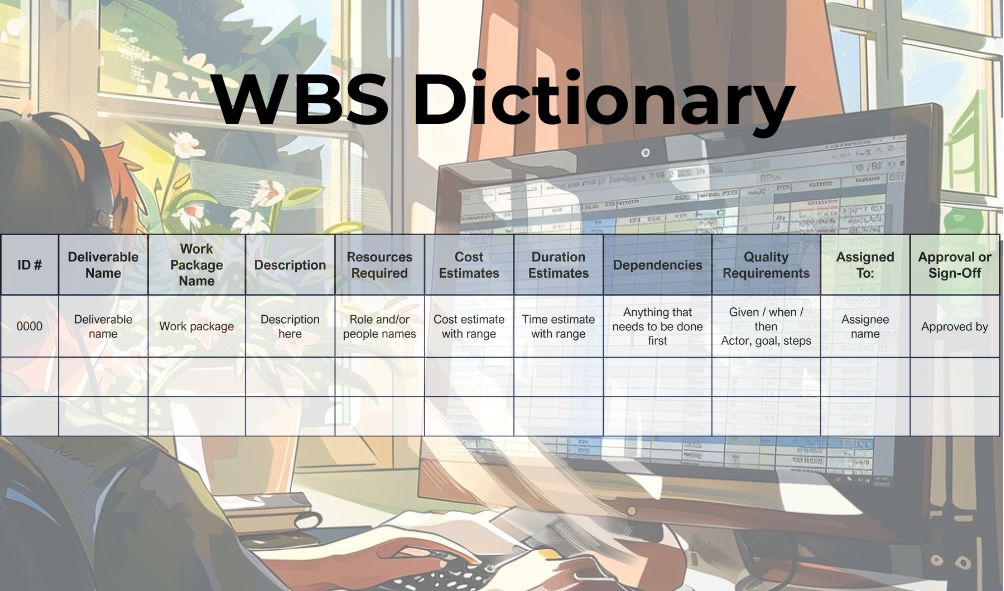
A typical Work Breakdown Structure “decomposes” items, or breaks them down from a high level feature or deliverable, into smaller Work Packages or User Stories that a person can work on.
But once you’ve decomposed those deliverables, you need to add information to them to make them meaningful. And you do that with a WBS Dictionary.
What Goes In A WBS Dictionary?
A WBS Dictionary lists our deliverables, the work packages in those deliverables, and then any additional project information we need. It will usually include:
A Unique ID
Deliverable Name
Work Package Name
Description
And then Project attributes, such as:
Resources Required
Cost Estimates
Duration Estimates
Dependencies (what needs to be completed first)
Quality Requirements (tasks or acceptance criteria)
And lastly, the people involved, such as:
Who the item is assigned to
Who approved or signed off on the item.
Having all this information at a glance makes it easier to understand your project and see what is needed.
It’s time to look at the interpersonal and team skills that you will need as part of your project management career, and stakeholder engagement.
Interpersonal and team skills are the behaviors and tactics that a person uses to interact with stakeholders in a project effectively. The ability to establish a relationship with others and maintain that relationship is a key to the success of your project.
If you don’t get along with the people that you’re working with, or delivering the project to, there are going to be problems when your project comes to delivery.
Types of Interpersonal Skills
So what are these interpersonal and team skills? Well, we’ve got things like Conflict Management. This can be used to help bring stakeholders into alignment on the objectives success criteria, high-level requirements, project description and other things. We might need to manage that conflict as we’re going along and there are various techniques for that in the PMBOK guide.
We’re definitely going to need facilitation. Facilitating meetings or facilitating focus groups or requirements gathering sessions or reporting on the how the project is going – facilitation is very important. And that involves meeting management as well.
We’ve got active listening. So how we are mirroring the person that we’re speaking to and repeating back what they’ve said so we ensure that we understand what they’ve said.
General leadership is used to communicate the vision and inspire the project team to focus on the appropriate knowledge and knowledge objectives.
You will need networking. So this allows informal connections and relations among project stakeholders. Sometimes if you have a good network within an organization, you can actually just go over to someone at the water cooler and say “Did you get this? I actually need your support on this. Can you help me out?” And they’ll say yes without any need for formal communication.
You’ll definitely need political awareness. Who has those those networking relationships in the organization? Maybe there’s a group of people over here and they talk a lot, and so if you’re in the bad books was one of them, potentially you’re in the bad books with all of them. You need to be aware of the politics that are going on and how business gets done in an organization.
That leads us to influencing. Influencing is gathering the relevant and critical information to address important issues and reach agreements while maintaining mutual trust. Sometimes we need to get our way across to others but do it in a way so that everybody feels good about it, and that’s not often easy to do.
Which brings us to negotiation. Sometimes if we’re influencing it might involve a little bit of back and forth. Two teams might need the same resource, and now we need to negotiate for those resources, and we need to do it in a way that everyone feels good so that you can come back and work with them again. We’re using that stakeholder engagement and ensuring that your network is still okay.
We’ve got motivation in general as part of our leadership. It’s providing a reason for someone to act. We want them to know why they’re doing something. We do need to help motivate them to do what we need them to do.
That also involves team building. So now we’re building our team, conducting activities that enhance the team’s social relations, and that includes increasing their motivation. It builds a collaborative and cooperative working environment. That might be doing things like requirements gathering together as a team, or making sure everyone has an input during the team meeting, making sure that a team is being built and no one is feeling left out.
Now as part of that we need a high emotional intelligence. So high emotional intelligence, we want the ability to identify, assess and manage the personal emotions of ourselves and of other people, as well as the collective emotions of groups of people. Not an easy task as a project manager, but definitely essential and something that you will learn and get better at over time.
As we’re doing that were also we’ve got communication styles assessment, which is a technique used to assess the communication styles of people, identify the preferred communication method – do they prefer to catch up, do they prefer a telephone call? Do they email or do they prefer a daily stand up or meeting once a week. What is the preferred communication style? And can you work with that with your stakeholders.
We’ve got cultural awareness, again very similar to political awareness so how business is getting done. But also just general cultural sensitivity, which is more broad, things like different nationalities or different things going on in people’s home lives. We have to be aware of that and aware of the fact that not everyone is the same.
To ensure that we’re able to work together in a nice and positive way involves observation and conversation as well. So that’s used to stay in touch with the work and the attitudes of the project team members and other stakeholders. Maybe we are having conversations about something that’s going on, with different festivals for different cultures and different ways of work, different hours that people will need to work depending on the situation and that comes through observation and conversation.
And those are all of the interpersonal and team skills that you’ll need as part of your project management career.
Power and influence models, versus the Salience model for capturing stakeholder engagement
During your PMP exam you will come across many different stakeholder engagement techniques, and it’s important to know the difference between these various Power over Influence or 2D models, and the Salience model, which is known as a 3D model because we’ve got three particular parts to that particular model.
The Salience Model
So the Salience model itself describes the classes of stakeholders based on assessments of their Power, Urgency and Legitimacy. So power is the level of authority or ability to influence. The Urgency is the need for immediate attention, so how urgent is the stakeholders involvement in the project? And legitimacy is how appropriate is their involvement.
The salience model is useful for large projects where there are complex communities of stakeholders, or where there are complex networks of relationships within the project or the organization itself. Here’s an example, as you can see it’s known as a 3D model or a cube model, but the best way to represent it is through these three circles. So you’ve got Power, Legitimacy and Urgency and you can simply note all of your stakeholders within within these three circles and where they fit in the three circles to make it that easy graphical representation.
Power over Influence Models
We can also look at that in conjunction with the two dimensional classification models. They are more useful for small projects, or projects with simple relationships between stakeholders. We’ve got Power over Interest, or Power over Influence, and Impact over Influence. All of those you might use depending on which one fits you the best or fits the project the best.
My personal favorite is the influence of the stakeholder over the impact to that stakeholder. So does it have a high impact and does that person have a high influence? So are they an executive within that particular area, and is it having a high impact on them? We probably want to manage them very closely.
If it’s a high impact but they have a low influence on our project or the organization, then we just really want to keep them informed. If it’s a low impact to them and they have a low influence, then we can just monitor their involvement. If they have a high influence, but a low impact you still want to keep them satisfied, because with a high influence they may be able to influence the project, derail it or even help it under the right conditions.
So those are the power and influence models versus the salience model in your project.
You may not see too many direct questions on this on the PMP exam, but you will definitely have to use this in your project management career. Communication is the exchange of information, whether intended or involuntary. Sometimes we’re communicating something and we’re actually not aware that we’re communicating it. It might not be verbal, it might just be body language or that sort of thing. The information is exchanged and it can be in the form of ideas, instructions or even emotions. 80% of a project managers time is spent communicating in some form or another, trying to get support for your project, trying to elicit ideas or gathering the requirements, checking how everything is going, meeting with the team members.
Factors that Affect Communication
There is so much going on in a project that we really need to be really good at communicating. Here are the skills and the techniques that we might use as we go along through our project. First of all, factors that can affect the choice of communication might include the urgency or the need for the information – so do we need to meet straight away, or can it just be an email? Can it be an SMS or can it be a slack message? This will change during the different phases of a project as well. The availability and reliability of technology – is email actually reliable, or should we send a letter? Can we pick up the phone, or can we use other forms of technology?
The ease of use for that particular technology – what’s going to be easiest for everyone to get the message in your project, not just one person but everyone that you need. It a SharePoint page, or is it a Confluence page, or is it a web page or is it a teleconference communication method. What’s the easiest way for everyone to get the message?
And of course the project environment – whether the team will meet and operate on a face-to-face basis or in a virtual environment, whether they’ll be located in one place, or multiple time zones with multiple languages.
And whether there are any other project environmental factors involved, so the sensitivity and confidentiality of the information – can we actually shout it from the rooftops, or should we have to meet and discuss it in private. This might also involve the social media policies for employees to ensure appropriate behavior so that we’re not telling the project details on social media, when it’s a secret project or something that we don’t want everyone to know about, it might be proprietary information.
Types of Communication Skills You Can Use
Communication skills include communication competence in general – this is a combination of tailored communication skills and it involves things like clarity of purpose, effective relationships with the people that you’re sharing the message with, and leadership behaviors. Really starting with “why”, or why are we doing things, making sure everyone is really clear and getting the message across.
Feedback is also one of the skills that we need. Feedback is information about the reactions to those communications, so how did they receive it? Was it received well, or received badly? Sometimes we need to ask for that feedback and we need to take it on board, even when it’s bad. That’s part of being a project manager. Feedback supports interactive communication between the project managers, the team and all other stakeholders.
Other communication skills you’ll see are nonverbal communication skills. Appropriate body language to transmit meaning through gestures. If we’re all closed up but we’re trying to get people pumped up for a particular project, maybe that’s not going to work. Our tone of voice needs to be appropriate, our facial expressions need to be appropriate, mirroring the people that we’re talking to and eye contact are also important techniques in communication skills.
You’ll definitely find yourself presenting during your project management career or the projects that you’re working on at the moment. Presenting as a formal delivery of information and/or documentation such as progress reports, background information for decision-making for the stakeholders in your project, and information aimed at increasing the support for your project with all of the stakeholders as well.
Taking the audience type into consideration. Is it a group of executives, do you need to be more formal under those scenarios? Or is it your a few people that you’re delivering the project to? You need to be considerate that it might be affecting them and take that into consideration when you’re communicating.
Lastly, there are communication artifacts and methods that are really useful as you go along on your project. You’ve got noticeboards, and that could be your virtual notice board or a physical notice board, newsletters, staff letters, press releases, annual reports, emails and intranets. Accompanying web portals – can we display the information that we need in that particular place? We might have phone conversations, presentations, team briefings and group meetings, focus groups, face to face formal or informal meetings between various stakeholders, consultation groups or staff forums and social computing like slack for example, technology and media.
And those are the communication skills that you will come across in your project management career.
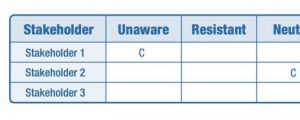
The Stakeholder Engagement Matrix is a very useful tool, and it supports the comparison between the current engagement levels of your stakeholders and the desired engagement levels required for successful project delivery.
It asks and answers the question – how engaged do we need our team, or the people around the project, to be to ensure successful project delivery?
There are five different levels through which we can measure this stakeholder engagement. First of all, we’ve got Unaware, then Resistant, then Neutral, then Supportive and then Leading. Let’s look at them in a little bit more detail.
Stakeholder Analysis
An Unaware stakeholder is when they’re unaware of the project completely, or its potential impacts. They simply don’t know that it exists.
Now if they’re Resistant, they’re aware of the project and its potential impacts but they’re resistant to any changes that might occur as a result of the work or the outcomes of the project. These stakeholders will be unsupportive of the work or the outcomes of the project, and we really need to communicate more and manage the relationship for those particular stakeholders.
We might have Neutral stakeholders, where they’re aware of the project but they’re not supportive and they’re not unsupportive. They’re just going with the flow.
We might have supportive stakeholders, where they’re aware of the project and potential impacts and they’re supportive of the work and its outcomes. This is ideally where we want to be leading to and ultimately the next step is when we’ve got stakeholders Leading, where they’re aware of the project and its potential impacts and they’re actively engaged in ensuring that that project is a success. They’re really helping us out, they’re not hindering us. And that’s where we really want our stakeholders to be.
A stakeholder engagement assessment matrix involves mapping our stakeholders against those descriptions. We might have stakeholders over here on the left where are they are currently (C) unaware, but we actually need them to be supportive as our desired state (D).
Most of them really need to be supportive or leading. An executive might need to be leading, or a sponsor might need to be leading, so we need to really make sure that we’re communicating properly and helping get them up into those upper levels of stakeholder engagement.
Current and Desired Stakeholder States
The gap between the current (C) and the desired (D) state for each stakeholder will direct the level of communications necessary, and to effectively engage that stakeholder so do we need to communicate a lot more, in a way that’s best for that stakeholder. Now we really need to use those soft skills that a project manager has to have, to increase the engagement of those project team members or the the other members around the project. The closing of this gap between the current and desired is an essential element of monitoring stakeholder engagement. You will definitely be using this in your project management career, and you will also see it as part of the questions for the PMP and the CAPM exams.
And that is the stakeholder engagement assessment matrix.

 Strengths: You can remain calm while managing a crisis, quickly deciding what needs to be done to solve the problem.
 Strengths: You’re a creative visionary who enjoys providing practical help or service to others, as well as facilitating and encouraging cooperation.
 Strengths: You’re adaptable, friendly, and talkative. You enjoy working with others and experiencing new situations.
 Strengths: You apply common sense and experience to problems, quickly analyzing what is wrong and then fixing it.
 Strengths: You enjoy working within clear systems and processes.
 Strengths: You apply common sense and experience to solving problems for other people.
 Strengths: You drive yourself to reach your goal, organizing people and resources in order to achieve it.
 Strengths: You’re sociable and outgoing, understanding what others need and express appreciation for their efforts.
 Strengths: You enjoy finding a shared vision for everyone, inspiring others and devising new ways to achieve the vision.
 Strengths: You enjoy helping others with their growth and inner development to reach their full potential.
 Strengths: You’re able to get the most out of teams by working closely with them, and make decisions that take into account the values of others.
 Strengths: You’re willing to consider almost any possibility and often develop multiple solutions to a problem.
 Strengths: You’re able to define a compelling, long-range vision, and can devise innovative solutions to complex problems.
 Strengths: You can adopt a detached and concise way of analyzing the world, and often uncover innovative approaches.
 Strengths: You’re able to efficiently organize people and resources in order to accomplish long-term goals.
 Strengths: You enjoy developing strategy and often spot and capitalize on new opportunities that present themselves.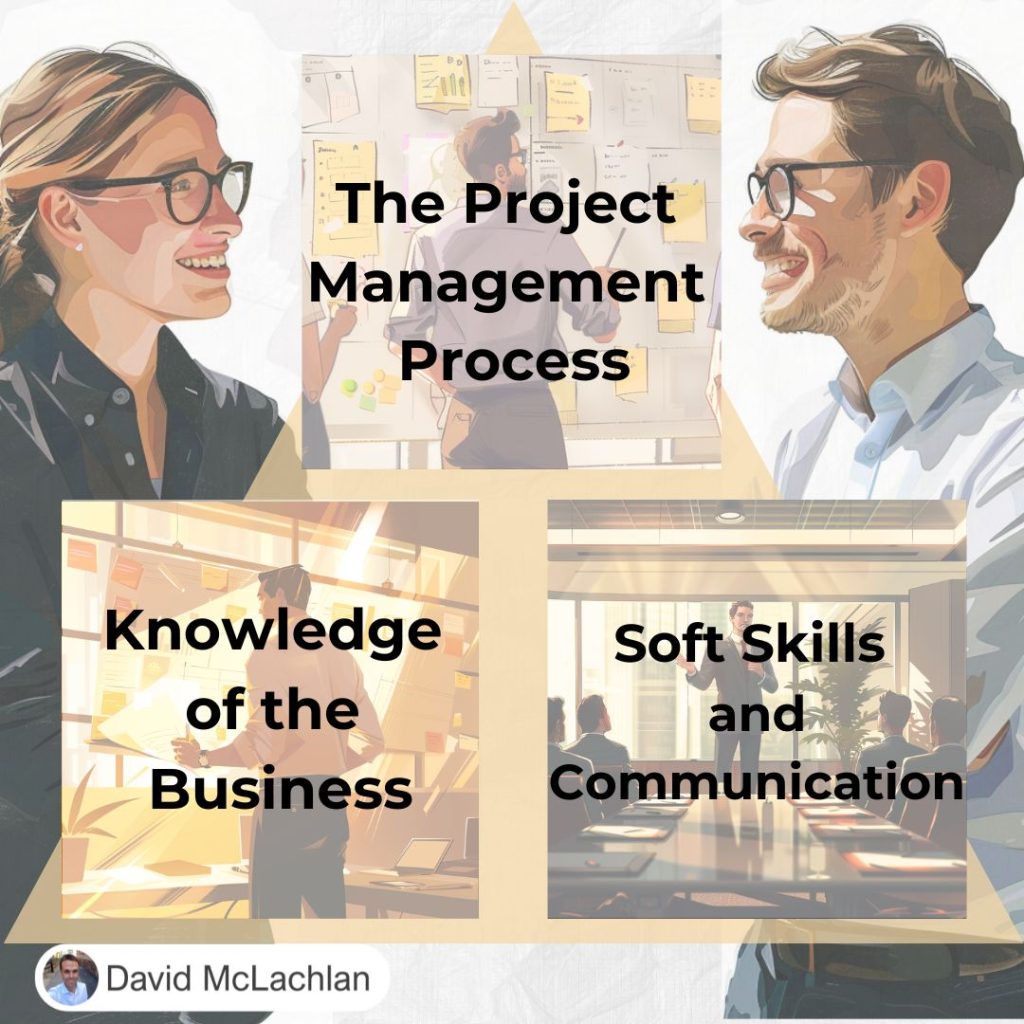
 Interpersonal and Team Skills
 Power and influence models, versus the Salience model for capturing stakeholder engagement
 Communication Skills
 The Stakeholder Engagement Assessment Matrix