Tag Archives: David McLachlan

Four Ways to Recover a Failing Project

Every project manager has experienced a project going off the rails. Here are four reasons  I’ve seen projects fail, over and over again, and what to do about each of them.

1. Disruptive Noise

When a project starts to struggle, the stakeholders around it get “loud”. Executives start poking around, stakeholders start asking more questions – and rightly so because they sense that something isn’t quite right. But the increased scrutiny creates a cycle that disrupts the project further. They might replace key people that you need, or they might even make some decisions that you know will have a negative effect.

The fastest way to break the cycle of “disruptive noise” is to deliver small, early wins.

Break the project into smaller pieces and showcase something real as soon as possible. A working prototype, a test environment delivery or a completed milestone. Follow it up with a clear communication far and wide – to the right people showing what has been achieved.

Speaking of the right people: check the organizational chart. Missing a high-influence stakeholder is one of the most common ways projects run into trouble. Identifying and engaging them early prevents much bigger problems later.

2. No Resources or Authority

Being asked to deliver a project without the funding or access to make it happen is a situation that catches many project managers off guard. The fix is to get commitment in writing before work begins.

A signed project charter that includes the project sponsor’s commitment to funding and resources is not just a formality. It is a forcing function. If a sponsor is not willing to commit resources to paper, that tells you something important before you have spent months working toward a goal that was never properly supported.

3. Unrealistic Timeframes

An executive wants it done in two months. The people doing the work say six months. This is one of the most universal project management experiences there is.

Always get estimates from the people actually doing the work, not from the people requesting it. Use ranges rather than single-point estimates, especially early in the project when complexity is highest. Experienced project managers on large construction projects routinely build in a 40% contingency. Things change over one to two years in ways that cannot be fully anticipated at the start.

If the pressure for an unrealistic timeframe continues, raise it formally as a risk. Document the potential impacts: reduced scope, increased cost or both. Assign an owner to that risk. Often the right owner is the executive applying the pressure in the first place. Once the risk is documented and assigned, everyone is on the same page if things deteriorate further.

4. Frequent Change Requests

Constant changes to scope are usually a symptom of unclear scope from the start. The solution is to get specific about what is being delivered before work begins.

Involve subject matter experts and break the work down into a work breakdown structure. Prototypes, wireframes, storyboards and process maps are all useful tools for making the scope visible and testable early. The more concrete the picture of what is being delivered, the less room there is for misalignment later.

When change requests do come in, make the impacts transparent. Every change affects the triple constraint: scope, schedule and cost. If someone wants to add something, show them exactly what it will cost in time and money. When the person requesting the change understands the tradeoffs, the conversation becomes much more straightforward.

None of these problems are unusual. Most experienced project managers have encountered all four. The difference between a project that recovers and one that does not usually comes down to how quickly the root cause is identified and addressed.

– David McLachlan

You can see what people are saying about David McLachlan here: REVIEWS

Navigate to Free Project Management and Leadership Articles through the links on the right (or at the bottom if on Mobile) 
PMI PMP 35 PDUs CourseThe Ultimate PMP Project Management Prep Course (35 PDUs)
Agile Certified Practitioner (PMI-ACP 28 PDUs)The Complete PMI-ACP Course: (28 PDUs) 
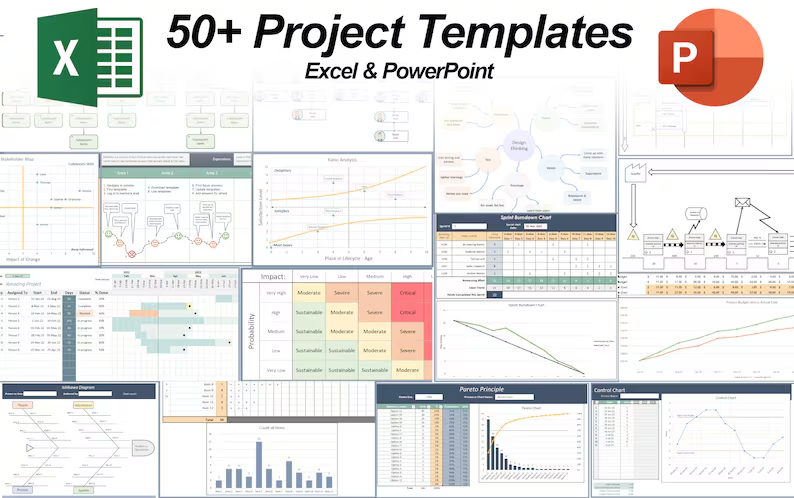
50 Project Management Templates Gantt Chart Risk Matrix and more Excel50+ Project Management Templates in Excel and PowerPoint (Gantt Chart, Risk Matrix and more!)
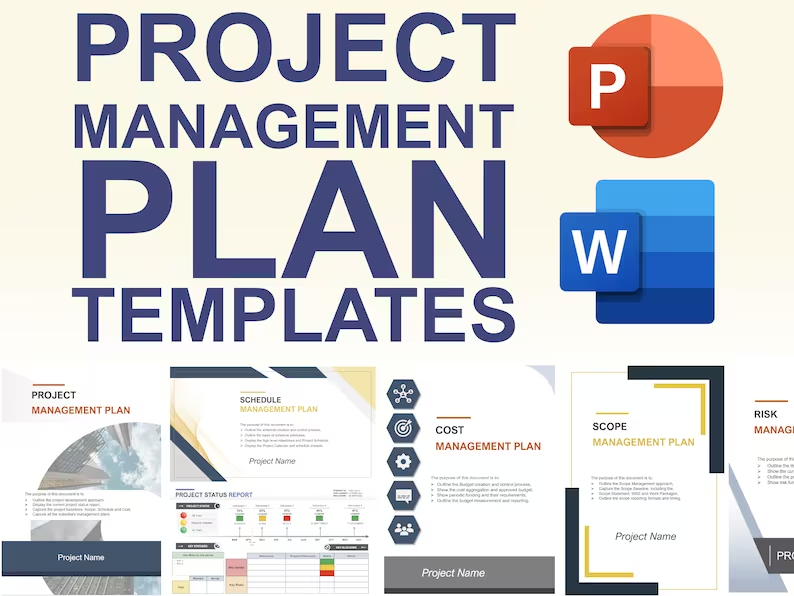
Project Management Plan TemplatesPre-made Project Management Plan Templates: Save 100 HOURS!
PgMP Program Management CourseLearn Program Management – the PgMP Prep Course
Full PMP Exams to Pass on the First TryFour Full PMP Practice Exams (180 Qs each) to pass your PMP on the First Try!
Scrum Master Course PSMScrum Master Course (PSM)
Product Owner Course PSPOProduct Owner Course (PSPO)
Business Analyst CourseBusiness Analyst Course


Agile from Start to Finish: Everything You Need to Know

More than 86% of software development teams have used agile in some form. If you have been meaning to get your head around Agile here is everything you need to know, from the history through to the daily practice.

Where Agile Came From

Agile did not appear from nowhere. It traces back to the Toyota Production System and lean thinking developed decades earlier. Kanban was created at Toyota in 1953. Scrum grew from a 1986 paper called “The New New Product Development Game.” Extreme programming, feature-driven development and several other lightweight frameworks followed.

In 2001, 17 practitioners representing these different approaches came together and agreed on a shared set of values. The result was the Agile Manifesto, which prioritizes individuals and interactions over processes and tools, working software over comprehensive documentation, customer collaboration over contract negotiation and responding to change over following a plan.

Agile Roles

Three roles sit at the center of most agile teams.

The Product Owner represents the customer. They maintain the product backlog, which is a prioritized list of features to be delivered, with the highest-value item always at the top. They are one person, not a committee. They have the final say on what gets worked on next.

The scrum master is a servant leader. They help the team remove blockers, facilitate cere

monies or “events” and protect the team’s focus. They are a neutral third party in problem solving to help unblock the work.

The team does the work. In software that usually means developers, but agile applies equally to research, design and any other knowledge work.

How a Sprint (or Iteration) Works

Work is organized into iterations, typically two weeks long. Here is how one flows from start to finish.

Sprint planning kicks things off. The team selects the highest-priority user stories from the product backlog, enough to fill the sprint based on their velocity. Velocity is simply how many story points the team completed in recent sprints. If the last few averaged 25 points, the next sprint is filled to 25. This keeps the pace sustainable.

Every day the team holds a 15-minute standup around the Kanban board. Each person shares their progress and flags any blockers. The goal is to surface problems quickly so the team can swarm around them and keep moving.

During the sprint, backlog refinement happens in parallel. The three amigos (someone representing the customer, a developer and a tester) come together to break upcoming features into user stories, add acceptance criteria and estimate their size relative to each other.

At the end of the sprint, the team holds a sprint review. A real, usable increment is demonstrated to the customer. Not a presentation. Not a report. The actual thing. The customer gives feedback and the backlog is updated accordingly.

The sprint closes with a retrospective. What went well, what did not and what will improve next time. Actions are agreed and carried into the next sprint.

The 12 Agile Principles

The signatories of the Agile Manifesto later published 12 clarifying principles. They are worth knowing.

  1. Satisfy the customer through early and continuous delivery of working software.
  2. Welcome changing requirements even late in development.
  3. Deliver working software frequently, with a preference for shorter timescales.
  4. Business people and developers must work together daily.
  5. Build teams around motivated individuals and trust them.
  6. Face-to-face communication is the most efficient way to share information.
  7. Working software is the primary measure of progress.
  8. Maintain a sustainable and constant pace.
  9. Pursue technical excellence and good design continuously.
  10. Simplicity, maximizing the work not done, is essential.
  11. The best solutions emerge from self-organizing teams.
  12. At regular intervals, reflect and adjust.

Agile works because it is built around real feedback, real increments and continuous improvement. Once you understand the logic behind it, the events and the roles all start to make sense.

– David McLachlan

You can see what people are saying about David McLachlan here: REVIEWS

Navigate to Free Project Management and Leadership Articles through the links on the right (or at the bottom if on Mobile) 

PMI PMP 35 PDUs CourseThe Ultimate PMP Project Management Prep Course (35 PDUs)
Agile Certified Practitioner (PMI-ACP 21 PDUs)The Complete PMI-ACP Course: (28 PDUs) 
50 Project Management Templates Gantt Chart Risk Matrix and more Excel50+ Project Management Templates in Excel and PowerPoint (Gantt Chart, Risk Matrix and more!)
Project Management Plan TemplatesPre-made Project Management Plan Template: Save 100 HOURS!


PMP Project Management Course Specials for May 2026

If you’re looking for a fast, cheap and enjoyable way to study project management this year, you can get my courses at a VERY low price with the coupon code:

  • MAY2026

Only during May 2026 😊 It’s a great way to get PDUs – ranging from 10 to 35 PDUs in one go, to help you renew your PMP or other PMI Certification.

Here are the courses:

PMI PMP 35 PDUs CourseThe Ultimate PMP Project Management Prep Course (35 PDUs)
Agile Certified Practitioner (PMI-ACP 28 PDUs)The Complete PMI-ACP Course: (28 PDUs) 
PgMP Program Management CourseLearn Program Management – the PgMP Prep Course
Full PMP Exams to Pass on the First TryFour Full PMP Practice Exams (180 Qs each) to pass your PMP on the First Try!
Scrum Master Course PSMScrum Master Course (PSM)
Product Owner Course PSPOProduct Owner Course (PSPO)
Business Analyst CourseBusiness Analyst Course

Also available are my Project Management Templates – these don’t have a coupon code but they’re a great way to save 100s of hours when you’re first starting out:

50 Project Management Templates Gantt Chart Risk Matrix and more Excel50+ Project Management Templates in Excel and PowerPoint (Gantt Chart, Risk Matrix and more!)
Project Management Plan TemplatesPre-made Project Management Plan Templates: Save 100 HOURS!

– David McLachlan

From Zero to Jira Hero: Everything You Need to Run Your Jira Projects

Jira is one of the most widely used project management tools for agile teams. Here is everything you need to get from first login to sprint reporting.

Creating Your Account and First Project

Jira is free for teams of one to ten users. Once you are in, create a new project, select Software Development and choose the Scrum template. For most users, Team Managed is the right choice as it keeps your project self-contained. Company Managed is worth knowing about if you have multiple projects that need central administration by Jira admins.

Give your project a name and Jira will generate a short key that appears on every card.

Setting Up Your Epics

Your two main workspaces are the Backlog and the Board. Start in the Backlog.
Open the Epic panel by pressing E or clicking the option in the panel. Epics are your high-level features. Click Create Epic to add one and assign each a different color so you can track which work belongs where as the board fills up.

Building Your Backlog

With epics in place, start adding user stories by clicking Create. Each card can be typed as a story, bug or other work type. Custom types like risks or spikes are available through Manage Types.

Click any card to open its details. From there you can assign it to an epic, set its status, assign it to a team member and add story point estimates. Add a description to capture acceptance criteria and any supporting information.

Creating and Starting a Sprint

Click Create Sprint, set the duration and select a start date. Jira calculates the end date automatically. Add a sprint goal to give the team a clear focus.

Move cards into the sprint by dragging them from the backlog or right-clicking and selecting the target sprint. Keep an eye on story point totals and match them to your team’s velocity. When ready, click Start Sprint and your cards move onto the board.

Working the Board

The board displays your active sprint in columns. Add new columns by clicking the plus symbol on the right and dragging them into position. Custom filters through Manage Custom Filters use JQL (Jira Query Language) to adjust the board view. A simple filter showing only cards assigned to the current user is a good starting point.

Completing a Sprint and Reading Reports

At the end of the sprint, click Complete Sprint. Unfinished cards roll over automatically. Review your backlog, confirm priorities with the product owner and start the next sprint when the team is ready.

After two or three sprints, navigate to Reports to start tracking performance. The Velocity Report shows story points committed versus completed across recent sprints, giving you a reliable average to plan against. The Sprint Burndown Chart tracks work coming down over the course of a sprint against the ideal trend line, making it easy to spot if the team is falling behind mid-sprint.

Using the Timeline as a Roadmap

The Timeline view shows your epics and user stories laid out across time, similar to a Gantt chart. Drag items to adjust dates and use this view to communicate progress and upcoming features to stakeholders. It is one of the clearest ways to show where the product is heading and when things will be delivered.

Set up your epics, build your backlog, match your work to your velocity and use the reports to keep improving. It is a straightforward tool once you know where everything lives.

– David McLachlan

You can see what people are saying about David McLachlan here: REVIEWS

Navigate to Free Project Management and Leadership Articles through the links on the right (or at the bottom if on Mobile) 
PMI PMP 35 PDUs CourseThe Ultimate PMP Project Management Prep Course (35 PDUs)
Agile Certified Practitioner (PMI-ACP 21 PDUs)The Complete PMI-ACP Course: (28 PDUs) 
50 Project Management Templates Gantt Chart Risk Matrix and more Excel50+ Project Management Templates in Excel and PowerPoint (Gantt Chart, Risk Matrix and more!)
Project Management Plan TemplatesPre-made Project Management Plan Template: Save 100 HOURS!


Everything You Need to Know from the Google Project Management Certificate

More than two million people have enrolled in the Google Project Management Certificate. It covers six courses, 27 modules and takes most people over 240 hours to complete. Here is the entire program distilled into a single read.

The Foundations

A project is a unique, temporary endeavor with a start and end date, designed to deliver value. That sounds simple enough until you are six months in, the scope has doubled and nobody can agree on what done looks like. Project management exists to prevent exactly that.

Core responsibilities include gathering requirements, developing a plan, tracking progress, communicating milestones and managing the budget. Career paths run from junior project manager through to program and portfolio manager. In agile environments, the scrum master and product owner are the key roles to understand.

Two broad methodologies dominate the field. Waterfall follows a sequential order of phases and works best when scope is clearly defined. Agile delivers in short iterations of one to four weeks, gathers real customer feedback after each and adjusts course. Lean Six Sigma rounds things out with a focus on reducing defects and waste through DMAIC: define, measure, analyze, improve and control.

Initiating a Project

Every project starts with a problem or an opportunity. Before anything else, a cost-benefit analysis confirms it is actually worth solving. Goals should be SMART: specific, measurable, attainable, relevant and timebound. The difference between “improve customer experience” and “reduce checkout time by 10% within six weeks” is the difference between a project that drifts and one that delivers.

The project charter formalizes the goals, scope and resources and gives the project manager authority to proceed once the sponsor signs off. Without it, you are running on goodwill.

Planning

Good planning is not bureaucracy. It is what separates projects that succeed from ones that quietly fall apart. Build a work breakdown structure, map milestones to a Gantt chart, assign resources and involve the team in estimating durations. They know their work better than anyone.

Build in buffers, identify risks early and rate each one by multiplying probability by impact. Plan a response for the ones that matter most. A communication plan that defines what gets shared, with whom and how often is not optional: some practitioners argue communication is 90% of the job.

Executing and Closing

Execution is where plans meet reality. Track everything: tasks, milestones, costs, scope changes and risks. A weekly status report with a red, amber or green indicator keeps stakeholders informed without overwhelming them. Hold retrospectives regularly to surface what is working and fix what is not before it compounds.

When closing, get formal sign-off, archive documentation and produce two things: a project closeout report (planned versus actual) and a project impact report showing the real value delivered. Executives respond to metrics and visuals. Give them both.

Agile and Scrum

Agile was formalized in 2001 and scrum is now used by 72% of agile teams. The product owner prioritizes the backlog, the scrum master removes blockers and the team decides how the work gets done. Keep user stories small, match sprint capacity to velocity and use retrospectives to keep improving. When agile works well, it really works.

Project management is one of the most transferable skills in any industry. This is the foundation.

Something VERY STRANGE Happened When I Passed The PMP

Something unexpected happens when you pass the PMP exam. It is not just a credential. It changes how you see the work you have been doing all along.

After months of study, working through the Project Management Body of Knowledge and grinding through practice questions, I did pass the exam but the real shift was what happened afterwards.

The best way to describe it is a scene from the 1999 film The Matrix. The main character discovers he has been living in a simulation and, by the end, gains the ability to see through the surface of everyday reality into the underlying structure of everything around him.

Or think of the moment in The Wizard of Oz when the curtain is pulled back and the machinery behind the illusion is finally visible. That is what the PMP does. Before passing, project work often felt like fumbling forward. Sometimes things worked. Sometimes they did not. There was no reliable framework to explain why.

After passing, the reasons became clear.

Looking back at old projects that had not gone well, I could now see the reasons why. On one project in particular, the deliverables were being met and the project was technically doing what it was supposed to do, but  the right stakeholders had not been identified. Senior executives with real influence over the project outcome were not being engaged, when they should have been engaged by me. The project eventually succeeded, but the personal outcome was a failure because stakeholder identification and engagement had not been handled properly.

That was hard to accept. But it meant the next project could go differently, if I applied my mistakes and the lessons I learned.

The same applied to other fundamentals: understanding why a project stalls without proper sponsor support, why resources and authority dry up when that relationship is not managed, why scope needs to be visible and accepted by the customer before work begins, and why a clear change control process matters whether you are working as a product owner on an agile team or managing a predictive waterfall project.

The PMBOK is like a lens. Once you have it, you cannot unsee what it shows you about how projects actually work and why they succeed or fail.

If you are still studying, do not rush past the material to get to the pass. Work through all of it. The process on a page from the PMBOK Guide Sixth Edition (or 8th Edition now) is one of the clearest distillations of project management thinking available. It will change over time, but the underlying logic it represents is worth understanding thoroughly.

– David McLachlan

You can see what people are saying about David McLachlan here: REVIEWS

Navigate to Free Project Management and Leadership Articles through the links on the right (or at the bottom if on Mobile) 
PMI PMP 35 PDUs CourseThe Ultimate PMP Project Management Prep Course (35 PDUs)
Agile Certified Practitioner (PMI-ACP 21 PDUs)The Complete PMI-ACP Course: (28 PDUs) 
50 Project Management Templates Gantt Chart Risk Matrix and more Excel50+ Project Management Templates in Excel and PowerPoint (Gantt Chart, Risk Matrix and more!)
Project Management Plan TemplatesPre-made Project Management Plan Template: Save 100 HOURS!


Get David McLachlan’s Udemy Courses for $14.99 During March 2025

If you’re on your PMP or ACP Journey this year – get my courses for $14.99 this March!

Coupon codes below – thousands of people are enjoying this course and using it to pass their PMP.

  • PMP Exam Prep (35 PDUs) – Use code: MAR2025PMP
  • Link: https://www.udemy.com/course/ultimate-project-management-pmp-35-pdus/?couponCode=MAR2025PMP


  • ACP Exam Prep (28 PDUs) – Use code: MAR2025ACP
  • Link: https://www.udemy.com/course/the-greatest-agile-course-ever-pmi-acp/?couponCode=MAR2025ACP

With consistent effort every day, you can pass your PMP. Keep growing, keep improving. You can do it!

Here’s what people are saying:

The Power of Robert Cialdini’s Six Weapons of Influence

Note: Click on the video above to watch.

cartoon of boy leading influencingMastering Project Management with Influence

Project management is a bit like juggling flaming torches—you’re constantly balancing resources, timelines, and expectations, often without having direct control over these things. But fear not! The secret to thriving in this challenging landscape lies in honing your influencing and negotiating skills. Enter Robert Cialdini’s Six Weapons of Influence, a toolkit that’s been a game-changer since 1984. Here’s how you can use these principles to steer your projects toward success.

1. Reciprocation: The Power of Give and Take

Reciprocation is the art of give and take. When someone gives something to you, it often creates a need to give something back.

Ever notice how charities send you a free pen, and then ask for a donation? That’s reciprocation in action. It creates a sense of obligation. In project management, this could come in the form of helping out another team with your resources. When you do this, they’re much more likely to return the favor when you need it.

Pro tip from Cialdini: when someone thanks you, you can reinforce reciprocation by saying, “I’m sure you’d do the same for me.” It subtly sets the stage for future exchanges.

2. Commitment and Consistency: The Power of Small Steps

People are more likely to follow through on a request if it aligns with their past actions, or their self-image. In project management, when you often don’t have direct control, here’s a strategy you can use.

Get people team involved early – if you’re trying to improve a system, start by asking for their input on improvements through a survey. When it comes time to ask for volunteers to help with those changes, they’ll be more inclined to step up because they’ve already committed to the idea, and they want to stay consistent with that initial involvement.

3. Social Proof: The Influence of the Crowd

Social proof means we’re influenced by what others are doing. Have you ever noticed you’re more likely to buy something if you see hundreds of five star reviews? But if there’s only one or two, we hesitate.

If your project involves rolling out a new system and the team is hesitant to use it, try introducing it across the organization gradually. Then showcase successful implementations and have people from the first team share positive feedback to the new teams. When others see their peers benefiting from the change, they’ll be more likely to embrace it themselves.

4. Liking: The Friend Factor

We’re more inclined to say yes to those we like. In project management, this translates to building rapport with key stakeholders. If you’re trying to gain support for a new feature, get to know the influential people involved. Compliment their past achievements, align with their goals, and be genuinely friendly. A little likability can go a long way in winning their support.

5. Authority: The Power of Expertise

Authority means people are more likely to listen to someone with credentials or experience. If you’re pushing for a new framework or tool, flaunt your qualifications. Share your relevant experience, industry standards, and any endorsements from higher-ups. Demonstrating your expertise will make your case more compelling.

6. Scarcity: The Urgency Effect

Scarcity creates a sense of urgency and increases perceived value. If you want your team to adopt a new tool, highlight any limited-time offers or exclusive benefits. Emphasize that the opportunity won’t last forever. By making something seem scarce, you can motivate quicker decisions and actions.

By mastering these six weapons of influence – reciprocation, commitment and consistency, social proof, liking, authority, and scarcity – you can navigate the complexities of project management with greater ease. So, get ready to put these strategies into action and watch your projects thrive!

Keep pushing forward, and remember, with these tools at your disposal, you’re not just managing projects; you’re mastering them.

See more Leadership articles: 

You can see what people are saying about David McLachlan here: REVIEWS

Navigate to Free Project Management and Leadership Articles through the links on the right (or at the bottom if on Mobile) 

PMI PMP 35 PDUs CourseThe Ultimate PMP Project Management Prep Course (35 PDUs)
Agile Certified Practitioner (PMI-ACP 21 PDUs)The Complete Agile Course: PMI-ACP (21 PDUs), Coaching, Jira and MORE! 
50 Project Management Templates Gantt Chart Risk Matrix and more Excel50+ Project Management Templates in Excel and PowerPoint (Gantt Chart, Risk Matrix and more!)
Project Management Plan TemplatesPre-made Project Management Plan Template: Save 100 HOURS!


How to Handle a Project Crisis

Note: Click on the video above to watch.

Handling a Project Crisis: What to Do When Things Go South

So, you’ve just been thrown into the deep end as the lead project manager, and things are looking pretty grim. You’ve got 300 people needing to move into a new building, but with just six weeks until the big day, you find out the new site isn’t even properly authorized, and it’s on tribal land in Arizona. To top it off, the current building is being sold, and the owner is adamant about not allowing remote work. Tomorrow, you’ll be negotiating with a business owner who thinks she’s always right. Sounds like a nightmare, right? Here’s how to tackle this mess like a pro.

1. Keep Cool and Don’t Take It Personally

First off, remember that project management is all about dealing with complex, often chaotic situations. It’s not about taking things personally but rather about finding solutions and options to move forward. If things are falling apart, it’s crucial to stay level-headed and focus on solving the problems rather than stressing over the situation.

2. Present the Reality with a Gantt Chart

One of the best ways to handle a crisis is to lay out the facts clearly. Start by showing the business owner the current status of the project, including the remaining deliverables. Use a project schedule like a Gantt Chart to highlight where things are going to be delayed. Explain which risks or issues are causing delays and how this could potentially push the project back by months. A clear, visual representation of the situation can help make the urgency and impact more tangible.

3. Identify and Manage Risks

Next, categorize what’s happening as either a risk or an issue. A risk is a potential problem that hasn’t happened yet, while an issue is something that’s already occurred. Document these and assess their impacts.

Then, brainstorm possible solutions—can you expedite the process or find temporary alternatives? Assign costs and benefits to each option to help make an informed decision.

4. Use Cost-Benefit Analysis to Prioritize Options

When evaluating solutions, weigh the costs versus the benefits. For instance, if you can speed up getting the certificate of occupancy, what’s the cost, and how much time would it save? Present these options to the business owner to help prioritize which solutions offer the best trade-offs between cost and speed.

5. Employ People Skills

Dealing with a business owner who always thinks she’s right as is the case in this video could use a few people skills to navigate this tricky terrain:

Yes, And:

This technique, borrowed from improv comedy, involves agreeing with the person’s ideas and then adding your own input. For example, if the business owner insists on a certain approach, acknowledge it and then explain what the implications are and what additional steps might be needed. This helps keep the conversation positive and collaborative.

Communication Preferences:

Understand how the business owner prefers to communicate. Do they want detailed emails or face-to-face meetings? Tailoring your communication style to their preference can reduce friction and make your interactions more effective.

Deliver Small Wins:

Build trust by achieving and showcasing small victories. Regularly update the business owner with progress and minor successes to demonstrate that things are moving in the right direction.

Ask Open-Ended Questions:

Use open-ended questions to gather more information and encourage discussion. Instead of asking yes-or-no questions, ask, “What do you think we should do about this issue?” or “How would you like to handle this situation?” This invites the business owner to contribute ideas and feel more involved in the solution.

6. Keep Learning and Adapting

Remember, project management is a skill that improves with experience and continuous learning. Each project, especially the challenging ones, provides an opportunity to enhance your abilities. Stay focused on learning both the technical aspects of project management and the softer people skills that can make or break a project’s success.

Navigating through a project crisis can be daunting, but with a clear approach, effective communication, and problem-solving skills, you can steer the project back on track. Keep calm, stay organized, and remember that every challenge is a chance to grow. You’ve got this!

Until next time, keep pushing forward and learning from each experience.

See more Questions of the Day: 

You can see what people are saying about David McLachlan here: REVIEWS

Navigate to Free Project Management and Leadership Articles through the links on the right (or at the bottom if on Mobile) 

PMI PMP 35 PDUs CourseThe Ultimate PMP Project Management Prep Course (35 PDUs)
Agile Certified Practitioner (PMI-ACP 21 PDUs)The Complete Agile Course: PMI-ACP (21 PDUs), Coaching, Jira and MORE! 
50 Project Management Templates Gantt Chart Risk Matrix and more Excel50+ Project Management Templates in Excel and PowerPoint (Gantt Chart, Risk Matrix and more!)
Project Management Plan TemplatesPre-made Project Management Plan Template: Save 100 HOURS!


CAPM versus PMP – What Are They and Which Should You Choose?

Note: Click on the video above to watch.

CAPM versus PMP: Different Certificates for Different Times

If you’ve been considering diving into project management certifications, you’ve probably heard about the CAPM (Certified Associate in Project Management) and the PMP (Project Management Professional) from PMI (Project Management Institute). Both certifications can boost your career, but they cater to different needs and levels of experience. Let’s break down the key differences between them to help you figure out which one might be right for you.

Which Certification is Right for You?

CAPM:

If you’re new to project management or looking to switch careers, the CAPM is a great starting point. It’s designed for those who might not have a lot of project management experience but want to demonstrate their understanding of the basics. You don’t need years of experience to qualify for the CAPM, but you do need education and a willingness to learn.

PMP:

On the other hand, the PMP is for seasoned professionals who want to showcase their project management expertise. It’s ideal if you’ve already been leading projects and want to prove your advanced skills and experience. The PMP is recognized globally and can be a powerful credential if you’re aiming to advance in your career or work internationally.

Requirements to Apply

CAPM:

To apply for the CAPM, you need a secondary degree (like a high school diploma or GED) and 23 hours of project management education. The CAPM doesn’t require project management experience, making it accessible for those just starting out.

PMP:

For the PMP, you need more than just education. You need either a secondary degree or GED plus 5 years of professional project management experience, or 3 years of experience leading projects if you have a four-year degree. Additionally, you’ll need 35 contact hours of project management education. If you already hold a CAPM, those education hours count completely towards your PMP application instead.

Exam Differences

CAPM:

The CAPM exam consists of 150 questions to be completed in 3 hours. Of these, 135 are scored, and 15 are “seeded” questions used to test future exam content. The CAPM exam covers project management fundamentals, predictive methodologies (waterfall), Agile frameworks, and business analysis. The breakdown is roughly 36% fundamentals, 17% predictive, 20% Agile, and 27% business analysis in the CAPM Exam Content Outline.

PMP:

The PMP exam is a bit more involved, with 180 questions to be answered in 3 hours and 50 minutes (230 minutes). Out of these, 175 are scored, and 5 are seeded. The PMP exam focuses on people and soft skills (42%), project management processes (50%), and the business environment (8%). This reflects the advanced nature of the PMP and the comprehensive knowledge required.

What to Study for CAPM versus the PMP

CAPM:

To prepare for the CAPM, focus on the exam content outline, the PMBOK (Project Management Body of Knowledge) Guide, and PMI’s guides on process groups and Agile practices. The CAPM requires a solid understanding of project management fundamentals and methodologies.

PMP:

For the PMP, you’ll want to study the same resources as for the CAPM but in greater depth. The PMP also includes additional recommended readings and a more detailed examination of project management processes, leadership skills, and business environment. The PMBOK 7th Edition and the Agile Practice Guide are essential resources for this.

Final Thoughts

Both the CAPM and PMP certifications offer significant value depending on where you are in your project management career. The CAPM is a fantastic entry-level certification that can open doors to new opportunities, while the PMP is a prestigious credential for those with substantial project management experience looking to advance their careers.

Whichever certification you choose, both will enhance your project management skills and add value to your career. With dedication and the right preparation, you can successfully achieve either certification and stand out in the ever-evolving field of project management.

See more PMP Articles and Tips for Passing your Exam: 

You can see what people are saying about David McLachlan here: REVIEWS

Navigate to Free Project Management and Leadership Articles through the links on the right (or at the bottom if on Mobile) 

PMI PMP 35 PDUs CourseThe Ultimate PMP Project Management Prep Course (35 PDUs)
Agile Certified Practitioner (PMI-ACP 21 PDUs)The Complete Agile Course: PMI-ACP (21 PDUs), Coaching, Jira and MORE! 
50 Project Management Templates Gantt Chart Risk Matrix and more Excel50+ Project Management Templates in Excel and PowerPoint (Gantt Chart, Risk Matrix and more!)
Project Management Plan TemplatesPre-made Project Management Plan Template: Save 100 HOURS!