What is the Team Charter? It’s a document that establishes the team values, agreements and operating guidelines for the team. A team charter establishes clear expectations regarding acceptable behavior by the project team members, and usually it’s created as a team collaboratively, so everyone has a bit of an input and everyone agrees on the Team Charter and how they want the team to work going forward.
What is in a Team Charter?
The Team Charter might include (but it’s not limited to) team values, communication guidelines (so how are we going to communicate?). Is it via email, is it via Slack? Is it via meetings, do we have a daily stand up? Those sorts of things.
Decision-making criteria and process – who needs to sign off on things?
Conflict resolution – what happens if something goes wrong?
Meeting guidelines – are we showing up early or showing up late? Can we miss the standup if it’s something important? Or do we have to be at every stand up in the morning?
And then team agreements in general.
It also answers these questions: Why are we doing this project? or why is this team here? Who benefits from the project? What does done mean? or how do we know when we’re finished? How are we going to work together?
A servant leader from Agile may facilitate this chartering process and as a servant leader their aim is to coach the team through this process, where everyone has an input and it’s not just someone dictating it from the top. A team charter can be reviewed and updated periodically to ensure continued understanding of the team ground rules and to orient and integrate new team members (similarly to a Retrospective). What that means is every two or four weeks we look back on our process and we say you know what worked well, what didn’t work well, what still puzzles me, what have I learned. We can also review the team charter and make sure that it’s still up to scratch. Do we want to add anything? Do we want to take away anything? Do we want to change any of the ways that we work as a team?
A resource assignment matrix or a RAM you might see it referred to on the PMP exam, shows the project resources assigned to each work package. Each thing that we’re working on and who is working on it. It is used to illustrate the connections between work packages or activities and the project team members.
An example of a resource assignment matrix that you may be familiar with, or one of the most common ones is a RACI chart which is Responsible, Accountable, Consult (who needs to be consulted) and who needs to be Informed.
The RACI chart is a useful tool to ensure clear assignment of resource roles and responsibilities when the team consists of internal and external resources. As you can see we’ve got the activity of the Project Charter, and who’s creating that? Well Ben is Responsible for that, Anne is Accountable for that so she may need to sign off on that particular item, and we need to inform Carlos, Dina and Ed.
Then the task of collecting requirements – who’s responsible? Carlos is responsible here and Ben needs to sign off on that particular item, he is Accountable for it to make sure that it is done.
A resource assignment matrix can be developed at various levels of your work breakdown structure. In other words you can do it at a higher level, at the high level feature or you can break it down. At the high level it might define those responsibilities of the whole project or of the whole team or a group or a unit, but as we break our work down into smaller activities that we can actually estimate and deliver on, then our lower level matrix might be used within the group to designate roles responsibilities and the levels of authority within that particular work item. So it provides a lot of clarity, there’s no confusion about who is ultimately in charge or who has authority to do the work.
And that is the benefit of your resource assignment matrix.
The reason we’re looking at Quality versus Grade is that they are not the same concepts, and you will come across one or the other during the PMP exam. So you will need to know the difference between quality and grade.
What is the actual difference? Well quality is the degree to which a set of inherent characteristics fulfill requirements. In other words we’re checking whether it has met the requirements that we are wanting to deliver. If it’s yes, then we’re looking at high quality. Think of Quality Testing for example – when we’re quality testing we’re checking that our product meets those requirements. If it does not meet those requirements then it is of a Low quality, according to the Project Management Body of Knowledge.
Now that is different to Grade. Grade as a design intent is a category assigned to deliverables having the same functional use but different technical characteristics, and that’s how I remember it. Think would you give an “A”, or would you give this a “D” as a grade, thinking that you’re back at school.
For example for Apple products would usually get an “A” grade as they have a lot of features that are usually well looked upon.
So Grade is your feature set – is it a lot of features? Is it a high feature set that we really want?
Quality asks “Does it correctly deliver and meet all of those features that we are wanting to deliver?” and if it is yes, then it is a high quality.
So it might not be a problem if a suitable low grade, (i.e. a “D” grade) or a product with a limited number of features, is of a high quality. So it has a limited number of features, but it meets all those features. That might not be a problem. That’s fine. The product will be appropriate for its general purpose of use – not many features.
However, it might be a problem if a higher grade product (i.e. an “A” grade product) where we have a lot of features here and we are expecting a lot from this particular product. Now if that is of a low quality (so it doesn’t meet all those features when we’re delivering), it has many defects when we’re using it, then that could be a big problem. And apple probably wouldn’t have been around very long if that actually had happened, as you can imagine.
So the high-grade feature set – lots of features, nice things would prove ineffective and or inefficient due to the low quality where we’ve got many defects on those features.
And that is the difference between quality and grade.
Why are we looking at Inspections versus Audits? Because you will come across both inspections and audits in your project management career, and during the PMP exam, so it is important to know their differences and their similarities and when and where they are used.
First of all let’s look at inspections. An inspection is the examination of a work product. So someone is actually inspecting it physically, a particular work product or an item that we’re delivering. We’re determining if it conforms to the documented standards. This could be a quality check for example, where we ask “Does it meet meet the feature set that we agreed upon?” when we’re delivering our project.
The results of a single activity can be inspected, or the final product itself can be inspected. Inspections might be called reviews, peer reviews, audits or walkthroughs (especially in an Agile sense). You might have a walkthrough or even a peer review or demonstration or review to your product owner or to the customer that you’re delivering to. Inspections are also used to verify defect repairs if we’re fixing something in our project. We will need to inspect that once it’s fixed and make sure that it is ok and we’re happy to proceed.
Now this differs from audits, where an audit is a structured independent process used to determine if project activities comply with organizational and project policies, processes and procedures.
This is more of a high-level view – someone is coming in, usually from the outside (external to the project) such as the organization’s internal audit department, or a project management office or an auditor external to the organization itself. They’re coming in and having a look and asking “Is our project being documented in the right way, is it following the the methods that we want them to follow, is it delivering the project in the way that we want it to be delivered, does it meet those policies, procedures and those requirements?” Does it have a system in place for delivering all of those things?
All of that will be looked at as part of an audit within your project. Some audit objectives may include (but they’re not limited to) identifying all the good and best practices being implemented – so maybe they could recommend some best practices for your project. Maybe we could follow the PMBOK guide for example as one of the best practices in the industry to deliver your project. We’re identifying all nonconformity or gaps or shortcomings, so maybe there are gaps in the way that we’re delivering, maybe there are gaps in the product that we are delivering, and all those can be called out by one of those auditors coming in and looking at the way our project is been delivered.
And that is the difference between inspections and audits.
What is a cause and effect diagram? You will likely see a Cause and Effect diagram as part of quality or problem solving within your project. It breaks down the causes of a problem or problem statement which has been identified, and it breaks it down into certain branches. It’s a method of brainstorming and we usually have our problem statement at the end and the problem areas off the spine.
Because of this, it looks like a fish or a fish bone, which is why it’s also known as a fishbone diagram. All of these branches are used to break our problem down to help identify the main cause, or the “root cause” of a problem.
It’s also called an Ishikawa diagram after Kaoru Ishikawa from the University of Tokyo who invented this idea.
Let’s look at a quick example. The problem or the “problem statement” is placed at the head of the fish, and the reasons are brainstormed in the categories that you might choose. Some popular categories that you will find are People, Information, Processing, System or “PIPS” as it’s known. This is pretty well known in Lean or the Toyota production system.
You might also see in manufacturing other categories: Man, Method, Machine and Material.
Ultimately, you can put anything you like here, but this just gives us a framework to view the problem through. We can ask, “What information are people not getting?” or do we have the right people on board here? or “Is the process not up to scratch?” Do we need to change the process to fix this particular problem, or is the system hindering us. Do we have the wrong system, is there a bug in the system, is the system not quite up to scratch, is it not performing as we expected?
All of those things might contribute to the problem, and that’s just the lens that we view our problems through to help us find the real cause or the root cause of a problem.
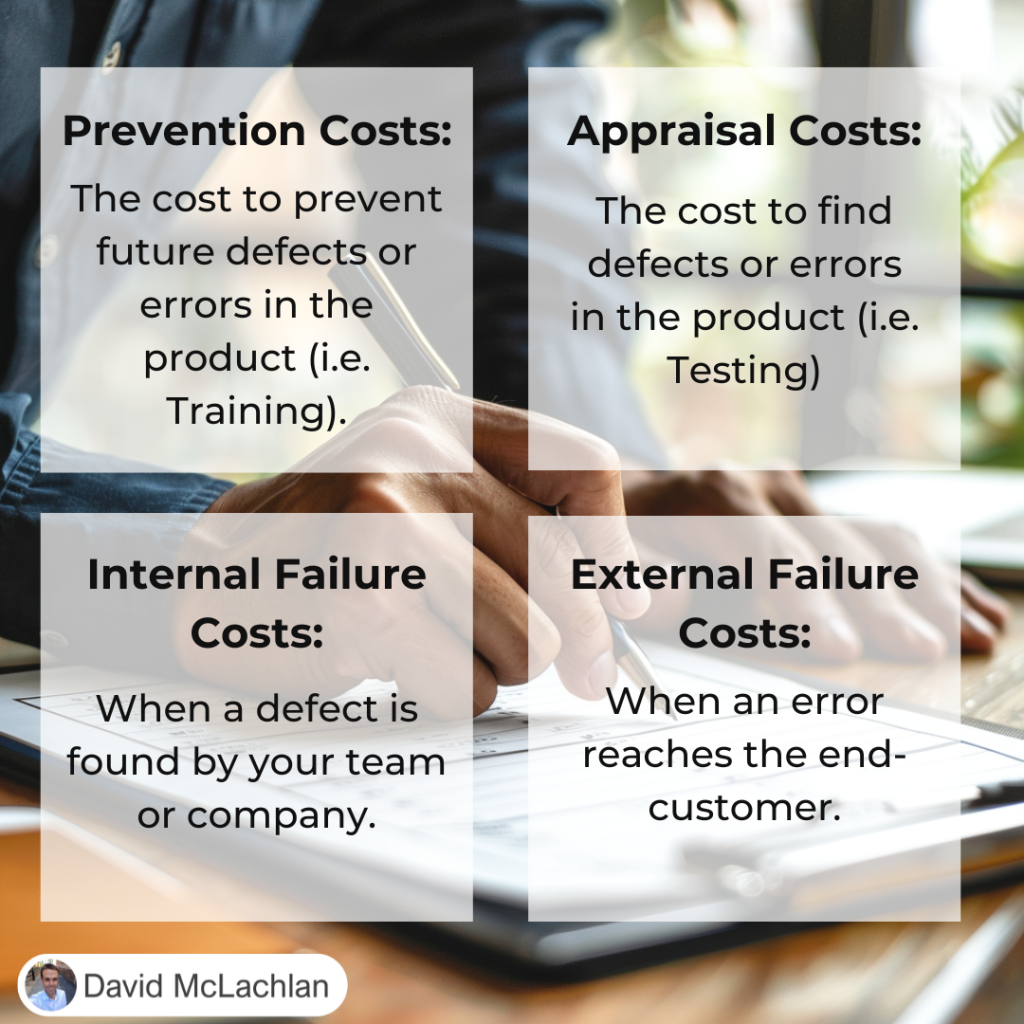
There are three main things we’ll be looking at relating to the cost of quality.
What is the Cost of Quality? It’s the cumulative cost required to bring poor quality service or products (what we’re delivering as part of our project) up to the standards that are defined by the project.
Cost of Quality asks: “What does it cost if things go wrong or to prevent things from going wrong?”
The three things that we’re looking at for the cost of quality are:
Prevention costs
Appraisal costs, and;
Failure costs.
Let’s look at them in a little bit more detail.
Prevention costs
These are related to the prevention of poor quality, in the products, deliverables or services of the specific project, or the products that we’re delivering. We’re wanting to stop an error before it happens. Now, how much does it cost for us to stop an error before it happens? Do we need to put something in place to stop it? Do we need to change the way that we’re delivering? Do we need to add more money in some way? It’s how we preventing those things from happening.
Appraisal cost is the next one, and this is the cost related to evaluating, to measuring, auditing and testing the products, testing the deliverables and the services of the specific product that we’re delivering. So we’re checking to see if errors are being made and then correcting those before they reach the final state. That definitely involves a cost, because we’ve got people having to go out and check systems or processes or products as they go along. Quality assurance or testing is a big part of your project in many cases, and obviously there’s a cost involved in that as well.
Failure costs is the last one, and this is the cost of when an error actually happens. So we haven’t been able to prevent it – we haven’t found it by appraising or inspection, and instead things have failed. What is the actual cost of when things go wrong? These are the costs related to non-conformance of the products, deliverables or services to the needs or expectations of the stakeholders. This ends up in unhappy stakeholders because they’ve received a faulty product or an error in the product that we’re delivering.
And those are the three costs of quality that you’ll find.
We’re delving into the second part of cost forecasting methods, where we previously looked at all of the different ones like estimate at completion (which we looked at in detail because there’s many different ways to to calculate that one) and now we’re going to look at the Estimate to Complete, Variance at Completion, and the To Complete Performance Index.
Now just a quick refresher, the first one for the Estimate at Completion, this will feed into our other calculations, and this is the easiest one to calculate. We’ve got the Actual Cost (AC) of $5000, plus the the Budget at Completion (BAC) of $10,000, minus the Earned Value, which is what we’ve completed so far – 30% of $10,000 or $3,000. So that is $7,000 in total plus the $5,000, equals twelve thousand dollars. So that’s what we’re going to use as our Estimate at Completion for this particular example.
Estimate to Complete (ETC)
So we’re up to the Estimate To Complete (ETC). This is the expected cost to finish all the remaining project work, and it equals our Estimate At Completion, which we said was $12,000, minus our Actual Cost so far, which is $5,000. This one is nice and easy – it’s $7,000 for this particular example of the Estimate to Complete.
Variance at Completion (VAC)
Variance at Completion (VAC) is the estimated difference in cost at the completion of our project. So variance at completion is the budget at completion (BAC), which is our $10,000 minus our Estimate at Completion, which we said was our $12,000. So we’ve got $10,000 minus $12,000 which equals -$2,000 our variance, meaning we’re going to be behind because it’s negative.
If we were positive then we’d be ahead of schedule, we would have delivered more value than we wanted. For our purposes, if it’s negative we’re behind and we’re not doing that well. If it’s positive we’re doing well.
To Complete Performance Index (TCPI)
The To Complete Performance Index (TCPI) is the efficiency that must be maintained in order to complete your project as planned, and it comes up as a basically as a 1.4, 1.2, or 1 etc. If it’s more than 1 it’s harder to complete (we need to deliver more to get it done on time), and if it’s less than 1 it’s going to be easier to complete (we need to deliver less to get it done on time).
It’s not too hard to figure out the To Complete Performance Index – it’s the Budget at Completion minus Earned Value (earned value being what we’ve earned so far or what we’ve completed). So $10,000 minus $3,000 is $7,000, and divided by the the Budget at Completion minus the Actual Cost – so $10,000 minus $5,000 is our Actual Cost (what we’ve spent so far), which equals $7,000 divided by $5,000, equals 1.4. So we’re behind, it’s going to be harder for us to complete, it’s above one. That’s the To Complete Performance Index.
And those are the remaining cost forecasting techniques that you will see on your PMP exam, and also a few little tricks on how to handle potential exam questions as you come across them.
What are cost estimates in a project? Well in project management you may need to estimate the cost of a work package, an activity or the project as a whole, and knowing the different types of cost estimates that you can make – from easy and inaccurate to more difficult and more accurate – will help you budget for your project at the appropriate times and the appropriate levels.
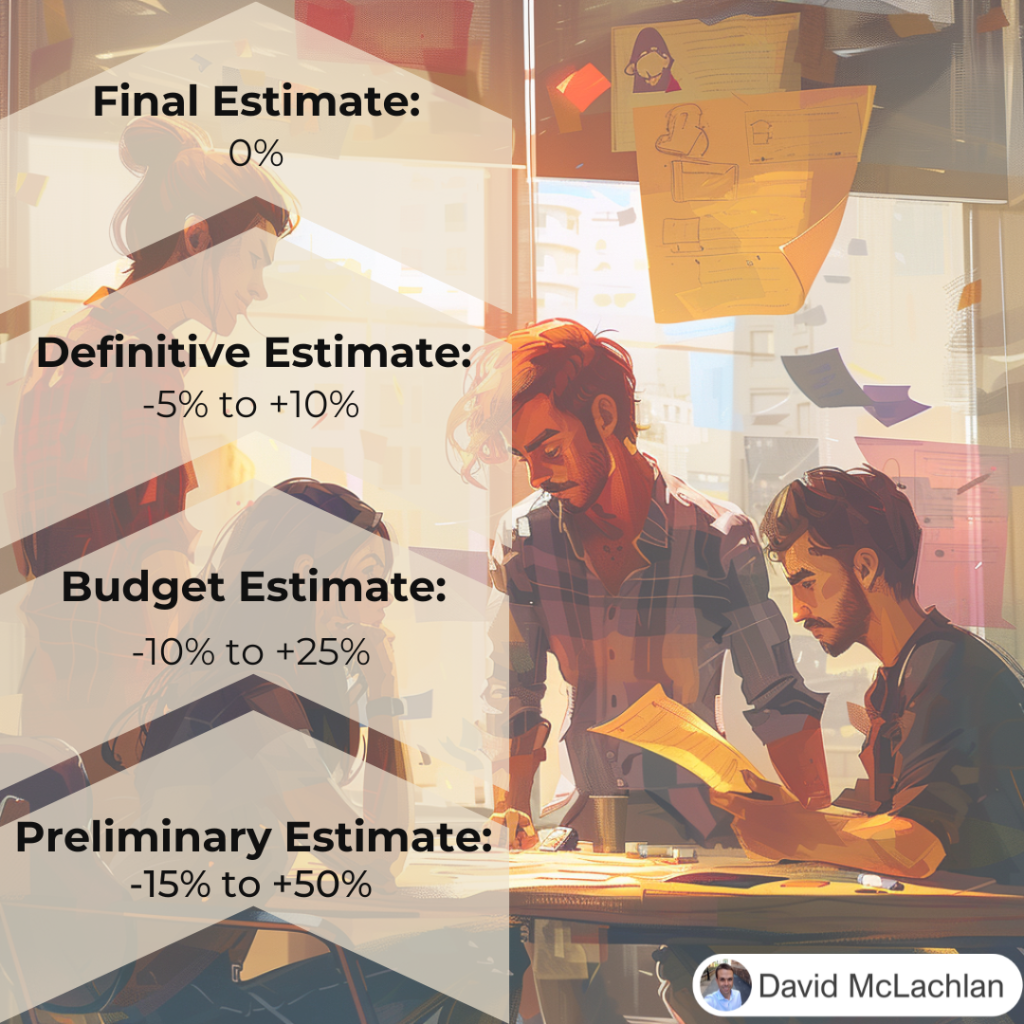
What do we mean by this? Well there are five types of cost estimates that you will come across in project management and in the PMP exam.
The first one is your order of magnitude estimate, also called the rough order of magnitude or ROM. The preliminary estimate is next, the budget estimate is after that, the definitive estimate gets a little bit more definitive as the name says, and finally we have the final estimate which is where we end up with the final cost for our project.
Let’s delve into them.
The rough Order of Magnitude estimate. If we had $100,000 where we thought it might be, we can’t just say it’s a hundred thousand dollars and be done with it because ultimately things change and adjust as the project goes on – sometimes we need to get a little bit more definitive as we get more information in our project. So our range is minus 25% to plus 75%. We would take 25 percent off that (so $75,000) but also add 75 percent (so $175,000) and that is our range. This is a ballpark estimate used to provide a starting estimate and move forward.
Next we have the Preliminary estimate, where we’ve got minus fifteen and plus fifty percent. So we might have $85,000, 100,000 in the middle and $150,000 on the top end. As you can see we might have a bit more information and we are honing it down, so it’s more of a top-down estimation approach. We’re just using the the high-level packages and looking at what they might cost and we’re also using Analogous estimation techniques which means we’re looking for similar projects or similar activities and what they cost, and we’re just sort of using that as our guide to get the costings for our project at this early stage.
Next we have the Budget estimate which is minus 10 percent to plus 25 percent, so we might have $90,000, $100,000 in the middle and $125,000 on the top end. This is also a top-down estimation approach, where we’re still looking at the high level approach and also using that Analogous technique, with similar projects and similar activities to get this budget estimate which is still fairly broad.
Next is the Definitive estimate, where we really start to delve deeper into it. We’re looking at minus 5 percent to plus 10 percent. So potentially $95,000, $100,000 in the middle and $110,000 on the top end for our estimate. The Definitive estimate is more of a bottom-up estimation technique. In other words for our work package we’ve got our feature and all the different activities or work packages that are needed to deliver that feature, and now we are looking at the cost for each of these different activities. We’re really delving a lot more into the detail for those particular activities and using that to budget for the overall feature, adding them all together.
Lastly we have the final estimate in which there is ZERO leeway. It’s finally ended up and it is actually a hundred thousand dollars for this particular example, now there’s no leeway left or no change in the budget then we know that potentially the project has been delivered, because there’s no chance for it to change. Or we might be using contracts where something needs to be locked in at a certain price and that’s what’s going to happen – that’s the work that is going to be delivered for that particular price.
And those are the different estimates that you’ll see in your project.
It’s time to look at the Cost Forecasting techniques that you will see as you go through your project management career, and definitely in the PMBOK guide.
So what is cost forecasting? As the project progresses the project team may need to develop forecasts for how much it will cost to complete the project, and compare these to the planned budget (such as the Budget at Completion or BAC). Maybe the project is going on track, but maybe it’s going along off track, or maybe it’s the cost is blowing out.
The value you’re delivering is changing because everything changes, and sometimes things just don’t go to plan. So we have to figure out how much is it going to cost us to finish all of the work that we’ve got, and that’s where this cost forecasting comes into play.
There are four main things that you will see on the PMP exam and in your project management career, and the main one that we’re looking at today is the Estimate at Completion, because there are lots of different ways of measuring and calculating this. But the other ones that we’ll go through in another article are the Estimate To Complete (ETC), the Variance at Completion (VAC) and the To Complete Performance Index (TCPI).
The scenario that we’re going to go through for all of these is we’ve got a project budget of $10,000 (the Budget at Completion) where 30% is completed (that’s our Earned Value / EV) against 40% planned (that’s our Planned Value) and $5,000 spent so far (this is our Actual Cost). So you’re going to see these things come up time and time again and we’re going to use these in the calculations for this particular project scenario.
Let’s jump into Estimate at Completion, and the many different ways that you can calculate this particular one. Estimate at completion it is the estimated total cost of completing all the work.
Basic EAC, When Work Proceeds as Planned
The first one we’re going to look at is the Actual Cost (AC) plus the Budget at Completion (BAC) minus the Earned Value (EV). This one is used for when everything is just going to be completed at the planned rate, so no matter what’s happened before we’re still still expecting things to proceed as they were planned.
Remember our budget at completion is $10,000, 30% is completed (that’s our earned value) and our planned value was 40%, so $4,000. $5,000 is our actual cost. Let’s jump into it – $5,000 plus our budget at completion ($10,000) minus our earned value ($3,000) equals twelve thousand. That’s what we’re expecting to have to pay to complete this project, the estimate at completion.
Notice that it’s different to our budget, what we had planned. We’d actually planned $10,000 and now it’s going to be $12,000, so this is going to factor in, we’re going to have to adjust, possibly do a change request, get more money, maybe use some of our management reserves, all of these things you’ll delve into in the PMBOK guide as well. Let’s look at the next one.
EAC, When Cost Performance Index Influences Future Work
We’ve got our Budget at Completion (BAC) divided by our CPI (Cost performance index), and our CPI is our Earned Value divided by our Actual Cost.
Let’s delve into the calculation. BAC of $10,000, divided by CPI (30% of $10,000 divided by $5,000 actual cost). So our CPI is our earned value divided by actual cost equals 0.6, and our $10,000 budget at completion divided by 0.6 gives us $16,667. So if the cost performance index is going to impact our project then it’s actually going to end up we’re going to be behind for the rest of our project and it’s going to be more than our other estimate. So this is a really good thing to know if the cost or performance index is going to impact our estimate at completion.
There’s two more to go, let’s delve into them.
EAC When CPI and SPI Influences Future Work
This one is if both the CPI (cost performance index) and the SPI (schedule performance index) influence the remaining work. Previously we just had the CPI influencing the remaining work, now we’ve got CPI and SPI. So basically we’re just including those calculations in our Estimate at Completion.
EAC = AC + [(BAC – EV) / (CPI * SPI)]
So the actual cost ($5,000) plus budget at completion minus earned value ($10,000 – $3,000 = $7,000) divided by our CPI (cost performance index, 0.6) multiplied by our SPI (schedule performance index). This is probably one of the most complex ones. And even if you do get on the exam, you really need to know when you would use these particular things, so if the CPI and the SPI influence the remaining work then you will have to use this longer calculation because these two things are included. So our schedule performance index is EV / PV ($3,000 divided by $4,000) gives us 0.75.
So we’ve got all of these and when we multiply those two things (SPI and CPI) together we get 0.45. So that’s our answer there – we’ve got $5,000 plus $7,000 divided by 0.45 which (plus AC) equals $20,055. Because we’ve got cost influencing and schedule influencing, and we’re behind on cost and we’re behind on schedule, and we get a higher estimate again.
EAC with Bottom Up Estimate
Now lastly you do need to know that your Estimate at Completion could just be your your Actual Cost so far (which is $5,000) plus your bottom up estimate to completion. You may actually just figure all those costs for your project and add that to the total cost that you’ve spent so far. That’s another way if you need to change plans completely and everything has gone off the rails.
Those the different ways that you’ll look at your Estimate at Completion, and this is the foundation for the rest of the cost forecasting methods that we’re going to see when we check them out in the next video.
You’ll see earned value analysis come up a lot in the PMP (project management professional) exam and in your project management career. Earned value provides a current view on the scope, the schedule and the cost performance of your project. What it helps do is compare the performance of your project, or what was actually planned to what’s happening in your project – the actual schedule and the actual cost performance as our project goes along.
There are three main concepts for earned value management and earned value analysis.
The first one is Planned Value (PV), which is what we’ve planned for our project. Then Earned Value (EV) which is the percentage of what we’ve delivered for our project, and then the Actual Cost (AC). So what we’ve actually spent on our project so far. We also use all of this when we’re looking at variance analysis. Other factors we will use include the budget at completion (BAC), which is what we had planned as our budget for the project.
Let’s look at a couple of examples Planned Value. PV is the authorized budget allocated by phase over the life of the project – as the project is going on at a given point in time. Planned value defines the physical work that should have been accomplished at this stage.
So let’s have a look at what that means. If we’ve got a project budget at completion (BAC) of $10,000 where 30% has been completed but we had 40% that we had planned to be completed at this stage, and we’ve spent $5,000, then our Planned Value is what we’ve planned to be completed – 40% of $10,000. That’s $4,000 as our Planned Value.
Earned value (EV) in this case is the budget associated with the authorized work that has actually been completed. Earned value is often used to calculate the percent complete of the project. It’s what we have delivered so far for our customers. Now obviously that’s not the same as what we have spent on our project so far and that’s why we separate the two.
So in our example, $10,000 where 30% is completed, 40% was planned and $5,000 was spent so far, Earned Value is what we’ve earned on our project and it’s 30% of $10,000, which is $3,000.
Actual cost is simply the total cost incurred. So anytime you see how much we’ve spent, that is the actual cost of a project. For our example we have $5,000 spent so far, so the Actual Cost is five thousand dollars.
Now once we know all of these things and the budget at completion that we had planned we can use these for variance analysis to see how a project is tracking. This will give us things like the cost performance index, schedule performance index, cost variance and schedule variance, and we will be using all of our earned value analysis tools, the things that we’ve just looked at, to plug into all of these calculations as well.
 The Team Charter
 The Resource Assignment Matrix
 Quality versus Grade
 Inspections versus Audits
 The Cause and Effect Diagram
 Earned Value Analysis