There are three parts to integration within project management, and integration is the first process group that you’ll come across in the PMBOK guide.
The project sponsor usually kicks off a project through a business need or a business charter and they are also usually the ones funding the project. You will need to understand the strategic objectives from them and then ensure alignment of your project to meet those project objectives.
It is continuous communication that you’ll need to go through with the project sponsor to make sure that you are always going to be on track to delivering that business value.
Underneath that we’ve got the project team and the team members, and all the different moving parts of a project. We need to work with that team to focus on what’s really essential. We’re integrating all the processes, all the knowledge and all of the people involved to make it happen.
When we’re integrating something, whether it’s the project management processes or the different knowledge areas of a project, or the teams that we were talking about before, there are three levels of integration that you’ll come across whether in everyday life or as a project manager.
As a project manager we’re using a process level of integration, such as the processes outlined in the project management body of knowledge (the PMBOK guide). Knowing when they overlap and knowing when to use some or to discard some is important.
Cognitive level of integration involves a deep understanding of all of the processes the skills and the tools to drive a project success.
Context level of integration is where we’re changing the way a process is used, given a different context, situation or scenario.
So we’ve got processes up the top, we understand them deeply in the middle with a cognitive level of integration, and lastly we know when to change them or when to modify them at the context level, because we know them so deeply and so well. And that is the ultimate aim for you as a project manager, and a person doing the PMP.
There are different levels of complexity with integration – you might have system behavior, the interdependencies of components and their systems and how they interact and are related. This can get quite complex. Human behavior is always complex as well, and if someone’s having a bad day they may act differently. All these things are diverse and individuals are very different and groups can have set ways of working that you need to be aware of when you are managing a project.
Lastly ambiguity and uncertainty of emerging issues. These things can come out of left field, and they do. You will come across this quite often – something will happen maybe it’s a regulatory change, maybe it is a business change, maybe it’s an organizational change but something will happen and you will need to manage the ambiguity that arises out of that when you’re going through your project.
“I start with the premise that the function of leadership is to produce more leaders, not more followers.” – Ralph Nader
Have you heard this leadership quote from Ralph Nader?
Ralph Nader is an American author, lawyer, and former candidate for President of the United States. His view on Leadership is sorely needed in today’s world, because when we build people up as true leaders, then not only is our job easier but the world becomes a nicer place to live.
How To Know When A Leader Has Done Their Job
It is easy to keep people down. It is easy to tell people they are no good, or that you are better than them, or that
What’s not easy is to give people a little bit of grace. To understand what they are going through, and that what they are going through may not be completely visible at first pass.
And then from giving people a bit of grace to building them up, not just to be good followers, but to be good leaders themselves.
Many dictators around the world have built countries of “followers”, where the people are afraid to speak up, and afraid to stand out. As a result, nothing of consequence ever gets done in those countries. It is the same in your company. Sure it might be OK for a while to have a large amount of followers, but when it comes time for something really important to be done, or if you can’t be there, or if you need to take on a different role yourself, you need people who are going to lead. Leaders take responsibility, instead of shirking it. They go the extra mile, instead of stopping a mile early.
And they lead in a way that will build more leaders again – by growing, building, sharing the “why” behind the daily activity and showing the progress that they’re making.
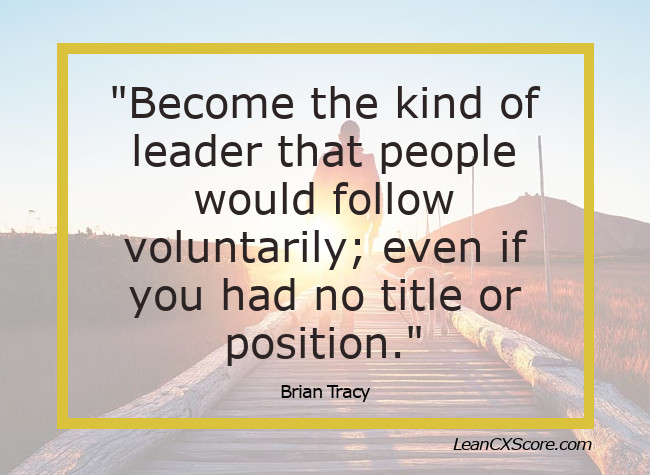
“Become the kind of leader that people would follow voluntarily; even if you had no title or position.” – Brian Tracy
Have you heard this leadership quote from Brian Tracy?
Brian Tracy was born on the 5th January 1944, and is the author of over eighty books that have been translated into dozens of languages around the world. He has been a highly sought after motivational speaker for more than 30 years.
Not Everybody can Have the Title, But Everybody Can Have the Quality of a Leader
It’s as simple as that. Leaders build people up. They help people grow. They have the humility to take the blame when things go wrong and let their team take the credit when things go right.
Good leaders also see a little bit further than most people. They have a vision, understand the “why” behind what their team is doing, and have an idea of what will happen in the future so they can respond correctly.
It’s not easy being a leader. But anyone can start building these qualities within themselves today, and it doesn’t cost anything to do so.
Global polling firm Gallup found that only one in 10 people possessed the inherent ability to be a good leader. In fact, most employees were unhappy with their boss, their manager, or their leader and the way they did things. And that means there is always room for one more good leader if you have the skills, care about your team and are willing to grow.
Why not let that leader be you?
So be the kind of person that people would follow, even if you do not have the title of “leader”. Because if you do, and enough people follow you, then soon enough the title will come.
In a project manager role you will experience politics and power, and you’ll need to understand both of those things in order to get things done in an organization.
“Leadership” and “management” involve getting things done, but to do that a project manager needs to understand how an organization works. What is the culture? And what are the unwritten laws of getting things done? That will give you a higher chance of success, and that’s where you need to have a hefty serve of emotional intelligence to understand the politics and the power sources, and how to use those to your advantage. You’ll need to influence and guide and help deliver that business value as a project manager.
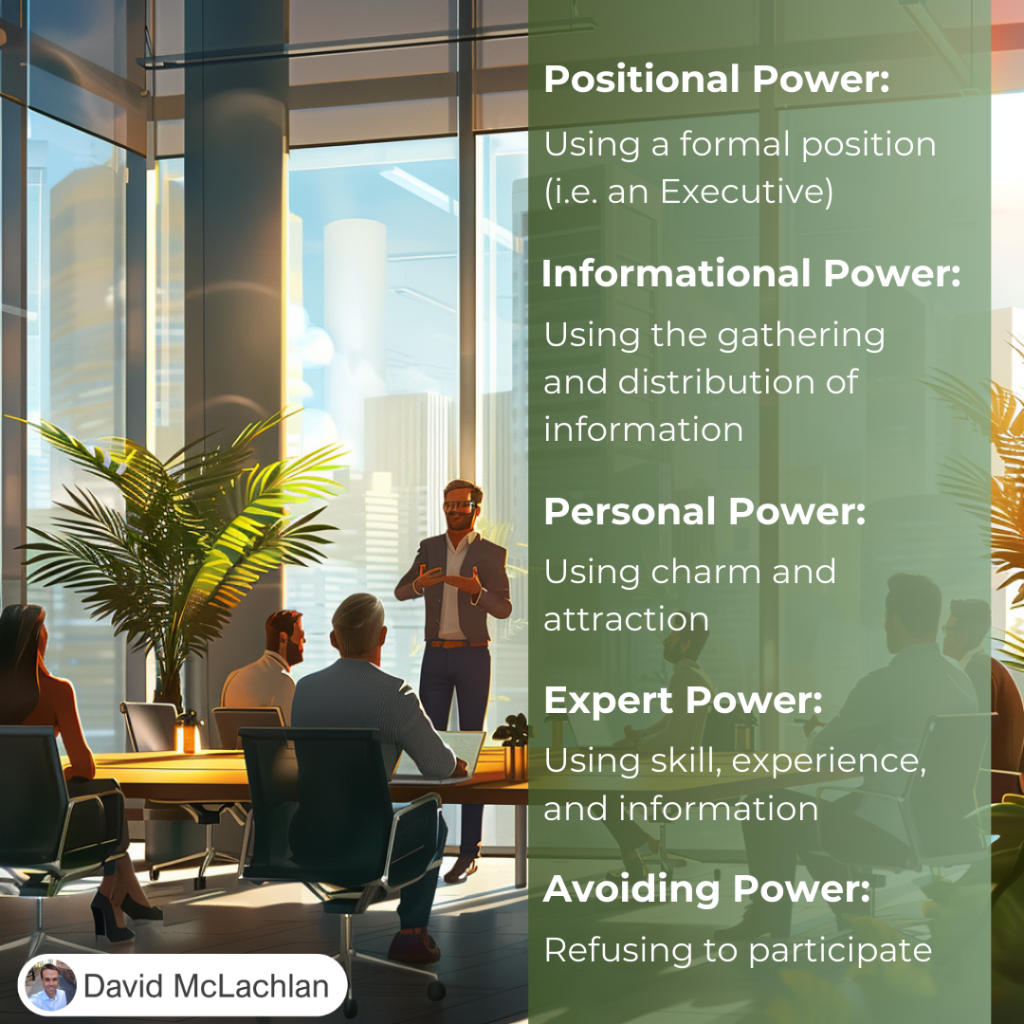
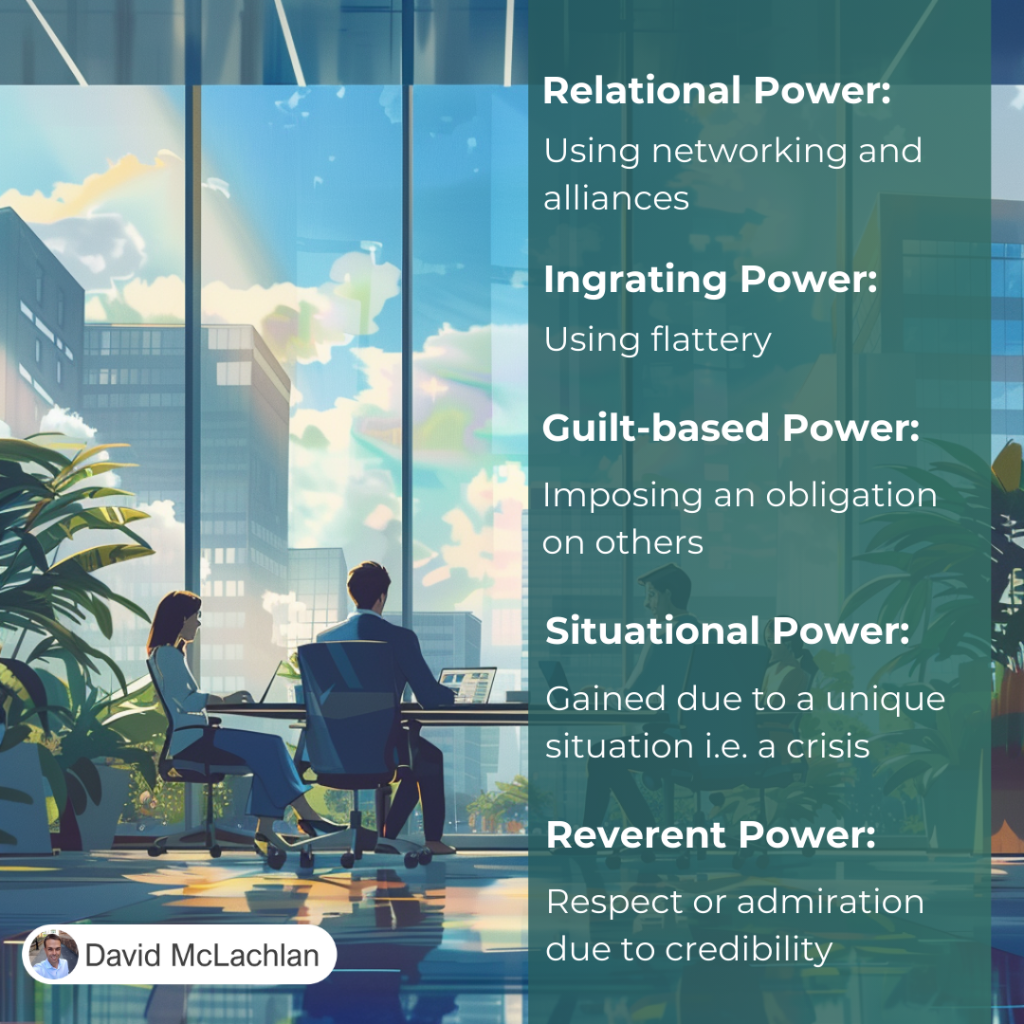
There’s a great list from the PMBOK guide on the types of power that you will come across.
You’ve got positional power, where you’re directly in the position of power as a manager or a leader.
Informational power, where you have information and you don’t need to share that with everyone – they need to come to you for that information.
Referent power, where you’re saying “The CEO asked me to do this, so everyone gather round and let’s get this done.” – we’re referring to someone else’s credibility.
Situational power, where maybe there’s a crisis involved and now all of a sudden we have more power because we need to really urgently get something done.
Personal power, using charm and attraction.
Relational power, where you are using your network of people
Expert power, where you have expertise in a certain area.
Rewards, where you can give rewards for certain things and that makes people want to do things for you.
Coercive power, where you might say “Something bad will happen if you don’t do this,” you’re coercing people into doing what you need.
Ingratiating power, where you’re using flattery – “Look how wonderful you’re doing, such a great job, you’re a wonderful person because you’re helping me out.”
All of these are valid, and you’ll find that when you’re aware of them you’ll see them more and more in your own workplace, and even in your day to day life. Within your family, within your friendship groups, it’s really great to be aware of.
And there are more.
You have pressure based power, limiting that freedom of choice.
Guilt based power, where maybe you did something for them and now you’re putting a bit of a guilt on them.
Persuasive power where you’re simply providing the right arguments, and lastly;
Avoiding power, where you’re simply refusing to participate.
These types of power will be on the PMP exam you’ll usually encounter them in some way shape or form simply because they’re part of everyday life and getting things done.
There are also different personalities that you’ll come across in your life as a project manager, and they are:
Authentic,
Courteous,
Creative,
Cultural where you’re measuring the sensitivity to other’s cultural values,
Emotional, being able to perceive other’s emotions quite easily,
Intellectual, which is just human intelligence and management practice
Political, understanding the political environment and how to make things happen,
Service-oriented where we’re serving others, maybe as a servant leader.
Social,
Systemic, where we’re understanding the need to build systems around things and ways of work and making it easier for people through processes as opposed to just forcing things through.
Those are the types of power and types of personalities you will find in your career and on the PMP Exam.
“Your most unhappy customers are your greatest source of learning.” – Bill Gates
Have you heard this leadership quote from Bill Gates?
William Henry Gates III was born on October 28, 1955 and is an American business magnate, software developer, and philanthropist. He is one of the best-known entrepreneurs and pioneers of the microcomputer revolution of the 1970s and 1980s, specifically as the co-founder of Microsoft Corporation.
Complaints are Little Nuggets of Gold
Bill Gates famously said that unhappy customers are the greatest source of learning, but it’s not just Bill Gates who believes this. Another of the richest people in the world, Jeff Bezos, famously had customer complaint emails come to an inbox he could see himself in the early days of Amazon, so he could see where customers were unhappy.
Complaints Reveal Weak Points in Your Process
The power behind unhappy customers is it shows us where our process is falling down and not meeting expectations. When our product or our service is meeting or exceeding our customers’ expectations, that’s when they start doing the work of selling our product for us. They talk about it at barbecues, they recommend it to their friends.
Likewise however it’s a great thing to talk about when they have a chance to complain and warn their friends and family against buying something when it has not been a good experience.
If everything is a process – whether we have articulated that process properly or not – then any complaints allow us to fix those weak points, build a better way of doing things and ensure it is done that way every time.
Bill Gates had it a little bit easy – he was dealing with software where he could update it and make fixes when it was necessary. Of course his main products, Microsoft Windows, and then Microsoft Office, weren’t perfect at first. They garnered a lot of criticism. But the company improved it over time, and ensured it was the best thing to use for its customers, and subsequently Bill Gates (and Jeff Bezos) have become very, very rich.
“The moment one definitely commits oneself, then providence moves too.” – William H. Murray
Have you heard this leadership quote from William H. Murray?
William Hutchison Murray was a writer from Scotland who lived from 1913 to 1996. He was an active mountain climber and writer before and just after World War II, even writing on small scraps of paper available to him while a prisoner of war during World War II.
The Entire Quote is Even More Powerful
While it makes sense to say that until one definitely commits oneself, there will be setbacks, the whole quote from William H. Murray has even more sense to it.
“Until one is committed, there is hesitancy, the chance to draw back. Concerning all acts of initiative (and creation), there is one elementary truth, the ignorance of which kills countless ideas and splendid plans: that the moment one definitely commits oneself, then Providence moves too. All sorts of things occur to help one that would never otherwise have occurred. A whole stream of events issues from the decision, raising in one’s favor all manner of unforeseen incidents and meetings and material assistance, which no man could have dreamed would have come his way. Whatever you can do, or dream you can do, begin it. Boldness has genius, power, and magic in it. Begin it now.”
It Seems Like Magic
And of course it seems like magic. Before you were truly committed to something your success in it was fleeting, it would come and go, it would show itself and then disappear. But then something changed in you – you found a new reason to do this thing, a deeper reason. Perhaps you had a new family to care for, perhaps you wanted to impress someone you liked, perhaps you felt as though this path was your true calling. And that reason gave you commitment, and from that moment it seemed as though doors opened more easily.
Sure, you worked hard, but perhaps it didn’t seem like work. You were working towards your dream, or a higher calling. And the commitment helped you see things you wouldn’t normally have seen, and do things you wouldn’t normally have done. And because of that, it felt like magic, it felt like Providence was truly helping you walk along your journey.
What have you been working on? Are you fully committed, or could you be more committed to it? If you are sitting on the fence, remember this quote by William H. Murray.
When you are working as a project manager, you don’t necessarily own a team of your own inside the business. Instead, you’re usually coming in and using business resources to help you deliver something, and they may not report to you on a daily basis.
Because of that it’s very interesting to look at the project manager’s sphere of influence, because it really does vary and it is different to a normal manager’s sphere of influence. For example, the normal manager will have direct influence over their team – they can pretty much hire or fire, they can tell their people exactly what to do with real consequences. Sure, a project manager can in some ways do that as well, but it’s much more prominent as a functional manager will have direct control over those people.
A project manager will need to have influence over the project team, and the managers and the resource managers for those people. But it extends out even further. They need to work with and ensure influence and responsibility for the project sponsors – who we’re delivering that business value to. There are also governing bodies around the project such as the steering committee of the project. There’s project management organizations or PMOs – all of these within an organization will need to be worked with, and you’ll need to provide information make sure that they’re working with you not against you, and ensure there’s little friction so that you can help get those things delivered nice and smoothly.
And that’s all part of being in the project manager role.
Beyond that we’ve got stakeholders of the project, for example suppliers who are supplying either resources or tools or things or information into the project. The end customer and the end users as well – all of these people will ultimately be influenced by the work that we do and so are subject to the project manager’s influence over the project.
A project manager needs to lead the project team and meet the project objectives, and meet or manage their stakeholder’s expectations. If things need to change over time a project manager will need to use their skills to ensure that stakeholders support the project instead of going against the project (which definitely can happen if things go sideways) and even to support the project decisions even when they don’t agree with them sometimes.
That can be a very challenging situation but it will be something that you do need to work through. It was noted in the PMBOK guide that the top 2% of project managers demonstrate superior relationship and communication skills, while displaying a positive attitude.
Even when things get tough, they still are able to display a positive attitude and work through those issues in a positive way. This is so they can keep those good stakeholder relationships as well, and work through those things in the future. It’s very, very important.
A project manager must also have influence over the organisation, working with other project managers in the organization. Maybe you’ve got 10 projects going on at the same time and maybe there are different resources required – this project needs some of your resources and now you have to ensure that you’re using your power and influence and your skills to make sure that your stuff still gets done at the same time as helping out other projects around the organization.
It can be a tough situation, but it is something that you will need to be aware of. Other projects may impact yours due to demands on the same resources, funding (maybe they need money and it’s coming out of the same bucket of money), impacts of the change to the business. Sometimes the business can only handle so much change going into it, such as training and communication and process changes that need to be done, and they have their business as usual work that they need to do as well, so sometimes they just run out of capacity to take it all on.
As project management capability is increased it’s also important throughout the organization that everyone is operating from the same playbook, the same strategic steps, the same tactical steps (such as processes that you go through to complete a project), so that everyone is is on the same page and knows what you’re talking about. It’s a much nicer shortcut to working with others when everyone is working from the same process steps.
But that is not all.
The project manager needs to work with the industry as well. We need to stay informed about current industry trends, no matter what industry you’re in all of these things are constantly changing and it’s up to us to be aware of what’s happening in our industry because they might impact our project. Something could come out of the blue and completely change the landscape, and we need to be aware of that.
We might have product technology development, new market niches. You might have broader economic forces, for example maybe the stock market is starting to fall, or maybe money is flowing out of this particular industry. We’ve got new tools, new skills or disciplines (for example Agile coming into IT around 15 years ago and now into project management, and also into operations management).
We’ve got new competitors, new threats and of course new laws and regulations. We seen our fair share of of regulation changes over the last few years in almost every industry.
But that is still not all.
A project manager needs to influence and be aware of their own professional discipline as well. That means continuing our professional development, continuing to learn, continuing our education and sharing that knowledge, the things that we’ve learned with others within our organization to help everyone sing from the same hymn book, to work from the same process steps. Beyond the organization is helping other organizations improve their way of work and their methods for delivering projects as well. It might include standards for delivering change around the world, whether it’s in your industry or other industries. This is a wonderful thing because now we’re not just helping ourselves, but we’re going out there and helping others where we can as well – we’re developing our project management knowledge, our knowledge in our related profession and we share that at local, global and national levels.
Lastly the project manager’s sphere of influence will occur across disciplines. And that’s part of the real value of project management because project management is a skill set that will sit across almost any industry, because any industry will require to put change into an organization or to go from point A to point B at some point, and to do that you need a project. To do that change you need to manage a project from start to finish. In using a project management process that works across disciplines we can help coach, improve and inspire others in that method to help them get the business value that they need.
The Role of the Project Manager and Leadership Types
Part of managing a project and being a project manager is having the skills and qualities of a leader. The reason for this is because we have to lead people and influence people and help people and smooth over situations, or help go through situations or assist in situations to get the desired result. And all of that comes down to being a leader.
The qualities and skills of a leader according to the PMBOK guide (The project management body of knowledge) for project management is communication. Often what is quoted is nearly 90% of the time a project manager will be communicating with others, helping all those different bits and pieces come together, getting information into the right areas and making sure that communication is taking place.
We also need to be giving feedback constructively and accepting feedback graciously, and managing expectations in the right way. Being a leader also means being respectful, kind, being honest, being loyal and being ethical in the way that we do business. It means giving credit to others where credit is due.
Usually as a leader myself I would prefer to give credit to my team and if something goes wrong then I would take the blame for that, and help improve the process and help coach and improve team members. Taking the blame myself as the leader for anything that goes wrong, while giving praise to everyone when a team effort or even an individual effort goes right.
Being a leader also means being a lifelong learner. Continuing to learn and continuous improvement, being able to sift through massive amounts of information to get to the important information. Wow is that a good one! You’ll see this in the project management tools and techniques for each process as you go through the PMBOK guide – you will see expert judgment and data analysis are actually the top two tools and techniques, along with meetings.
Long story short, if you don’t like meeting with people and sifting through amounts of information and data and communicating a lot then those are the skills that you will need to work on to help do this in the best way possible.
You’ll need critical thinking, and to be service oriented for the people who you’re delivering that business value to.
The Six Types of Leadership
There are many different leadership styles as well.
There is the laissez-faire leader, which is a hands-off approach allowing the team to make their own decisions.
There is the transactional leader, where we’re focusing on achievements, and “I’ll do this for you if you do this for me,” where we’re transacting instead of maybe doing other management or leadership things.
The servant leader will focus on others’ growth and their learning, it’ll be a coaching role but also someone who coaches. They carry food and water for the team (metaphorically) and they will really get in and get their hands dirty. They will facilitate all that communication as opposed to just directing things all the time.
There is a transformational leader, a visionary leader, and they’re inspiring and they’re motivational.
The charismatic leader is high energy, they’re self-confident and they hold strong convictions. Usually people are drawn to these charismatic leaders because they are naturally people who draw other people to them. That can help them get things done in an organization – which is really great.
There is an interactional leadership style, which is a combination of a few – the transactional, transformational and charismatic leadership styles.
The Difference between Leadership and Management
Leadership and management are not the same thing. You have probably heard this before but project managers will need both to pull off the work that they do. For example “management” – even though being a boss instead of a leader could be seen as being a bad thing – sometimes you do need to work on your management skills to manage things and get them done.
Whereas leadership and guiding and coaching and being more visionary, that is also important from a strategic perspective. Seeing the bigger picture for example. Through leadership you’ll be guiding and influencing and collaborating with people, you’ll be focusing on the systems, the broader systems and the structure of things instead of the nitty-gritty.
You’ll be looking at the long term vision, inspiring trust with your people, and looking at the “why”. “Start with why”is that famous book by Simon Sinek. They start with the broader “why” behind things and then work on how and what we’re doing.
Management on the other hand is that smaller day to day nitty-gritty stuff. It’s your near term goals, really getting things done, relying on control such as the direct control you have over your team, and then focusing on the how and when things are getting done instead of just the why. It’s the bottom line, managing that cost and that’s still important. You do need both and you need it in a balance to be a good project manager.
Below you will find all the project management lessons so you can learn all about Project Management. Direct from the Project Management Body of Knowledge (PMBOK), these lessons will help you navigate the often difficult waters that are a part of completing a project or change in your organisation.
Project Management Introduction, Overview and Basics
Well done for working towards a better career and improving your life and knowledge! Project Management is one of the best overall disciplines to help you navigate difficult organisation situations when you are trying to delivery value and make a positive difference.
“Success is the result of nothing more than a few simple disciplines, practiced every day.” – Jim Rohn
Have you heard this leadership quote from Jim Rohn?
Jim Rohn was an american business man and motivational speaker. He left college as a young man after just one year and soon found himself behind on his debts. in the mid 1900s he was mentored by millionaire John Earl Shoaff, went on to create a multi million dollar fortune for himself, and spoke around the country on his personal philosophy that led him to his millions.
Success is Simple, But Not Easy
Jim Rohn understands the power of discipline – he had to use it himself to create his own fortune in the mid 1900s. Discipline doesn’t have to be on big things either, it can be a few simple things, as long as you have the tenacity to do them every day.
When you do something every day, even if it’s small, it builds upon itself until that first small result grows into something much larger. It is the power of compounding, and it works just as well for your money as it does for your skills, your home, your marriage and your friendships.
If you take a dollar, and you put it away every day, in a year you’ll have $365. When you earn 10% return on that money, you have an extra $36, and next year you’re earning a return on your money saved PLUS the return. In this way it grows and grows, even though it starts out small.
Now if you practice and perform something every day, maybe it’s making a call for a sale, maybe it’s catching up with your team, maybe it’s doing a new skill for a job you want to move into. If you do it every day your skill starts out unimpressive. But it builds, and it grows, and if you continue to do it every day you will be improving through your practice AND the existing experience you have gained.
Have the discipline to do something every day and you will be rewarded in ways you cannot imagine today.
 Three Parts To Integration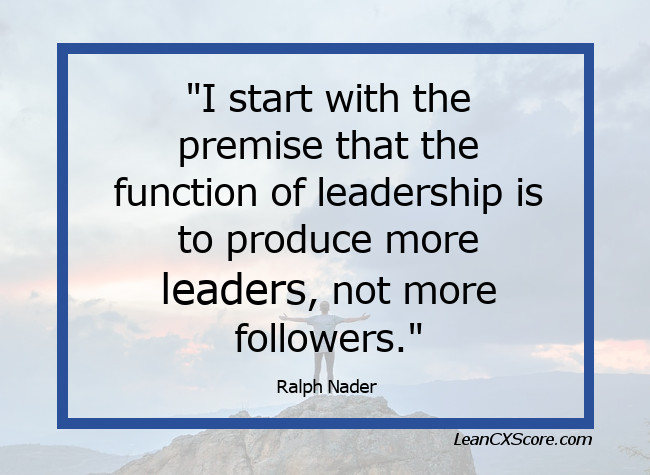



 The Project Manager’s Sphere of Influence
 The Role of the Project Manager and Leadership Types
