Standard Work and Kaizen: Two Sides of the Same Coin

Describing Lean to people can be both extremely easy, and extremely hard.

Easy because many people brush over it in a sentence, and tell their audience of the massive increase in quality and reduction in time it takes to do the work that Lean can bring.

Hard because the depth of Lean, once you really get into it, is massive.  Yes, it is a method for improving your business, and your work processes, and it can increase quality and reduce delivery times significantly.  But it is also a mindset change, where team-mates embed a problem solving and continuously improving culture that supports the tools.

If you are talking to someone with even the slightest knowledge of Lean tools and practices, however, I’ll make it easier for you.  That’s because I can sum it up in two concepts: Standard Work, and Kaizen.

Standard Work

It’s hard to improve something that you don’t have.  That is why it’s important to have a standard, repeatable process in place before you set about improving it.  While this might seem like a mundane or ordinary thing, very few companies actually have it (or even know how important it is to have).

Michael Gerber called it out in his best selling book “The E-Myth, Revisited”.  He used the term “operating manuals”, but it doesn’t matter what you call them.  If you don’t have Standard Work in your job or business, there’s a good chance you will have to hire or work with expensive “experts” with their own knowledge and way of doing things, or rely on people who have been doing the job for years.  Their methods may not even mesh with what you want, and certainly may not match the work culture you already have in place.

With a good standard operating procedure, a person off the street should be able to come in and do the job with a minimum of training.

Kaizen is Continuous Improvement: Every Person, Every day

Kaizen is the term for continuous improvement in Japanese, and when we have a stable, standard process, it is our aim to work on improving it.

We do this by calling out problems as quickly as possible – anything that slows it down, causes re-work, waiting, unnecessary inventory (pretty much any of the eight wastes).  It means supporting a culture that celebrates problems instead of hiding them, that error proofs the process or at the very least stops work if something is not right.

Put Together, They are Unstoppable

So we have standard work, then we improve it.  This creates a better process, and we can improve that.  This creates a better process again.  As we progress, lead times go down.  Re-work goes down.  Complaints go down.   Costs go down.  Morale goes up.  Customers are happier.

And suddenly, you find yourself enjoying your job again.

Yours in change,

David McLachlan
Why is Game of Thrones Lean?

Two of My Favourite Things

Game of Thrones is one of my favourite shows.  Sure, you have to send the kids to bed before you click that play button on the DVD player, but it’s a great reminder of the cool things you can do as an adult.  Like watch a lady-knight and a man-knight kick each other in the groin.  Ok – cool, and slightly disturbing.

Lean is also one of my favourite work philosophies.  Sure, not many people really understand it, but when you are surrounded by a few good people who do, life just seems that much easier and worthwhile.

This is why I nearly wet myself when I stumbled across the fact that Game of Thrones is, well, Lean.

Enter a Good Friend

A good friend of mine gets HBO every year for the few months that Game of Thrones is on cable.  This year, a funny thing happened when he called up to arrange access.

After the first ring, a voice prompt said: “Press “1” if you are calling because you want to watch Game of Thrones this season.”

He pressed “1”.

It took her to another section where he was prompted to enter his cable details and password to confirm.  And it was then that a beautiful thing happened.

He was automatically signed up for just the right channel so he could watch Game of Thrones, placed on his regular bill so no additional payment details needed to be given, and which would also cancel immediately and automatically when the season ended.  No more, no less.  Just the right amount, just in time.

When a Company Gets it Right, It’s a Beautiful Thing

The cable company nailed it.  They knew that value is determined by the customer, and that seven million viewers can’t be wrong.  They separated the hordes of callers all wanting the same thing, gave them exactly what they wanted, when they wanted it, in one simple, speedy, transaction, and enabled the regular call centre staff to continue doing their job.

When customers get the value they crave, the financial rewards flow for the company delivering it.  The stock price of said cable company has gone up more than 100% in the last two years.  Not a bad return.

Now, I just have to hold my breath for the next series, and hope like crazy that George R. R. Martin finishes the books in time.

Yours in change,

David McLachlan

Lean Articles Vault

Review Our Lean Articles Archive

Below is a list of the Lean articles published at Five Minute Lean.   Click on any of the links below to learn more about these Lean methods.


Seth Godin on the Gemba

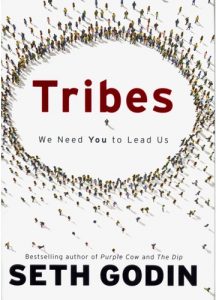
Seth Godin, author of the fantastic book “Tribes” often brings great ideas to the marketplace and certainly has more than a few hungry customers ready to snap up his every word.
In the book Tribes, Seth notes that “the top isn’t the top anymore, because the streets are where the action is”.

What he’s describing, without knowing it, is the Gemba.  Otherwise known as “where the work is done”, the Gemba is where the action is, where the customer interacts with us, and where we have the power to make or break a company.

Leading from the top is no longer enough.  Simply decreeing change will no longer work, it has to be led from the ground up.  The best way to discover customer value is by being there on the front lines.  The best way to see wasteful processes is to be there performing them.

Leading from the bottom, by creating a movement, a groundswell, a crowd of raving fans, is also the way to incite positive change.  Whether it is in a company or an entire industry, change is led from the bottom more than ever before.

And when we have a movement, an idea worth believing in, then all we need is a means to connect and communicate with our tribe and create that groundswell.  We have the tools to do this already at our fingertips – with Twitter, with Facebook, with WordPress, with dozens of other tools, all free and easy to use.

So if you’re having trouble connecting to your customers or inciting change, go to the Gemba.  Those third-hand reports you’re getting are simply not going to cut it.

Yours in change,

Dave McLachlan

First Pass Yield: Lean Glossary

– Back to Lean Glossary –

First Pass Yield: What Is It?

First Pass Yield is the amount of times as a percentage that a process goes through perfectly the first time.  Or to put it another way, it measures how many times you need to go back through the previous steps to get additional information or fix a defect.  An example might be a car’s paint job that has bubbles or patches or in an office environment it might be a form that is not filled out correctly and needs more information from the previous department.

If our item comes through correctly 70% of the time, then we have a “First Pass Yield” of 70%.  Or if you prefer, you can note it as re-work which is one of the eight wastes, in which case it would be re-work of 30%.

Ideally we want our first pass yield to be 100%.

First Pass Yield is almost a by-product of a good Lean implementation.  To increase it, we are targeting the waste of defects or re-work.  We can use Poka-Yoke (Mistake-Proofing) to avoid errors.  We can add Visual Management and Jidoka to see if the process is broken and should be stopped, fixed or looked at.  We can ask our 5 Whys if something is continually happening that requires rework.  We can use Line Balancing and One-Piece-Flow (or get as close as we can to it) to reduce information silos that might be causing rework.

All of these tools work together to increase First Pass Yield.

– Back to Lean Glossary –

Design For Manufacture and Assembly: Lean Glossary

– Back to Lean Glossary –

DFMA: What Is It?

Design for Manufacture and Assembly (or DFMA) is where the process is designed for ease of manufacture and ease of assembly, so that everything fits perfectly together at the end.  This can help a product be made with fewer parts and at the best price.

A good example of this is IKEA – especially in Europe – where everything is made to fit together perfectly so the end user can assemble easily, and prices are much cheaper than can be found in other stores.

In your own work it might be a process that has all its parts come together at exactly the right time and fit seamlessly for the end result.  The idea is to keep it simple, or to quote a phrase that is attributed with Albert Einstein – “Everything should be made as simple as possible, but not simpler.”

You will notice that DFMA also ties in with increasing First Pass Yield, reducing defects and reducing the wastes of “over-processing or over-designing” a product.

– Back to Lean Glossary –

Work In Process (WIP): Lean Glossary

– Back to Lean Glossary –

Work in Process: What Is It?

Work in Process are the items between process steps within a value stream.  In Lean systems, standardised Work in Process is the minimum number of parts, including parts in machines or queues, needed to keep a department of process step flowing smoothly.

A Supermarket is one of the most common standard ways for implementing Work in Process if necessary.

By David McLachlan

– Back to Lean Glossary –

Voice Of The Customer (VOC): Lean Glossary

– Back to Lean Glossary –

Voice of the Customer (VOC): What Is It?

The Voice of the Customer (VOC) is a term used to describe the gathering and analysing of data around what the customer needs and wants.

It can be collected using tools such as the Net Promoter Score and analysed using tools like Kano Analysis.  Either way, our customer is any department or step after us in the process, and also the most important – as Value can only be determined by our customer and to get this we have to ask.

By David McLachlan

– Back to Lean Glossary –

Value Stream Map: Lean Glossary

– Back to Lean Glossary –

Value Stream Map: What Is It?

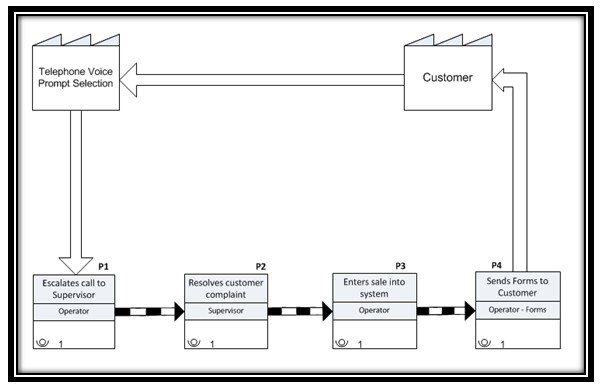
A Value Stream Map is the accepted method for mapping a process flow or “Value Stream”.

It starts with the customer in the top right, and a Supplier in the top left corner, and shows the steps in the value stream from left to right.

lean value stream map basic

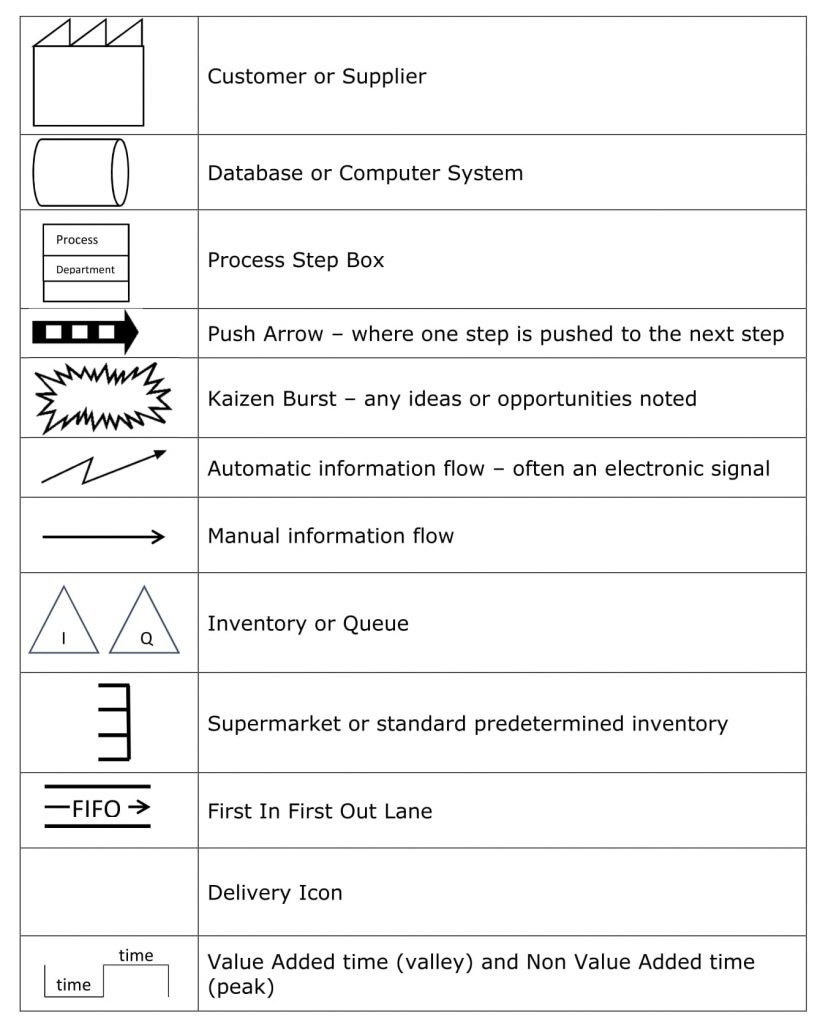
Value Stream Mapping icons have evolved over the years to include many different Lean tools, such as FIFO Lanes, Supermarkets, rework, inventories or queues, Push, Pull and many others.  For this reason it can seem quite complex, however a Lean practitioner will often argue that with a little practice or experience they are able to see the full process at a glance with the help of these icons.

lean value stream map icons list

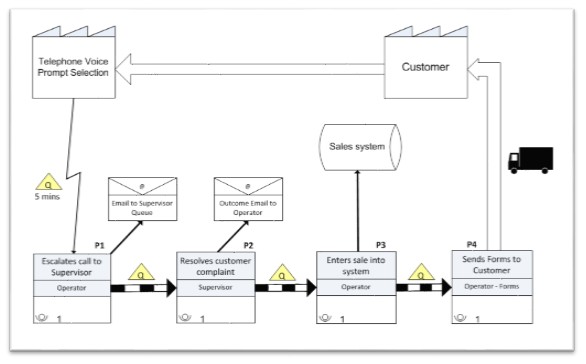
Once you’ve added the icons, measures and wastes to your Value Stream Map, it will often look like this:

lean value stream map example

Other practitioners may prefer a Swim Lane Flow Chart.

By David McLachlan

– Back to Lean Glossary –

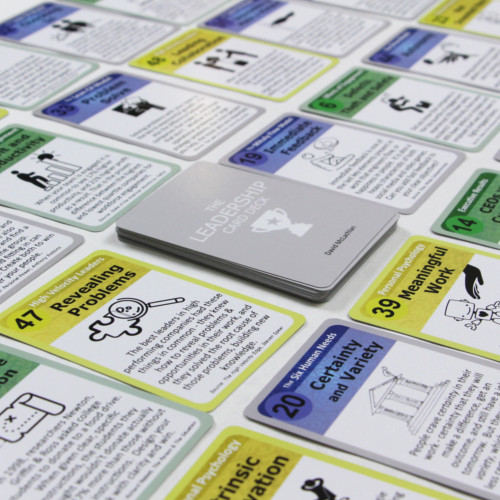
Get the Leadership Card Deck or the Five Minute Lean Book:

Leadership CardsView All The Leadership Cards (48)

- or - Have the Leadership Cards delivered for your next meeting


Want to learn about Lean? Get the book "Five Minute Lean", by David McLachlan - a wonderful book that blends teaching of the tools, culture and philosophy of traditional Lean with a modern-day Lean parable. You can get the whole book on Amazon here and enjoy your own copy.

Value: Lean Glossary

– Back to Lean Glossary –

Value: What Is It?

Value in Lean terms is always determined by the customer.  And you can’t just guess, you need to ask.  Lean is about getting information from the source, from the Gemba, and determining Value is no different.

When mapping a Value Stream, it is important to note whether a process step is:

  1. VA:   Value Add
  2. NVA:  Non-Value Add
  3. NVAR: Non-Value Add but Required

NVAR steps might be something that doesn’t add value to a customer or the end product, but is required for regulatory approval.

A Value Stream is how a process flows from start to finish as it delivers value to the customer.

By David McLachlan

– Back to Lean Glossary –