Net Promoter Score: Lean Glossary

 – Back to Lean Glossary –

Net Promoter Score: What Is It?

The Net Promoter Score is a method of gauging customer satisfaction that was outlined in “The Ultimate Question 2.0” by Fred Reichheld.  It is a simple method that involves asking a customer after they have received their product or service the following question:

  • “On a scale of 1 to 10, how likely would you be to recommend us to a friend?”

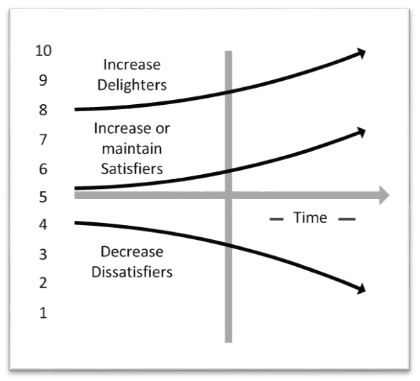
The results can often be output into a Kano model, outlining delighters, satisfiers and dissatisfiers based on how high the score is.

The most common mistake people make, however, is not including the follow-up to this “Ultimate Question”.  And that is, if a customer rates your product or service less than an 8 to ask the next question:

  • “And what would it take to make it a 10?”

This allows your customer to tell you in a safe environment, free of judgement, exactly what would “delight” them and how you can make your product or service the best it can be.  It also has the power to save you a lot of time in analysing the problem by simply asking.

– Back to Lean Glossary –
Line Balancing: Lean Glossary

 – Back to Lean Glossary –

Line Balancing: What Is It?

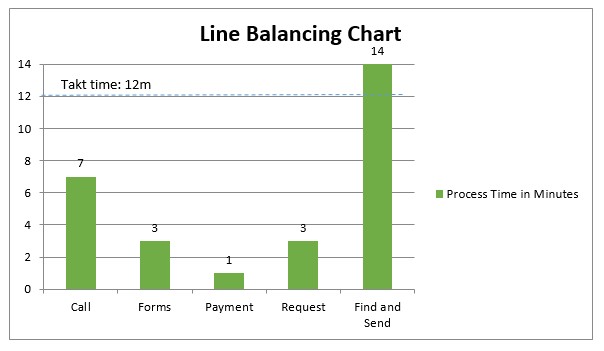
Line Balancing is based on the premise that a process is only as fast as its slowest part.   A line balancing chart shows us our process steps in order, with timings (usually as a bar chart).   It then becomes easy to see the processes and how long they take.

In many cases we can combine the faster processes together – reducing queues, wait time, re-work and working towards one-piece-flow, and together they will still be faster than the slowest part and takt time.  Sometimes there is more than one “slowest” part in a process.

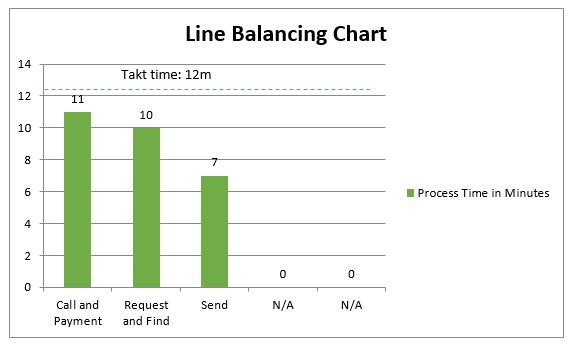
To perform line balancing, we take the times for each part of a process and put them in order on a bar chart.  A line is drawn in to show the time of customer demand, or takt time.

lean line balancing chart

We then look at the faster processes and see which ones we might be able to combine, while still keeping them faster than the slowest process.  We can also look at the slower processes, and see where we can split them up, so that if they are performed in parallel (at the same time) it can speed up the overall process.

lean line balancing chart

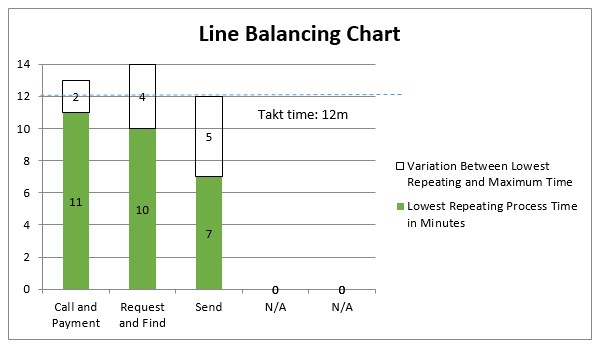
You can also include the “variation” in your process, with a dotted line or empty bar.  This way you will know the maximum it has been, while keeping in mind the average as well.

lean line balancing chart

– Back to Lean Glossary –

Get the Leadership Card Deck or the Five Minute Lean Book:

Leadership CardsView All The Leadership Cards (48)

- or - Have the Leadership Cards delivered for your next meeting


Want to learn about Lean? Get the book "Five Minute Lean", by David McLachlan - a wonderful book that blends teaching of the tools, culture and philosophy of traditional Lean with a modern-day Lean parable. You can get the whole book on Amazon here and enjoy your own copy.

Kano Analysis: Lean Glossary

 – Back to Lean Glossary –

Kano Analysis: What Is It?

Kano Analysis is a method of measuring customer satisfaction.  Data from customer satisfaction surveys (like the Net Promoter Score) are taken and output to a graph that shows how well a task was performed on the horizontal axis, and the level of customer satisfaction on the vertical axis.

This results in “Delighters” being in the top quadrants, “Satisfiers” through the middle and “Dissatisfiers” in the bottom quadrants.

The three main customer needs that should be met and improved in order to improve your Kano score and constantly “delight” your customers are:

  1. Expected Needs, that are the basic must have qualities expected in a product.
  2. Normal Needs, that are the wants of a customer in a product – things that a customer wants and will pay for.
  3. Exciting Needs, that are the “wow” level qualities of a product, positive surprises and extra touches that create raving fans.

You should be warned that over time, Normal needs become “expected” in the market place, and often Exciting needs become “normal”.  You must not remain stagnant if you are to keep delighting your customers.

lean kano analysis

A company that is continually giving all a customer’s musts or Expected needs, plenty of customer wants or Normal needs, and the best wow factors or Exciting needs is the company that gets ahead and stays ahead in their field.

– Back to Lean Glossary –

Kanban: Lean Glossary

 – Back to Lean Glossary –

Kanban: What Is It?

Kanban is the Japanese term for “Signboard”.  It is a way of signalling that gives authorisation and instructions for the production of items in a Pull System.

The most common form of Kanban is a card that holds the relevant information on it, telling an upstream process the type and quantity of products to make for a downstream process when the demand arises.

Kanban is therefore an important part of a Pull System, where items are produced at the demand of the downstream process or customer.  It also works well with a Supermarket, where a small inventory is kept and a Kanban is sent when the inventory is running low or emptied.

– Back to Lean Glossary –

Flow: Lean Glossary

 – Back to Lean Glossary –

Flow: What Is It?

Flow is defined as the Flow of a product as it moves through a process.  In Lean, the aim is “Continuous Flow”, where a product can move through the process stream uninhibited by queues, wait time, down time, re-work or other wastes, and with each step making only what is requested by the next step.

The ultimate Flow is “One Piece Flow”, where a product is made in as close to one place and time as possible and at the demand of the customer.

Flow production was introduced originally by Henry Ford, with the aim to drastically reduce human effort and the throughput time of the product.

– Back to Lean Glossary –

Fishbone or Ishikawa Diagram: Lean Glossary

 – Back to Lean Glossary –

Fishbone Diagram: What Is It?

First implemented by Kaoru Ishikawa, a Fishbone diagram is a method of getting to the root cause of a problem, challenge or opportunity.  It is often used in conjunction with a Kaizen meeting or event, and the 5 Whys.

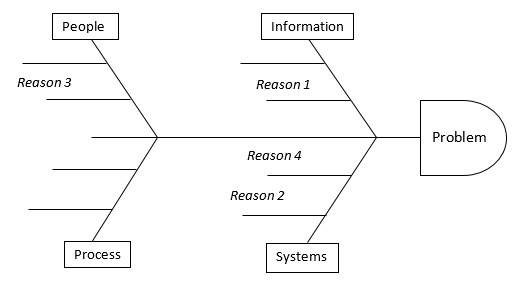
To use a fishbone diagram, the problem (or “effect”) is stated at the “head” of the fish, and different areas are noted as the “bones” of the fish.

Traditionally from manufacturing environments, the bones for each area were noted as:

  1. Man
  2. Material
  3. Method
  4. Machine

In an office environment, it is often clearer and easier to state the areas as “PIPS”:

  1. People
  2. Information
  3. Process
  4. Systems

With a fishbone diagram, you brainstorm reasons with your team for why the problem is happening, and associate these with each area.

fishbone diagram

Once completed, these reasons are grouped together – for instance there may be three main “causes” that are similar, but relate to people and to process.  They are given the same number so the causes can be chunked together.  We can then delve deeper using the Five Whys.

Also check out this excerpt on finding the Root Cause from the book Five Minute Lean! It goes into the 5 Whys, Fishbone Diagrams and more.

– Back to Lean Glossary –

FIFO Lane: Lean Glossary

 – Back to Lean Glossary –

FIFO Lane: What Is It?

FIFO Lane stands for “First In, First Out”.  It is the method of ensuring that the first part to enter a process or storage location is also the first to be used or taken.

A good example of this is the bread isle in your local supermarket, where bread is loaded at the top of the lane, and typically taken from the bottom.  This ensures that the oldest bread is taken first.

A FIFO Lane works extremely well with other Lean Principles.  If the lane is full, no more product needs to be made (avoiding over production).  An Andon can be used as a visual trigger for full or empty lanes.  As an item is taken, it can trigger production once again, and this is often done with a Kanban.  As product is only made as it is pulled by the customer, it becomes an excellent example of a Pull System.

– Back to Lean Glossary –

Cycle Time: Lean Glossary

– Back to Lean Glossary –

Cycle Time: What Is It?

Cycle time is the amount of time it takes an operator to complete their process step from start to finish.

It is not to be confused with Lead time, which is the total amount of time starting when the customer places an order to when the product (or service) is delivered.

It is the opposite of Takt time, that is the rate of demand for a product as determined by the customer.

– Back to Lean Glossary –

Customer: Lean Glossary

  – Back to Lean Glossary –

“Customer”: What Does It Mean?

In Lean terms, the Customer is any person, department or work station that is downstream in the process from you.

Also in Lean terms, Value is always determined by the Customer (as a product or service they would be willing to pay for), takt time is defined as the rate of demand for a product as determined by the Customer, and implementing a Pull System in your workplace means waiting for your customer to request an item before creating the product.

 – Back to Lean Glossary –

Batch Processing: Lean Glossary

  – Back to Lean Glossary –

Batch Processing: What Is It?

Batch processing is producing large amounts of the same item, often in advance based on forecasting made by the company.

Batch processing is the enemy of Lean – as it often results in  over production (one of the Eight Wastes) requires much larger warehousing, additional travel of goods and is not based on real-time customer demand.  Batch processing can also result in unevenness (another enemy of Lean), as large batches are created followed by periods of downtime.

The opposite of Batch Processing is Continuous Flow, and especially One Piece Flow where an item is created in the same space and time based on the demand (Pull) of the customer.

 – Back to Lean Glossary –