Spaghetti Diagram: Lean Glossary

– Back to Lean Glossary –

Spaghetti Diagram: What Is It?

A Spaghetti Diagram is a top down diagram of the flow of product as it moves through the process or value stream.

Most commonly used for a single shop, floor or warehouse, a spaghetti diagram begins by drawing in the workstations, touch-points or departments and then draws lines between them to show the process flow.  It can also be used for a “high level” view across multiple departments or warehouses.

Often a diagram created before a Lean Transformation will look like a bowl of spaghetti, hence the name.

Things we can do to improve the look of our diagram include 5s to organise our space, reduce clutter and keep things close at hand, reduce any of the eight wastes, and even analyse the stations with the most touch points so we can move them close together.

By David McLachlan

– Back to Lean Glossary –
SOP or Standard Operating Procedure: Lean Glossary

– Back to Lean Glossary –

Standard Operating Procedure: What Is It?

A Standard Operating Procedure is a documented process that ensures work is done the same way each and every time.  It can be a simple checklist to mark off as you perform a job, or a list of steps in a process with pictures to assist your team-mates understand what they are doing.

Most Lean Transformations will start with and finish with a Standard Operating Procedure.  We start with them because we need to know how a process is currently working (or not working) before we can improve it.  We finish with them because we need to ensure we have a new standard way of operating that anyone can follow once waste is removed and value is increased.

Another benefit of having a current SOP is that it assists greatly in training and on-boarding new staff, and helps to reduce existing “silos” of knowledge.

By David McLachlan

– Back to Lean Glossary –

SMED or Quick Changeover Techniques: Lean Glossary

– Back to Lean Glossary –

Single Minute Exchange of Dies: What Is It?

SMED or Single Minute Exchange of Dies refers to the aim of reducing changeover time at workstations to single digit minutes (so no more than 9).

Shigeo Shingo developed the key ideas about SMED in manufacturing, which were:

  1. Separate Internal Setup operations and External setup operations
  2. Internal setup operations can only be done when a machine is stopped
  3. External setup operations can be done while the machine is running
  4. Convert Internal Setup Operations to External to reduce setup time.

While the original ideas related to manufacturing, Quick Changeover techniques can be applied to any industry where changeovers apply.  As well as using Shingo’s insights, we could use these four simple steps:

  1. Map the current changeover process
  2. Reduce wasteful steps and movements as per the Eight Wastes
  3. Utilise 5s to ensure items are close at hand and easy to find, and;
  4. Create a new standard process to improve the time

The benefit of using these steps is that time is improved but quality is not sacrificed – in fact in many cases quality may improve as well.

By David McLachlan

– Back to Lean Glossary –

SIPOC: Lean Glossary

– Back to Lean Glossary –

SIPOC: What Is It?

SIPOC stands for Suppliers, Inputs, Process, Outputs, and Customer.  It is a method of gathering the information needed around a new change project.  It is often one of the first steps in a Kaizen Event for a larger project.

Practitioners often add “Cr”, Customer Requirements and “M” for Measurements as well, making it SIPOCrM.

The standard order for gathering the information is:

  1. Process and process steps
  2. Customer and customer requirements
  3. Process Outputs
  4. Process Inputs
  5. Process Suppliers (upstream)
  6. Process Measurements

The information in a SIPOC can assist us in making a Value Stream Map and engaging correct stakeholders.

By David McLachlan

– Back to Lean Glossary –

Push: Lean Glossary

– Back to Lean Glossary –

Push or Push Production: What Is It?

“Push” or Push Production is where product is created regardless of downstream or customer demand, often in large batches.  Because it is not created to demand, product created using push production often needs to be warehoused and stored, resulting in additional unnecessary movement and taking up unnecessary space.

Push production often results in unevenness in a process, and low morale as team-mates are disconnected from the customer and downstream team-mates.

By David McLachlan

– Back to Lean Glossary –

Pull: Lean Glossary

– Back to Lean Glossary –

Pull or Pull Production: What Is It?

“Pull” or Pull Production is a method of production control, where downstream activities signal their needs to upstream activities instead of upstream activities “pushing” work onto the downstream process regardless of capacity.

Using Pull is a great way to avoid over-production, one of the Eight Wastes.  Pull is often implemented using a FIFO Lane or a Supermarket – both being techniques that limit production and signal when product is taken so it can be replenished.  A signal is often triggered using Kanban – a sign or card that shows the items and amount required.

By David McLachlan

– Back to Lean Glossary –

Problem Charter: Lean Glossary

– Back to Lean Glossary –

Problem Charter: What Is It?

A Problem Statement or Charter is one of the best methods for defining the problem at the beginning of your change initiative.  It is a great way to find out where you are starting from and what is required or expected from the project.

The typical problem charter includes:

  1. The Stated Problem
  2. The Current Situation and the Impact it has
  3. The new expected “Standard” or what we are aiming for
  4. The stakeholders or problem owners and;
  5. Any Team Members assigned to the problem

All of these can and should be included on a single A4 sheet of paper with the project name at the top.  This allows you to see all your information at a glance when necessary.

– Back to Lean Glossary –

Poka Yoke or Error Proofing: Lean Glossary

– Back to Lean Glossary –

Poke Yoke: What Is It?

Poka Yoke (po-kah yo-keh) is a Japanese term that literally means “Mistake Avoid”.  Translating to its English counterpart, it becomes “Error Proofing” and this is how it is used in Lean.

Error Proofing means using methods in a process step that helps our team-mates avoid making mistakes.  In other words, anything that makes it close to impossible to make a mistake becomes our Error Proofing ally in Lean.  The most common example of Error proofing is the household electrical plug – whose cable end is the exact shape and size to fit properly into the wall socket.  A USB stick that will only fit in a USB port in your computer is another great example of things that are nearly impossible to get wrong.

The idea translates to any work process with only a little imagination.  We have online forms with set, specific drop down menus, or character limits for credit card payment fields.  There are dispensers that only dispense the exact amount of an item required, and there are bar codes that are used to scan and record the exact item to avoid human error.

No matter what your line of business, you can find a way to “error proof” it.

By David McLachlan

– Back to Lean Glossary –

Pareto Chart: Lean Glossary

– Back to Lean Glossary –

Pareto Chart: What Is It?

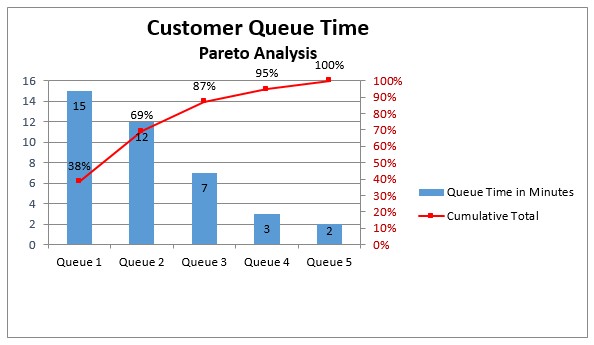
A Pareto Chart is a tool that refers to “Pareto’s Principle”, where it is common for 80% of results to come from 20% of the effort or inputs.  While these numbers are not set in stone they are often close, with similar percentages such as 70% of your problems coming from 30% of your processes, and so on.

Pareto Charts are often used to determine where you might get the best return on your effort when doing a Lean transformation – by focusing on the item that is causing the most problem.

To use a Pareto Chart:

  1. We get the data around the process or problem we are looking at and arrange it from largest to smallest in a bar chart.
  2. We then take the cumulative amounts (as a percentage) and overlay these as a line chart.  This will result in the bar chart moving down, and the cumulative line moving up.

Using this, you should be able to see at a glance where you will get the most return on focusing your effort.  Many people mark the “80%” line, so they can see where the majority of problems or opportunities lie.

– Back to Lean Glossary –

Overburden or Muri: Lean Glossary

– Back to Lean Glossary –

Overburden (Muri): Lean Glossary

Overburden or Muri is where team-mates or equipment are required to work harder, faster or more than is necessary, often because of wasteful steps or processes.

Reducing Overburden is one of the key reasons for implementing Lean.  You will see it during your transformation project in reducing rework, using 5s to keep areas tidy and tools close at hand, increasing visibility and streamlining processes to make things easier.

– Back to Lean Glossary –