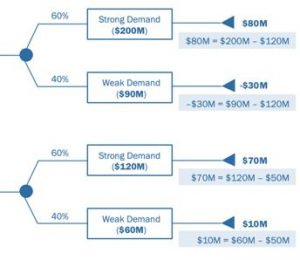
What is decision tree analysis? Decision trees are used to support selection of the best of several alternative courses of action.
We might have a few different ways that we could go in a project, and we actually need to start analyzing that and which one is the best and which one is not the best, and to do that we look at alternative paths through the project which are shown in the decision tree using these branches, representing different decisions or events.
Each of these branches can have associated costs and related individual project risks assigned to them as well. Those risks could be both positive or negative as we know – we’ve got threats and opportunities.
Decision Tree Example Analysis
Here is an example of what that looks like. We’ve got the different branches of the tree and each one has a cost associated with it, and also the probability and impact of the risks associated with that decision path. That is a really handy thing to know, and we need to know what happens if something goes wrong – what’s the cost of that? And also what’s the cost to take that path?
The endpoints of the branches in the decision tree represent the outcome from following that particular path which, can be negative or positive, and the decision tree is evaluated by calculating the expected monetary value of each branch – which is quantitative analysis. So that’s where our qualitative and quantitative differences come into play. Quantitative analysis is the cost or the monetary value, and we want to know what that cost is going to be so we can follow the optimal path, avoiding additional costs where we can and making sure that we’re keeping our costs down while still providing that business value of the project.
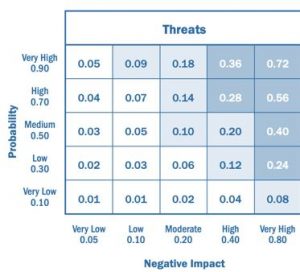
What is a Probability and Impact Matrix? Well, it’s part of your qualitative risk analysis. It’s a grid for mapping the probability of each risk occurrence, and its impact on your project objectives if that risk occurs.
We ask, “What is the probability of it happening?” Maybe it’s 70 percent for example. And what’s the impact if that actually happens? Is it high, is it low? By giving it a rating, it allows project risks to be allocated into priority groups. So is it a high priority? Is there a high probability and a high impact? Then we probably want to be focusing on that, and the low ones we can maybe leave for later.
Using a Probability and Impact Matrix
So first of all, both opportunities and threats are rated, so we do want to find the strengths and our weaknesses of our project. And things like descriptive terms could be used if you want to – so it might have a “high impact”, medium, low, very low. Or more common is numeric values, where a 5 might be a high, and a 1 might be a low for example.
The reason we use numbers is if numbers are used they can be multiplied to give a probability impact score for each risk, and that’s a great way to prioritize those risks. Here’s an example of a probability of impact Matrix. As you can see, we’ve got the probability on one side, and its actually given descriptive terms and numbers just so you can see the difference. So we’ve got very low and very high, or 0.1 to 0.9. And then the impact as a negative impact for threats, or a positive impact for opportunities, and those are multiplied together to give us the outcome.
As you can see, we’ve got the high impact and high probability up in the top right, and low impact and low probability in the bottom left. And that’s the way that they’re prioritizing in this particular probability and impact matrix. Of course, you can lay it out in any way that you choose as long as you’re following those general guidelines that will help you the most during the qualitative analysis of the risks of your project.
And that is the Probability and Impact Matrix for reviewing Risk.
Strategies for Threats and Strategies for Opportunities
Seeing the differences in strategy between Threats and Opportunities is important as this will definitely come up in your PMP exam, and being prepared for these in the real world will really help your career.
What do we mean by strategies for threats and opportunities? They are plans of action that are considered for dealing with risks, both negative and positive in a project. Opportunities being positive, and threats being negative.
Threats and Opportunities
Here are the broad differences and similarities between these two strategies that we’ll use for these particular risks.
Strategies for threats, we could escalate that threat. And it’s the same for opportunities, we might escalate that opportunity as well. We’ve also got Accept that threat, which is the same for opportunities as well.
Now the ones in between are different between the two approaches.
For threats we’ve got Avoiding the threat, Transferring the threat, and Mitigating that threat.
And strategies for opportunities we’ve got Exploiting that opportunity, Sharing that opportunity, and Enhancing the opportunity. Just remember Escalate and Accept are the same for threats and opportunities, or they’re both used for threats and opportunities, but the ones in between are different. Let’s look at them in a bit more detail.
Strategies for Dealing with Threats (Negative Risks)
There are five strategies considered for dealing with threats. Escalate, where we’re escalating that risk or proposed response to a higher level. And it’s the level that would be affected – for example the sponsor or an executive within the company that’s appropriate to escalate that risk to or the risk response to.
We might be Avoiding the risks, which is when we’re moving or changing the project objective to avoid the risk. We’re actually moving out of the way of that risk, maybe where we’re changing what we’re delivering because we just don’t want to be involved, we want to avoid it.
When we’re transferring a risk we might shift the ownership of a threat to a third party, for a price. For example that’s what insurance does. We pay a premium and that shifts the risk – maybe to the insurer instead of to us, and then they manage that risk and bear the impact if the threat occurs.
If we’re mitigating the risk, then we’re taking action to reduce the probability of the occurrence or the impact of that threat. So we’re using things like Prototyping, or more testing, or less complex processes to try and simplify things – we’re mitigating that occurrence, trying to reduce the probability of that threat occurring.
Lastly of course we’ve got Accept, and that’s where we simply acknowledge the existence of that threat but we don’t take any action. We just say “There it is.” Usually we do this for low impact or low probability risks, where it’s not going to bother us too much if it actually happens. We might say “Okay, we accept that that could happen.”
Strategies for Dealing with Opportunities (Positive Risk)
The five strategies considered for dealing with Opportunities – Escalate and Accept are the same. So we’ve got Escalate again when our opportunity is outside of the scope of the project, or would exceed the project managers authority, we might escalate that opportunity to a higher level.
If we want to exploit the opportunity, it might be selected for high priority. Opportunities that we come across in our project and the organization we might want to ensure that that opportunity is realized, so we’re exploiting the opportunity.
We might want to Share it as well, so that involves transferring the ownership of that opportunity to a third party so that it shares some of the benefit of the opportunity when the opportunity occurs. That might be within our organization or it might be to another organization or something similar.
If we’re Enhancing the opportunity, then it’s a strategy where we want to increase the probability or the impact of that opportunity occurring. We can focus attention on the causes of that opportunity and that way we can hopefully enhance it and take advantage of it.
Finally we might want to just Accept that an opportunity is there, so no proactive action is taken and this might be for low priority opportunities in the same way that we’ve got low priority threats, and we’re just taking no action for those as well.
And that is strategies for threats versus strategies for opportunities in your project.
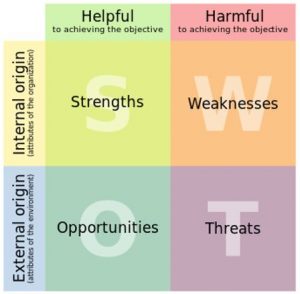
You might come across SWOT analysis being used for identifying risks, or weaknesses and strengths in a project and in your career. It’s a technique that examines the project from that perspective of Strengths, Weaknesses, Opportunities and Threats, which is SWOT.
This technique can broaden the scope of your risk identification. The steps for SWOT is firstly to brainstorm and identify the Strengths and Weaknesses of the project, product or organization. That’s where we need that “Expert Judgment”, usually from people in and around the area that we’re working in or delivering the project to.
Once we’ve got our strengths and weaknesses, we want to identify Opportunities from those Strengths and identify any Threats from the Weaknesses. It’s a very simple two step process.
Here’s an example you’ll see where we’ve got Strengths, Weaknesses, Opportunities and Threats and we’ve got our internal origin, what’s helpful. What’s harmful are our weaknesses and threats, while what’s helpful are our strengths and opportunities. As you know risks can come about as opportunities or positive risks, or they can come about as threats or negative risks, so it helps to identify both of those.
Risk Categories and Identifying Risks During your Project
What are risk categories? They’re described in the risk management plan, and they provide a means for grouping individual project risks for the project team to try and consider the full range of sources from which project risks might come about, or may arise.
It’s just a way of breaking down those risks and starting from a large source of risk, where maybe there’s a few different risks within that large source and in that way we’re finding the categories of risk that we can actually look to and reuse over time in other projects as well.
This also comes down to the organizational process assets, or the OPAs of the organization that you’re working in. Perhaps they already have a list available, but risk categories might be used differently depending on the organizational process assets in a company. One of the ways is a risk breakdown structure. In the same way that we’re talking about that we might have a large source and then delving deeper into that source of risk and finding the categories, a company might have just a simple list of categories based on project objectives that you can pick and choose from to give you or to prompt you, so that you understand or you can see in advance things that might come about.
Here’s an example of a risk breakdown structure or an RBS, as you can see there’s the high level view and then all of the smaller levels as we delve deeper into those risks, and that’s usually done by brainstorming, finding the large functions here and then getting together with expert users in particular areas and seeing what they think. They’ll usually have a good idea of the risks that might come about. There are other ways to find common categories of risks, and some of those are using frameworks – strategic frameworks that are more suitable for identifying sources of overall project risk.
Example Risk Frameworks
Some of those you might be familiar with: We’ve got PESTEL, which is Political, Economic, Social, Technological, Environmental and Legal. That’s just a framework that we can use or a lens that we can use to view the project risks through. So what might come about from political changes, what might come about from economic changes for example.
Next is TECOP, which is technical, environmental, commercial, operational and political – very similar to PESTEL.
Lastly VUCA, and you might have seen this one used in the Defense Forces or in government quite often, where we’re looking at Volatility, Uncertainty, Complexity (so what are the areas of complexity that might throw us off course), and Ambiguity – what is ambiguous about the project that we aren’t quite sure about? And that’s just another lens that we can view the project through, to try and identify those sources of risk.
Face-to-face or virtual meetings are used for decision making, and they’re used for responding to stakeholder requests, having discussions with suppliers, vendors and other project stakeholders. Meeting management is taking those steps to ensure that meetings meet their intended objectives quickly and efficiently, so that we’re not all stuck in meetings that we don’t want to be in.
Steps for Effective Meeting Management
What are the steps for effective meeting management? First of all, it’s ideal to prepare and distribute that agenda, stating the objectives of the meeting. What are we trying to achieve? Send this out to everyone involved, so everyone’s on the same page.
We should ensure that the meetings start and finish at the published time. Sometimes meetings drag on and it’s not ideal for other people – we’ve all got other things to do.
We should ensure the appropriate participants are invited and attend. If they can’t attend, can we change the meeting time or can we ask them to reach reshuffle other things? Sometimes we have to shuffle these things around.
We should stay on topic, and as we go along on that intended topic we should manage the expectations, issues and conflicts during the meeting. Sometimes it’s best not to promise the world, and instead we’re managing those expectations. It is quite an important thing, maybe it can be done but by ensuring we don’t promise that upfront we’re under promising and over delivering in that way.
Lastly, record all actions and those who have been allocated the responsibility for completing any actions. This usually comes from the meeting minutes at the end, or it can be in the form of just a follow-up email or an actual professional proper document. But what was discussed, what actions came out of it, and what do we need to do to follow up for next time?
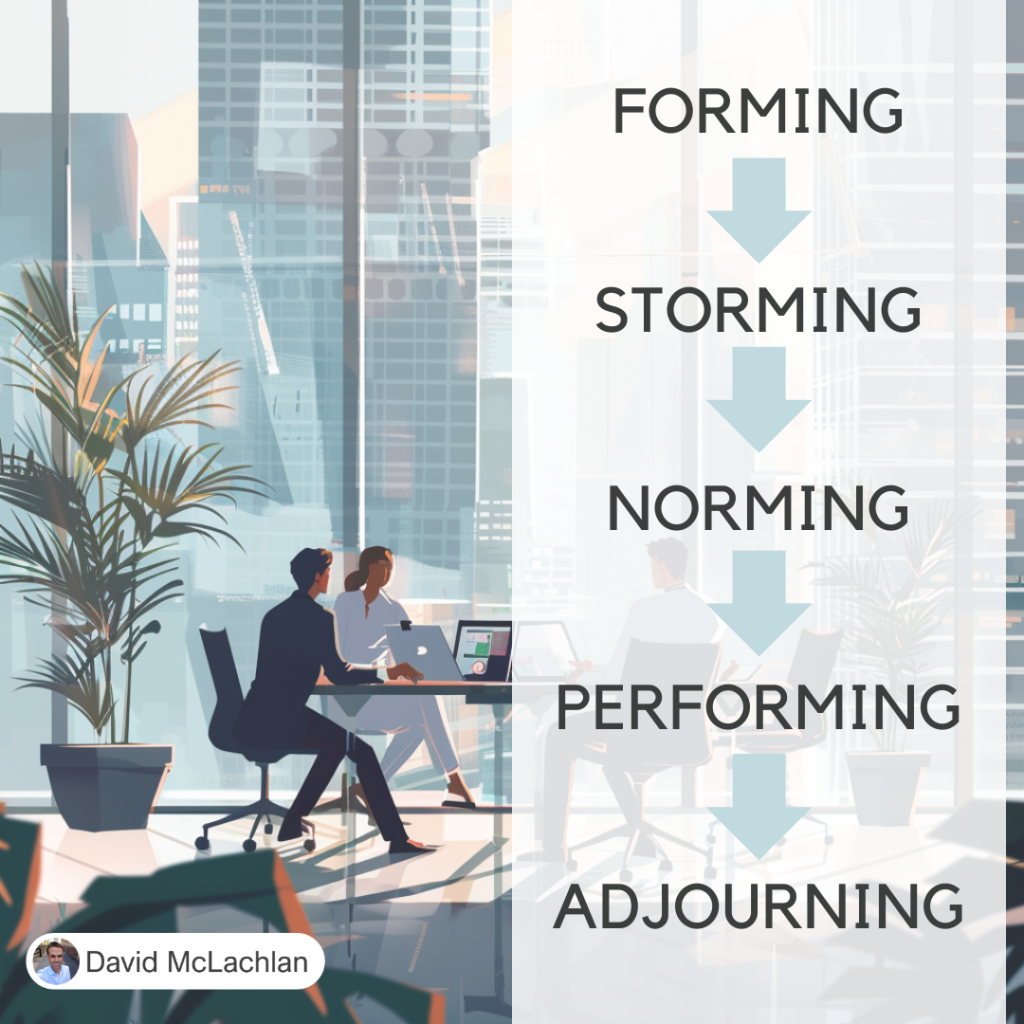
What is Tuckman’s ladder? It was created by Bruce Tuckman, a psychologist, and it’s a model that focuses on the way in which a team works from the initial formation of the team through to the completion of the project. As we get better and better at working as a team, things improve and change, and this is what Tuckman’s ladder describes.
There are five stages in Tuckman’s ladder.
We’ve got Forming, Storming, Norming, Performing, and adjourning at the end. These are the differences between them.
Forming
When we’re forming the team, this phase is where team members meet and learn about the project and their formal roles and responsibilities. Team members tend to be independent and not as open in this phase, so we’re still not really a collective team, we’re just independent people coming together. We’re still a little bit wary.
Storming
Next is the storming stage. During this phase the team begins to address the project work, the technical decisions and the project management approach. If the team members are not collaborative or open to different ideas the environment can become counterproductive. This is where we’re storming through those issues, trying to become one team eventually and you’ll see this happen all the time. All the independent people are working through those methods to become one collaborative team, and that’s where we start our norming phase.
Norming
In the norming phase we’re starting to work normally together. The team members begin to work together and adjust their work habits and behaviors to support the team instead of just working individually or thinking that everyone has a better way. Maybe we’re starting to come together as a team. The team members are learning to trust each other.
Performing
The next stage from here is when we are performing as a team, and this is where it’s a well-organized unit, we are we are really thinking as one team here. We’re interdependent, not independent. We have our skills but we are working towards one goal very collaboratively, and we work through issues smoothly and effectively because we all feel as though we’re the one team.
Of course with any project there is that adjourning stage, where a project will end. It is a temporary endeavour that delivers business value and so in the adjourning phase the team completes the work and moves on from the project, and it can be very sad if you’ve had a wonderful project team with a good performing stage. This typically occurs when the staff is released from the project, as deliverables are completed by the project or as part of the close project or close phase process in the PMBOK guide.
What is conflict management? Conflict is inevitable in a project environment, because there are many sources of conflict.
Sources of conflict can include: scarce resources, scheduling priorities and personal work styles – there are many things that people have to change as well as the change coming through from the project itself, and that drives conflict.
The success of a project manager often depends on their ability to resolve that conflict, and that’s where conflict management comes into it. There are five general techniques used for resolving conflict and you will see these on the PMP exam. Each technique has its place and its use.
We have withdraw or avoid, smooth and accommodate, compromise and reconcile, force or direct, and collaborate and problem-solve. Let’s look at them in a bit more detail.
If we’re withdrawing or avoiding the situation, we’re retreating from an actual or potential conflict situation – postponing that issue to be better prepared or to be better resolved by others. We’re not actually facing that particular issue at this time – maybe we want to face it later maybe, we want someone else to face it, but we are withdrawing or avoiding the situation.
Smoothing and accommodating for conflict is when we’re emphasizing areas of agreement rather than areas of difference. For example, “This is where we agree, isn’t that wonderful, oh and we’ve got one thing that we disagree on, can we work together on this?” Often we are conceding our position to the needs of others to maintain harmony and relationships. Sometimes we do need to smooth or accommodate, we need to give a little in order to get a little for this particular method.
Compromising and reconciling is when we’re searching for solutions that bring some degree of satisfaction to all parties in order to temporarily or partially partially resolve the conflict. This approach occasionally results in a lose-lose situation. It sounds nice, after all we’re compromising, however we’re giving up a little bit and someone else is giving up a little bit as well so you know maybe we’re not all winning here at all – we’re actually both losing a little bit that’s why it’s called a lose-lose situation. This is a good example where it sounds like a nice thing – we might say this is a positive thing on the exam however it can result in that lose-lose situation. So we have to be aware.
Forcing or directing is when we’re pushing one’s viewpoint at the expense of others, offering only win-lose solutions. We only want to win and we don’t care what happens to someone else – it doesn’t matter what requirements they want or or what they need from the project, so it’s usually enforced through a power position and they have to do it because you’re the manager for example. Or to resolve an emergency. This approach often results in that win-lose situation, again something to know for your PMP exam.
Collaborating and problem-solving is where we’re incorporating multiple viewpoints and insights from differing perspectives. It requires a cooperative attitude and an open dialogue. Typically this leads to a consensus and commitment from everyone involved, and this approach can result in a win-win situation – not always, but it’s one of the most common where problem-solving for everyone can result in that win-win situation.
There are lots of different factors that influence conflict and bring conflict. There is the importance and intensity of it, the time pressure, the relative power of people involved (so are we dealing with executive managers or people who we have to make sure that they are happy as part of this, or the project sponsor for example), the importance of maintaining a good relationship with people, and the motivation to resolve the conflict on a long-term or a short term basis. Maybe we have a short-term solution, and maybe we have a long-term solution for example and we can work within those boundaries.
Lastly things that can help conflict include our team ground rules, group norms and solid project management practices. This is very helpful – is there a process involved?
Communication planning, role definition and all of those also reduce the amount of conflict.
If the conflict escalates one thing that you may come across in the PMP exam and definitely in your project management career – conflicts should be addressed early and usually in private, using a direct and collaborative approach. So again we’re problem-solving here, trying for that win-win, collaborating with the other party but using a direct approach. We’re not hinting or you know going around in circles, we need to go directly to what the source of the problem is, go there and use a collaborative approach. And that is the approach recommended by the PMBOK guide.
And that is the idea of conflict management in your project.
What are communication models? They represent the communication process, ranging from a basic “sender to receiver” model, to a more interactive model of communication, and we’ll look at both. This is the sort of thing that you will come across in an MBA or a business course, and certainly you will need to know for your project management career.
Basic Communication Example
Here’s a brief example, where we’ve got the sender on one side, and the receiver on the other side, we’re encoding the message and transmitting that message, and there might be some noise in between. The receiver has to decode that message through their current emotional state – through the things that are going on in their lives, their personal biases or assumptions that they might have (which we all have).
Of course when we’re encoding a message we’re putting that into a message as well, and that’s a really good example of the basic sender receiver communication model. It’s a process that consists of two parties, defined as the sender and defined as the receiver. And there are a few things that go on in this basic model. First of all the sender encodes the message – they’re using their words, or they’re using symbols, for example words on a page, or if it was ancient Egypt it would be hieroglyphs.
How are we communicating and sending that message? We’re transmitting the message from me to whoever reads it in the end. Now in between, when it’s being transmitted it can come against noise so in the message. Then lastly the person who receives the message has to decode it, and that’s translated by the receiver back into a form that’s useful to that receiver.
When we look at it that way we can be much more careful about the way we communicate to people so that everybody understands.
Interactive Model Example
Now there is an interactive model as well, and this can help with understanding a message. Basically it’s the same as the basic model – we’ve got two parties, the sender and the receiver, but it recognizes the need to ensure that the message has been understood. So there’s a check here, basically upon receipt of the message the receiver might acknowledge that they received it. You might be nodding your head as you’re talking to someone, or if someone gets an email you might say “Thank you very much I’ve got that email,” and so that that doesn’t necessarily mean an agreement, but it just means that they received it.
Now after that they would provide a feedback or a response to the message, so we’re acknowledging, saying “I understand, and here’s what I think about it,” so they respond with their own thoughts and ideas into that message and then they transmit that message back to the original sender.
Now let me give you a quick example from Procter & Gamble, this is from the book “Playing to Win” by Alan Lafley, a wonderful book. He talks about something called “The Assertive Inquiry,” that they used. This is where in the boardroom they said, “This is the way I see it, and do you see it the same way?” So am I missing anything by doing that? in other words, this is everything that I see, these are my thoughts and views, they’re sending that message out and then they’re asking directly for feedback and a response. So they’re not waiting, someone doesn’t have to have that model already ingrained in their in their system, they’re asking for that feedback – “Do you see it the same way as I see it? What have I missed?” By doing that they were actually able to really improve their communication and get more information from people than they might have been given you know under usual circumstances. That’s the assertive inquiry from Procter & Gamble.
And that is communication models from the PMBOK guide.
You will see this come up more and more in your project management career as the world tends to move towards things like virtual teams.
What are virtual teams? First of all they’re people who work on the same project, but they’re not co-located at the same site. So you might have your project here and a person over here working on it, another person over here working from home for example. This is becoming more and more common in today’s society.
The availability of communication technologies such as email, audio conferencing, social media, web-based meetings, and video conferencing has made virtual teams much more feasible. The virtual team model also makes it possible as a project or an organization to do a few things – particularly to reduce cost or increase the expertise within your team. For example you might be able to form teams of people from the same organization who live in different places. You might be able to add a special expertise to a project team, even though that expert isn’t in the area. You might be able to incorporate employees who work from home offices, or include people with mobility limitations or disabilities who cannot get into certain buildings but now they can actually work from a different site.
You might be able to move forward with projects that would have been held up or cancelled due to travel expenses. This is particularly a good thing to note as that becomes more of an issue these days. You might save the expense of offices and all physical equipment needed for employees, as the cost savings involved for virtual teams.
Examples of communication technology
Examples of communication technology that might assist with virtual teams are shared portals, for example a Confluence page or a SharePoint page or a Jira or a Trello kanban board. These sorts of things online where you can share your documents. Video conferencing, where you might have Skype, Zoom, Microsoft teams, Facetime, all of those video conferencing tools that you can use to feel as though you’re in person.
Audio conferencing via telephone and many other methods as well, Discord for example where gamers have been using that for for many years and that’s a powerful tool. And lastly email and chat, where you’ve got Slack or Messenger. These are also quick messaging tools that you can get a quick message across to someone even if they’re not in the same area as you.
And that is virtual teams and the communication technologies that tie them together.
 Decision Tree Analysis
 The Probability and Impact Matrix
 Strategies for Threats and Strategies for Opportunities
 SWOT analysis
 Risk Categories and Identifying Risks During your Project
 Meetings and meeting management
 Conflict Management
 Communication Models in your Project
 Virtual teams and communication technologies