All posts by David McLachlan

03 – Project Life Cycles and Phase Gates – PMP, CAPM and PMBOK Training

3_Project Lifecycles and Phase GatesProject Life Cycles and Phase Gates

In order to deliver projects and programs there are many different methods and what we call project life cycles, which are ways of working within a project that we can use to deliver these things.

Predictive Life Cycle

First of all we’ve got our Predictive life cycle, which is traditionally called waterfall, where we think about all the scope and the requirements upfront then we go away for a certain period of time and make it all happen within a project without necessarily getting too much feedback, and then we deliver in one big bang at the end. That’s our predictive lifecycle – we’re predicting all of the things upfront that a customer might want and that might happen in a project.

Iterative Life Cycle

We have our iterative life cycle and incremental life cycle, which actually combine to become Agile in the end. We’re iterating towards a final product but we’re gathering feedback and changing as we go, usually in two to four week cycles or iterations. We’re gathering that feedback, putting it back into our plan, then gathering that feedback again and putting it back into the plan again, but we’re still delivering in one big bang.

Incremental Life Cycle

Incremental is when we’re delivering increments that a customer can see, feel and touch. Based on that they’re actually using that feature in the real world, and then at the end they still get their full final product as well. We do this to get better and more feedback from our customer delivering those features to a customer as we’re going along.

Adaptive Life Cycles

Second to last is adaptive life cycles so these are our Agile agile life cycles and these are usually iterative and incremental. Detailed scope can be defined and approved before the start of each iteration of two to four weeks instead of doing the whole project in a predictive manner – we’re only looking at shorter life cycles. We we don’t need to predict the whole thing and we can change as we’re going along.

Hybrid Life Cycles

Hybrid is just a combination of either predictive or an agile life cycle or an adaptive life cycle where we might have all of our scope upfront but we’re using agile methodologies like Kanban to manage that scope and what should go from “in progress” or the “backlog” to “done”. Or we might be using scrum where we’re having daily stand-ups, just short sharp meetings that give us an update on where everything is up to. These are the combinations that you can have in your project life cycles.

Just as there are multiple different ways of managing a project there are different phase gates we can use as we’re going along. These can be matched up to any of those project life cycles where we’ve got iterations, and each of those iterations or a few different iterations could match up to be one of these phase gates at the end where we are delivering our feasibility study at the beginning for example to see if it’s worth kicking off a project, then we’re delivering our customer requirements (these are just ideas) you might have more phase gates or things that you need to deliver or features that you’d need to deliver as part of your project as you go along. Potentially we’re building all these things, testing them and transitioning them back to the business or back to the operations of the business.

Managing Life Cycles With Project Documents 

That phase gate is the end of a phase and a project’s performance is benchmarked to documents such as the project business case which is up here in the beginning documents. The Project Charter kicks off a project, the project management plan combines all the things like risk, scope, schedule, quality, communications, and stakeholders into one project management plan that you use to monitor and control and execute on the project as you’re going along.

Lastly how do we know that we we’ve met our requirements? It’s the benefits management plan. What are the benefits that we’re delivering and how do we know we’ve met them, or what are we aiming for once this project has been delivered. Is it an increase in customer revenue? Is it an increase in this particular product’s performance? We’re wanting to measure it.

– David McLachlan

PMP Exam Questions – Practice Session | 02

– See all the PMP Exam Questions – 

PMP Practice ExamPMP Exam Question Session 2

In this series we will walk through five PMP Practice Exam Questions each day – a great way to set up your morning as you prepare to pass the PMP Exam. It is also useful for the CAPM exam, as the content is very similar.

We will also figure them out together, and you’ll see the thought process behind solving these PMP exam questions.

I hope you enjoy!


Question 1

The Benefit to Cost Ratio (BCR) is the ratio of the benefits of a project relative to its costs. You are working on a project with a total cost of $200,000. That project results in a benefit of $190,000. What is the Benefit Cost Ratio?

A) 1.05
B) 0.95
C) 0.85
D) 1.15

Question 2

A recent news article spread a rumour about a supplier who is providing services for the project you are working on. They are reportedly in the middle of a hostile takeover bid from another larger company. You need to ensure you project is able to continue. What should you do?

A) Ignore the news article – they don’t know the supplier like you do
B) Set a meeting and talk to executives in charge at the hostile bidder
C) Talk to the vendor and find the facts
D) Stop working with the vendor immediately, get another vendor to do the work

Question 3

You are asked to select a new project for your company. Project X will take 3 years to complete with Net Present Value of $101,000. Project Y will take 2 years to complete with Net Present Value of $95,000. Which should you select?

A) Project Y
B) Project X
C) Both projects
D) Either project

Question 4

What is the Opportunity Cost of selecting Project X over Project Y, when Project X has a NPV of$124,000 and Project Y has a NPV of $179,000?

A) $40,000
B) $179,000
C) $124,000
D) $310,000

Question 5

The Benefit Cost Ratio or Profitability Index is commonly used to identify the most efficient projects. What does a benefit cost ratio of 1.45 imply?

A) Cost is 1.45 times the profit
B) Cost is 1.45 times the revenue
C) Profit is 1.45 times the cost
D) Revenue is 1.45 times the cost

– See all the PMP Exam Questions – 

02 – The Importance of Project Management – PMP, CAPM and PMBOK Training
2_Importance of Project ManagementThe Importance of Project Management

This article is about the importance of project management itself, and managing that project in a successful way from beginning to end.

There are benefits to having good project management – effective project management leads to meeting stakeholder objectives, increasing the chances of the project success, resolving problems and issues as they arise (which they always do), responding to risks that might arise, as well as optimizing the use of organizational resources so the people that you’re bringing on board to your project can be used in the absolute best way. Identifying failing projects and sometimes terminating them if you absolutely need to, and managing all of the constraints – money, scope, time frame – all of those need to be managed or shuffled around so you can still meet the project objectives.

Poor project management on the other hand is a different story. I’ve seen this many times and I’m sure you have to, because project management is quite difficult. That’s why it’s nice to have a framework to operate by. You could have missed deadlines where now all of a sudden your project is late. You could have cost overruns where now all of a sudden it’s going to cost two million dollars instead of 1 million dollars or fifty thousand dollars instead of twenty thousand dollars whatever it is.

You could have poor quality – so it’s not actually meeting what the customer wanted. You could be having to rework things to redo them over and over again and the customer is not happy about that. Expansion of scope, otherwise known as scope creep, where the things that the customer wants actually end up being more and more and more and they weren’t designed in the initial project for what we wanted to deliver.

Using a Proven Project Management Framework

There are lots of things that can happen if a project is not managed well, and even when it is managed well. These things can go wrong but that’s the benefit of having a framework to manage it by – you know you’re doing the absolute best you can to try and get these things on the left here (meeting those stakeholder needs, increasing the chances of success) rather than having missed deadlines or cost overruns.

Operations, Projects, Programs, Portfolios

There is a relationship here between three things and we’ve got basically at the very base level, at the operating level where things are done on a day to day basis we’ve got the operations of a business. And that’s where we’ve got shared resources and shared stakeholders, we’re going to have to use these resources and these people from within the organization to help us get the project done, and that’s an essential thing that we need to manage throughout the life of a project.

The next layer from there are our projects, and these are the things that are delivering change to our BAU or operations, but sometimes you want to have a really good overview of all of these multiple projects – there’s lots of projects happening and you need something to clearly define a bunch of those projects in one, and that’s where we come into a program.

Program managers might have a couple of projects, a handful maybe 10 maybe even 20 sometimes where they’ve got multiple projects all delivering the same strategic objective, they’re all delivering a similar thing but doing different things.

Lastly made up of programs and projects and operations are our portfolios. A portfolio manager will have multiple programs and then multiple projects under each of those programs and then lots and lots of BAU teams and operations within the operations side of the business.

– David McLachlan

PMP Exam Questions – Practice Session | 01

– See all the PMP Exam Questions – 

PMP Exam Question Session 1

In this series we will walk through five PMP Practice Exam Questions each day – a great way to set up your morning as you prepare to pass the PMP Exam. It is also useful for the CAPM exam, as the content is very similar.

We will also figure them out together, and you’ll see the thought process behind solving these PMP exam questions.

I hope you enjoy!

Question 1

You are asked to decide which project is a better investment. Project X takes 3 years to complete with a Net Present Value of $125,000 and Project Y takes 2 years to complete with a Net Present Value of $100,000. Which will you choose?

A) Both projects
B) Project X only
C) Either project
D) Project Y only

Question 2

You are a certified PMP working as a project manager in a company. One of your colleagues is planning to take the PMP exam too, and asks for your guidance on preparation. What should you do?

A) Give them a few instructions and let them work out the rest
B) Say you’re too busy to help them – after all, it’s true
C) Give them whatever guidance you can provide based on your experience
D) Tell them to go to the PMI website and find the information they want

Question 3

What is the Cost Performance Index of a project with a PV of $795,000, EV of $850,000, and AC of $950,000?

A) 1.12, you are over budget
B) 0.89, you are over budget
C) 2.05, you are under budget
D) 0.75, you are under budget

Question 4

Return on Investment (ROI) is the percentage return we get from investing in something. Your project cost the company $200,000 to complete. That project returns a benefit of $240,000. The Return on Investment (ROI) would be:

A) 20%
B) 24%
C) 240%
D) 16%

Question 5

The Benefit Cost Ratio is used to compare the benefits to the costs for a project. As a project manager working for your company which one of the following projects will you recommend based on the BCRs below?

A) Project X at 0.75
B) Project Y at 1.20
C) Project R at 1.85
D) Project W at 2.05

– See all the PMP Exam Questions – 

Leadership Quote – Jeff Bezos on Success

– See all the Leadership Quotes here –

“We’ve had three big ideas at Amazon that we’ve stuck with for 18 years, and they’re the reason we’re successful: Put the customer first. Invent. And be patient.” – Jeff Bezos

Have you heard this Leadership Quote from Jeff Bezos?

Jeff Bezos is an American internet entrepreneur best known as the founder and CEO of Amazon.com. He is famous for obsessing over customers, reducing friction in the user experience, and operational excellence.

Leadership quote Jeff Bezos customer first

Three Big Ideas

Jeff Bezos’ three big ideas may seem simple, but many have tried to pull them off and failed. In fact, most companies end up purely putting lip-service to the “put your customers first” line, instead of truly doing everything they can to improve the customer experience.

Why would you want to put your customers first?

Because customers pay your bills and your wages, by buying your product or service, that’s why.

This is something that most middle managers, even many CEOs unfortunately forget. But even when you have put the customer at the center of your universe, the next challenge is to invent the things that solve their problems instead of having someone else do it.

In fact Toys ‘R’ Us famously used Amazon in the early 2000s to sell toys online, through their merchant marketplace. However by doing so, Toys ‘R’ Us were giving away their data and their power over the customer transaction – data that Amazon willingly used to improve their service for other toy offerings and become even larger. Eventually Toys ‘R’ Us dissolved their partnership with Amazon to start their own online store, but by then the writing was already on the wall. Toys ‘R’ Us ended up filing for bankruptcy just fifteen years later.

Customer first. Invent. And have patience while you perform the small, incremental improvements every day.

– David McLachlan

Get the Leadership Card Deck or the Lean CX Score Book:

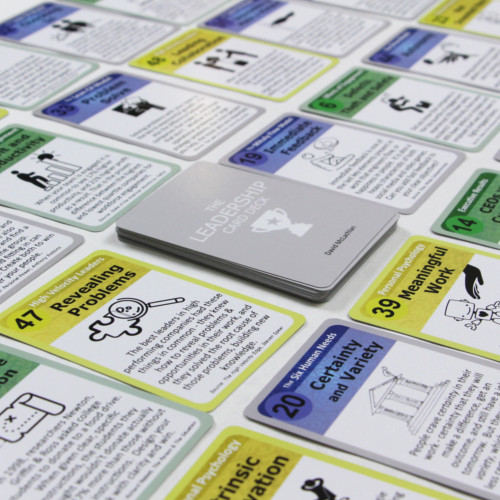
Leadership CardsView All The Leadership Cards (48)

- or - Have the Leadership Cards delivered for your next meeting


Lean CX ScoreGet "The Lean CX Score" now, and start creating disruptors in your industry that completely annihilate your competition.

Oh and good news!  You'll be improving the speed, morale and engagement of your teams at the same time.  Get the Lean CX Score now.

Leadership Quotes – Anthony Robbins on Success

– See all the Leadership Quotes here –

“Successful people ask better questions, and as a result, they get better answers.” – Anthony Robbins

Have you heard this leadership quote from Anthony Robbins?

Anthony Robbins is an American author, coach, motivational speaker and business owner known for his infomercials, seminars, and self-help books including Unlimited Power and Awaken the Giant Within. He has taught hundreds of thousands of people on success worldwide, so he knows a thing or two about it.

Leadership Quote Anthony Robbins Ask Better Questions

Changing Your Frame

We see the world through certain lenses – through the things we were taught as we were growing up, through our religion, our beliefs, our current physical restrictions. Changing any of these, and many others will change how we see the world and even how we believe what is possible.

What Anthony Robbins is saying in this quote is that by asking a different question you will start to shift the lens you see the world through, and by asking better questions you will get better results.

For example, if you ask yourself: “Why does this always happen to me?” your brain goes searching for all the reasons why these things always happen to you and comes back with demoralising things like “You’re stupid, you’re not worth anything more, you’ll never be good enough.”

But if you ask yourself “How can I get better?” your brain will search for all of the ways you might be able to get better – maybe exercise, meditate, study new things and work for a promotion.

“Seek and you shall find, ask and you shall receive.” is such a true quote. Your brain is constantly serving you, just make sure it is serving you in the right way, by making it search for the right answers to the right questions.

– David McLachlan

Get the Leadership Card Deck or the Lean CX Score Book:

Leadership CardsView All The Leadership Cards (48)

- or - Have the Leadership Cards delivered for your next meeting


Lean CX ScoreGet "The Lean CX Score" now, and start creating disruptors in your industry that completely annihilate your competition.

Oh and good news!  You'll be improving the speed, morale and engagement of your teams at the same time.  Get the Lean CX Score now.

Leadership Quote – Charles Darwin – The One That is Most Adaptable To Change

– See all the Leadership Quotes here –

“It is not the strongest nor the most intelligent of species that survives, but the one that is most adaptable to change.” – Charles Darwin

Have you heard this quote from Charles Darwin?

Charles Darwin was an English naturalist, geologist and biologist, best known for his contributions to the science of evolution. His proposition that all species of life have descended over time from common ancestors is now widely accepted, and considered a foundational concept in science.

Leadership Quote Charles Darwin It is not the strongest that survive

Because of this, it makes sense to listen when Charles Darwin says something about survivorship – after all, he studied the reasons behind species surviving or perishing, and the same can be said of people, civilizations, and even companies.

The World Changes – So Must We

Is the world the same as it was fifty years ago? Certainly not. There were no iPhones, no internet, limited globalisation, no social media, among many other things. If the world constantly changes it is folly to think that we can remain the same and still survive, or even thrive.

Charles Darwin saw this in the mid-to-late 1800s, and the same is true today, because the one true constant is change itself. Things are always evolving, things are always changing.

Kodak film and cameras saw the digital revolution coming early on – they even wrote a paper on the coming digital revolution in the early 1980s – fully twenty years before it happened. And yet, they still went bust because they were unable to change. Middle management in-fighting and bickering over organisational turf took priority over actually changing the company toward something profitable, even until the end when the writing was truly on the wall. Eventually, Kodak went bankrupt.

Meanwhile, Amazon always does business like it’s “day one” – in other words, the most vulnerable time for a business. They are constantly moving, constantly evolving, and its CEO Jeff Bezos is consequently the richest man in the world. Is he smarter than everyone else? No, not everyone. Is Jeff Bezos stronger than everyone else?  No. But it is not the strongest nor the most intelligent of species that survives, it is the one that is most adaptable to change.

– David McLachlan

Get the Leadership Card Deck or the Lean CX Score Book:

Leadership CardsView All The Leadership Cards (48)

- or - Have the Leadership Cards delivered for your next meeting


Lean CX ScoreGet "The Lean CX Score" now, and start creating disruptors in your industry that completely annihilate your competition.

Oh and good news!  You'll be improving the speed, morale and engagement of your teams at the same time.  Get the Lean CX Score now.

Leadership Quote – Emerson – Go Your Own Path and Leave a Trail

– See all the Leadership Quotes here –

“Do not follow where the path may lead. Go instead where there is no path and leave a trail.” – Ralph Waldo Emerson

Have you heard this Leadership Quote from Ralph Waldo Emerson?

Emerson was an American essayist, lecturer, philosopher, and poet who published dozens of essays and gave more than 1,500 public lectures across the United States in the mid 1800s. He was a champion critic against the prevailing pressures of society.

Leadership Quote Emerson do not go where the path may lead

A Leader Makes Their Own Path

Many times we’ve heard true leaders needing to make their own path, even when others ridicule or make fun of them at first. Steve Jobs was ousted from his own company before he made his own way back and made it a success. Bill Gates was so adamant that computers were the future he gave everything towards making the software that controlled it. Jeff Bezos sold books online even as others thought it was crazy to do so, and he held fast during the dot com bust to prevail as the world’s largest marketplace a decade later.

None of these billionaires, these leaders, followed someone else into their billions. They formed their own path and left a trail for others to follow.

– David McLachlan

Get the Leadership Card Deck or the Lean CX Score Book:

Leadership CardsView All The Leadership Cards (48)

- or - Have the Leadership Cards delivered for your next meeting


Lean CX ScoreGet "The Lean CX Score" now, and start creating disruptors in your industry that completely annihilate your competition.

Oh and good news!  You'll be improving the speed, morale and engagement of your teams at the same time.  Get the Lean CX Score now.

Leadership Quote – Jim Rohn on the Challenge of Leadership

– See all the Leadership Quotes here –

“The challenge of leadership is to be strong, but not rude; be kind, but not weak; be bold, but not a bully; be thoughtful, but not lazy; be humble, but not timid; be proud, but not arrogant; have humor, but without folly.” – Jim Rohn

Have you heard this leadership quote from Jim Rohn?

Jim is a well known author, entrepreneur, and speaker. One of his best speeches is “How To Have Your Best Year Ever” and is a speech that can be listened to over and over again, teaching some of the most powerful fundamentals of life, success and business.

Jim Rohn Quote Leadership

The Paradox of Leadership 

In his quote, Jim Rohn rightly points out the paradox of leadership – that a true leader is strong enough within themselves to be humble, strong enough to know the difference they made and give credit to their people to lift their spirits and build their self esteem, but also strong enough not to be bowled over or led astray.

From this perspective, “strength” doesn’t mean beating someone up, it doesn’t mean putting others down, and it doesn’t mean all talk and no action.

A lot of it comes back to self-discipline, which Jim talks about frequently in his speeches. When a leader has the discipline within themselves, they clearly know when to draw the line and when to cross it.

– David McLachlan

Get the Leadership Card Deck or the Lean CX Score Book:

Leadership CardsView All The Leadership Cards (48)

- or - Have the Leadership Cards delivered for your next meeting


Lean CX ScoreGet "The Lean CX Score" now, and start creating disruptors in your industry that completely annihilate your competition.

Oh and good news!  You'll be improving the speed, morale and engagement of your teams at the same time.  Get the Lean CX Score now.

05 – Project Management Business Documents | PMBOK Course

Project Management Business Documents

There are many different business documents

There are many different business documents that you’ll need to help kick-off and then manage your project, and we call these Project Management Business Documents that we’re going to need in the managing of our project. There are two main business documents, which are the project business case, and the project benefits management plan. Ultimately the business case will help us kick off the project and start the project but the project management benefits plan will help us manage those benefits that we’re wanting to deliver and make sure that we are delivering on those benefits when the project is delivered. The pre-work we’re looking at is the needs assessment – for example what’s the need of this project? Why is it being kicked off? Why is it being initiated? That helps us and feeds into our business case.

Benefits Management Plan

The project business case also has the benefits management plan within that, so that we know what benefits we’re delivering. All these documents will feed into our project charter which ultimately is one of the first steps, or is the first step in initiating a project. From there the project charter will feed in with all of the information that we’ve gathered from our needs assessment, business case, the risks involved, the stakeholders as an early view of the stakeholders, and risks and scope and schedule that might be involved and all of that feeds into the project management plan on a larger scale where we’re using that now to manage our project on a daily basis.

Project Business Case

So let’s dive into the project business case. What is actually in it? There are a few things usually, and they include business needs – so a description of what is prompting the need for action. Maybe customers have fallen off over the last year and we’re wanting to get more customers, maybe there’s a lot of rework that’s happening in a certain area and we’re wanting to reduce that rework. Whatever the business need is, we’re wanting to include that in the project business case. It’s a feasibility study of why we’re initiating the project. We usually give an analysis of the situation, so what are the facts, what is currently happening, are we currently at 80% capacity but we need to be at a hundred percent capacity? Whatever it is put the raw data and that project management data and info into this analysis of the situation for your business case, and then based on that we’re wanting to give a recommendation.

What’s the need, what’s the current situation, and based on that what are we recommending that people do to make a change and deliver what we need to deliver for this project.

Lastly once we’ve done that of course we’re wanting to see how the benefits that we’re delivering will be measured. Will it be Bob over there in a certain department measuring this for the next two or three months to make sure that things are on track and that it’s actually delivering what we want to deliver? However we’re going to measure it we want to put that in the plan as well.

Project Benefits Management Plan

Which leads us into the project benefits management plan. How are we managing these benefits? We want to usually include what the target benefits are, is it increasing this or decreasing that, include it in the project benefits management plan. We want the time-frame for realizing those benefits – is it a year? Is it six months? Is it one month?

Next, who owns the benefits. This comes back to our BAU, our operations. What are the metrics that we’re measuring, what are the assumptions that we’re making when we’re here measuring these things? We just need to know what those assumptions are in case they end up being wrong, and then we can see why we didn’t meet the the target or maybe we did better than the target (or whatever it is).

Ultimately we want to see what risks there are to meeting those benefits as well and put those in the project benefits management plan.

How to Measure the Project Benefits

There are many different ways to measure these things and measure these benefits and some of these are called out in the project management body of knowledge. They are Net Present Value – you will need to know this for the exam usually they’re fairly straightforward to go into and often the way they’ll word it on the exam will be “you have a net present value of of this and a net present value of that, so which one should you actually choose?” And you choose the highest.

For your Return On Investment we just want the highest return on investment. Internal Rate of Return – we want the higher rate of return as well. The payback period we want a shorter payback period if possible, and the benefit to cost ratio we usually want a higher benefit to a lower cost if possible.

But all of those are just numbers and numerical objectives and financial objectives – usually we can also have things like meeting non-financial objectives, fulfilling contract terms or conditions, meeting governance or regulatory requirements, achieving stakeholder satisfaction, meeting organizational strategy or goals – all these things could be non-monetary benefits that we’re realizing at the end of the project and we can also include.

And those are the project management business documents as part of our foundational elements of project management.