All posts by David McLachlan

What Is Lean CX?

You can recognise disruptors before they become a reality.

Lean CX is a step by step framework for Operational Excellence and how it relates to disruptive companies and technologies – especially as they grow and are ready to scale.

Disruptive companies are those that can deliver something a customer wants faster, cheaper, with better quality and sufficient brand recognition.  Think McDonald’s in the 1950s, the model T Ford in the early 1900s, the Apple iPod in the early 2000s or the iPhone in 2007, Uber disrupting the cab industry, Netflix disrupting DVD hire and Amazon disrupting retail.

All of them have at least three of these four in common:

Continue reading What Is Lean CX?

Leadership Card 21 – Core Human Needs, Significance and Connection

See The Leadership Card Deck Here

Design For Ease of Use with Lean CX – Leadership Card 21

Leadership Card 021 Significance Connection - Lean CX Ease of Use

Leadership CardsView All The Leadership Cards (48)

- or - Have the Leadership Cards delivered for your next meeting

Engineering Happiness In your Team With Significance and Connection

There’s a funny thing about happiness.  We all seem to want it, and yet so many times we do things that we know don’t bring us happiness in the long run, don’t we?

That extra piece of chocolate cake, or spending too much time working instead of bonding with friends or partners (which was, incidentally, one of the top five regrets of the dying).  Not exercising or being outdoors enough.  it all adds up.

But there could be a very good reason for us missing the mark when it comes to performing happiness improving activities – and that is because the real core needs that drive us are actually conflicting.

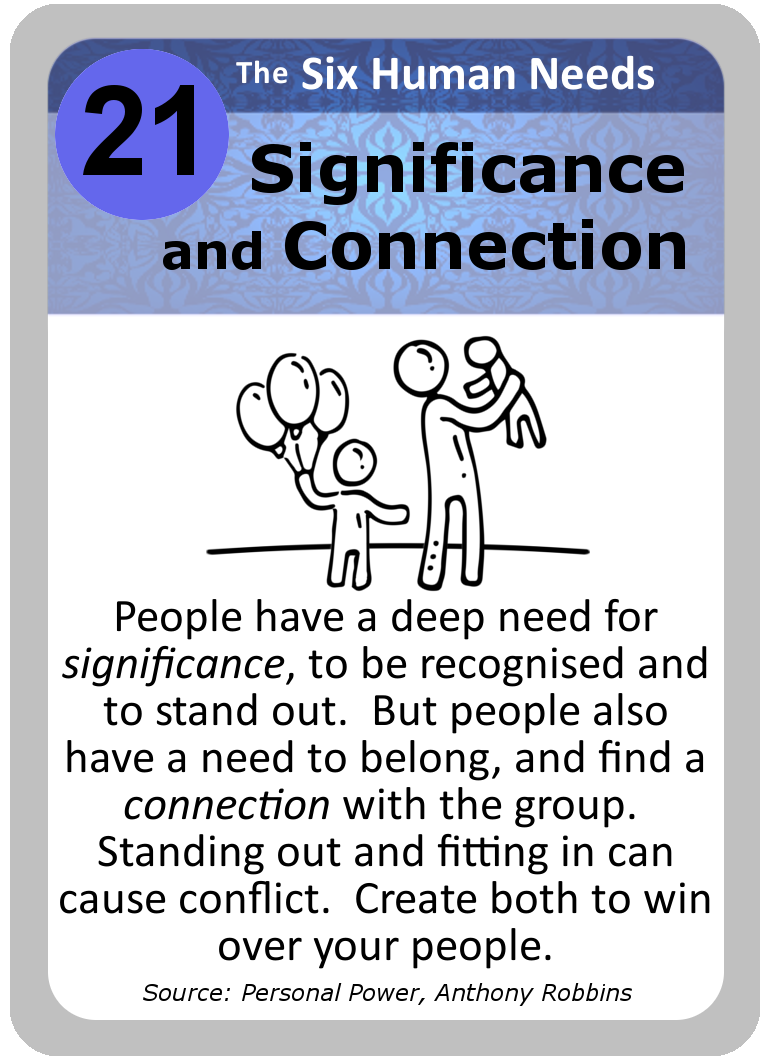
In the last card, Leadership Card 19, we saw that we deeply crave certainty in our lives, but also variety.  And the more variety we have, the less certainty we have.  Well it’s the same with Leadership Card 20, where we crave significance and connection, but the two don’t necessarily go hand in hand.

Significance and Connection – At Odds With Each Other

You see, to be significant you have to stand out.  You have to lead the pack, often be different to others.  And people get significance in different ways.  They can feel significant by performing really well, earning lots of money, moving up in their career, or they can feel significant by being difficult, causing trouble to get attention, and other ways like that.

But when we stand out and are different, it’s much harder to fit in, to feel that connection and bonding with people in a team, a family, a friendship group or anywhere else.

So while we crave both, significance and connection are hard to engineer together.

Engineering Both In Your Team’s Work

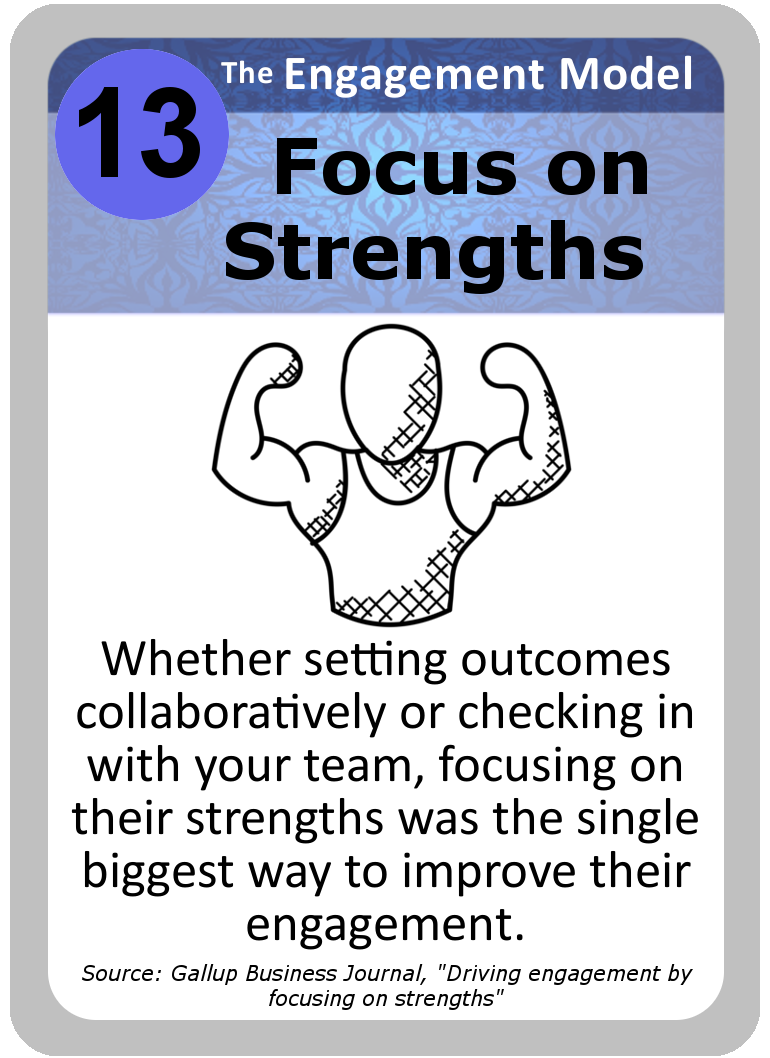
So how do we create both in our team’s work?  Part of Lean CX and the Ease of Use framework is a thing called “Checking In”, where we check in with our team members at least once a week, see where we need to adjust, and then focus on their strengths.

Doing this ensures two things – first, we build that connection by checking in, making sure they know they are on our radar as a leader and that we care about their path and their progress.

But then we focus on their strengths, building that significance of individuality, because we are all slightly different at the end of the day and have individual strengths and things we want to achieve.

So check in with your team, and focus on their strengths.  Even research from Gallup on employee engagement has shown that it can improve engagement by up to 27%.  And employees who are more engaged have higher productivity, sales, profit, and lower absenteeism and turnover.

Chat soon – David McLachlan

Leadership CardsView All The Leadership Cards (48)

- or - Have the Leadership Cards delivered for your next meeting

Leadership Card 20 – Certainty and Variety, Deep Human Needs

See The Leadership Card Deck Here

Design For Ease of Use with Lean CX – Leadership Card 20

Leadership Card 020 Certainty Variety - Lean CX Ease of Use

Leadership CardsView All The Leadership Cards (48)

- or - Have the Leadership Cards delivered for your next meeting

Give Your Team Happiness, By Meeting Their Core Needs

Happiness.  People want it, talk about it, reminisce about it, and miss it when it’s not there.  And it can be everything from instant gratification (like a big meal) to deep meaning in a person’s life (like having meaningful work).

Seeing as anyone can eat a big meal or piece of chocolate and get instant gratification, I’m going to talk about the deeper meaning, that you can actually engineer into your team’s work to make them happier, more productive, and ultimately want to do a good job.

In fact, one study I found for the Lean CX Score book showed that people perform around 12% better simply by being happy.

Anthony Robbins’ Six Human Needs

You’ve probably heard of a few different types of “Needs hierarchies”, like Maslow’s hierarchy of needs that goes from safety to self-actualization.  But in the 1990s Anthony Robbins came up with a deep set of human needs that completely make sense, because they actually conflict with each other.

They make sense because in a way we are all striving for happiness, and  the ebb and flow of life, and events that happen over time make it either easy to get or elusive.

The first combination of needs are Certainty and Variety.

Certainty and Variety

We need certainty that what we do will turn out OK.  Some people need more certainty than others before they do something, and others need no certainty at all.

The only problem is, having certainty conflicts with our other need, which is to have variety in our life and work.  After all, if we have a lot of certainty, doing the same thing in the same way every day, then we don’t have a lot of variety.  but if we have a lot of variety – spontaneous things, ideas, and outings – then we don’t have as much certainty.

And yet we need them both for fulfilling work.

How Can We Engineer Both Into Our People’s Work?

Over the years, I’ve experienced a few ways to engineer both of these things into a team’s work.  The best ones I’ve seen involve this:

  • Having clear outcomes, and a clear path or process to get there (certainty)
  • Allowing (and encouraging) our team to problem solve ways to improve that work regularly (giving variety)

Not everyone is a natural problem solver.  It can be hard to work through uncertain territory, and that is why it helps to have a standard process for problem solving and improving our work, making it easier to use.

The Lean CX Score is that framework that improves the ease of use and engages your team at the same time.  Using things like a repeatable process, error proofing, visual management and checking in, you can go a long way to building the meaning back into your team’s life and work, no matter what they are doing.

Chat soon – David McLachlan

Leadership CardsView All The Leadership Cards (48)

- or - Have the Leadership Cards delivered for your next meeting

Leadership Card 19 – Flow, Happiness and Immediate Feedback

See The Leadership Card Deck Here

Design For Ease of Use with Lean CX – Leadership Card 19
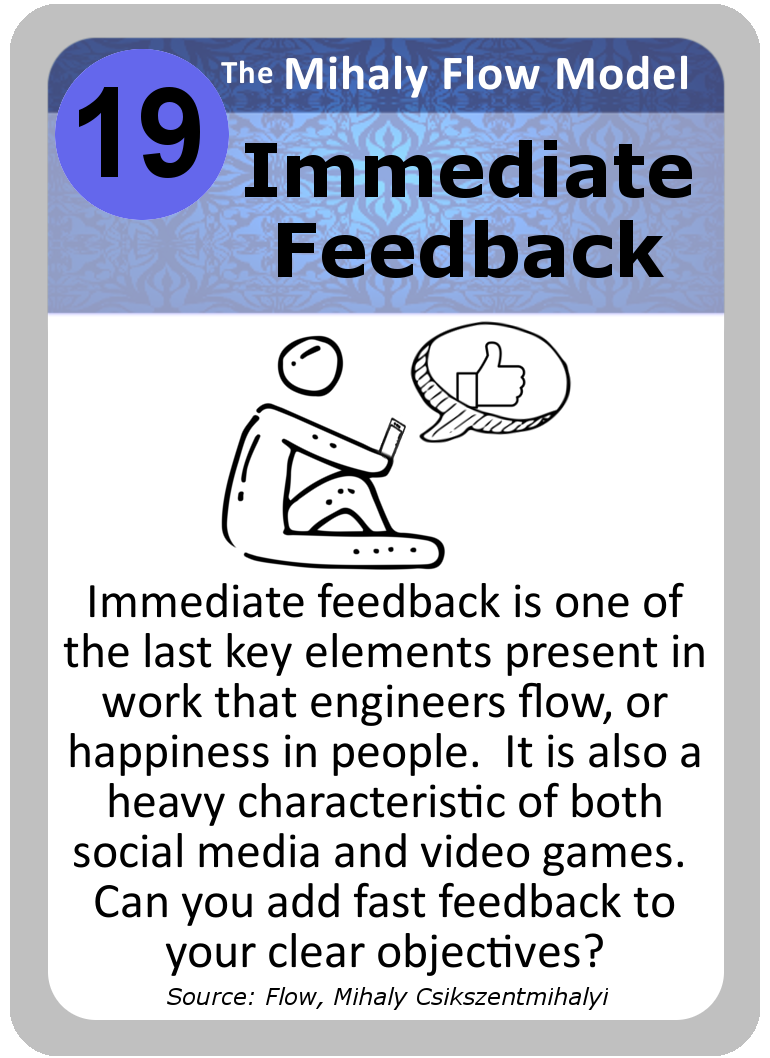
Leadership Card 019 Immediate Feedback - Lean CX Ease of Use

Leadership CardsView All The Leadership Cards (48)

- or - Have the Leadership Cards delivered for your next meeting

Engineering Happiness, Engagement and Flow in your Team

Leadership is a funny thing.  We naturally look up to those risk takers, the ones who “made it”, who did something outrageous against impossible odds, and won.  It’s easy to write an article about those guys (and gals), and it’s easy to think “if only I had done this or that, maybe I could have been that leader too.”

But here’s the thing about those high flying, outrageous risk taking leaders – they’re full of sh*t.

They’re full of sh*t because of a very simple psychological principle: Survivorship Bias.

What is Survivorship Bias?

Survivorship bias is our tendency to look at people who have done something against all odds, see them a lot because the news loves their story, and believe it is easier than it really is or that we can do it do, or that it is even more common than it really is.

When the reality is we see more of them because they are the ones who made it, making it look as though it is easy to do and more people are doing it.

Case in point – look at all the people who try out for American Idol, because they can sing.  Even just a little bit.  Even only in the shower.  So they go on the show and they get obliterated by the judges, because real, true, burning talent is a hard thing to find and in reality it takes years and years of hard work.  Now look at it from the other perspective – how many of these tens of thousands of people go on to have long, successful careers as entertainers?

Very, very few.  Even the ones who “make it” on the show have short lived careers that fizzle out relatively quickly.  And yet we see them in the spotlight, while they are there, and we hail them for their seemingly incredible life.

So Here’s What We Don’t Do

We don’t celebrate the grinders.  The workers.  The ones who are building a solid foundation for their team and engineering an environment that makes them happy to come to work, engaged in the work they do, and feel as though they are working towards something bigger than themselves.  And people who don’t make it to the spotlight – the majority of people – are the ones who need that engagement and happiness in the work they do.  And that happiness leads to the “Flow” state, where you can lose yourself in the moment, do things effortlessly, and forget to eat.

Engineering Flow in the Work Your Team Does

How would that be, if you could engineer that flow state in your team and their work?  Do you think their results would be affected?  You bet they would.

And so far we’ve seen a few key ideas in designing our work to create a state of flow in our team.  This last one is a key idea not just from Mihaly Csiksentmihalyi, who originally coined the idea of the flow state, but from many other methodologies as well – namely the Lean CX Score, Agile, Lean Startup and more.

This last key idea is fast feedback.

The idea is feedback because have you ever been doing something – making something really special or important, and working very hard on it every day?  But imagine this – you’ve worked on it every day for many months, even years, and at the end of that time for whatever reason it turns out it’s actually not the right thing.  It doesn’t do what you wanted and nobody wants anything to do with it.

That is what happens when you don’t get fast feedback.

The Lean Startup method is built around fast feedback – creating a Minimum Viable Product, a small product that does just enough to test in the marketplace and see if it works and gather feedback from real customers.  The Net Promoter Score is built around fast feedback – if you’re not doing well the customer gives you a score below 8 and you’re meant to follow up immediately to find out more and adjust if you can.

Feedback is almost priceless.  It is extremely valuable in business, and yet most businesses are afraid of it.

Asking for, and receiving feedback can be quite tough.  It’s tough on our ego, who doesn’t like things rocking the boat.  And yet to thrive in business we need to know if our customers aren’t getting what they want, and if it’s not ridiculously easy to get what they want.

It’s Like Playing A Video Game

Finally, I’ll say this: what else has clear rules, a clear objective, is neither too easy nor too hard, and gives you immediate feedback if you’re winning or not?

That’s right, a video game.

And people play video games for hours and hours.  They forget to eat.  They forget to sleep.  Some people become quite addicted to them, which has unfortunate results but it happens for good reason – they are the perfect example of the things that need to be present in order to engineer the flow state.

Do This For Your Own Teams, And Win

So find a way to give your team a process that is neither too easy nor too hard, and that gives them immediate feedback if they are on the wrong track.  It’s like a pilot checking in on the flight plan.  Are they on course or off course?  Are they moving towards their destination?  Because if you’re a pilot you need to know.  In fact, if you’re a human being you need to know.  But most leaders first don’t clearly articulate the process and objectives for their team, or don’t improve the ease of use of that process, and then finally they don’t check in to see how their teammates are tracking towards that goal so they can assist and make changes to the process as necessary.

Objective.  Process.  Feedback.  Improve and repeat.  You’ll soon be on your way to your destination when previously you were only flying around in circles.

Chat soon – David McLachlan

Leadership CardsView All The Leadership Cards (48)

- or - Have the Leadership Cards delivered for your next meeting

Lean CX ScoreGet "The Lean CX Score" now, and start creating disruptors in your industry that completely annihilate your competition.

Oh and good news!  You'll be improving the speed, morale and engagement of your teams at the same time.  Get the Lean CX Score now.
Leadership Card 18 – Engineering Flow and a Clear Objective

See The Leadership Card Deck Here

Design For Ease of Use with Lean CX – Leadership Card 18

Leadership Card 018 Clear Objective - Lean CX Ease of Use

Leadership CardsView All The Leadership Cards (48)

- or - Have the Leadership Cards delivered for your next meeting

Engineering The State of Flow, and Happiness

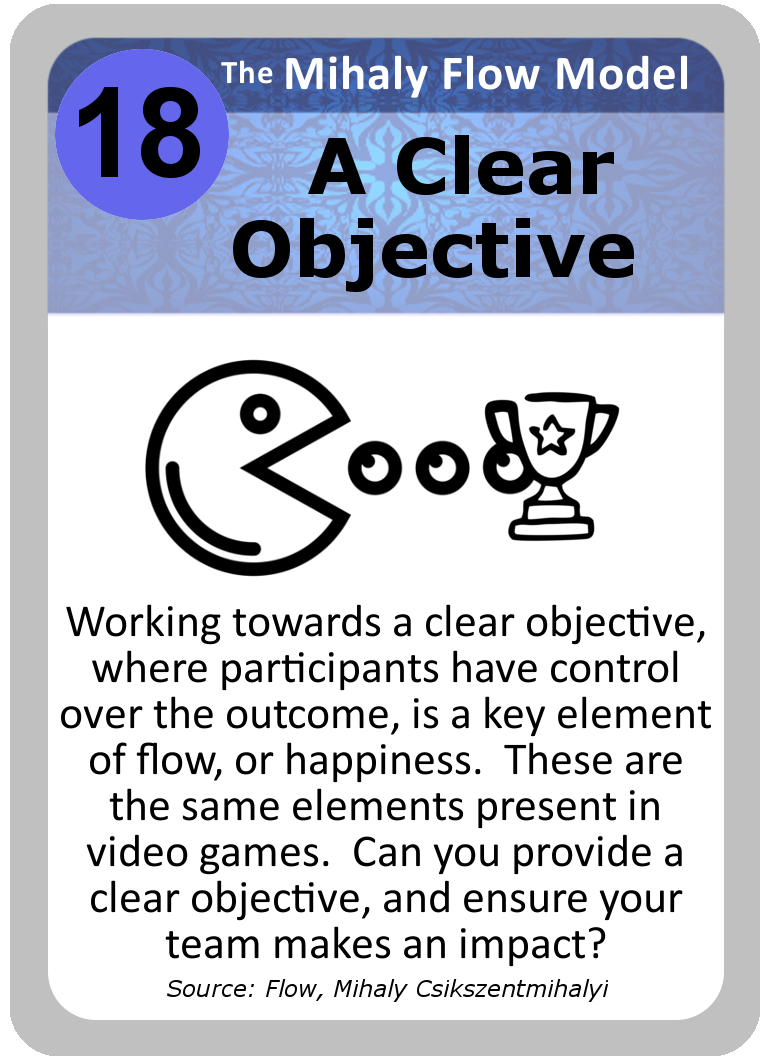
In the late 60s, Mihaly Csikszentmihalyi interviewed 1000 people on what makes them happy.  He found a few main things that, when present, can engineer what he called the state of “flow”, when you are lost in the moment, time flies, and you feel like you could do a task forever.

In the Leadership Card Deck we’ve seen a few different studies that have shown that a clear objective can make a huge difference to your team’s results.  And creating a clear path for your team with a repeatable process that is easy to use can increase those results again.

But there is more to this story when it comes to increasing the engagement and happiness of your teams.  And it’s because of this:

Have you ever been in a situation where what you did had absolutely no effect on the outcome?  Take this as an example – imagine you were driving a car, and trying to get to a destination, but when you turned the steering wheel it had no effect on the path you took.  In other words, the action you took had no bearing on whether you made it there or not.

A lot of teams are operating like that car ride today, because even if they have taken a step above everyone else and clearly articulated the objective and the process to get there and made it ridiculously easy to do, if your team’s actions have no effect on getting to that objective they will lose interest very quickly.  And losing interest is the absolute opposite of a state of Flow.

Working Towards A Clear Objective, With Control Over The Outcome

Mihali isn’t the only one to have found this in his studies.  In research brought to light via Daniel Pink’s book, Drive, he found that one of the best motivators wasn’t money or rewards, it was actually a thing called “Mastery”, which he described like this:

“Working continuously towards mastering a worthy skill.”

So we have a fairly ideal set up here, and this is only the start of it.  All the research is pointing in the same direction.  In Leadership Card 10, we saw that tying outcomes to a higher meaning had a huge effect on the happiness of your team.  So if we have a clear objective, where our team’s actions have control over the outcome, and those outcomes are tied to a higher meaning or purpose, then we start to see the ideal situation for engineering happiness and flow in the work that they do.

What Happens Next?

And what happens next when your team can effortlessly perform their work and it is working towards something meaningful?  Well, they enjoy coming to work much more than they thought possible.  It stops being just about the paycheck.  And the effects of high engagement show profit can go up by 17%, revenue can be doubled, absenteeism and sick days can go down by 40%, and much, much more.

Enjoying yourself at work takes a little bit of awareness – awareness that is not taught at school and is not present in most leaders who work their way up through the ranks.  But creating this scenario at work has a big payback, and doing even a little bit will show you just how powerful it can be.

Chat soon – David McLachlan

Leadership CardsView All The Leadership Cards (48)

- or - Have the Leadership Cards delivered for your next meeting

Leadership Card 17 – Engineering Flow, Intensely Focused on an Activity

See The Leadership Card Deck Here

Design For Ease of Use with Lean CX – Leadership Card 17

Leadership Card 017 Intense Focus on Activity - Lean CX Ease of Use

Leadership CardsView All The Leadership Cards (48)

- or - Have the Leadership Cards delivered for your next meeting

How Would You Like To Play Video Games For A Living?

No matter how old you are – teen, millennial, Gen Y, X or Baby Boomer, I can pretty much guarantee there was a time in your life when you played some sort of a video game.  Maybe it was on your mobile phone just the other day, maybe it was on one of the original consoles like Atari in the 1980s, maybe it was more sophisticated like the PlayStation or XBox, or maybe it was just plain old solitaire on Windows.  The point is, it was fun, and you could easily get lost in the moment (which turned into moment-s) while playing it.

That’s the thing about games.  Because of their very nature they naturally engineer the state of “flow” in people participating in it – that state where time flies, you get into a rhythm, and you’re so engaged you forget to eat.

And with the state of flow – it can actually be engineered into your work to make it more game-like in its systems, through the process, the feedback, and the way the work is performed.

It’s Not Quite Playing Candy Crush All Day

Now this doesn’t mean we’re literally playing Candy Crush all day and getting paid for it – when I say more game-like I’m talking about the way the work is structured to engineer the state of flow, and help the work get done with more engagement from your team.

So we’re looking at the mechanisms behind games, not games themselves, and how they are addictive because they create this state in people.

Flow Model – The First Tip – Make it Repeatable 

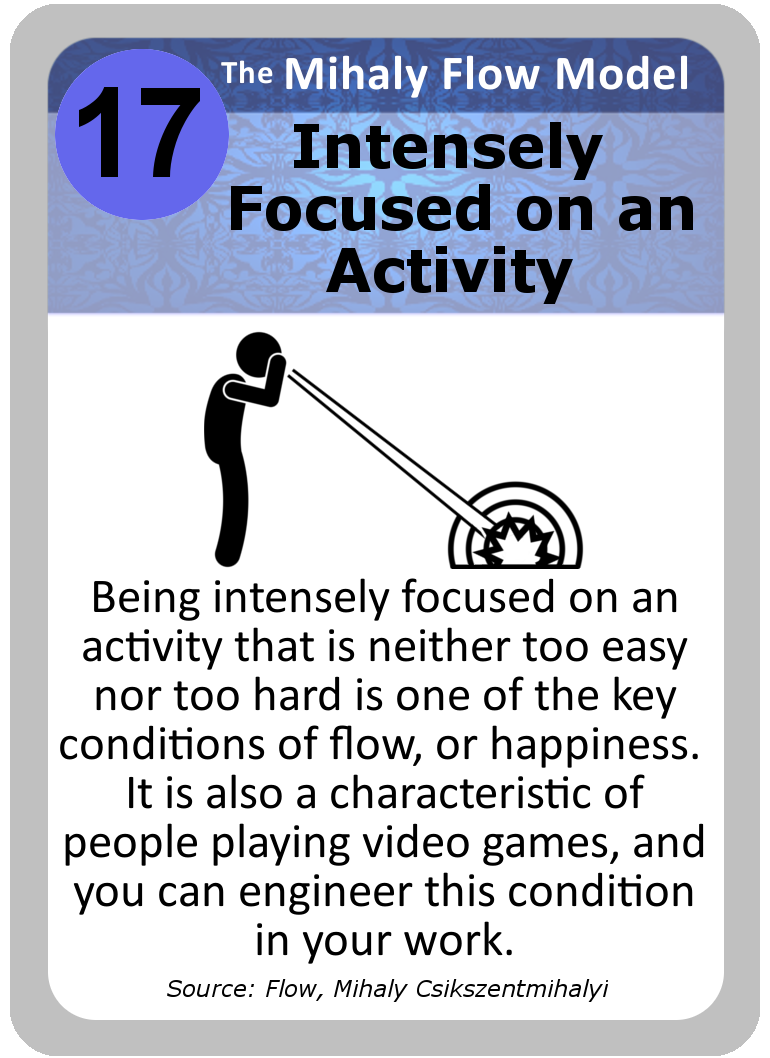
The first part of the Flow Model is creating work for your team that is neither too easy, nor too hard.  This means getting right in there and creating the rules of the game – a repeatable process that can be done the same way every time (or used as a guideline for work that is wildly different, complex or creative).

Because you know what?  Most leaders never clearly articulate the rules of the game – the outcomes, the path to get there, and regular check ins to see if we’re on that path.  Can you imagine playing a game – whether it’s football outside or a video game inside – and not knowing the rules to the game?  It wouldn’t last very long, and that is exactly what is happening with your teams.

When creating that work process, it’s also really important to look at the ways we can make it easier to do – to improve the “Ease of Use” of that process.  By improving the ease of use we are making it easier for our people to fall into a natural rhythm and state of flow, and not be interrupted by making mistakes, having to check how to do something, having to wait for someone else, or multitasking between too many things.

That’s what we mean in this first step by “performing a task, that is neither too easy nor too hard”.

Most leaders never get to this step in their leadership.  

Putting out fires unfortunately becomes a routine part of their day.  They don’t understand that you have to engineer the work – design the work – and design it specifically for ease of use.

Now look at it the other way.  Your best staff – the ones you love and the ones who “naturally” do a good job.  There’s nothing natural about it at all – in order to get good at something, any star performer has simply figured out, most likely through trial and error, the best way that flows naturally for them to do something.  They’ve experienced the errors, so they know how to avoid them.  They know the sticking points, so they know how to approach them.   To learn something – anything – humans have to create and strengthen neural pathways in our brains by doing something over and over.

What I’m asking you to do is to do better for your team.  Help them design their work and the process.  Make the objective clear and make the path clear, and help make it easy to do before they have to go through all that figuring out themselves.

In doing so, I absolutely guarantee you will see some incredible results.

Chat soon – David McLachlan

Leadership CardsView All The Leadership Cards (48)

- or - Have the Leadership Cards delivered for your next meeting

Leadership Card 16 – What Workers Want

See The Leadership Card Deck Here

Design For Ease of Use with Lean CX – Leadership Card 16

Leadership Card 016 What Workers Want - Lean CX Ease of Use

Leadership CardsView All The Leadership Cards (48)

- or - Have the Leadership Cards delivered for your next meeting

It’s Not About The Money (Money, Money)

Apart from being the lyrics to a catchy tune in 2011 by Jessie J, it turns out it really isn’t all about the money when it comes to your team and the people within your business.

When Richard Florida took the responses to an information week survey and filtered them for the things that made people want to do a good job, even he was surprised.  Having “Challenge and Responsibility” came in at number one, where a person is given autonomy in completing a task that isn’t too boring for them.  Flexibility came in number two, and job stability at number three – and these two things match up with other studies and research you will see in these Leadership Cards, such as Anthony Robbins’ six human needs where Variety and Comfort are both necessary to our happiness, even though they can be conflicting.

After all of those things, came money at number four.  Yes, we need money to eat, pay the mortgage, put the kids through school and go on date nights with our partner, but it turns out people put a lot of things ahead of it when it comes to their happiness at work.

Intrinsic and Extrinsic Motivators

You see, there is a very large difference in motivating factors within your team.  Sure, there are the obvious ones, like them getting up in the morning and going to work because you’re paying them.  Money and other physical benefits – something external to that person – are known as extrinsic motivators.

But have you ever done something for someone else just because?   Without the need for money and without the need for something in return?  Chances are you’ve experienced an intrinsic motivating force, where you are compelled to do something because it gives you an internal payoff.  Things like working back extra time because you like your leader, or the things you do for your kids or your family or your friends, or perhaps creating something like a drawing or piece of music.

Daniel Pink found three main intrinsic motivators in his book “Drive”.  they occurred when a person had:

  1. Autonomy: Where they are given free reign in solving a problem
  2. Mastery: Where they can work continuously towards mastering a worthy skill
  3. Purpose: Where they are contributing to something greater than themselves

Can you find a way to engineer these into your own work and process?  If you can, the results just might surprise you.

Chat soon – David McLachlan

Leadership CardsView All The Leadership Cards (48)

- or - Have the Leadership Cards delivered for your next meeting

Leadership Card 15 – Design The Situation

See The Leadership Card Deck Here

Design For Ease of Use with Lean CX – Leadership Card 15

Leadership Card 015 Design the Situation - Lean CX Ease of Use

Leadership CardsView All The Leadership Cards (48)

- or - Have the Leadership Cards delivered for your next meeting

Design The Situation For Ease of Use And People Will Do What You Want

In a study by three researchers featuring college students, and seeing what it might take to get them to donate to a food drive on campus, Nisbett, Griffin and Ross found something very valuable.

Before they started, they interviewed their subjects and separated them into two groups – those who they believed would give to a food drive, meaning they were kind, charitable people by nature, and those who they believed would not give to a food drive.

The funny thing is, the students they believed would not give to the food drive actually gave more than their so-called charitable counterparts when they were given clear instructions on how to do it, where the box was to donate to (including a map of the campus), and asked to think about the exact item and day they would go and donate.

Clarity Matters

You see, it’s not enough for someone to just be “naturally” good at something.  The environment shapes a large part of a person’s results, which is ultimately good news because we can shape the environment to make it easier for our people and customers to do the things we want.

If something is hard to do – if there are many obstacles, it’s not front-of-mind, it has too many steps or we need to redo too many things, or there’s too much waiting around or there are too many hand-offs between departments – then there is a much higher chance that a person won’t do it.  That can include a customer buying your product, or a team member performing work for you.

Getting intentional about designing your work and customer experience, and designing it specifically for ease of use, can make all the difference.

And as we saw in the charitable giving example, that can mean giving clear instructions, a map of where to go, and a clear vision of what to give and when they are going to give it.  In other words – How, What, When, and Where.  For you in your business, it might be simpler.  Knowing who your customers are, what they want, and the steps to get there is a great start.  Then you can improve the ease of use for your customers simply by reducing those steps in getting what they want.

Try it for yourself, and I believe the results will absolutely astound you.

Chat soon – David Mclachlan

Leadership CardsView All The Leadership Cards (48)

- or - Have the Leadership Cards delivered for your next meeting

Leadership Card 14 – CEOs versus Customers

See The Leadership Card Deck Here

Design For Ease of Use with Lean CX – Leadership Card 14

Leadership Card 014 CEOs Customers - Lean CX Ease of Use

Leadership CardsView All The Leadership Cards (48)

- or - Have the Leadership Cards delivered for your next meeting

The Customer Experience Disconnect

In a study by Bain & Co it was revealed that around 80% of firms believed they delivered a “superior customer experience”.  The only trouble was, their customers didn’t agree, with just 8% of customers confirming they were provided a superior customer experience.

The study also found that companies were trying to do a good job – they truly believed they were customer focused and recognized the importance of their customers.  They obviously genuinely wanted to provide a superior customer experience, they just didn’t know how to truly pull it off.

Instead of focusing on improvements that truly value the customer, they do things like relentlessly pursuing new customers at the cost of old ones.  For example, heavy discounts for new customers while more expensive pricing for existing customers.  Or they gathered immense loads of data on their customer’s habits without actually talking to them, understanding what makes them want to stay.

How Easy Was It To Get What You Wanted, Really?

Research and consulting firm Forrester has found that making it easy for your customer to get what they want goes a long, long way to providing them that “Superior” customer experience.  In fact, customers are more likely see your company as competent and to forgive any mistakes that happen along the way.

Part of making it easy for a customer to get what they want is reducing the steps to getting what they want.  The more “steps” a customer has to take, whether it’s talking to different people or departments, filling out multiple forms or needing to gather multiple pieces of information, all affects the ease of use and the likelihood of a good customer experience.

Checking in with your most profitable customers to understand what went well, and what didn’t go well, also helped the best companies design their experiences to attract more profitable clients.

Getting Intentional About Designing Your Work

The research by Bain & Co also found that companies who outperformed others when it came to customer experience had intentionally designed their work (i.e. the operations of their business) and customer experience.  They called it Design, Delivery and Developing Capabilities, and this is where it is handy to have a simple yet powerful framework to work through decisions with.  The Ease of Use framework first outlined in the book The Lean CX Score can immediately improve the ease of use for your customers and your team in a few simple ways.

First, it brings clarity to a process by making it repeatable.  Then it reduces the steps to a customer getting what they want, by making hidden things visible and making it impossible to make a mistake.  Finally, by checking in to see if the customer got what they wanted they can reduce the steps further and make things easier again.

Don’t fall into the trap of a complicated programme of work to improve the retention of your customers – make it easy with an easy framework and focus on the ease of use for your customers.

Chat soon – David McLachlan

Leadership CardsView All The Leadership Cards (48)

- or - Have the Leadership Cards delivered for your next meeting