“It is always the simple that produces the marvelous.” – Amelia Barr
Have you heard this leadership quote from Amelia Barr?
Amelia Barr was a writer and teacher from Britain who lived in the late 1800s to early 1900s. When she was only nine years old she had to read for her father, and developed her reading and comprehension well beyond her years. As an adult she learned the Stowe teaching method, whose principles are based on morality and lifelong learning.
Simplicity is a Powerful Thing
People often get simplicity confused with ease. the two are not the same. For something to be simple, often we have to cut things out of it, and reduce things to their essential form or qualities, and this is actually quite hard for human beings to do.
But the power of simplicity is that fewer things can go wrong, and there are fewer things to overload our senses or confuse our target audience. When you are able to focus on just one thing, there is a much higher likelihood it will get done, as opposed to switching tasks and having to get up to speed on each task again.
The iPhone made things exceptionally simple for its users. It famously only had one button, and the rest was a simple touch of the screen. Before this it was computers with full keyboards and often complicated navigation.
Amazon also made things simple, when they were the first company to patent the “One Click Buy” button, which had all the relevant customer details saved so a customer only needed to focus on the thing that made Amazon money – the point where the customer bought it.
Ask yourself – “How can I make things more simple in my life, in my organisation, in my team and in my product?”
“The challenge of leadership is to be strong, but not rude; be kind, but not weak; be bold, but not a bully; be thoughtful, but not lazy; be humble, but not timid; be proud, but not arrogant; have humor, but without folly.” – Jim Rohn
Have you heard this leadership quote from Jim Rohn?
Jim is a well known author, entrepreneur, and speaker. One of his best speeches is “How To Have Your Best Year Ever” and is a speech that can be listened to over and over again, teaching some of the most powerful fundamentals of life, success and business.
The Paradox of Leadership
In his quote, Jim Rohn rightly points out the paradox of leadership – that a true leader is strong enough within themselves to be humble, strong enough to know the difference they made and give credit to their people to lift their spirits and build their self esteem, but also strong enough not to be bowled over or led astray.
From this perspective, “strength” doesn’t mean beating someone up, it doesn’t mean putting others down, and it doesn’t mean all talk and no action.
A lot of it comes back to self-discipline, which Jim talks about frequently in his speeches. When a leader has the discipline within themselves, they clearly know when to draw the line and when to cross it.
“A leader is best when people barely know he exists…when his work is done, his aim fulfilled, they will all say: We did it ourselves.” – Lao-Tzu
This is an old, yet timeless leadership quote from the founder of Taoism, Lao Tzu, who lived in China around 600 years BC. And thankfully we can add “he or she“, and “his or her aim” today, as we’ve made strides towards equality over the last 1600 years that Lao Tzu wasn’t privy to, and we’re blessed with many wonderful women leaders, both high profile and local.
Do you know what this quote means? Lao Tzu is talking about “servant leadership”, 1600 years before it became a popular leadership method and framework, which is amazing in itself.
Empowering Your People So They Can Do It Themselves
There are as many different leadership styles as there are personality styles, although you may know the most common ones: from the Autocratic, where the manager is primarily focused on getting the tasks done with little regard to a team’s feelings, to directing, democratic, laissez-faire or “hands-off”, charismatic and transactional.
But there is one leadership style which has grown in popularity, especially with the rise of Agile and Lean methodologies in and around software development, and that is the Servant Leader.
If you’ve read any form of leadership literature over the past year there’s a good chance you’ve heard about the epidemic that is sweeping the globe, and has been for some time. No country is safe – whether it is a first world country with all the benefits a person could want, or a third world country where workers are truly exploited.
That epidemic is employee engagement.
Low engagement across the world in what should be a meaningful endeavor – work, has strangled productivity and is robbing employees around the world of their energy and happiness. You see, it’s only in the last 100 years that work has really been separate from the management and planning. And that separation has led to meaningless work, separated from the customers who benefit or the outcomes they produce.
Now more than 70% of employees, even in first world countries, are disengaged in their work.
I’ve put together a manifesto with a clear step-by-step guide to improving employee engagement, and below are the sources for research that all point to the same thing: We crave clarity, regular checking in from our leaders where they focus on our strengths, and continuous improvement, and despite what you may have experienced the meaning we can get from normal every day jobs runs very deep.
Let’s check it out!
The State of the Global Workplace, Gallup
Growth Mindset
Maslow’s Hierarchy of Needs
Hertzberg’s Two Factor Theory
Happiness, income satiation and turning points around the world
High income improves evaluation of life but not emotional well-being
Eustress versus Distress
Harvard Forces of Employee Engagement
Self-Determination Theory and the Facilitation of Intrinsic Motivation
SWOT Analysis For Management Consulting (Albert Humphrey)
Do Employees Really Know What’s Expected of Them? Gallup
The Million Dollar Checklist: Sustaining reductions in catheter related bloodstream infections
The Person and the Situation – effects of environment on motivation
Universal and Cultural Dimensions of Optimal Experiences
Motivating Language Theory
The Art of Motivating Employees
Driving Engagement by Focusing on Strengths
Inner Work Life: Understanding the Subtext of Business Performance
Harvard, The Easiest Way To Change People’s Behavior
Timing Matters: The Impact of Immediate and Delayed Feedback on Learning
The Power of Feedback
Google’s research on Clarity and Meaning
First, the statistics on the current engagement epidemic.
This is a powerful definition of Operational Excellence, how it relates to Customer Obsession and has a huge impact on revenue, profit and employee engagement. You can download a PDF version for yourself, free. Enjoy!
A Framework For Operational Excellence and Customer Obsession
Operational Excellence. It’s a term most of us have heard, maybe even used, but when it comes down to it few people know what it really, truly means. Operational Excellence certainly sounds like something we should want – after all, everyone would say they want their business or team to operate well, and we want it to be excellent rather than average, right?
Operational Excellence is important enough for Jeff Bezos (the richest man in the world and the CEO of Amazon.com) to mention repeatedly in his shareholder letters, so there has to be some value in it. And let me ruin the ending for you here – because when it comes to well defined operational excellence there is massive value indeed.
It’s a strategy that has helped Amazon become the most feared (and revered) business of the century so far – sending whole industries running for cover at the slightest mention of working there. It’s a strategy that helped Toyota thrive for over 100 years in one of the toughest industries on earth. It’s a strategy that took McDonald’s from one store to over 36,000 stores worldwide, and it’s a strategy that enabled Uber to grow to more than 2,000,000 drivers worldwide. Bezos says:
Congratulations and thank you to the now over 560,000 Amazonians who come to work every day with unrelenting customer obsession, ingenuity, and commitment to operational excellence.
The thing is, when Jeff Bezos talks about customer obsession, he’s not talking about meeting a customer at a cash register and giving them a smile. He’s talking about reducing any friction a customer might have in doing business with Amazon.com, and making it ridiculously easy for them to buy (and continue to buy) from them.
Which gives us some good news. When it comes to Customer Obsession and Operational Excellence, those two things are 100% related.
Wow, that’s a mouthful, isn’t it? Solving the root cause of operational problems. What does that even mean? Well it must mean something, because Jeff Bezos (he’s the CEO of Amazon.com if you haven’t heard of him, and currently the richest man in the world) makes a point of doing it day in and day out in his business, and ensuring his managers do the same.
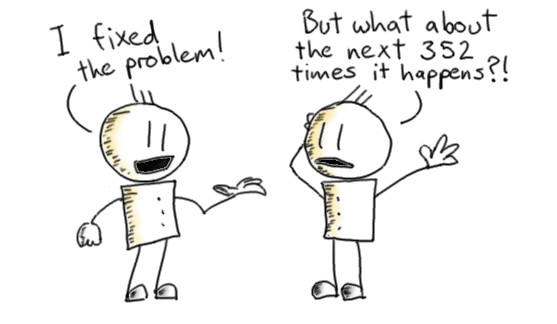
And it might sound fancy but in fact it’s very simple – find out what is bothering your customers, then don’t just fix it one time, fix the reason behind it. Here’s an example from the book “One Click: Jeff Bezos and the Rise of Amazon” by Richard Brandt:
“When one elderly woman sent an email to the company saying she loved ordering books from the site but had to wait for her nephew to come over and tear into the difficult-to-open packaging, Bezos had the packaging redesigned to make it easier to open.”
He had the packaging redesigned. He didn’t just apologize. He didn’t go to her home and open the package one time. He had the packaging redesigned so it wouldn’t happen again.
Companies With the High Velocity Edge
A man by the name of Steven Spear found the same thing, through research in his book “The High Velocity Edge”. Companies who outperformed others over long periods of time had leaders who:
Designed their work to reveal problems and opportunities
Solved the root cause of those problems
Shared that knowledge throughout the organisation, then;
Developed the problem solving skill in others.
This meets the actions of Jeff Bezos perfectly. By solving the root cause of problems customers are having, they stop those problems from happening again. They are saving time, money, and retaining customers. Then by sharing that knowledge and building the problem solving skill in others, the managers and teams at Amazon.com are building upon previous successes in a way that starts as small improvements and gains, but soon grows to large gains as the improvements compound on each other.
Start and Finish with a Repeatable Process
Problem solving by itself may not give you the results you want. If you improve something, but don’t lock in those changes, there’s a good chance things will revert to normal after a short period of time.
This is where a standard, repeatable process comes in to play. By ensuring each product we sell, and each operational process we perform to get there has a clear, repeatable way of doing it, we can use that process to improve. Something as simple as a checklist, or screenshots, can work wonders with ensuring everyone knows what to do and can do it the same great way every time.
Then when you improve things, you can lock in the changes by updating the process, checklist, screenshots (or any other way you prefer), so the improvement isn’t lost and you can continue to grow over time.
In that way, small incremental improvements will compound on each other over time, leading to large improvements overall.
In that way, solving operational problems is the key to operational excellence. And by solving problems your customers bring to you (whether through complaints or other feedback) you are unlocking the door to a customer obsession mindset.
We all make mistakes. In fact, making mistakes usually is a good way to learn and become better in life. But what happens when we allow – even encourage – our customers to make mistakes as they try to buy from us? Or what about your team members, trying to do a good job in your business, but thwarted (yes, thwarted) by long, convoluted processes that seem to trip them up at every turn?
Making things easy is the real key to engaging your workers, getting customers to buy from you, and ultimately getting the results you deserve in your business. And making things easy is done in a few ways, but one of the best ways is to find a way to make it impossible to make a mistake, as your team or your customer goes through their process.
If it’s impossible for them to make a mistake when they buy from you, they are more likely to buy. If your team can’t make a mistake in the work that they do, they are more likely to do it. But it also works the other way. If it is possible, even easy, for your team to make mistakes, then they may have to redo their task over and over again, costing you more, frustrating them and reducing their engagement.
Designing your work intentionally to make it harder to make mistakes takes work, which is why most leaders don’t do it. Instead, they fall on the crutch of “hiring the right people” or “hiring people smarter than themselves” and letting those superstars get to work. But here’s the thing – hiring superstars is expensive. And even when you do, there’s still an 80% chance they will be a dud – not matching the culture of your team, getting bored with the work, or wanting to go in different directions than your team, and the way they do things is ultimately still hidden in their minds (not made visible for all to see).
It is MUCH better, easier and cheaper for you to simply hire nice people – collaborative people – and give them the right boundaries with a repeatable process where it’s impossible to make a mistake.
After all, McDonald’s did it, and now it’s a multinational company with over 36,000 stores that has run for nearly eighty years. Uber did it, and it’s now it has scaled across the globe and is worth 70 Billion Dollars. Amazon, Apple, Microsoft, all the big names you hear about know the power of making it impossible to make a mistake. They’ve all done it separately in different ways and have all had stellar success. How will you do it?
Yes, you will have to brainstorm with your team. Yes, you will have to put in a little extra work to make your process simpler. But the rewards you will see are 100 times worth the effort.
A picture is worth a thousand words. That’s what they say. Sure, it may be an old saying, and who knows where it started? But the thing is, it’s right.
One study found that adding pictures increased understanding and recall of information 98% of the time. So if you’re a leader and you want your people to do something, or if you’re a business owner or entrepreneur and you want your customers to buy something, making it visual is a huge part of them getting and retaining that information so they can do what you want.
Making it visual means taking your process from being hidden in someone’s mind, and writing it down or putting it on a wall so everyone can see it. Or better yet, taking that 1000 word report and turning it into one chart that people can easily and quickly understand.
The best websites have a user experience that visually guides their customers in the direction they want. The best software development teams have simple red or green lights when development environments are working or when they are not. Uber gave its customers a GPS map where you could see how many cars were close by to pick you up.
A picture is worth a thousand words. It is also around 1000 times faster at conveying the information you want, to the people you want.
Making things visible also brings clarity to your work and engagement to your people. When your team are uncertain of what they need to do, they are more likely to be disengaged and also more likely to not do the work – that’s what the research says. Making the work clear and the process visible goes a long way to improving your performance and your results.
What Can You Do In Your Own Work?
Is there “hidden” information you can make visible in your own work? Maybe it’s your best performing team member and how she does her work. Maybe it’s clarity on the next steps your customer has to take (or will go through) in their customer experience. All of these things are often hidden, and not clearly exposed for people to see, because it actually takes extra work for us to bring them out into the open. Most people won’t do it. But if and when you do, your team will be more engaged, and your customers will buy more often.
How does a single restaurant manage to stay in business? Thousands of restaurants go out of business every year. Possibly hundreds of thousands, if you look at the industry around the world. So how does one manage to survive?
But then let’s take it a step further – how does a restaurant not only survive, thrive, scaling to over 36,000 stores worldwide?
36,000 stores. That’s roughly how many McDonald’s family restaurants there are around the globe, and it all started with a single one nearly 80 years ago. The McDonald brothers made burgers so well, so fresh, and so fast, and so repeatably that their model was able to be scaled to other stores quickly. It could be taught quickly, it could be replicated quickly, and each new store could have success quickly all because of one simple approach: Capturing their process and making it repeatable.
You see, every tiny piece of the process that went into making a McDonald’s hamburger was looked at, written down, and then improved and streamlined until it was the fastest burger at a very low price that could be found anywhere, for a long time.
By making their process so repeatable by anyone who came along, they were able to hire kids still in school, as their first job, and train them in their repeatable process. They didn’t need to hire people with degrees (costing them more) and anyone they did hire had great success at their work because it was made clear and simple.
2018 and Beyond – Scaling Drivers Worldwide
But it’s not just burgers that have a process that can be made repeatable. It’s anything. And when you do this, you can scale your business beyond anything you had ever thought of before.
In 2009, could you have ever imagined that more than two million individual drivers from around the world would all be trained and working towards a common goal? Well that’s exactly what Uber has done, and exactly why it is worth 70 billion dollars today. They used the power of technology and delivered it in an app, error proofing with automatic payments, GPS tracking and simple visual management where you could see exactly where your driver or passenger was. They made the process repeatable.
What Can You Make Repeatable?
Now it’s over to you. Everything can be made repeatable, and everything can be simplified. What are some areas in your business that you just know you need to clarify, write down the steps for, and then make a little bit simpler?
The Lean CX (or Ease of Use) framework shows you exactly how to simplify your work and your customer experience. Clarifying the steps to getting the outcomes you want, therefore making them repeatable by anyone, is the first step to simplification.
Are you unhappy in your job? Do you hate your work? Is your life boring? I’ve got something that you may find controversial, and if this is you I want to say that it’s NOT your fault. Your leader has not intentionally designed your work for ease of use and engagement – probably because they don’t know how.
So the question is – if they’re not going to lead, then who is? And the answer is YOU. YOU are the leader your team needs to get intentional about designing your work for ease of use and engagement, and when you do, no matter what industry or work type you are in, you will start enjoying those 8 to 12 hours everyday we call “Work”.
Get the Leadership Card Deck, printed on strong, beautiful linen card, delivered to anywhere in the world.
Get the Lean CX Score, delivered wirelessly on Kindle or in print to anywhere in the the world.
Transcript:
David McLachlan: It’s an absolutely beautiful morning in the city, this is gonna be a great ride. But I really want to talk to you about something super important, in fact one thing that we haven’t really spoken about over the last couple of videos is a little thing called designing your work.
Like I said I really want to talk to you about designing your work, and more specifically designing your work for ease of use. So what does it mean to design your work? Well think about it from this perspective. Have you
ever had to call a company, or deal with another department in your company, and you can just tell they don’t really know what they’re doing? You know, they have to redo things over and over again, they have to hand off to another department or another person, there’s a lot of waiting in between steps and the person that you’re dealing with or even a team or another department, and the person that you’re dealing with is just dragging their feet and everything is too hard for them. And all of this grates on the experience.
So pretty soon you’re not wanting to do business with these people or this
company because of all of this extra friction, and it’s quite obvious that they don’t like their job. I’m gonna say something a little bit controversial and that is it’s not their fault. It’s actually because their process and their work has not been intentionally designed for ease of use. Because when you design your process in your work and your job for ease of use you’re making things easy naturally so then it wouldn’t matter these things would be easy for that person to do, whether they were having a good day or a bad day. And we all have bad days but there’s absolutely no excuse for having a bad process.
So why is it important to design your work, and specifically design for ease of use? Well, a recent study found that more than 50% of people in their jobs
actually don’t know what’s expected of them at work. And because of that they’re not doing the best job that they can do. And of course out of those people who don’t really know what’s expected of them at work there’s a higher proportion of people who are disengaged in their work – just like that person we were talking about before who’s dragging their feet and everything’s too
hard. These are everyday people trying to do a good job but they may not
necessarily be able to, because it hasn’t been made clear what is expected. The outcomes and the steps have not been made clear.
Disengaged workers – the impact that has on your business is, their sales rates are lower their productivity is lower. Happiness has a big impact on your bottom line. Now look at it from the other perspective as well. Recent research by Stanford University actually found 35 percent was the difference in results of people who had clear outcomes and people who had not clear outcomes at all. Teams and companies that didn’t have clear outcomes actually performed 35% worse than people and teams and companies that
did have clearly articulated outcomes and clearly designed steps to get there.
Now there’s another study as well that was done on happiness and flow, and it’s by a great man called Mihali Csikszentmihalyi, and in the 1960s he took a thousand people and interviewed them when they found the most happiness
and meaning in their lives and there were a handful of things, but three of
the most prominent were they had control over the outcome when they were doing the task, they had a clear objective when they were doing the task, just like the Stanford University study and just like the Gallup study as well, and the task gave immediate feedback. Now all of these things are actually part of the
ease-of-use framework which I’m going to share with you over the next couple of videos. So everything is starting to tie together all of the research is pointing in a very very very similar direction, and that direction is making sure that we’re clearly articulating things, intentionally designing the work, and
designing it specifically for ease of use.
Now I’m going to go into the five steps of the ease-of-use framework in other
videos but really quickly they are: making your process repeatable so it’s
the same great repeatable process every time, reducing those steps to a customer getting what they want, making it visuals so they can see exactly what to do first time without having to ask, making it impossible to make a mistake and checking in so that we know whether they got what they want or not.
So where do we go from here? A very simple thing that you can do straight up is just simply write out the steps that you take to perform a few of the tasks in your work and then try and reduce those steps so by reducing the steps you are actually reducing the complexity making things easier just straight off the bat just doing those two things alone will have a massive impact on your business and the rest of it comes down to the ease-of-use framework which I absolutely cannot wait to share with you over the next coming videos.

 View All The Leadership Cards (48)
 Get "The Lean CX Score" now, and start creating disruptors in your industry that completely annihilate your competition.

 Employee Engagement Research & Sources