In this series we will walk through five PMP Practice Exam Questions each day – a great way to set up your morning as you prepare to pass the PMP Exam. It is also useful for the CAPM exam, as the content is very similar.
We will also figure them out together, and you’ll see the thought process behind solving these PMP exam questions.
Watch the video below for the questions and answers!
Question 1
You have just validated the last piece of scope for the product you are delivering, with your stakeholders and gained their sign off. You have released the resources working with you back to their normal areas. What will you do next?
A) List all the stakeholders for your project
B) Create a project management plan
C) Oversee the testing of the product to ensure its quality
D) Write a Final Report summarising the performance of the project
Question 2
As a project manager, you are working on an activity that develops a document that formally authorizes the existence of a project. What will you do next?
A) Identify the Stakeholders and list them in the stakeholder register
B) Gather and acquire the Project Team
C) Plan the costs of your project in detail
D) Plan the schedule of your project
Question 3
A project management plan is a formal approved document that defines how the project is executed, monitored and controlled. Who is responsible for the project management plan?
A) The Program Manager
B) The Project Manager
C) The Project Sponsor
D) The Project Team
Question 4
You are working on your project management plan and quality management plan with your quality team leader. Your quality team leader wants to review the Cost of Quality (CoQ), and asks you for advice on what to include. Out of his list, which costs would you NOT consider?
A) The cost of your project team (resources)
B) The cost of preventing defects
C) Appraisal costs
D) Failure costs
Question 5
The To Complete Performance Index is the rate that future project work must be performed at. Your current project has a BAC of $100,000, EV of $50,000, and AC of $40,000. What is the rate of work we must achieve (To Complete Performance Index)?
It’s time to look at the interpersonal and team skills that you will need as part of your project management career, and stakeholder engagement.
Interpersonal and team skills are the behaviors and tactics that a person uses to interact with stakeholders in a project effectively. The ability to establish a relationship with others and maintain that relationship is a key to the success of your project.
If you don’t get along with the people that you’re working with, or delivering the project to, there are going to be problems when your project comes to delivery.
Types of Interpersonal Skills
So what are these interpersonal and team skills? Well, we’ve got things like Conflict Management. This can be used to help bring stakeholders into alignment on the objectives success criteria, high-level requirements, project description and other things. We might need to manage that conflict as we’re going along and there are various techniques for that in the PMBOK guide.
We’re definitely going to need facilitation. Facilitating meetings or facilitating focus groups or requirements gathering sessions or reporting on the how the project is going – facilitation is very important. And that involves meeting management as well.
We’ve got active listening. So how we are mirroring the person that we’re speaking to and repeating back what they’ve said so we ensure that we understand what they’ve said.
General leadership is used to communicate the vision and inspire the project team to focus on the appropriate knowledge and knowledge objectives.
You will need networking. So this allows informal connections and relations among project stakeholders. Sometimes if you have a good network within an organization, you can actually just go over to someone at the water cooler and say “Did you get this? I actually need your support on this. Can you help me out?” And they’ll say yes without any need for formal communication.
You’ll definitely need political awareness. Who has those those networking relationships in the organization? Maybe there’s a group of people over here and they talk a lot, and so if you’re in the bad books was one of them, potentially you’re in the bad books with all of them. You need to be aware of the politics that are going on and how business gets done in an organization.
That leads us to influencing. Influencing is gathering the relevant and critical information to address important issues and reach agreements while maintaining mutual trust. Sometimes we need to get our way across to others but do it in a way so that everybody feels good about it, and that’s not often easy to do.
Which brings us to negotiation. Sometimes if we’re influencing it might involve a little bit of back and forth. Two teams might need the same resource, and now we need to negotiate for those resources, and we need to do it in a way that everyone feels good so that you can come back and work with them again. We’re using that stakeholder engagement and ensuring that your network is still okay.
We’ve got motivation in general as part of our leadership. It’s providing a reason for someone to act. We want them to know why they’re doing something. We do need to help motivate them to do what we need them to do.
That also involves team building. So now we’re building our team, conducting activities that enhance the team’s social relations, and that includes increasing their motivation. It builds a collaborative and cooperative working environment. That might be doing things like requirements gathering together as a team, or making sure everyone has an input during the team meeting, making sure that a team is being built and no one is feeling left out.
Now as part of that we need a high emotional intelligence. So high emotional intelligence, we want the ability to identify, assess and manage the personal emotions of ourselves and of other people, as well as the collective emotions of groups of people. Not an easy task as a project manager, but definitely essential and something that you will learn and get better at over time.
As we’re doing that were also we’ve got communication styles assessment, which is a technique used to assess the communication styles of people, identify the preferred communication method – do they prefer to catch up, do they prefer a telephone call? Do they email or do they prefer a daily stand up or meeting once a week. What is the preferred communication style? And can you work with that with your stakeholders.
We’ve got cultural awareness, again very similar to political awareness so how business is getting done. But also just general cultural sensitivity, which is more broad, things like different nationalities or different things going on in people’s home lives. We have to be aware of that and aware of the fact that not everyone is the same.
To ensure that we’re able to work together in a nice and positive way involves observation and conversation as well. So that’s used to stay in touch with the work and the attitudes of the project team members and other stakeholders. Maybe we are having conversations about something that’s going on, with different festivals for different cultures and different ways of work, different hours that people will need to work depending on the situation and that comes through observation and conversation.
And those are all of the interpersonal and team skills that you’ll need as part of your project management career.
You may not see too many direct questions on this on the PMP exam, but you will definitely have to use this in your project management career. Communication is the exchange of information, whether intended or involuntary. Sometimes we’re communicating something and we’re actually not aware that we’re communicating it. It might not be verbal, it might just be body language or that sort of thing. The information is exchanged and it can be in the form of ideas, instructions or even emotions. 80% of a project managers time is spent communicating in some form or another, trying to get support for your project, trying to elicit ideas or gathering the requirements, checking how everything is going, meeting with the team members.
Factors that Affect Communication
There is so much going on in a project that we really need to be really good at communicating. Here are the skills and the techniques that we might use as we go along through our project. First of all, factors that can affect the choice of communication might include the urgency or the need for the information – so do we need to meet straight away, or can it just be an email? Can it be an SMS or can it be a slack message? This will change during the different phases of a project as well. The availability and reliability of technology – is email actually reliable, or should we send a letter? Can we pick up the phone, or can we use other forms of technology?
The ease of use for that particular technology – what’s going to be easiest for everyone to get the message in your project, not just one person but everyone that you need. It a SharePoint page, or is it a Confluence page, or is it a web page or is it a teleconference communication method. What’s the easiest way for everyone to get the message?
And of course the project environment – whether the team will meet and operate on a face-to-face basis or in a virtual environment, whether they’ll be located in one place, or multiple time zones with multiple languages.
And whether there are any other project environmental factors involved, so the sensitivity and confidentiality of the information – can we actually shout it from the rooftops, or should we have to meet and discuss it in private. This might also involve the social media policies for employees to ensure appropriate behavior so that we’re not telling the project details on social media, when it’s a secret project or something that we don’t want everyone to know about, it might be proprietary information.
Types of Communication Skills You Can Use
Communication skills include communication competence in general – this is a combination of tailored communication skills and it involves things like clarity of purpose, effective relationships with the people that you’re sharing the message with, and leadership behaviors. Really starting with “why”, or why are we doing things, making sure everyone is really clear and getting the message across.
Feedback is also one of the skills that we need. Feedback is information about the reactions to those communications, so how did they receive it? Was it received well, or received badly? Sometimes we need to ask for that feedback and we need to take it on board, even when it’s bad. That’s part of being a project manager. Feedback supports interactive communication between the project managers, the team and all other stakeholders.
Other communication skills you’ll see are nonverbal communication skills. Appropriate body language to transmit meaning through gestures. If we’re all closed up but we’re trying to get people pumped up for a particular project, maybe that’s not going to work. Our tone of voice needs to be appropriate, our facial expressions need to be appropriate, mirroring the people that we’re talking to and eye contact are also important techniques in communication skills.
You’ll definitely find yourself presenting during your project management career or the projects that you’re working on at the moment. Presenting as a formal delivery of information and/or documentation such as progress reports, background information for decision-making for the stakeholders in your project, and information aimed at increasing the support for your project with all of the stakeholders as well.
Taking the audience type into consideration. Is it a group of executives, do you need to be more formal under those scenarios? Or is it your a few people that you’re delivering the project to? You need to be considerate that it might be affecting them and take that into consideration when you’re communicating.
Lastly, there are communication artifacts and methods that are really useful as you go along on your project. You’ve got noticeboards, and that could be your virtual notice board or a physical notice board, newsletters, staff letters, press releases, annual reports, emails and intranets. Accompanying web portals – can we display the information that we need in that particular place? We might have phone conversations, presentations, team briefings and group meetings, focus groups, face to face formal or informal meetings between various stakeholders, consultation groups or staff forums and social computing like slack for example, technology and media.
And those are the communication skills that you will come across in your project management career.
Power and influence models, versus the Salience model for capturing stakeholder engagement
During your PMP exam you will come across many different stakeholder engagement techniques, and it’s important to know the difference between these various Power over Influence or 2D models, and the Salience model, which is known as a 3D model because we’ve got three particular parts to that particular model.
The Salience Model
So the Salience model itself describes the classes of stakeholders based on assessments of their Power, Urgency and Legitimacy. So power is the level of authority or ability to influence. The Urgency is the need for immediate attention, so how urgent is the stakeholders involvement in the project? And legitimacy is how appropriate is their involvement.
The salience model is useful for large projects where there are complex communities of stakeholders, or where there are complex networks of relationships within the project or the organization itself. Here’s an example, as you can see it’s known as a 3D model or a cube model, but the best way to represent it is through these three circles. So you’ve got Power, Legitimacy and Urgency and you can simply note all of your stakeholders within within these three circles and where they fit in the three circles to make it that easy graphical representation.
Power over Influence Models
We can also look at that in conjunction with the two dimensional classification models. They are more useful for small projects, or projects with simple relationships between stakeholders. We’ve got Power over Interest, or Power over Influence, and Impact over Influence. All of those you might use depending on which one fits you the best or fits the project the best.
My personal favorite is the influence of the stakeholder over the impact to that stakeholder. So does it have a high impact and does that person have a high influence? So are they an executive within that particular area, and is it having a high impact on them? We probably want to manage them very closely.
If it’s a high impact but they have a low influence on our project or the organization, then we just really want to keep them informed. If it’s a low impact to them and they have a low influence, then we can just monitor their involvement. If they have a high influence, but a low impact you still want to keep them satisfied, because with a high influence they may be able to influence the project, derail it or even help it under the right conditions.
So those are the power and influence models versus the salience model in your project.
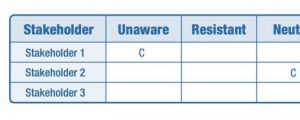
The Stakeholder Engagement Matrix is a very useful tool, and it supports the comparison between the current engagement levels of your stakeholders and the desired engagement levels required for successful project delivery.
It asks and answers the question – how engaged do we need our team, or the people around the project, to be to ensure successful project delivery?
There are five different levels through which we can measure this stakeholder engagement. First of all, we’ve got Unaware, then Resistant, then Neutral, then Supportive and then Leading. Let’s look at them in a little bit more detail.
Stakeholder Analysis
An Unaware stakeholder is when they’re unaware of the project completely, or its potential impacts. They simply don’t know that it exists.
Now if they’re Resistant, they’re aware of the project and its potential impacts but they’re resistant to any changes that might occur as a result of the work or the outcomes of the project. These stakeholders will be unsupportive of the work or the outcomes of the project, and we really need to communicate more and manage the relationship for those particular stakeholders.
We might have Neutral stakeholders, where they’re aware of the project but they’re not supportive and they’re not unsupportive. They’re just going with the flow.
We might have supportive stakeholders, where they’re aware of the project and potential impacts and they’re supportive of the work and its outcomes. This is ideally where we want to be leading to and ultimately the next step is when we’ve got stakeholders Leading, where they’re aware of the project and its potential impacts and they’re actively engaged in ensuring that that project is a success. They’re really helping us out, they’re not hindering us. And that’s where we really want our stakeholders to be.
A stakeholder engagement assessment matrix involves mapping our stakeholders against those descriptions. We might have stakeholders over here on the left where are they are currently (C) unaware, but we actually need them to be supportive as our desired state (D).
Most of them really need to be supportive or leading. An executive might need to be leading, or a sponsor might need to be leading, so we need to really make sure that we’re communicating properly and helping get them up into those upper levels of stakeholder engagement.
Current and Desired Stakeholder States
The gap between the current (C) and the desired (D) state for each stakeholder will direct the level of communications necessary, and to effectively engage that stakeholder so do we need to communicate a lot more, in a way that’s best for that stakeholder. Now we really need to use those soft skills that a project manager has to have, to increase the engagement of those project team members or the the other members around the project. The closing of this gap between the current and desired is an essential element of monitoring stakeholder engagement. You will definitely be using this in your project management career, and you will also see it as part of the questions for the PMP and the CAPM exams.
And that is the stakeholder engagement assessment matrix.
Claims are contested items in a project. This is when a buyer and a seller or perhaps someone delivering a project and someone receiving a project – where they cannot agree, they can’t reach an agreement on compensation for the change or can’t agree that a change has occurred. This might be where we said we were going to deliver “X” and when we’re delivering that business value or that project to our customer or to the organization (or whoever is receiving the benefit of that project) then they say it’s not actually what we wanted. If they can’t agree or we can’t fix it then a claim is raised and we go through the claims administration process.
Claim Prevention
Of course it’s best to prevent that from happening in the first place. Proactive claim management involves claim prevention. This is during the initial concept or design phases before a contract is signed. Can we get all of those requirements, and make sure that they are absolutely correct, from our customer? Can we make sure they are happy upfront, and that will reduce that possibility of a claim happening in the future.
Claim Mitigation
Another step is claim mitigation. During the contract preparation and pre-contract negotiation we can write these things into the contract – that they have absolutely agreed to “X” or if this happens then we’re not going to be liable for that.
Of course claims are pursued during the project execution and usually before or at delivery of the project.
Claim Resolution
Lastly claim resolution – this is settlement of outstanding issues, after completion and finalization of accounts. Once everything is agreed and we’ve gone through the claims process and all of that is finalized as part of the finalization of the project as well, if the parties themselves do not resolve a claim then it may have to be handled in accordance with alternative dispute resolution, also known as ADR, typically following the procedures established within the contract itself. This is a third party that can mediate this discussion, or the claim occurring and help everyone come to an agreement.
And that is claims administration in your project.
These are two things that you’ll see as part of procurement for the PMP exam, and it’s really great to know the difference between both just in case.
There are many different methods of attracting a relevant seller to procure an item or a service from, and you’ll come across advertising and bidder conferences either in your project management work or during the PMP exam. Bidder conferences you might also see called Contractor Conferences or Vendor Conferences and pre-bid conferences – these are meetings between the buyer (which is us) where we’re buying a service or a product, and perspective sellers. So there might be quite a few different sellers of a particular service that we need, and we’re actually meeting all of these sellers.
Why Use Bidder Conferences?
We use these bidder conferences to ensure that all prospective bidders have a clear and common understanding of the procurement, and no bidders receive preferential treatment because we’re either seeing them all at the same time or very close to each other, and everyone has very similar or the same information.
Advertising
Now the opposite of that is advertising where we’re communicating with our list of potential sellers and with those potential sellers – we might actually be able to expand that list by placing advertisements in general circulation publications, newspapers or internet ads or in specialty trade publications, so that the sellers understand that we’re coming out and we wanting to be buying their service or their product. Most government jurisdictions require public advertising or online posting of pending government contracts just to ensure that it is fair and that everyone is aware that it’s going on.
And those are two of the things that you’ll see as part of procurement on the PMP exam.
Types of Contracts in your Project and Procurement
Contracts are a legal agreement or relationship between two or more parties. An agreement might not involve a contract – if we’re making an agreement such as kicking off a project or initiating a project with a project charter that’s just an agreement, and it doesn’t necessarily involve a contract. However every contract we make will involve an agreement, and you’ll see these terms come up and be used in the PMBOK guide and PMP exam.
You’ll see agreements come up and the use of these contracts that we’re going to go over now. There are a few different types of contracts that you’ll see in use and you might have questions on these on the PMP exam.
Fixed Price Contracts
First of all we’ve got fixed price contracts, and within that we’ve got Firm Fixed Price (and you might see these abbreviated as well so just be ready for that) you’ve got FFP, firm fixed price. Fixed Price Incentive Fee (FPIF), Fixed Price with Economic Price Adjustments (FPEPA).
We also have cost reimbursable contracts, and for these we’ve got Cost Plus Fixed Fee (CPFF), Cost Plus Incentive Fee (CPIF) and Cost Plus Award Fee (CPAF) and then lastly we’ve got Time and Material contracts. Let’s go over them in a bit more detail.
Fixed price contracts are a total price, for a defined product. In other words, what are we delivering? We know exactly what we’re delivering and we also know exactly what it’s going to cost. This is used when the requirements are really well defined and no significant changes to the scope are expected. If the scope does change then obviously we would have to change the price under those scenarios. The most commonly used contract type is the firm fixed price or FFP. This won’t change unless the scope of works changes.
Fixed price incentive fee or FPIF, this allows for deviation from performance with financial incentives tied to achieving those agreed-upon metrics. If the project be done by our provider under a certain level of cost, then maybe we provide an incentive fee on top of whatever we’re paying them to get it done. For example if they can get it done in 20 days instead of 40 days and then maybe we would pay them a little bit of an incentive fee – especially useful if it’s an urgent project. With FPIF the price ceiling is set and all costs above that price ceiling are the responsibility of the seller. We might say we’re going to pay you 1 million dollars, but if it goes over that 1 million dollars then all of those costs are yours. But if it goes under 1 million dollars then that’s the incentive – they could have those costs or a portion of those costs given back to them.
Fixed price with economic price adjustments (FPEPA) is when we think that the project is going for a long time and the conditions might change over the project. If that project is going for a long time and the conditions actually change over time – most commonly you might see currency changes, or even price changes for some of the materials that you might be buying, maybe there’s the price of iron or commodities that will often change over time, and this builds in a contingency for those price adjustments.
Cost Reimbursable Contracts
Next we’ve got our cost reimbursable contracts. This type of contract involves payments or reimbursements to the seller for all legitimate actual costs incurred for completed work, plus a fee representing seller profit. So for our seller, what did it cost them to complete the work, and then the little bit extra is the profit associated to the seller. We what it cost them and then any extra is just the the cost of them doing business that’s what we’re paying them to provide all of that service. This is best used if the scope of work is expected to change significantly during the execution of a contract, because they’re obviously taking on all of that cost themselves and we simply pay the extra part on top of all of that cost.
Cost plus fixed-fee is cost of to provide all of the work, time and materials, and then it’s just a fixed fee on top of that.
We might have a cost plus incentive fee, where the seller is reimbursed for all allowable costs for performing the work, and receives a predetermined incentive fee based on achieving certain performance objectives. So it’s not just a fixed fee on top of what they’re doing, but maybe if they complete it early then they get a little bit extra as well – a performance fee or an incentive fee.
Cost plus award fee, or CPAF is where the seller is reimbursed for all of their legitimate costs and the majority of the fee is earned based on the satisfaction of certain subjective performance criteria. So again we pay them for the costs of doing their work, and then we say well how happy were we with that work? Were we really happy? And then we pay them a lot, or we only a little bit happy, and that might be a subjective or it could be an objective criteria that we lock in as part of the contract.
Lastly we’ve got time and materials or T&M. You might see a hybrid type of contractual arrangement with aspects of both cost reimbursable and fixed price contracts. This might be used for staff, for acquisition of experts or for any outside support where a precise statement of work cannot be quickly prescribed. You might need to have some costs assigned, maybe an incentive fee or maybe a fixed fee on top of that, or maybe it is just a flat fee fixed price contract that you’re seeing. Maybe there’s an incentive fee on top of that, it could be all of the different aspects that we’ve seen as part of the contract so far.
And those are all the different contracts that you’ll see in the PMP exam.
What do we mean by reserve analysis? It is used to determine the amount of contingency and management reserves needed for the project or remaining for the project.
As you know, contingency reserves are within the cost baseline and each work package. So we’ve got all of our work packages and activities, the cost is added up to to give us that cost baseline and then in those activities we have any contingency reserves for any risks that we know about or have analyzed.
Management Reserves
Now on top of that we put the management reserves, and that might be a certain percentage or just a little bit extra depending on the organization that you’re working in. And that is for any unknown things that we might come across in our project, so we have not planned for these. It’s a little bit of a management reserve just in case those things happen. We need to know with those those reserves – do we have enough to complete our project?
Reserve analysis compares the amount of contingency reserves remaining to the amount of risk remaining at any time in the project, in order to determine if the remaining reserve is adequate. Now a contingency reserve for the project might include amounts of time, money or resources to be used, or people or systems or things that we need to get a project complete.
Communicating Our Remaining Risk
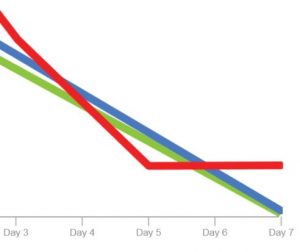
This might be communicated using various graphical representations, including a burn down chart. Here’s an example of a burn down chart, and the reason we’re showing this is we can clearly see the difference for the reserves that we need. The first one on the bottom here is what we had planned, and we would plan to get it in ten days time. But as you can see we’re tracking over here on the top a little bit later, so it’s quite likely if we keep going at this speed that we will be finished in 11 to 12 days instead. Now we know that there’s a bit of a gap there, and we might actually need to use some of our contingency reserve to get the project complete, and that’s the benefit of using a graphical representation, so that everyone can see what’s going on.
And that’s also the benefit of doing reserve analysis in your project.
Qualitative Risk Analysis versus Quantitative Risk Analysis
The reason we’re looking at this is that Qualitative risk analysis and Quantitative risk analysis can be confused during your PMP exam or CAPM exam, so it’s best to ensure that you know the difference before going in to take the test, and that will help you during a few of the questions there and help you get a higher mark.
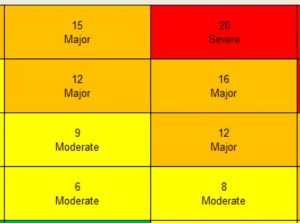
Let’s take a look at them. We’ve got Qualitative risk analysis which is the act of brainstorming risks, often based on existing risk categories which might be part of your Organizational Process Assets. You might have an existing list of categories that you can choose from or delve deeper into, and you’re subjectively assigning a probability and impact rating to them.
Using Ratings with Qualitative Risk Analysis
For example, is it a high? Or maybe a five out of five probability, and then a five impact. Then we’re multiplying those together which gives us a final score so those risks can be prioritized. In this case for example that 25 might be the highest. You could have any rating there, or any number assigned to those depending on the organization that you’re working in, which again might have existing ways of working, but under this circumstance that might be a high probability and impact and that would be prioritized quite highly as a result.
All project risks go through this process, through the process of Qualitative risk analysis, however all project risks do not go through Quantitative risk analysis. So only a few, as determined, or only if needed. This is the act of collating purely numerical data, often dollars or cost for the risks, first by risk and then combined as a whole.
Quantitative Risk Analysis
With our Quantitative risk analysis example we have a few risks here, you’ve got the dollars assigned to them and they can be collated up to a total project risk cost. It’s often used in finance, insurance, forecasting using large risk spreadsheets and Monte Carlo simulations, where you might be testing a thousand different runs of a simulation and then seeing the variations of cost in those different runs for example. It often that involves quite high computing power, and we want to see the range of possible cost impacts and use that to give you an idea of what you might be up against during your project, to basically see that range and maybe it’s a low range, maybe it’s a high range.
Not all risks will go through this process. I only use it as deemed necessary.
To summarize, for qualitative risk analysis we’re using the probability and impact assessment, and it’s used on every risk. We’re subjectively assigning a rating of probability and impact so that we can prioritize those risks. Quantitative risk analysis is most often the dollar impact, and certainly a numerical impact, and it’s not used on every risk.
And that is the difference between Qualitative and Quantitative Risk Analysis in your project.
 Interpersonal and Team Skills
 Communication Skills
 Power and influence models, versus the Salience model for capturing stakeholder engagement
 The Stakeholder Engagement Assessment Matrix
 Claims Administration
 Advertising versus Bidder conferences
 Types of Contracts in your Project and Procurement
 Reserve analysis and burndown charts
 Qualitative Risk Analysis versus Quantitative Risk Analysis