There has been some misinformation circulating about the updated PMP exam. Here is what is actually true.
Myth 1: There Are Now 185 Questions
There are still 180 questions on the PMP exam. This has not changed according to the latest exam content outline from PMI. You do have 240 minutes now, instead of 230 minutes to complete the exam, which is great!
Myth 2: The Breaks Are Shorter
Some people are saying the two 10-minute breaks have been reduced to five minutes each. This is also incorrect. You still get two 10-minute breaks.
Myth 3: There Is a Lot of New Content to Study
This one is causing the most unnecessary stress. The business environment domain has increased from 8% to around 26% of the exam, which sounds significant. But the content that has moved into that domain, managing risk, managing issues, change control and delivering value, was already part of the project management process domain. It has been rearranged, not replaced.
There are minor additions around artificial intelligence and sustainable project management, both of which appear in the PMBOK Guide 8th edition. But these are small additions, not a major new study load.
Bonus Myth: There are a lot of New Question Types
The question types are almost exactly the same as they have been for the past 3 years, as PMI slowly introduced new question styles and types to the PMP Exam. There will be drag and drop, pictures matching to the right words, matching descriptions to the right artifacts etc.
But the main new question type will be a “Case Study” – a longer explanation with 3 questions about it. Students have reported while this sounded scarier, it was actually easier and faster as once you’ve read the case study the questions can be answered quickly in a row.
If you are preparing for the PMP exam, the fundamentals you have been studying still apply. The exam has evolved but it has not been reinvented.
Also available are my Project Management Templates – these don’t have a coupon code but they’re a great way to save 100s of hours when you’re first starting out:
Is it possible to pass six certifications in six months? One person did exactly that, and shared every tip and resource that got him there.
The certifications, completed in order, were the PMP, ACP, PBA (Professional in Business Analysis), RMP (Risk Management Professional), PgMP (Program Management Professional) and PfMP (Portfolio Management Professional). His motivation was a career pivot from the military into the corporate world, achieved without an MBA and without prior corporate experience. On every exam he scored above target overall.
Two Tips That Applied to Every Certification
The first was to read, reread and keep reading the Exam Content Outline (ECO) for each certification. These are available free from PMI’s website. The language in the ECO appears throughout the exams and also guides your study in the right direction. If your reference material matches the ECO, you are on the right track.
The second was documenting project management experience clearly and deliberately. He maintained a master resume with detailed notes from his ten years of leadership roles, writing results-oriented summaries tied directly to each ECO. Strong action verbs, quantifiable outcomes and a focus on strategic impact and decision making. Each application was tailored to the specific certification he was pursuing.
Month by Month
Month 1:PMP. He completed the required 35 contact hours using PMI’s authorized on-demand prep before moving to more cost-effective Udemy courses. He studied both the PMBOK Guide Sixth and Seventh Editions and used PMI Study Hall for practice exams.
Month 2:ACP. The education requirement at the time was 21 hours (now 28). He again used PMI’s authorized prep for education hours and named PMI Study Hall as the single most valuable prep tool for this exam. The Agile Practice Guide was his primary reference.
Month 3:PBA. He found a Udemy course by Muhammad Elhoot for the education requirement and used the PMI PBA Certification Study Guide (Second Edition) by Elizabeth Larsen as his primary study resource. Five days of access to an online practice question bank was enough to get through everything with focused effort. He also skimmed several PMI guides including the Guide to Business Analysis and the Benefits Realization Management Practice Guide.
Month 4:RMP. He needed 30 PDUs of risk management education and used a Udemy course to satisfy that requirement. His core prep came from the Risk Management in Portfolios, Programs and Projects Practice Guide from PMI and PMI Study Hall practice exams.
Month 5:PgMP. The Standard for Program Management Fifth Edition was his primary reference and the foundation the exam is built on. He used two Udemy practice exam courses by Allah Sultan, both closely aligned with the real exam and citing rationale directly from the fifth edition with page numbers.
Month 6:PfMP. He used the Standard for Portfolio Management Third Edition as his foundation. PMI lists the fourth edition on their site but he notes the third is still the most relevant resource for the exam as of mid-2025. He read the fourth edition for additional context but did not rely on it. Practice exams again came from Allah Sultan’s Udemy course.
Six certifications, six months, above target on every exam. The formula was consistent: know the ECO, match your experience to it, use the right primary reference for each exam and practice until you are confident. If one person can do it, the path is there for others to follow.
Also available are my Project Management Templates – these don’t have a coupon code but they’re a great way to save 100s of hours when you’re first starting out:
If you already have your PMP, program management is a natural next step. Here is everything you need to know to decide whether the PgMP is the right move.
The Salary Difference
According to PMI’s Earning Power Report, the average US salary for a PMP holder is $135,000. PgMP holders earn around 10% more at $146,000. That gap alone makes it worth considering if you have the experience to qualify.
What Each Certification Represents
The PMP demonstrates project management expertise. It shows you can lead individual projects through initiation to closing with at least three years of experience behind you.
The PgMP positions you as a leader capable of managing multiple related projects as a unified program, delivering sustained business value across an organization. It is a step up in both scope and seniority.
Application Requirements
For the PMP you need either a high school diploma with five years of project management experience or a bachelor’s degree with three years, plus 35 contact hours of project management education.
The PgMP requirements are more involved. You need four years of project management experience or a current PMP. On top of that you need program management experience: seven years with a high school diploma, four years with a bachelor’s degree or three years with a master’s degree.
The Exam
The PMP has 180 questions to be completed in 230 minutes, roughly one answer every 75 seconds. It covers people, process and the business environment.
The PgMP has 170 questions with 240 minutes to complete them, giving you slightly more time per question at around 84 seconds each. Only 150 questions are scored and 20 are unscored test questions for future exams. The content covers strategic program management, the program life cycle (initiating, planning, executing, controlling and closing), benefits management, stakeholder management and governance.
Cost
The PMP costs $405 for PMI members or $655 without membership. The 35 contact hours of education are also required and can be completed through PMI, Udemy or other providers.
The PgMP costs $800 for PMI members or $1,000 without. There is no contact hours requirement for the PgMP. The focus is entirely on demonstrating program management experience.
What to Study
For the PMP the core resources are the Exam Content Outline, the PMBOK Guide, the Process Groups Practice Guide and the Agile Practice Guide.
For the PgMP the approach is similar. Download the PgMP Exam Content Outline free from PMI’s website as your study guide. Then work through the Standard for Program Management Fifth Edition and the PMBOK Guide. The PMBOK Guide is currently in its eighth edition.
If you have been managing programs for several years and want credentials that reflect that, the PgMP is a well-recognized way to demonstrate it. The experience requirements are substantial but so is the return.
Also available are my Project Management Templates – these don’t have a coupon code but they’re a great way to save 100s of hours when you’re first starting out:
Someone recently passed their PMP in four weeks and shared exactly how they did it, including what they studied each week and what helped most during the exam itself. Here is the full breakdown.
The Four-Week Study Plan
Week one was mostly procrastination dressed up as preparation. They made a study schedule, compiled resources and watched two videos: my complete PMBOK summary video on YouTube and Ricardo Vargas’ popular breakdown of the PMBOK Sixth Edition processes. Not a bad start, but mostly avoidance of the real work.
Week two was where the heavy lifting happened. The entire week was spent on one resource: my 150 PMBOK 7 scenario-based PMP exam questions and answers video on YouTube. The format mirrors the real exam closely, with two seemingly correct answers per question and a clear explanation of how to arrive at the right one. They skipped the 200 agile questions and 100 waterfall questions, feeling the PMBOK 7 set was comprehensive enough on its own.
Week three was a rest week. They acknowledged it was probably a mistake but took it anyway.
Week four was focused and practical. One day was spent speed-reading Third Rock’s study guide, which comes up frequently in PMP success stories. The rest of the week was dedicated to PMI Study Hall practice questions, reading the guide each morning and working through questions for the remainder of the day.
Four Study Tips
Start practice questions as soon as possible. This was the clearest theme across the entire four weeks. There is a scientific reason it works: retrieving information from memory strengthens the neural connections that hold it. Reading embeds information passively. Practice questions force active recall and that is what makes it stick.
Do not read the PMBOK Guide cover to cover if that is not how you learn. Watch a good summary video instead and move to practice questions quickly. The goal is not to memorize the book. It is to develop the right exam mindset.
Do not over-invest in the 35-hour education course. You need it to apply but do not treat it as your primary study tool. Use it to fulfill the requirement and then shift your focus to practice questions.
Do not stress about memorizing every framework, formula and diagram. Ishikawa diagrams, Tuckman’s ladder, earned value formulas: most of what you need to know will surface naturally once you start working through practice questions regularly.
Four Tips for the Exam Itself
1. Look before you leap.
Almost every PMP question presents multiple answers that appear equally valid at first glance. Slow down, follow the project management process (initiate, plan, execute, monitor and control, close) and talk to the relevant stakeholder before taking action. Gather information before making a move.
2. Stop making assumptions.
Even experienced project managers fall into this trap. Ten years in one organization can create blind spots. If something is not explicitly stated in the question, do not assume it is true. Ask yourself whether you are reading it in the question or bringing it from your own experience.
3. Know your role.
The project manager is not the sponsor, the product owner or the engineering team. The sponsor funds the project and handles escalations. The product owner prioritizes the backlog. The engineers do the engineering work and provide estimates. Do not answer questions by doing other people’s jobs for them.
4. Avoid the snaky answer.
If an option involves going around someone, ignoring a request or doing something that feels slightly underhanded, skip it. The right answer is almost always direct and collaborative. Go straight to the source, work with people and tackle problems head on.
Four weeks, one rest week included, and a pass. The formula was simpler than most people expect: get the mindset right, do the practice questions and trust the process.
Also available are my Project Management Templates – these don’t have a coupon code but they’re a great way to save 100s of hours when you’re first starting out:
More than 87% of people working in agile use scrum or some part of it. Yet many teams do not fully understand where it came from or how it was intended to work. The Scrum Guide, written by Ken Schwaber and Jeff Sutherland and last updated in 2020, is the authoritative source. It is free at scrumguides.org. Here is the whole thing explained plainly.
What Is Scrum?
Scrum is a lightweight framework for solving complex problems and delivering value through adaptive solutions. It works best when you cannot know everything upfront. Rather than planning in detail for a future you cannot predict, you deliver something real, get genuine feedback and adjust. That is the core logic.
The Scrum Team
A scrum team has three roles: developers, a product owner and a scrum master. No sub-teams, no hierarchies. Ten people or fewer.
Developers deliver a usable increment every sprint. They create the sprint plan, maintain quality and hold each other accountable. The term applies to anyone doing the work, not just software engineers.
The product owner manages the product backlog: defining the product goal, ordering backlog items by priority and keeping everything visible to the whole team. One person, not a committee. Others can suggest changes but only by convincing the product owner. When organizations trust this role and give it room to operate, decisions get made faster and the product improves faster.
The scrum master is a coach who also clears the path. They help the team stay self-managing, remove blockers, escalate issues and keep events productive. They serve the team, the product owner and the broader organization.
The Artifacts
The product backlog is the single source of work for the team: an ordered list of everything needed to meet the product goal. One product goal at a time.
The sprint backlog is the set of items selected for the sprint plus the developers’ plan for delivering them. Its commitment is the sprint goal: one clear objective that keeps the team focused.
The increment is the real, usable piece of value delivered at the end of a sprint. It must meet the definition of done before it can be released. If it does not, it goes back to the backlog.
The Events
The sprint is the container for everything else. One to four weeks, fixed length. The sprint goal must not change mid-sprint. Only the product owner can cancel a sprint, and only if the goal has become obsolete.
Sprint planning kicks off the sprint (timeboxed to eight hours for a one-month sprint). The team answers three questions: why is this sprint valuable, what can be done and how will the work get done?
The daily scrum is 15 minutes, same time and place each day, for developers only. Inspect progress toward the sprint goal and adapt the plan for the next 24 hours.
The sprint review (timeboxed to four hours) is where the team presents the real increment to stakeholders. Not a recording, not a mockup. The real thing. Together they discuss what was learned and what comes next.
The sprint retrospective (timeboxed to three hours) closes the sprint. What went well, what did not and what will improve next time. The most impactful changes are acted on immediately.
Theory and Values
Scrum runs on three pillars: transparency (make the work visible), inspection (regularly examine progress) and adaptation (adjust quickly when something is off track). The longer you wait to course-correct, the harder it gets.
The five scrum values tie it together: commitment, focus, openness, respect and courage. When a team genuinely lives these, trust builds and scrum works.
Scrum is simple by design. The challenge is not understanding it. It is applying it honestly and giving the team the trust and space to do the work.
Something unexpected happens when you pass the PMP exam. It is not just a credential. It changes how you see the work you have been doing all along.
After months of study, working through the Project Management Body of Knowledge and grinding through practice questions, I did pass the exam but the real shift was what happened afterwards.
The best way to describe it is a scene from the 1999 film The Matrix. The main character discovers he has been living in a simulation and, by the end, gains the ability to see through the surface of everyday reality into the underlying structure of everything around him.
Or think of the moment in The Wizard of Oz when the curtain is pulled back and the machinery behind the illusion is finally visible. That is what the PMP does. Before passing, project work often felt like fumbling forward. Sometimes things worked. Sometimes they did not. There was no reliable framework to explain why.
After passing, the reasons became clear.
Looking back at old projects that had not gone well, I could now see the reasons why. On one project in particular, the deliverables were being met and the project was technically doing what it was supposed to do, but the right stakeholders had not been identified. Senior executives with real influence over the project outcome were not being engaged, when they should have been engaged by me. The project eventually succeeded, but the personal outcome was a failure because stakeholder identification and engagement had not been handled properly.
That was hard to accept. But it meant the next project could go differently, if I applied my mistakes and the lessons I learned.
The same applied to other fundamentals: understanding why a project stalls without proper sponsor support, why resources and authority dry up when that relationship is not managed, why scope needs to be visible and accepted by the customer before work begins, and why a clear change control process matters whether you are working as a product owner on an agile team or managing a predictive waterfall project.
The PMBOK is like a lens. Once you have it, you cannot unsee what it shows you about how projects actually work and why they succeed or fail.
If you are still studying, do not rush past the material to get to the pass. Work through all of it. The process on a page from the PMBOK Guide Sixth Edition (or 8th Edition now) is one of the clearest distillations of project management thinking available. It will change over time, but the underlying logic it represents is worth understanding thoroughly.
Hundreds of thousands of people have used these five free videos to pass the PMP exam on their first try. They come up repeatedly in congratulations posts and resource lists shared by people who have already made it through. Here they are in one place.
1. 150 PMBOK 7 Questions and Answers
This video works through the PMBOK Guide Seventh Edition from start to finish using scenario-based questions in the same format you will encounter on the exam. Each question typically has two answers that both appear plausible, which mirrors the real exam experience closely. With more than a million views, the comments section is filled almost entirely with people sharing that they used it to pass.
2. PMP Fast Track
This one is built from more than a thousand PMI practice questions and distils a set of shortcuts you can default to when answering exam questions. Think of it as a cheat sheet for decision-making under pressure. If you are stuck on a question during the exam, this video gives you a reliable method for working through it. It consistently appears in the resources people credit when they share their results.
3. PMP Cheat Sheet
This video covers the exam content outline across the three domains: project management process, people and business environment. It runs for under 20 minutes and is designed to show you exactly what the exam tests and whether you have any gaps in your knowledge. It is one of the most efficient ways to check your readiness before sitting the exam.
4. 200 Agile Questions and Answers
This returns to the scenario-based question format with a focus on agile content, which makes up a significant portion of the current PMP exam. The questions follow the same style as the real exam and give you targeted practice in the agile domain.
5. 100 PMBOK 6 Questions and Answers
The PMBOK Sixth Edition is now known as the Process Groups Practice Guide and it remains highly relevant to the PMP exam. The core project management process has not changed significantly across editions. You will still be tested on initiating, planning, executing, controlling and closing a project or phase, and on managing scope, schedule and cost throughout. This video has been viewed more than a million times and the comments reflect how consistently it helps people pass.
If you finish all five videos and don’t want to lose study momentum, here are two bonus videos:
Bonus 1: Six Mistakes to Avoid on the PMP Exam
Bonus 2: 110 Drag and Drop Questions (Perfect Study Review)
63 project Management Tools for your PMP Exam
If you make it through all seven, you are doing more than most people ever will. Keep going, I know you will pass your PMP!
What is Business Analysis and What Does a Business Analyst Do?
In the world of project management, you may have heard of a business analyst (BA). Whether you’re preparing for a certification exam like the Certified Associate in Project Management (CAPM) or working with a business analyst, it’s important to understand what they do. In this article, we will explain what business analysis is, what a business analyst’s role involves, and how they help make projects successful.
Who is a Business Analyst?
Here is a simple way to explain a business analyst’s role. There are three main tasks that define business analysis:
Gathering Requirements: A business analyst works with stakeholders and customers to collect their needs.
Ensuring the Solution Matches: Once the requirements are gathered, the BA ensures that the solution meets these needs.
Evaluating the Outcome: After the solution is delivered, the BA checks if the desired results—like increased revenue or better customer satisfaction—were achieved.
This basic explanation gives a clear idea of the BA’s job in a project.
The Role of a Business Analyst in a Project
In a typical project, there are several stages: initiation, planning, execution, monitoring and controlling, and closing. A business analyst focuses on three key areas throughout the project:
Stakeholder Management: The BA identifies and works with stakeholders to gather and refine project requirements.
Scope Definition: The BA helps define the project’s scope, ensuring the right requirements are included.
Quality Assurance: The BA ensures that the solution matches the defined requirements and meets quality standards.
These three areas—stakeholders, scope, and quality—are vital for a business analyst’s success and contribute to the overall project success.
How Business Analysis Works in Practice
1. Engaging Stakeholders and Gathering Requirements
The business analyst’s first task is to identify and engage the right stakeholders—customers, users, and anyone affected by the project. To do this, the BA uses tools like an organizational breakdown chart to identify key people within the organization. Once the right stakeholders are identified, their roles are documented in a stakeholder register.
The BA uses a stakeholder classification matrix to assess the influence and impact of each stakeholder, focusing on those who have the greatest influence on the project’s outcome. Engaging the right people early ensures that the gathered requirements are accurate.
2. Eliciting and Visualizing Requirements
Once stakeholders are engaged, the BA uses various techniques like workshops, brainstorming, and facilitation skills to gather requirements. One effective method is the Nominal Group Technique, where everyone writes down their ideas anonymously, avoiding bias from higher-ups in the room.
After gathering the requirements, the BA visualizes them to ensure they are clear and understandable. Techniques such as process mapping, SE diagrams, and context diagrams help the BA create visual representations of how the system works or will work in the future. These diagrams make it easier for everyone to understand the requirements.
3. Ensuring the Solution Matches Requirements
After gathering and visualizing requirements, the BA works with developers and the project team to make sure the solution aligns with the requirements. To do this, the BA uses a Requirements Traceability Matrix, which ensures that all requirements are covered and tested.
The BA also helps break down the project into smaller tasks using a work breakdown structure (WBS). This helps the team manage the work more easily. The BA ensures that acceptance criteria are clearly defined, so the project team knows what is required for each task to be considered complete.
4. Evaluating the Success of the Solution
Once the solution is delivered, the BA checks if it achieved the desired results. Did it improve customer satisfaction? Did it increase revenue or reduce costs? The BA may use tools like Net Promoter Score (NPS) or customer satisfaction surveys to measure the impact.
Additionally, the BA may conduct a retrospective meeting with the project team to review what went well and what could be improved for future projects.
Tools and Techniques a Business Analyst Uses
Business analysts rely on various tools to do their job effectively. Here are some of the most common ones:
Stakeholder Register and Stakeholder Classification Matrix: To identify and assess stakeholders.
Workshops, Brainstorming, and Nominal Group Technique: To gather requirements.
Process Mapping, Sequence Diagrams, and Context Diagrams: To visualize systems and processes.
Requirements Traceability Matrix: To ensure requirements are met.
Work Breakdown Structure (WBS): To break down tasks into manageable pieces.
Acceptance Criteria: To define when a task is complete.
These tools help the business analyst manage requirements, scope, and quality throughout the project.
The Key Skill of a Business Analyst: Drawing Out Answers
A business analyst’s key skill is the ability to draw out answers. The BA doesn’t need all the answers at the start of the project. Instead, they must be good at asking the right questions and engaging the right people to uncover the information needed. This skill is essential for steering a project in the right direction.
Conclusion
A business analyst plays an important role in project management. They gather and clarify requirements, make sure the solution matches those needs, and evaluate the results to ensure success. By focusing on stakeholders, scope, and quality, business analysts help guide projects to successful outcomes.
With the right tools and techniques, a business analyst can keep the project on track and make sure it delivers value. Whether you’re preparing for a certification exam or working with a business analyst, understanding their role will help you achieve better project outcomes.
Have you ever wondered why some people seem to pass their exams effortlessly, even with minimal studying, while others struggle despite knowing all the material? The secret lies in psychology. Let’s dive into three powerful psychology tricks, inspired by Tony Robbins, to help you pass any exam. Plus, I’ll share two bonus tips that can make a huge difference in your success.
The 3 S’s for Exam Success
1. Strategy: Knowing What to Do
It may not seem like a psychology tip, but strategy is foundational. Whether you’re studying for an exam, losing weight, or pursuing a new job, the “what to do” is readily available. You can search online, take courses, and gather information. Having a clear plan influences your mindset and actions, setting the stage for success.
For your exam, I recommend taking Practice Exams – as many as possible – and reviewing where you went wrong. This way you will know when you are ready, or when you need to study more.
2. Story: The Narrative You Tell Yourself
What do you say to yourself when no one else is around?
Positive Story: “I’m great at taking tests. I stay calm, and time flies by.”
Negative Story: “I’m terrible at tests. I get nervous and always fail, even when I know the material.”
The story you believe becomes your reality, because your brain starts collecting evidence to support your narrative. A positive story boosts your confidence and encourages consistent effort, while a negative one sabotages your progress. Start telling yourself empowering stories and repeat affirmations like, “I’m capable of passing this exam.” Over time, your mindset will shift, and your actions will follow.
3. State: Your Energy and Emotional State
Your emotional state can make or break your performance. Are you pumped up and ready to conquer your exam? Or are you drained and doubting yourself?
One quick way to change your state is through physiology. Stand tall, smile, and even try a “power pose” for 30 seconds — this can boost confidence and energy. Your physical state directly influences your mental state, so use this to your advantage.
Bonus Tips for Exam Mastery
4. Massive Action Plan: Daily Habits and Practice
Success isn’t just about mindset — it requires action. Every student I’ve helped pass their exams developed a daily study habit. They took practice exams, measured their progress, and made studying a consistent routine. A structured plan, combined with the right psychology, creates unstoppable momentum.
5. Net Time (No Extra Time): Study Anytime, Anywhere
Struggling to find time? Use “Net Time” to study during moments that would otherwise go to waste. Listen to recordings during your commute, review flashcards on your lunch break, or watch videos while exercising. By doubling up activities, you reclaim valuable hours and stay on track.
You Can Do It
Combining these psychology tools with consistent action will transform your exam preparation. Remember, you are capable of success. I believe in you — now it’s time for you to believe in yourself.






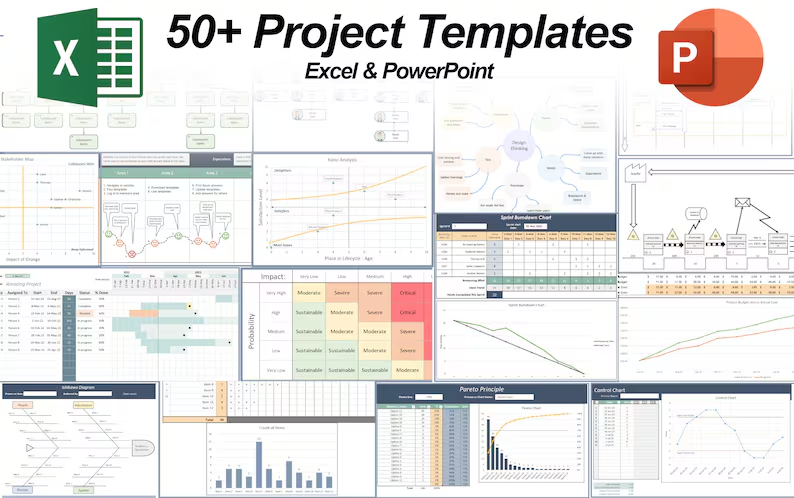 50+ Project Management Templates in Excel and PowerPoint (Gantt Chart, Risk Matrix and more!)
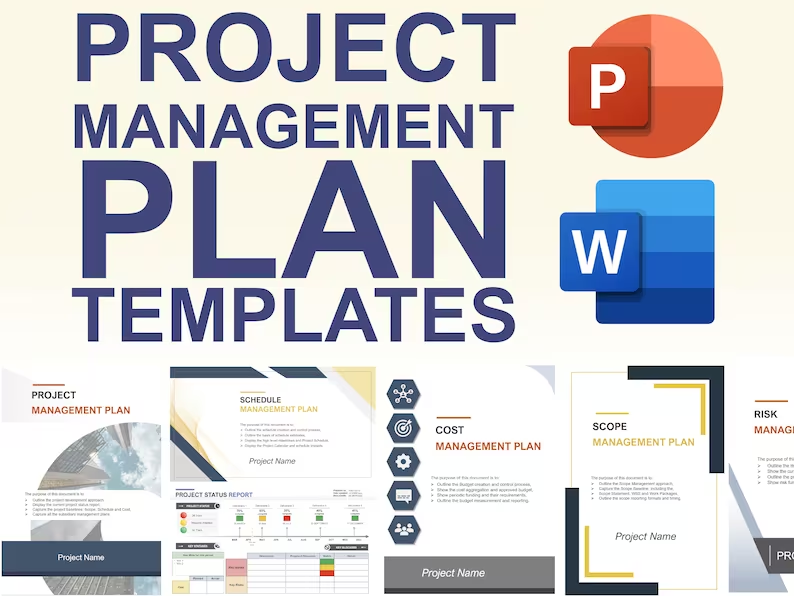 Pre-made Project Management Plan Templates: Save 100 HOURS!
 Week one was mostly procrastination dressed up as preparation. They made a study schedule, compiled resources and watched two videos: my complete PMBOK summary video on YouTube and Ricardo Vargas’ popular breakdown of the PMBOK Sixth Edition processes. Not a bad start, but mostly avoidance of the real work.