“Ceremonies” is the term for meetings and events when working in a Scrum team. Let’s look at the seven Scrum ceremonies and how to using them.
1. Backlog refinement meeting
The product owner, the Scrum Master, and the development team work together to discuss and prioritise the backlog items.
2. Sprint planning meeting
The team determines how much work they can take on from the prioritized backlog for the next sprint (two-week iteration).
This is based on estimates of the items, and velocity of the team.
The selected items from the product backlog become the sprint backlog and the goal of the sprint.
3. The Daily Scrum
This is a 15-minute daily meeting, sometimes called a “stand-up” (where everyone stands around the Kanban board).
The development team and the Scrum Master each take turns answering three questions:
What have I accomplished since the last Daily Scrum?
What will I accomplish before the next Daily Scrum?
Is there anything blocking my work?
4. The Scrum of Scrums
In larger projects or programs there are multiple teams working within the same “program of work”.
A representative from each team meets in a Scrum of Scrums (often one to three times a week) to report on each team’s progress. They answer the same Scrum questions plus a fourth: Will our team be putting something in another team’s way?
5. The Scrum of Scrum of Scrums
In larger programs, you may have overlapping projects or programs, where a representative from each scrum of scrums may attend this scrum of scrum of scrums. The same scrum of scrum questions are asked.
This is typically getting up to the executive level, where multiple programs are involved.
6. Sprint Review
At the end of each sprint, the development team demonstrates the work they’ve accomplished for the product owner, the Scrum Master, and other key stakeholders.
This is an opportunity to see, feel and touch the feature and garner any feedback necessary before signing the feature off as done.
7. Sprint Retrospective
After the sprint review, and before the next sprint planning meeting, the development team meets to discuss and answer:
What worked well,
What needs improvement,
What did we learn, and;
What still puzzles us.
This feedback goes back into the process to improve for future iterations.
Scenario-based questions, just like the real PMP exam!
In this series we will walk through five PMP Practice Exam Questions each day – a great way to set up your morning as you prepare to pass the PMP Exam. It is also useful for the CAPM exam, as the content is very similar.
We will also figure them out together, and you’ll see the thought process behind solving these PMP exam questions.
Watch the video below for the questions and answers!
Question 1
You are working on a project and it has become apparent that part of the product your company was creating they won’t be able to complete. You decide to outsource it to a vendor, and offer a bonus to the vendor if the work is completed in two months. What type of contract will you use?
A) CPFF (Cost plus fixed fee)
B) FPWEA (Fixed price with economic price adjustments)
C) T & M (Time and materials)
D) FPIF (Fixed price incentive fee)
Question 2
You are working on the schedule of your project and have just created a schedule network diagram. You have noted the duration, early start and early finish dates for each activity. What will you do next?
A) Perform a “forward pass”, noting the Late Start and Late Finish for each activity.
B) Perform a “backward pass”, noting the Late Start and Late Finish for each activity
C) Break down the scope into smaller work packages you can assign to your teams
D) Perform a “backward pass”, noting the float and positions of each activity
Question 3
You are working on a project that is outsourcing part of development to a third party. Your project sponsor wants to keep the risk to the organisation low. What sort of contract will you use to outsource this work?
A) CPFF (Cost plus fixed fee)
B) T & M (Time and Material)
C) FFP (Firm Fixed Price Contract)
D) CPIF (Cost plus Incentive fee)
Question 4
You have acquired your project team, and are ready to distribute the work to your team for them to begin. You will use your project’s outlined work authorisation system, which:
A) Manages the timing and sequence of when activities need to be performed, and by whom.
B) Tracks and manages work defects as they arise
C) Identifies the resources needed to complete activities
D) Is used for comparing actual work against the baselines
Question 5
You are managing a project to build a new meeting hall. Half way through, one of the stakeholders advises the stage is not big enough, it must be twice as big. This was not originally planned for. What will you do next?
A) Get the work done immediately and start executing
B) Update the impacted baselines – scope , cost and schedule
C) Update the work performance reports and share with stakeholders
D) Analyse the impact to the cost , schedule and scope, then submit the change request to the change control board for approval.
Scenario-based questions, just like the real PMP exam!
In this series we will walk through five PMP Practice Exam Questions each day – a great way to set up your morning as you prepare to pass the PMP Exam. It is also useful for the CAPM exam, as the content is very similar.
We will also figure them out together, and you’ll see the thought process behind solving these PMP exam questions.
Watch the video below for the questions and answers!
Question 1
You are in the process of creating the Scope Baseline of your project and have broken the high level features into assignable work packages. What will you do next?
A) Create a Schedule Network Diagram to show where those work packages will fit in your project schedule
B) Create an Activity List of activities needed to complete the work packages
C) Assign the work packages to people on a first come, first served basis.
D) Create the WBS Dictionary, and assign each activity a unique identifier, acceptance criteria and milestones.
Question 2
Your project is about three fourths done when the site engineer reports that due to inherent complexities a certain deliverable will be delayed as they work through the solution. He makes a request for this new work to be added to the scope and schedule of your project. You work with the engineer to analyse the impact of this change to cost, and write up a change request for approval from change control board. They have approved the change. What will you do next?
A) Start work immediately, you shouldn’t delay any further
B) Determine the impact of this change to scope , schedule and cost before making any change
C) Perform Quality Assurance on the change, so it doesn’t happen again
D) Before implementing the change, update the scope and schedule baseline and note the approved change in the change log.
Question 3
You are in reviewing the defect list with your project team and have found that many of the issues could have been prevented by using a simple code review checklist. You prepare a code review checklist and ensure the code is reviewed as per the checklist. This is called:
A) Preventive Action
B) Corrective Action
C) Defect Repair
D) Quality Control
Question 4
Your team is performing quality inspection and testing of the product, and some defects have been raised. Because they are small, the quality manager wants to just fix them immediately and keep quality testing – she doesn’t want to have to make extra paperwork. What will you do next?
A) Ask your quality manager to fix the defects quickly and move on, so there is no delay
B) Ask your quality manager to calculate the adjustments to schedule and cost and update the project management plan
C) Analyse the impact to cost and schedule, then ask your quality manager to raise a change request for the change to the product.
D) Remove the items from the project. If they are no longer in scope, no paperwork is needed.
Question 5
You are a project manager working closely with the customers of the project. During one conversation, a key customer executive mentioned they will need a particular feature not mentioned in the project scope statement. What should you do next?
A) Explain the change procedure and ask them to submit a request for change
B) Add the additional requirements to the project plan – the customer is most important.
C) Go ahead and create the main features and then see if the customer still wants the extra feature when they see it.
D) Discuss the feature with the other customer representatives to see if they change their mind.
Scenario-based questions, just like the real PMP exam!
In this series we will walk through five PMP Practice Exam Questions each day – a great way to set up your morning as you prepare to pass the PMP Exam. It is also useful for the CAPM exam, as the content is very similar.
We will also figure them out together, and you’ll see the thought process behind solving these PMP exam questions.
Watch the video below for the questions and answers!
Question 1
You are working through your project and performing quality inspections on the product. During inspection, a key part of the product was found defective. This was not planned for, and the team brainstormed and managed to make the product work without the defective component. This is:
A) Risk mitigation
B) Transfer of risk
C) Risk avoidance
D) Work-around
Question 2
You have a problem in the project you are working on, where a group of stakeholders from one part of the business are not receptive to the change brought on by your project. What is the best approach to resolve this conflict to assure longer lasting resolution?
A) Smoothing or accommodating them
B) Collaborating or problem solving with them
C) Compromising or reconciling with them
D) Forcing or directing them
Question 3
You are working on a new parkland project in New Zealand, where heavy earthquakes have been known to occur. You meet with your project sponsor and risk team, and agree on an action to “Transfer the risk.” What will you do next?
A) Ask the executive team to change project sponsors, so your current sponsor is not exposed to the risk.
B) Purchase insurance for earthquakes to transfer the risk to another company.
C) Form a shell company to transfer the risk of liability to, if anything bad happens.
D) Transfer the risk to the people using the park, by placing a “Caution” sign out front.
Question 4
You are working with the quality manager in your project, where your product has limited features in order to reduce the price, but you still want it to work well and correctly. The quality manager has asked you for advice on the quality and grade of the product. What will you tell her?
A) Bad quality is acceptable, but bad grade is not
B) Bad grade is acceptable, but bad quality is not
C) Neither bad grade nor quality is acceptable
D) Grade and quality are the same thing
Question 5
You are speaking with the quality manager of your project, and he has suggested a quality approach for the quality management plan process that was made popular by Deming. What is he referring to?
A) Apply continuous small improvements to reduce costs and ensure consistency
B) Perform inspections on every product that is made
C) X and Y Theory – only hire Y type workers as they are highly engaged
D) Plan-do-check-act to improve quality iteratively
Scenario-based questions, just like the real PMP exam!
In this series we will walk through five PMP Practice Exam Questions each day – a great way to set up your morning as you prepare to pass the PMP Exam. It is also useful for the CAPM exam, as the content is very similar.
We will also figure them out together, and you’ll see the thought process behind solving these PMP exam questions.
Watch the video below for the questions and answers!
Question 1
Your project sponsor has asked for an update so she can advise her executive team on the project progress. What will you tell her if your project has an EV of $98,000, PV of $90,000 and AC of $85,000? You are:
A) Ahead of planned schedule and under budget
B) Behind planned schedule and under budget
C) Ahead of planned schedule and over budget
D) Behind schedule and over budget
Question 2
The Estimate at Completion (EAC) is the forecast cost of the project once finished. Your project has a budget of $100,000, and 30% of the work has been completed against 40% planned. You have spent $40,000 so far. If future work will be accomplished at the planned rate, Estimate At Completion (EAC) would be:
A) $90,000
B) $140,000
C) $70,000
D) $110,000
Question 3
You have gathered the requirements and scope for your project, broken them down into work packages for your project teams and then into activities that need to be completed and scheduled. What will you use to find the minimum duration for your project, and any flexibility you have between activities?
A) Qualitative analysis
B) Critical path method
C) Resource leveling
D) Variance analysis
Question 4
You are in charge of a new building project where the project plan is in place and work is currently in progress. A critical concreting task is coming up in the next three months. Your company employs concreters specifically for this type of work. When asking them about their availability they do not wish to commit and cannot give a straight answer. What should you do next?
A) Review the project milestone list and put concreting later in the project to allow you time to get the right people.
B) Review the issue register and raise the lack of resources in the issue log.
C) Review the project scope and remove concreting for now to avoid the conflict.
D) Review the project resource calendars regarding their availability, then have the right conversation with their leader to bring them on board at the right time.
Question 5
You are working through the schedule for your project after gathering the requirements, scope, breaking them down into work packages and then activities. You now need to estimate how long each activity will take, so you can place them in your Gantt Chart. What should you do next?
A) Use your best guess for each and estimate for each activity so you can complete your Gantt Chart quickly
B) Involve people who will be doing the work to get estimates
C) Ask your boss to estimate, that way they will have to explain if it’s wrong
D) Write down each activity time without buffers – it will look more accurate this way
In this series we will walk through five PMP Practice Exam Questions each day – a great way to set up your morning as you prepare to pass the PMP Exam. It is also useful for the CAPM exam, as the content is very similar.
We will also figure them out together, and you’ll see the thought process behind solving these PMP exam questions.
Watch the video below for the questions and answers!
Question 1
You have just validated the last piece of scope for the product you are delivering, with your stakeholders and gained their sign off. You have released the resources working with you back to their normal areas. What will you do next?
A) List all the stakeholders for your project
B) Create a project management plan
C) Oversee the testing of the product to ensure its quality
D) Write a Final Report summarising the performance of the project
Question 2
As a project manager, you are working on an activity that develops a document that formally authorizes the existence of a project. What will you do next?
A) Identify the Stakeholders and list them in the stakeholder register
B) Gather and acquire the Project Team
C) Plan the costs of your project in detail
D) Plan the schedule of your project
Question 3
A project management plan is a formal approved document that defines how the project is executed, monitored and controlled. Who is responsible for the project management plan?
A) The Program Manager
B) The Project Manager
C) The Project Sponsor
D) The Project Team
Question 4
You are working on your project management plan and quality management plan with your quality team leader. Your quality team leader wants to review the Cost of Quality (CoQ), and asks you for advice on what to include. Out of his list, which costs would you NOT consider?
A) The cost of your project team (resources)
B) The cost of preventing defects
C) Appraisal costs
D) Failure costs
Question 5
The To Complete Performance Index is the rate that future project work must be performed at. Your current project has a BAC of $100,000, EV of $50,000, and AC of $40,000. What is the rate of work we must achieve (To Complete Performance Index)?
It’s time to look at the interpersonal and team skills that you will need as part of your project management career, and stakeholder engagement.
Interpersonal and team skills are the behaviors and tactics that a person uses to interact with stakeholders in a project effectively. The ability to establish a relationship with others and maintain that relationship is a key to the success of your project.
If you don’t get along with the people that you’re working with, or delivering the project to, there are going to be problems when your project comes to delivery.
Types of Interpersonal Skills
So what are these interpersonal and team skills? Well, we’ve got things like Conflict Management. This can be used to help bring stakeholders into alignment on the objectives success criteria, high-level requirements, project description and other things. We might need to manage that conflict as we’re going along and there are various techniques for that in the PMBOK guide.
We’re definitely going to need facilitation. Facilitating meetings or facilitating focus groups or requirements gathering sessions or reporting on the how the project is going – facilitation is very important. And that involves meeting management as well.
We’ve got active listening. So how we are mirroring the person that we’re speaking to and repeating back what they’ve said so we ensure that we understand what they’ve said.
General leadership is used to communicate the vision and inspire the project team to focus on the appropriate knowledge and knowledge objectives.
You will need networking. So this allows informal connections and relations among project stakeholders. Sometimes if you have a good network within an organization, you can actually just go over to someone at the water cooler and say “Did you get this? I actually need your support on this. Can you help me out?” And they’ll say yes without any need for formal communication.
You’ll definitely need political awareness. Who has those those networking relationships in the organization? Maybe there’s a group of people over here and they talk a lot, and so if you’re in the bad books was one of them, potentially you’re in the bad books with all of them. You need to be aware of the politics that are going on and how business gets done in an organization.
That leads us to influencing. Influencing is gathering the relevant and critical information to address important issues and reach agreements while maintaining mutual trust. Sometimes we need to get our way across to others but do it in a way so that everybody feels good about it, and that’s not often easy to do.
Which brings us to negotiation. Sometimes if we’re influencing it might involve a little bit of back and forth. Two teams might need the same resource, and now we need to negotiate for those resources, and we need to do it in a way that everyone feels good so that you can come back and work with them again. We’re using that stakeholder engagement and ensuring that your network is still okay.
We’ve got motivation in general as part of our leadership. It’s providing a reason for someone to act. We want them to know why they’re doing something. We do need to help motivate them to do what we need them to do.
That also involves team building. So now we’re building our team, conducting activities that enhance the team’s social relations, and that includes increasing their motivation. It builds a collaborative and cooperative working environment. That might be doing things like requirements gathering together as a team, or making sure everyone has an input during the team meeting, making sure that a team is being built and no one is feeling left out.
Now as part of that we need a high emotional intelligence. So high emotional intelligence, we want the ability to identify, assess and manage the personal emotions of ourselves and of other people, as well as the collective emotions of groups of people. Not an easy task as a project manager, but definitely essential and something that you will learn and get better at over time.
As we’re doing that were also we’ve got communication styles assessment, which is a technique used to assess the communication styles of people, identify the preferred communication method – do they prefer to catch up, do they prefer a telephone call? Do they email or do they prefer a daily stand up or meeting once a week. What is the preferred communication style? And can you work with that with your stakeholders.
We’ve got cultural awareness, again very similar to political awareness so how business is getting done. But also just general cultural sensitivity, which is more broad, things like different nationalities or different things going on in people’s home lives. We have to be aware of that and aware of the fact that not everyone is the same.
To ensure that we’re able to work together in a nice and positive way involves observation and conversation as well. So that’s used to stay in touch with the work and the attitudes of the project team members and other stakeholders. Maybe we are having conversations about something that’s going on, with different festivals for different cultures and different ways of work, different hours that people will need to work depending on the situation and that comes through observation and conversation.
And those are all of the interpersonal and team skills that you’ll need as part of your project management career.
You may not see too many direct questions on this on the PMP exam, but you will definitely have to use this in your project management career. Communication is the exchange of information, whether intended or involuntary. Sometimes we’re communicating something and we’re actually not aware that we’re communicating it. It might not be verbal, it might just be body language or that sort of thing. The information is exchanged and it can be in the form of ideas, instructions or even emotions. 80% of a project managers time is spent communicating in some form or another, trying to get support for your project, trying to elicit ideas or gathering the requirements, checking how everything is going, meeting with the team members.
Factors that Affect Communication
There is so much going on in a project that we really need to be really good at communicating. Here are the skills and the techniques that we might use as we go along through our project. First of all, factors that can affect the choice of communication might include the urgency or the need for the information – so do we need to meet straight away, or can it just be an email? Can it be an SMS or can it be a slack message? This will change during the different phases of a project as well. The availability and reliability of technology – is email actually reliable, or should we send a letter? Can we pick up the phone, or can we use other forms of technology?
The ease of use for that particular technology – what’s going to be easiest for everyone to get the message in your project, not just one person but everyone that you need. It a SharePoint page, or is it a Confluence page, or is it a web page or is it a teleconference communication method. What’s the easiest way for everyone to get the message?
And of course the project environment – whether the team will meet and operate on a face-to-face basis or in a virtual environment, whether they’ll be located in one place, or multiple time zones with multiple languages.
And whether there are any other project environmental factors involved, so the sensitivity and confidentiality of the information – can we actually shout it from the rooftops, or should we have to meet and discuss it in private. This might also involve the social media policies for employees to ensure appropriate behavior so that we’re not telling the project details on social media, when it’s a secret project or something that we don’t want everyone to know about, it might be proprietary information.
Types of Communication Skills You Can Use
Communication skills include communication competence in general – this is a combination of tailored communication skills and it involves things like clarity of purpose, effective relationships with the people that you’re sharing the message with, and leadership behaviors. Really starting with “why”, or why are we doing things, making sure everyone is really clear and getting the message across.
Feedback is also one of the skills that we need. Feedback is information about the reactions to those communications, so how did they receive it? Was it received well, or received badly? Sometimes we need to ask for that feedback and we need to take it on board, even when it’s bad. That’s part of being a project manager. Feedback supports interactive communication between the project managers, the team and all other stakeholders.
Other communication skills you’ll see are nonverbal communication skills. Appropriate body language to transmit meaning through gestures. If we’re all closed up but we’re trying to get people pumped up for a particular project, maybe that’s not going to work. Our tone of voice needs to be appropriate, our facial expressions need to be appropriate, mirroring the people that we’re talking to and eye contact are also important techniques in communication skills.
You’ll definitely find yourself presenting during your project management career or the projects that you’re working on at the moment. Presenting as a formal delivery of information and/or documentation such as progress reports, background information for decision-making for the stakeholders in your project, and information aimed at increasing the support for your project with all of the stakeholders as well.
Taking the audience type into consideration. Is it a group of executives, do you need to be more formal under those scenarios? Or is it your a few people that you’re delivering the project to? You need to be considerate that it might be affecting them and take that into consideration when you’re communicating.
Lastly, there are communication artifacts and methods that are really useful as you go along on your project. You’ve got noticeboards, and that could be your virtual notice board or a physical notice board, newsletters, staff letters, press releases, annual reports, emails and intranets. Accompanying web portals – can we display the information that we need in that particular place? We might have phone conversations, presentations, team briefings and group meetings, focus groups, face to face formal or informal meetings between various stakeholders, consultation groups or staff forums and social computing like slack for example, technology and media.
And those are the communication skills that you will come across in your project management career.
Power and influence models, versus the Salience model for capturing stakeholder engagement
During your PMP exam you will come across many different stakeholder engagement techniques, and it’s important to know the difference between these various Power over Influence or 2D models, and the Salience model, which is known as a 3D model because we’ve got three particular parts to that particular model.
The Salience Model
So the Salience model itself describes the classes of stakeholders based on assessments of their Power, Urgency and Legitimacy. So power is the level of authority or ability to influence. The Urgency is the need for immediate attention, so how urgent is the stakeholders involvement in the project? And legitimacy is how appropriate is their involvement.
The salience model is useful for large projects where there are complex communities of stakeholders, or where there are complex networks of relationships within the project or the organization itself. Here’s an example, as you can see it’s known as a 3D model or a cube model, but the best way to represent it is through these three circles. So you’ve got Power, Legitimacy and Urgency and you can simply note all of your stakeholders within within these three circles and where they fit in the three circles to make it that easy graphical representation.
Power over Influence Models
We can also look at that in conjunction with the two dimensional classification models. They are more useful for small projects, or projects with simple relationships between stakeholders. We’ve got Power over Interest, or Power over Influence, and Impact over Influence. All of those you might use depending on which one fits you the best or fits the project the best.
My personal favorite is the influence of the stakeholder over the impact to that stakeholder. So does it have a high impact and does that person have a high influence? So are they an executive within that particular area, and is it having a high impact on them? We probably want to manage them very closely.
If it’s a high impact but they have a low influence on our project or the organization, then we just really want to keep them informed. If it’s a low impact to them and they have a low influence, then we can just monitor their involvement. If they have a high influence, but a low impact you still want to keep them satisfied, because with a high influence they may be able to influence the project, derail it or even help it under the right conditions.
So those are the power and influence models versus the salience model in your project.
The Stakeholder Engagement Matrix is a very useful tool, and it supports the comparison between the current engagement levels of your stakeholders and the desired engagement levels required for successful project delivery.
It asks and answers the question – how engaged do we need our team, or the people around the project, to be to ensure successful project delivery?
There are five different levels through which we can measure this stakeholder engagement. First of all, we’ve got Unaware, then Resistant, then Neutral, then Supportive and then Leading. Let’s look at them in a little bit more detail.
Stakeholder Analysis
An Unaware stakeholder is when they’re unaware of the project completely, or its potential impacts. They simply don’t know that it exists.
Now if they’re Resistant, they’re aware of the project and its potential impacts but they’re resistant to any changes that might occur as a result of the work or the outcomes of the project. These stakeholders will be unsupportive of the work or the outcomes of the project, and we really need to communicate more and manage the relationship for those particular stakeholders.
We might have Neutral stakeholders, where they’re aware of the project but they’re not supportive and they’re not unsupportive. They’re just going with the flow.
We might have supportive stakeholders, where they’re aware of the project and potential impacts and they’re supportive of the work and its outcomes. This is ideally where we want to be leading to and ultimately the next step is when we’ve got stakeholders Leading, where they’re aware of the project and its potential impacts and they’re actively engaged in ensuring that that project is a success. They’re really helping us out, they’re not hindering us. And that’s where we really want our stakeholders to be.
A stakeholder engagement assessment matrix involves mapping our stakeholders against those descriptions. We might have stakeholders over here on the left where are they are currently (C) unaware, but we actually need them to be supportive as our desired state (D).
Most of them really need to be supportive or leading. An executive might need to be leading, or a sponsor might need to be leading, so we need to really make sure that we’re communicating properly and helping get them up into those upper levels of stakeholder engagement.
Current and Desired Stakeholder States
The gap between the current (C) and the desired (D) state for each stakeholder will direct the level of communications necessary, and to effectively engage that stakeholder so do we need to communicate a lot more, in a way that’s best for that stakeholder. Now we really need to use those soft skills that a project manager has to have, to increase the engagement of those project team members or the the other members around the project. The closing of this gap between the current and desired is an essential element of monitoring stakeholder engagement. You will definitely be using this in your project management career, and you will also see it as part of the questions for the PMP and the CAPM exams.
And that is the stakeholder engagement assessment matrix.
 Interpersonal and Team Skills
 Communication Skills
 Power and influence models, versus the Salience model for capturing stakeholder engagement
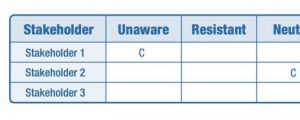 The Stakeholder Engagement Assessment Matrix