All posts by David McLachlan

Product or Solution Analysis

– See All Project Management Key Concepts –

Solution Analysis - PMBOKProduct Analysis

Product analysis, which is also the solution analysis because the product is what we’re going to be delivering, is the solution from all the requirements that we’ve gathered from our stakeholders. This is how we analyze and start creating that product and the idea of that product and solution.

What is product analysis?

First of all it can be used to define the products and the services that we’re going to be delivering as part of our project. Being a project manager it includes asking those questions about the product or service and forming answers to describe the use and characteristics and other relevant aspects of what is actually going to be delivered. Keep in mind we’ve already gathered the requirements, or what our customers want. But that doesn’t mean that we actually have a solution or a product in mind. We have to turn those requirements into a solution that ultimately a customer can see, feel and touch.

There are a few different techniques to product analysis techniques, and these might include product breakdown, which is breaking down the idea of the product into smaller pieces.

Requirements analysis which is going into those requirements and really breaking those down and matching those up to key pieces of our solution.

Systems analysis, which are the systems that we’re working with – do we have any limitations there?

Systems engineering, where we’re looking at the architecture behind things, and how we can actually engineer this product.

Value analysis, so are we might be rating from one to five and this is where the key concept of voting comes into it as well. Maybe we’re voting for the value of the particular requirement that we’re wanting to put into this solution.

Value engineering, or how can we engineer the most value out of this particular product with the least amount of effort?

As you can see there is more than one accepted method for translating these high-level product or service descriptions into meaningful deliverables. When we’ve got the idea of our solution, we still actually have to break these down into smaller pieces so that our teams can start working on those smaller pieces, and deliver those smaller pieces bit by bit. Requirements are captured at the higher level and they’re decomposed, which you’ll see is a project management body of knowledge key concept as well. They’re basically broken down into the level of detail that is needed to design and deliver the final product.

And that is the idea of product or solution analysis.

– David McLachlan

– See All Project Management Key Concepts –

PMP Practice Exam Questions and Answers | 24

– See all the PMP Exam Questions – 

PMP Exam Question Session 24

In this series we will walk through five PMP Practice Exam Questions each day – a great way to set up your morning as you prepare to pass the PMP Exam. It is also useful for the CAPM exam, as the content is very similar.

We will also figure them out together, and you’ll see the thought process behind solving these PMP exam questions.

I hope you enjoy!

Question 1

As a project manager, you understand the importance of interpersonal skills to enhance the probability of project success. Which of the following is NOT one of the types of project manager’s interpersonal skills?

A)  Team building
B)  Dictating
C)  Leadership
D)  Communication

Question 2

You are working on a new feature in your project and need to estimate the cost to complete it. You have the work packages from the lowest level of your work breakdown structure and the teams have all given their estimate to complete their parts. What estimation technique will you use for the total feature estimate?

A)  Parametric estimating
B)  Bottom-up estimating
C)  3 point estimating
D)  Analogous estimating

Question 3

You are working with a project sponsor who has a thorough understanding of motivating individuals. What is the third-level need of Maslow’s Hierarchy after physical needs and security?

A)  Social Needs
B)  Self-Actualization
C)  Business Need
D)  Personal Needs

Question 4

You are a project manager working in manufacturing and you need to estimate the resources you will need for the next phase of your project. What is a fast estimation technique that uses data from past projects for an activity that is very similar in nature for cost or duration?

A)  Related Estimating
B)  Parallel Estimating
C)  Analogous Estimating
D)  Comparable Estimating

Question 5

As an effective project manager, you understand the importance of actively communicating with your team members. What would be something you will do above everything else when communicating to others?

A)  Speaking
B)  Listening
C)  Mentoring
D)  Helping

– See all the PMP Exam Questions – 

Voting

– See All Project Management Key Concepts –

Voting - PMBOKVoting

What is voting? You’ll come across this in your project management career when we’re gathering requirements, and in other project process group areas as well. Voting is a very common way to get to a decision when a decision is need needed to be made. The way it’s described in the PMBOK guide is a “collective decision-making technique”. It’s an assessment process where we’re able to assess a few different options and see which option we actually want to move forward with.

When we have multiple alternatives, those are our options, with an expected outcome in the form of future actions. In other words, what are we going to do in the future? If we can’t all agree (and sometimes that’s totally fine) but there are other ways that we can move forward, and that’s what we use voting for.

These techniques can be used to generate, classify and prioritize your product requirements in the early days as you’re gathering these requirements for your product and your project. There are a few voting techniques that you’ll come across and that you’ll see in the PMP exam and the CAPM exam.

We’ve got unanimity, where where everybody agrees – so you’ve got the a hundred percent of people and everyone is happy, everyone agrees that they’re going forward. You have unanimity, they’re unanimous.

But you may not have that in your case, so the next step down from that is where we have the majority of people. This is where a decision is reached where and more than 50% of the members of the group agree. Instead of a hundred percent now we have more than fifty percent, and we’re able to move forward because that is the majority of people.

Now even then if you’ve got a large group of people, or maybe there’s a lot of different decisions to be made, you may not have the majority. So the last one is plurality.

Plurality is a decision that’s reached where the largest block in your group decides. Maybe you have 30% of the people agreeing for that particular decision and then all of the others are 20%, 10%, 5%, another 20% and whatever else it takes to make up the hundred percent. But none of those are a large enough block to get to that thirty percent, which is the largest block. And that’s the one that you’re able to move forward with.

There is a variation of voting. Voting is used throughout many different projects life cycles including the agile, iterative or incremental life cycles. One variation that they use is the fist of five.

The Fist of Five

The fist of five is where the project manager simply asks the team to show their level of support for a decision (i.e. your future actions, what are we going to be doing) and holding up a closed fist which would be no support, or five fingers which would be full support for a particular decision, or any fingers in between. The power of doing it this way is that if a team member holds up fewer than three fingers, then that team member is given the opportunity to discuss their objections with the team, and that gives them a voice. Maybe they advise of some risks or some ideas that other people have not thought of, that we need to consider as a team. The project manager can continue that until the team achieves a consensus or they agree to move on to the next decision, because maybe they haven’t agreed. They have achieved a majority for example or a plurality.

And that is the idea of voting in your project.

– David McLachlan

– See All Project Management Key Concepts –

PMP Practice Exam Questions and Answers | 23

– See all the PMP Exam Questions – 

PMP Exam Question Session 23

In this series we will walk through five PMP Practice Exam Questions each day – a great way to set up your morning as you prepare to pass the PMP Exam. It is also useful for the CAPM exam, as the content is very similar.

We will also figure them out together, and you’ll see the thought process behind solving these PMP exam questions.

I hope you enjoy!

Question 1

You are identifying the stakeholders in your project and need to analyse their engagement with a stakeholder engagement matrix. Which of the following is one of the types of Stakeholders?

A)  Executive
B)  Resistant
C)  Sensitive
D)  Passive

Question 2

You are working on managing stakeholder relationships in a project and identifying the stakeholders. What is something you will use as an input to this work?

A)  Work performance reports
B)  Change requests
C)  Approved change requests
D)  Agreements

Question 3

You have taken over a software development project 10 months after it started, and need to find out project stakeholders and roles. Which one of the following documents will provide the list of the project stakeholder to you?

A)  Project Management Plan
B)  Stakeholder List
C)  Stakeholder Register
D)  Identify Stakeholders

Question 4

There are many stakeholders in your project and you need to find out who is most likely to go above and beyond to help you. In your stakeholder analysis, what type of stakeholder are you looking for?

A)  Mature
B)  Saturated
C)  Superficial
D)  Leading

Question 5

You are working on a new project where the team is not working well together. You understand this as one of the five stages of team development that you will have to work through. Which of the following is NOT one of the stages of Team Development?

A)  Forming
B)  Initiating
C)  Storming
D)  Adjourning

– See all the PMP Exam Questions – 

Agile Certified Practitioner – Video and Audio Series

Below you will find all the Agile Certified Practitioner videos with audio, a great way to learn more about the Agile methodology in depth, or to prepare for your Agile Certified Practitioner exam. Agile is one of the most popular methodologies for knowledge work in this century, so please enjoy it!

– More Coming Soon –


Prototyping

– See All Project Management Key Concepts –

Prototyping - Project Management Key ConceptsPrototypes

What is a prototype? Prototyping is a method of obtaining early feedback on our requirements. Looking at the requirements that our customers have given us, we’re actually building a small model, providing a model of that expected product before actually building the big product where all of the dollars are spent. It might be very expensive to build the actual product itself, but it might only just cost a tiny bit to build a model of that product so that we can get feedback on it and see what it’s actually like.

So why do we build a prototype, or why do we do prototyping?

It allows our stakeholders and the project team and the project customers who we’re delivering the business value to, to experiment with a model of that final product rather than being limited to just discussing those ideas. How many times have you sat in a meeting where you’ve got dozens of people and they’re all saying this and that – this way is the best, that way is the best. But now we’re actually just building a small model of those ideas so that we can see, feel and touch it. Now we can really understand whether it’s fit for purpose instead of just talking about it.

When it’s only talk, maybe someone who was just the loudest voice in the room might get their way instead of us actually seeing whether it’s fit for purpose or not.

In an agile environment or an iterative environment, prototypes also support that concept of progressive elaboration. We’re mocking up the item, we’re allowing our users to experiment with the item and then we’re getting that feedback. Ultimately that helps us refine the prototype. We’re putting that feedback back into the prototype instead of spending all that money on revising the final product itself.

There are a few examples that we can use for prototypes. We might build a small-scale product, we might do a computer-generated 2D or 3D model that we can see and move around and change. We might have floor plans or a model of a car or a house that we can see and actually walk through with computer-aided drawing for example.

We’ve got mock-ups of websites or the flow of something using storyboards, and ultimately we’ve also got simulations, potentially 3D simulations or even just experiences that we can talk through or walk through. One of the most common ones that you’ll see in a software environment is a storyboard. You can mock up a website in a small form and call it a Minimum Viable Product (you will see this term a lot) that’s from the Lean Startup and also an Agile terminology that you’ll see. We can storyboard that product which is a prototyping technique. It shows the sequence or navigation of our item through a series of images or illustrations. In software development storyboards use mock-ups of those screens to show the navigation paths through various web pages, screens or other interfaces. We can actually click on on this thing even though it’s just a picture, and then it will take us to the right place so we can understand the flow, how it will look on a very basic basis. But still it’ll give us an idea, and we can use that to adjust before spending all our money on the final product.

And that is the idea of Prototyping.

– David McLachlan

– See All Project Management Key Concepts –

PMP Practice Exam Questions and Answers | 22

– See all the PMP Exam Questions – 

PMP Exam Question Session 22

In this series we will walk through five PMP Practice Exam Questions each day – a great way to set up your morning as you prepare to pass the PMP Exam. It is also useful for the CAPM exam, as the content is very similar.

We will also figure them out together, and you’ll see the thought process behind solving these PMP exam questions.

I hope you enjoy!

Question 1

You are arranging a third party to perform work for your project. You are creating a document outlining the details of the work to be completed and the time-frame it needs to be delivered in. This is called the procurement:

A)  Obtainment Of Work
B)  Recovery Of Work
C)  Statement of Work
D)  Executive Work

Question 2

What is the type of contract when an expert is hired to complete a particular portion of the project for $120 per hour, plus their materials?

A)  Fixed fee
B)  Time and materials
C)  Cost plus fixed fee
D)  Cost plus incentive fee

Question 3

You are a project manager working on a telecommunications project where a portion of the work has been completed by a vendor outside your project. What is it called when your team makes a review of the procurement process?

A)  Audits
B)  Inspection
C)  Quality Check
D)  Review

Question 4

You are starting a project with a project charter and the next major process is to identify all the relevant stakeholders for your project. Which one of the following is used to perform stakeholder analysis?

A)  Stakeholder Analysis Model
B)  Maslow’s Hierarchy of Needs
C)  Salience Model
D)  SWOT Analysis

Question 5

You are working as a project manager in the health sector where a stakeholder raises a proposal for modification to the scope of the project. What should you tell them to do?

A)  Raise an issue in the issue log
B)  Go head and change the scope themselves
C)  Raise a change request that will go through the CCB
D)  Raise their idea at the next retrospective

– See all the PMP Exam Questions – 

PMP Practice Exam Questions and Answers | 20

– See all the PMP Exam Questions – 

PMP Exam Question Session 20

In this series we will walk through five PMP Practice Exam Questions each day – a great way to set up your morning as you prepare to pass the PMP Exam. It is also useful for the CAPM exam, as the content is very similar.

We will also figure them out together, and you’ll see the thought process behind solving these PMP exam questions.

I hope you enjoy!

Question 1

You are analysing your project and have found there is a Cost Variance of -$40,866. What type of report is needed to report this to management?

A)  Progress report
B)  Exception report
C)  Forecasting report
D)  Trends report

Question 2

Delphi technique, Sensitivity analysis, and Monte Carlo Analysis are tools and techniques used as a part of which project task?

A)  Expert Judgement
B)  Reserve analysis
C)  Schedule Compression
D)  Quantitative Risk Assessment

Question 3

You are working in Risk Management and identifying the risks for a project. What document will be used to maintain and record information about risks identified and form appropriate responses?

A)  Risk Register
B)  Project Management Plan
C)  Tornado diagram
D)  Prompt lists

Question 4

You are working with the risk team in your project and are in the process of ranking risks for further analysis or action by assessing their probability of occurrence and impact. What is this called?

A)  Deep-dive Risk Analysis
B)  Subjective Risk Analysis
C)  Qualitative Risk Analysis
D)  Quantitative Risk Analysis

Question 5

You are wanting to brainstorm with your team to find and prepare a comprehensive list of risks in the project. Which of the following is not one of the types of information gathering techniques?

A)  Brainstorming
B)  Delphi technique
C)  Interviewing
D)  Sensitivity analysis

– See all the PMP Exam Questions – 

Leadership Quote – The Courage to Continue – Churchill

– See all the Leadership Quotes here –

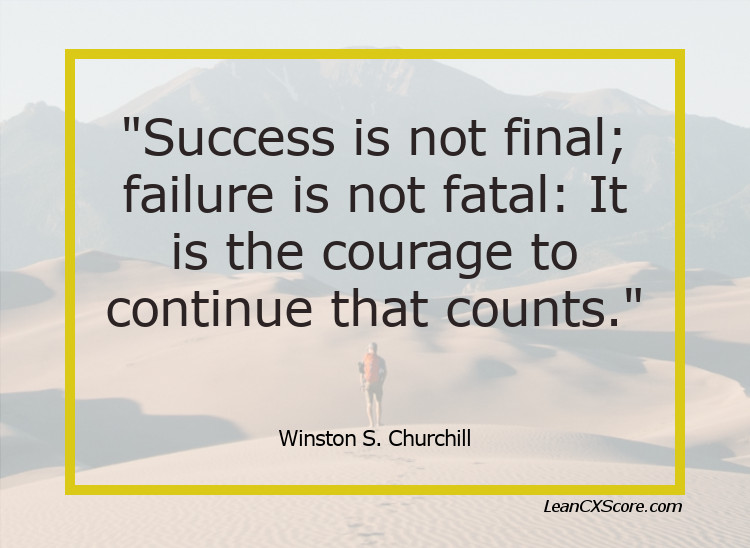
“Success is not final; failure is not fatal: It is the courage to continue that counts.” – Winston S. Churchill

Have you heard this leadership quote?

Winston Churchill is talking about the fact that when we win, or when we lose, it is often still not the end of the game. If we keep going, keep learning, and keep trying, we can turn our fortunes around.

Quote Churchill failure not fatal Courage to Continue

Never Give Up, Never Give Up, Never Give Up

Having the courage to continue is not always easy. Life gets in the way – things get busy and we get busy. And sometimes our own thoughts work against us – “I knew I couldn’t do it,” or “Why do these things always happen to me?”

Having the courage to continue means working through all of these things – that little voice saying you can’t do it, the market conditions changing, the failures you encounter both small and large. By working through them to the other side you are gaining something special. One is a new level of determination, a new level of grit.

Angela Duckworth and Carol Dweck both found that it wasn’t necessarily the students with the highest IQ that made the best grades in the end, it was the students with the highest level of stick-to-it-ive-ness, where they would keep going even when things got hard. They had the highest levels of grit.

Winston Churchill is also right. How many times have you seen the star student or the star football player from high school, now down on their luck, broke and in debt? Success is not final – you need a level of grit to keep going, even when you are not in your element.

And likewise, how many times have you heard of someone going from broke or homeless to leading a successful, stable life, or even becoming a millionaire? Their failure was not final either.

It was their courage to continue that counted.

– David McLachlan

Get the Leadership Card Deck or the Lean CX Score Book:

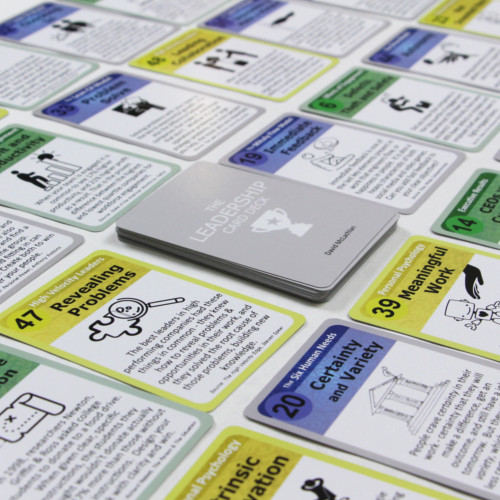
Leadership CardsView All The Leadership Cards (48)

- or - Have the Leadership Cards delivered for your next meeting


Lean CX ScoreGet "The Lean CX Score" now, and start creating disruptors in your industry that completely annihilate your competition.

Oh and good news!  You'll be improving the speed, morale and engagement of your teams at the same time.  Get the Lean CX Score now.

The Nominal Group Technique

– See All Project Management Key Concepts –

Nominal Group Technique - PMBOKThe Nominal Group Technique

You might need to use the nominal group technique as you’re gathering requirements in your project, and also arranging requirements and arranging solution ideas within your scope management process.

What is the nominal group technique? It’s basically a structured form of brainstorming which helps us gather ideas. It also helps us see what the most important ideas to work on, as it enhances brainstorming with an anonymous voting process used to rank the most useful ideas for further brainstorming or prioritization. Our most important ideas are the ones that receive the most votes during this anonymous voting process.

The nominal group technique consists of four steps. The first one is we pose a question or a problem to the group. For example “How do we solve this problem?” or “What are the requirements that you have out of this particular project or process?” Each person silently generates and writes down their own ideas. And this is a really important because it just stops one person or two people who everyone looks up to from being copied or followed. This is a way of getting around that so everyone gets a more even say, no one has influenced it in any way before they get to generate their own ideas.

So it’s a much more pure form of brainstorming. Now the moderator or the facilitator role that you’ll see come up in Agile a lot – and it’s a very important part of almost all of these processes – he or she will write down those ideas on a flip chart, on the wall, on a whiteboard or whatever until all of those ideas are recorded. Now then each idea is discussed until all group members have a clear understanding.

Some of the ideas might be the same or very similar, maybe a few relate to one particular idea. We can start to group the similar ones together. Now once we’ve got those groups then individuals vote privately to prioritize those ideas.

So you can either close your eyes and put your hand up, or you can just write down on a slip of paper and give it to the moderator or facilitator. Maybe this one gets four votes, this one gets two votes, this one gets five votes, then we might go with those ideas with the most votes.

It’s easy to do, if you just look at a scale of 1 to 5, one might be the lowest and five might be the highest priority that you could put during the voting process. You might do it in many rounds to reduce and focus in on ideas. So if you’ve got lots and lots then you can reduce them down. You’ve got 20, then you do another voting process and now you’ve just got one main one of the end after each round of votes are tallied and the highest-scoring ideas are selected.

And that is the nominal group technique.

– David McLachlan

– See All Project Management Key Concepts –