All posts by David McLachlan

Leadership Quote – You Don’t Learn by Following Rules – Branson

– See all the Leadership Quotes here –

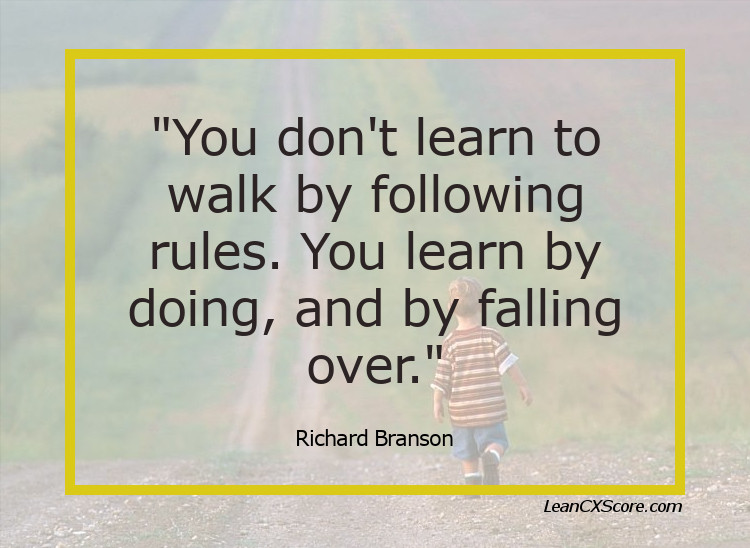
“You don’t learn to walk by following rules. You learn by doing, and by falling over.” – Richard Branson 

Have you heard this leadership quote?

Richard Branson is talking about the value of learning from your actual experiences, instead of learning from a book. And this is particularly useful, and particularly true, when it comes to entrepreneurship and starting a business.
Quote Richard Branson Learn by doing

There Are Some Things You Must Learn By Doing

They say if you tell someone something, they recall only a small portion of what you taught them. But if you have them do it with you, they will recall nearly 100% and that lesson will stick with them significantly longer.

Likewise, there are some things that you just can’t learn from books. Sure, you can learn a math solution. Two plus two will always equal four. Probability and statistics will have the same equations for the same things you need to figure out. Spelling doesn’t change when you’re writing a book, and the elements of science will largely remain the same as what you can read about.

But when you are putting something out there in the world – an idea, a service, a product, you may now know in advance how people will react to it. Sure, you might have a rough idea – maybe you have done some product testing, maybe customer have requested a new feature. But things can evolve in peculiar ways. Customers may change their habits. The market may change, the economy may change, trends come and go.

And so you have to learn by walking and falling down – you have to “do”, and adjust when the market feedback tells you that something is working (i.e. you should do more of it) or not working (i.e. time to pivot in to something else).

As long as you are learning, and never give up, you will have success. It is only a matter of when.

– David McLachlan

Get the Leadership Card Deck or the Lean CX Score Book:
Leadership CardsView All The Leadership Cards (48)

- or - Have the Leadership Cards delivered for your next meeting
 

Lean CX ScoreGet "The Lean CX Score" now, and start creating disruptors in your industry that completely annihilate your competition.

Oh and good news!  You'll be improving the speed, morale and engagement of your teams at the same time.  Get the Lean CX Score now.

What is the Final Report?

– See All Project Management Key Concepts –

The Final Report Project Management Key ConceptsThe Final Report

What is the final report? It is a report that provides a summary of the project performance and how it went, either during that phase or during the entire project itself. As with all things in project management it can be a small piece of work or it could be a large detailed document in itself. It could be formal or it could be informal. It could range from a document just a few lines in your project measurement plan, or it could be the outputs of a retrospective if you’re delivering a feature using agile for example.

A retrospective occurs for us to say what went well, what didn’t go well, what still puzzles me and what have I learned. Asking those questions and feeding that back into the process and that could be documented as a final report for that iteration or that particular feature.

There are many different ways to use the final report. It can include things like the scope objectives – were they met? And evidence of them being met. Has the scope been verified, and has it been delivered and accepted by the stakeholders? The quality objectives, actual milestone delivery dates (when did we deliver these things) and any variances in those. Did we say we’re going to deliver here but we actually only delivered there? What were the variances, and why.

This also feeds into our lessons learned register. Lessons learned from the project will really help future projects if this information is available.

We’ve got cost objectives – the actual versus predicted cost, reasons for any variances, same with the schedule and same with any risks. Did we encounter risks? How did we resolve them? All of that can go in the final report.

The final report puts it in a nice sort of nice package for the end of project report. Part of this could also include a handover document to whoever you’re handing over to or ultimately delivering this project to. All that information that they might need down the track, who to go to for this system access, who to go to if they need to get more of this resource once it’s gone into BAU. That can be part of a handover and can potentially go into the final report as well.

– David McLachlan

– See All Project Management Key Concepts –

PMP Practice Exam Questions and Answers | 17

– See all the PMP Exam Questions – 

PMP Practice Exam Questions 17PMP Exam Question Session 17

In this series we will walk through five PMP Practice Exam Questions each day – a great way to set up your morning as you prepare to pass the PMP Exam. It is also useful for the CAPM exam, as the content is very similar.

We will also figure them out together, and you’ll see the thought process behind solving these PMP exam questions.

I hope you enjoy!

Question 1

Estimate at Completion is the forecasted cost of the project as the project progresses. Your project has a budget of $10,000.
30% of the work has been completed against planned 30%, and $10,000 has been spent so far. If the CPI impacts our future cost, what is the Estimate At Completion (EAC)?

A)  $17,000
B)  $44,444
C)  $33,333
D)  $22,222

Question 2

You are working on a project and wanting to plan the immediate work in detail, while leaving the remaining work at a higher level. What are you doing?

A)  Executive Planning
B)  Rolling Wave Planning
C)  Progressive Planning
D)  Extra Planning

Question 3

You are working with your project team and wanting to stimulate creativity and new ideas. Which of the following is a group creativity technique you might use?

A)  Nominal group technique
B)  Regression analysis
C)  Tornado diagram
D)  Prompt lists

Question 4

As a project manager, you are wanting to work with the project sponsor to bring more objectivity to the acceptance process. What is this project activity called?

A)  Collecting Requirements
B)  Estimating Activity Durations
C)  Planning Schedule Management
D)  Validating Scope

Question 5

You are working through the scope of your project and wanting to decompose the high level features into smaller pieces of work that a team can deliver using a work breakdown structure. What is that level of the work breakdown structure called?

A)  Work Package
B)  Work Product
C)  Work Deliverable
D)  Work Task

– See all the PMP Exam Questions – 

Leadership Quote – You Can Have Everything You Want – Zig Ziglar

– See all the Leadership Quotes here –

“You can get everything in life you want if you will just help enough other people get what they want.” – Zig Ziglar

Have you heard this leadership quote from Zig Ziglar?

Zig Ziglar is talking about a very special thing, that has made thousands of millionaires over the years. He is talking about the value you bring to the marketplace.

Quote Zig Ziglar You Can Have Anything You Want

Helping Other People Brings Them Value

An it’s value that they are often willing to pay for. Think about your favorite service, or thing you like to do or buy. Maybe it’s an online shopping site, maybe it’s an activity, but whatever it is if you like it a lot, chances are you pay for that service. And that service is provided by someone – maybe a person, maybe a business, but the point is that person is helping you get what you want.

And by helping you get what you want, you are paying them money, and they are working their way to being able to have whatever they want in return.

The more people you help, the more value you bring, the more money you are able to earn.

Now, can you change the amount of value you bring to the marketplace?  Of course! If you currently earn $15 an hour flipping burgers, can you learn a new skill and earn $18 an hour? Of course you can.

Could you learn a particular skill, or set of skills that earned you $50 an hour? $100 an hour? $1,000 an hour or more? Yes you can. A surgeon is paid more than a window washer, and an accountant is paid more than a taxi driver. All of these skills are learnable and there are a million variations in between.

Does it take time to change the value you bring to the marketplace? Of course it does. But if you know your direction and spend time on it every day, you will be there before you know it.

– David McLachlan

Get the Leadership Card Deck or the Lean CX Score Book:

Leadership CardsView All The Leadership Cards (48)

- or - Have the Leadership Cards delivered for your next meeting


Lean CX ScoreGet "The Lean CX Score" now, and start creating disruptors in your industry that completely annihilate your competition.

Oh and good news!  You'll be improving the speed, morale and engagement of your teams at the same time.  Get the Lean CX Score now.

PMP Practice Exam Questions and Answers | 16

– See all the PMP Exam Questions – 

PMP Exam Question Practice 16PMP Exam Question Session 16

In this series we will walk through five PMP Practice Exam Questions each day – a great way to set up your morning as you prepare to pass the PMP Exam. It is also useful for the CAPM exam, as the content is very similar.

We will also figure them out together, and you’ll see the thought process behind solving these PMP exam questions.

I hope you enjoy!

Question 1

You are working on a major project for your company, where only 50% of the project has been completed, while 80% of the project budget has been spent. When making a decision on whether or not to continue, what are the costs called that have already been spent?

A)  Earned Value
B)  Exception Report
C)  Sunk Costs
D)  Milestone

Question 2

The To Complete Performance Index (TCPI) is the future cost performance of the project. Your project has a budget of $15,000. 50% of the work has been completed, against planned 60%. $9,000 has been spent so far. What is the efficiency that must be maintained in order to complete as planned (TCPI)?

A)  1.89
B)  1.25
C)  0.56
D)  0.78

Question 3

Your project has a budget of $200,000.
60% of the work has been completed against planned 50%. $590,000 has been spent so far. What is the Schedule Performance Index (SPI)?

A)  1.20
B)  0.83
C)  0.63
D)  2.50

Question 4

You are working on a brand new project and need to estimate how much it will cost. You have the cost per unit for all items needed. What is the name of the estimating technique you will use?

A)  Three point estimating
B)  Executive estimating
C)  Data estimating
D)  Parametric estimating

Question 5

Your project has a budget of $500,000. 60% of the work has been completed against planned 70%. $280,000 has been spent so far. What is the Earned Value (EV)?

A)  $500,000
B)  $280,000
C)  $300,000
D)  $350,000

– See all the PMP Exam Questions – 

Leadership Quote – Missions are Better than Plans – Seth Godin

– See all the Leadership Quotes here –

“Plans are great but missions are better. Missions survive when plans fail, and plans almost always fail.” – Seth Godin

Have you heard this leadership quote from Seth Godin?

He is talking about giving your people something bigger than themselves to believe in – a mission.

Quote Seth Godin Missions are better than plans

Giving yourself or your team a mission – even bigger than “Starting with Why”

Simon Sinek’s famous book, “Start With Why” gave his audience the reason most companies succeed where others fail – they have given their people a strong enough “why” behind what they do, that they would follow and work on even when things are hard.

Think about it in your own life – how often would you do something for your family that you wouldn’t even do for yourself – help them out, give them time, go to work at a job you hate to keep a roof over their head, all because they are your “why” and it’s strong enough for you to keep going.

It’s the same when a company has a strong enough reason too. If it’s a real something for their people to believe in, they will put in hours above and beyond the norm to help make that vision happen.

Now what Seth Godin is saying is even beyond starting with “Why”, it is giving your team a mission. A mission is something that everyone is invested in. It is something bigger than just one person, and it is something beyond just money or a paycheck.

Most executives make “Plans”, then they change those plans frequently when they haven’t got results in three months and the stock market reacts poorly to their earnings report. But not Amazon. CEO Jeff Bezos made the mission very clear at Amazon – Obsess over customers. Make their lives ridiculously easy. Make buying easy, make getting what they want easy. And even though the profit has taken a long time to grow (more than a three month cycle or single earnings report), it has now made him the richest man in the world.

– David McLachlan

Get the Leadership Card Deck or the Lean CX Score Book:

Leadership CardsView All The Leadership Cards (48)

- or - Have the Leadership Cards delivered for your next meeting


Lean CX ScoreGet "The Lean CX Score" now, and start creating disruptors in your industry that completely annihilate your competition.

Oh and good news!  You'll be improving the speed, morale and engagement of your teams at the same time.  Get the Lean CX Score now.

The Agile Declaration of Interdependence

– See all the Agile Certified Practitioner Videos –

Creators of the Agile Declaration of InterdependenceThe Agile Declaration of Interdependence

The team of people who established the guiding principles of Agile in 2001, released these principles of Agile project management in 2005 called the declaration of interdependence, and they did so to serve as a value system for Agile project managers.

These are the core values we can use to work in an Agile way on our projects. Above is the cast who created this – an amazing cast of people who’ve helped organizations become more Agile over the years and have really contributed to this methodology, and who really founded this methodology.

Let’s look at the six principles of Agile Interdependence.

Principle 1

We increase return on investment by making continuous flow of value our
focus.

Principle 2

We deliver reliable results by engaging customers in frequent interactions and shared  ownership.

Principle 3

We expect uncertainty and manage for it through iterations, anticipation, and adaptation.

Principle 4

We unleash creativity and innovation by recognizing that individuals are the ultimate source of value, and creating an environment where they can make a difference.

Principle 5

We boost performance through group accountability for results and shared responsibility for team effectiveness.

Principle 6

We improve effectiveness and reliability through situationally specific strategies, processes and practices.

– See all the Agile Certified Practitioner Videos –

Roles and Responsibilities in a Scrum Team

– See all the Agile Certified Practitioner Videos –

Scrum Roles and ResponsibilitiesRoles and Responsibilities in a Scrum Team

Below are the roles and responsibilities that you’ll come across in a Scrum team.

Scrum is one of the biggest parts of Agile – the main parts being Scrum, Kanban, and eXtreme programming or XP. All of these things you will come across but scrum is one of the biggest, so this is a really great thing to know about the three core roles and responsibilities that you’ll come across in a Scrum team.

There are three distinct roles in the Scrum environment and they all work together throughout the project.

  1. The Product Owner
  2. The Development Team
  3. The Scrum Master

The Product Owner

  • Manages the product backlog, which is the long list of prioritized project requirements.
  • The product owner arranges these items from most valuable to least valuable.
  • What’s in the backlog and the ordering of the items is transparent to the whole team.

The Development Team

  • The Development team is responsible for sizing the requirements of the product backlog and getting work done in each sprint.
  • Self-organizing and self-led, and its members are called generalizing specialists (T-shaped team members) because they can often do more than one function on the team, but specialise deeply in one area.
  • An ideal Scrum team has no less than five people and no more than eleven people (seven being perfect).

The Scrum Master

  • Is the project manager role, but with more focus on servant leadership.
  • The Scrum Master ensures that everyone understands the rules of Scrum, removes blockers for the team, facilitates Scrum meetings (stand-ups)
  • They also bring in anyone necessary for the whole team approach
  • They help the product owner groom the backlog, and communicate the vision of the project to everyone that’s involved.

You may find similar roles on any project or even within any team working towards Scrum and Agile – the principles translate to all types of knowledge work.

– David McLachlan

– See all the Agile Certified Practitioner Videos –

The Configuration Management Plan

– See All Project Management Key Concepts –

Jasper | DocumentationThe configuration management plan

What is the configuration management plan? It’s a plan that defines those items that are configurable. In other words the items that require a formal change control – usually items that have been baselined, they have been locked into a point in time.

These things might be to do with your scope, your schedule, your cost, usually locked in at a point in time beause we don’t really want those to change without any formal process.

We don’t want them to change on an ad-hoc basis because obviously these will affect and impact the outcome of your project. If we’re changing the scope or the schedule or the timeline or the cost involved, those documents are usually baselined and then they require that formal change control process, and the process for controlling changes to these items.

So while it usually relates to these baselined items such as the project budget for example in our cost baseline, schedule, scope statement and work breakdown structure where we’ve broken down the scope statement into smaller activities for us to complete in order to to deliver those features or those pieces of scope.

In order to change this we’ll need to go through the configuration management process.

Like all plans in your project management plan it can be small, just a few lines of text or it can be large and detailed. It could be an entire document of its own design, depending on the size of the project, depending on the enterprise environmental factors (EEFs) of your organization. The main point is to outline which of those documents will need formal change control, and that can be completely up to you and the project sponsor. You can work together and advise which things need to go through a formal process to change. Anyone can raise a change request, and in your change management plan you note the change process, such as where that change request will go into once it’s raised. Once that change is approved after going through the approval process, we will need to realign the project scope or schedule to suit these new changes. Maybe more money or funding comes in, so you’ll have all of these steps and these steps will need to be outlined, and that’s why we have the configuration management plan.

– David McLachlan

– See All Project Management Key Concepts –

The Issue Log

– See All Project Management Key Concepts –

The Issue Log - PMBOKThe Issue Log

What is the issue log? Throughout the life cycle of a project, you (as the project manager) will normally face problems or gaps, inconsistencies or even conflicts in a project. This stuff happens all the time, because your project is designed to bring about change, and so there will always be little things happening – stakeholders to manage or things people will be unhappy about. Maybe the scope needs to change, all of these little things are happening all the time in a project and they occur unexpectedly, and they require some action to bring everything back on track so that it doesn’t impact the project performance in general.

That’s when we need to raise an Issue, once these things have happened.

The issue log is a project document where all of these issues are recorded and tracked. It’s important to note that an issue and a risk are not the same. Before something happens, it’s noted as a risk, and we can note that in the risk assessment, and we’ll assign things like controls to that risk so that we can prevent the risks from happening. We’ll assign owners of those risks to look at the activities around those controls, make sure that things remain on track. Obviously not everything always goes to plan and we can’t always think of everything that will happen, so if something does happen it becomes an issue.

An issue should be noted in the issue log at that time. The issue log will help the project manager effectively track and manage those issues. We’re going to be assigning extra information to these issues so that we can effectively track those issues, and we’re ensuring that they’re investigated and resolved and closed.

Issues may happen at any time, and the issue log is updated as a result of the monitoring and controlling activities throughout the project’s life-cycle. As part of controlling issues it may result in a change request as well. If we’ve raised an issue and it’s resolved, but it is something that needs to change like the scope or the schedule, then we need to raise a change request. Maybe we’re changing one of those baselined documents, around our scope, our time or schedule, or our cost.

These are the three most most important things that will be baselined, and that might need to go through the formal change control process by raising a change request. Then you can update the issue log with all of the appropriate information once that’s resolved.

The data that we’ll put on our issues are things like the issue type, who raised that issue, the description of the issue, priority (is it high, is it low) who is assigned to the issue to manage it ongoing, the target resolution date (is in June, July or August etc), the status current status and of course the final solution to resolving that issue, which is where that change management or the change request might come into it if something needs to change.

So overall it’s a very important part of your project, because you will need to raise and manage these issues as they occur. You’ll still need to keep an eye out for risks as there are you know on the horizon as well before they turn into issues all of this is part of managing a project and keeping it on track and that is the Issue Log.

– David McLachlan

– See All Project Management Key Concepts –