“All anyone asks for is a chance to work with pride.” – W. Edwards Deming
Have you heard this leadership quote?
William Edwards Deming lived from 1900 to 1993 and was an American engineer, statistician, professor, author, lecturer, and management consultant. He is well known for his work on operations including statistical process control and the Plan-Do-check-Act (PDCA) cycle.
Give Your People a Deeper Meaning
A chance to create something that one can be proud of is worth more to most people than a modest pay rise. Because creating something good, something meaningful meets some core emotional needs like belonging and achievement.
Abraham Maslow found it, in his “Theory of Human Motivation” – best known as Maslow’s Hierarchy of needs. While food and shelter were important, once they were met people really craved belonging, achievement, and ultimately a sense of purpose in their life.
What is the real goal of life?
Often people mistake the goal of life to be “retirement” – to just get through their working life and be done with it so they can finally, at the end of their life, do what they want. Sure it’s true that not everyone can do a job they love, and sometimes we have to have the discipline to work through difficult situations to get to greener pastures. But what they fail to realise is that when a person retires it is often only a few short years until they pass away. They die – and it’s not because they are too old necessarily – after all, people live to be 100 more and more – it’s because they have lost their sense of purpose.
Now they don’t have to get up everyday, because they aren’t forced to, and no matter how much they said they hated they job, and even meant it, that job was a sense of purpose and a reason to get out of the house every single day.
Be Intentional About Purpose
So don’t wait for retirement to realise this. Can you give your team a sense of purpose in the work they do, now? Can you make it meaningful, and tie it to something greater than themselves? If you do, you might just win their hearts and minds, and you might just see performance you have never seen before.
In this series we will walk through five PMP Practice Exam Questions each day – a great way to set up your morning as you prepare to pass the PMP Exam. It is also useful for the CAPM exam, as the content is very similar.
We will also figure them out together, and you’ll see the thought process behind solving these PMP exam questions.
I hope you enjoy!
Question 1
You are working through various options in your project and need to help stimulate your group towards innovation and ideas. Which of the following is a type of group creativity technique?
A) Monte Carlo Analysis
B) Regression analysis
C) Brainstorming
D) Root cause analysis
Question 2
You are working as a project manager, at the stage where you need to validate the scope and products you have created with the appropriate people. What is the output called that is produced by a project and approved by the end-user or customer?
A) Accepted Products
B) Accepted Deliverables
C) Accepted Results
D) Accepted Data
Question 3
You are working on your Project Management Plan and will need the opinion of an individual or a group who has a wide range of knowledge and experience in that specific field. What is this called?
A) Expert Judgment
B) Expert Findings
C) Expert Comment
D) Expert Decision
Question 4
You are developing a new product and decide to add three extra features that the customer did not ask for, to make the product extra special. You feel as though it will work better this way. What is this called?
A) Scope Creep
B) Customer first
C) Verified Deliverables
D) Gold Plating
Question 5
A project management plan is a formal approved document that defines how the project is planned, executed, monitored and controlled. Who is responsible for creating and updating the project management plan?
A) The Program Manager
B) The Project Manager
C) The Project Sponsor
D) The Project Team
“If you hear a voice within you say ‘you cannot paint,’ then by all means paint and that voice will be silenced.” – Vincent Van Gogh
Have you heard this leadership quote?
It is talking about silencing your critics. And the biggest critic for most of us reading is not some terrible person out there in the world. Realise it or not, most often that biggest critic is ourselves.
Vincent Van Gogh Was No Stranger to Misfortune
Vincent lived in the late 1800s and is well known for his paintings now, but was only an artist by trade for 10 years of his life. He also only sold one painting during his lifetime, while his popularity exploded in the century after his death.
He struggled for many years with mental illness, and would have had many encounters with that voice in one’s head saying that they cannot do it. Which gives even more weight to Vincent Van Gogh’s quote, as he knew well what to do to achieve greatness.
How To Silence Your Own Self-Criticism
The best part about Van Gogh’s advice was that it wasn’t something airy-fairy or intangible. He says all you need to do is do it – to start, to begin, and to try. By doing the very thing you are afraid of, that criticism will melt away. Your mind won’t have time to be negative as it is now too busy figuring out how you are actually going to pull this off.
And whether we have put something off because off fear – fear of failure, or even fear that we might have some success – “and then what?” – we can get through it by taking a little action.
What can you start today? What can you take action on? Start small, it doesn’t have to be big. But every little bit will get you one step further toward your goal.
In this series we will walk through five PMP Practice Exam Questions each day – a great way to set up your morning as you prepare to pass the PMP Exam. It is also useful for the CAPM exam, as the content is very similar.
We will also figure them out together, and you’ll see the thought process behind solving these PMP exam questions.
I hope you enjoy!
Question 1
You are working on a project and have been asked to create a plan that shows the practices and procedures to be adopted for execution and monitoring and controlling the project. What will you create?
A) Risk Management Plan
B) Project Management Plan
C) Sponsor Management Plan
D) Benefits Measurement Plan
Question 2
You have recently discovered the importance of communication in your project after one of your directions was misunderstood. What is one of the most effective way to handle complex communications?
A) Informal written communication
B) Oral formal communication
C) Formal written communication
D) Oral informal communication
Question 3
You are working in the risk area of a project. The project work is half way complete and dozens of new risks have been found that could jeopardise your project. The risk plan is not yet complete. When should risk management planning have been completed?
A) At the beginning of your project, during initiation and planning
B) In the middle of your project, during execution
C) When monitoring your project – you can analyse what isn’t created yet
D) When the project is finalised – as you will know the risks that have occurred.
Question 4
You are a project manager needing to use a project tool and technique that will inspect, clean, transform and model large amounts of data to uncover the impact of certain project risks. What technique are you using?
A) Meetings
B) Assessment Analysis
C) Information Technology
D) Data Analysis
Question 5
You are working on Risk Planning in your project and have asked one of your team to find the established records of risk categories within the organisation for you to pick from and re-use. What project management tool and technique are these also called?
A) Prompt Lists
B) Mitigation Lists
C) Issue Lists
D) Risks Lists
“It is not enough to do your best; you must know what to do, and then do your best.” – W. Edwards Deming
Have you heard this leadership quote?
William Edwards Deming lived from 1900 to 1993 and was an American engineer, statistician, professor, author, lecturer, and management consultant. Many in Japan believe that Japan rose to becoming one of the world’s largest economies through processes partially influenced by the ideas Deming taught.
It is Not Enough To Be Motivated
If you are moving fast, make sure you are moving in the right direction. You might be travelling quickly but if you are on the wrong train, you will quickly end up in the wrong place.
What W. Edwards Deming is saying here is that if your team is doing their best, at least do them the kindness of ensuring that they first know what to do so they can do it well, but also why they are doing it so they can see the bigger picture.
Google Found The Same Thing
Nearly 80 years later, Google found the same thing in their project called “Aristotle”. In that project they studied more than 100 outperforming teams and found that clarity was one of the most common factors involved with a successful team. Clarity on what to do, clarity on why they were doing it. When a team had clarity then, and only then, could they work hard, travel quickly, and get to the place they wanted to go to – the result they wanted to achieve.
So give your team clarity on the work, ensure they know what to do – and ensure you know what to do too! Then when you work harder, you know you will be moving in the right direction.
There are five Scrum values that all project team members, including the project manager (Scrum Master), strive to adhere to on a Scrum project.
Core Value 1 – Commitment
Each team member commits to the team, to each other, and to achieving the goal of each sprint.
Core Value 2 – Focus
The team focuses on the task at hand (avoiding the dangers of multi-tasking) and on the goals of the sprint.
Core Value 3 – Openness
The team is open and transparent – they share information freely and ask for help when they need it.
Core Value 4 – Respect
The team respects each other as capable, independent people.
Core Value 5 – Courage
The team has the courage to do the right thing, work through tough problems, ask for help if needed or say when they don’t know.
The Core Values of a Scrum Team
These core values of Scrum help hold a team together and form a contract (like a Team Charter) that creates a solid foundation as you work together towards your goals.
In this series we will walk through five PMP Practice Exam Questions each day – a great way to set up your morning as you prepare to pass the PMP Exam. It is also useful for the CAPM exam, as the content is very similar.
We will also figure them out together, and you’ll see the thought process behind solving these PMP exam questions.
I hope you enjoy!
Question 1
You have started to notice the impact that team motivation has on your project results. If you are giving your team love, affection, acceptance, friendship, you are using their:
A) Legal Needs
B) Social Needs
C) Wealth Needs
D) Organisational Needs
Question 2
You are working on a project where a strict and powerful union for the employees ensures that no employee can work more than 37 hours a week. This is an example of:
A) Project permissions
B) Project regulations
C) Project constraints
D) Project laws
Question 3
You are working on an Agile project and have been asked to create a document that lists team principles, agreements, and guidelines about the acceptable behaviour by team members. What are you working on?
A) The Team Guideline
B) The Project Management Plan
C) The Project Charter
D) The Team Charter
Question 4
You are managing a project team and need to ensure your team members are doing what is needed to get the job done. What is a project document you will use that helps you know the effectiveness of the team?
A) Team Performance Assessments
B) Team Progress Assessments
C) Team Presentation Assessments
D) Team Achievement Assessments
Question 5
A project manager will spend up to 90% of their time communicating, and your interpersonal skills will directly or indirectly impact the outcome of your project. Which of the following is a type of interpersonal skill?
A) Selling
B) Converting
C) Team building
D) Physical skills
This one is really fantastic because it looks into forecasting and maybe figuring out whether we want to spend money on a particular project or on another particular project. It really gets into into the meat of it before you kick off or initiate your project, and that’s what makes it really really great to learn about and to know about these forecasting techniques.
Using Future Value, Net Present Value, and Internal Rate of Return
For your project returns, there are many different ways to forecast these these things and as you initiate your project you may need to show your stakeholders the potential benefit that might come out of your project or what you’re going to deliver. Are you delivering a million dollars, or is it something else in benefit – maybe it’s customer value or customer goodwill as some soft benefits. Or is it some amount of value over time, potentially every month or every year for example.
To do this there are three common methods of forecasting that you will see on the PMP exam and in your project management career as well. You’ve got Future Value (FV) where we’re looking at what the value of a dollar today is in the future. Net Present Value (NPV where we’re looking at what the total outcome of our project three years into the future is, what that’s actually worth today. And our Internal Rate of Return (IRR), where if we’re delivering a million dollars over three years, what’s the actual percentage return in today’s figures?
For all of these on your PMP exam you really just need to choose the highest for each of them – so Net Present Value if you’ve got a choice between a hundred thousand dollars and a hundred and twenty thousand dollars, you choose the hundred and twenty thousand dollar one. It’s the same with Future Value – choose the highest future value, and choose the highest percentage for your Internal Rate of Return.
We’re also going to show you how to calculate these, just so know them, and it’s a little bit of fun as well.
Future Value
Future value asks “What would our money be based on a certain rate of return?” For example an interest rate, if we’re earning five percent a year or ten percent a year, in this example our future value equals our current (present) value multiplied by 1 plus our interest rate (so 1 plus 0.10 for example so it ends up as 1.10) to the power of the time – so in this case we’ve got three years. Let’s look at this example.
The value of a thousand dollars, in three years time, at ten percent interest.
We’ve got a thousand dollars, times 1.1 – so 10 percent (0.10) is our interest plus 1, to the power of 3. “To the power of” means 1.1 times 1.1 times 1.1, that’s three times we multiply those by each other. And that ends up to be 1.331 when you multiply all of those together. So we end up with a thousand times 1.331 and that gives us our future value of 1331. That’s how we figure out the future value at a certain rate of return.
Let’s say our project is going to give us a return of 10 per year, that’s very promising and that’s our potential return. We can do this the other way as well. We could say if we’ve got 1331 dollars in the future, and we want to figure out what that’s worth today then we actually just use divide instead of multiplication. So we just we go 1331 divided by 1.331 or our 1.1 times 1.1 times 1.1, and that will give us a thousand dollars in today’s value. So that’s how we do that looking backwards, and that’s important because that’s what we’re going to use for our Net Present Value.
Net Present Value
Now you might see this come up in financial accounting and statistics and that sort of thing, it’s a really cool technique to figure out what the project returns would be worth today, versus a certain rate of return and the future cash flows that we’re going to get out of our project.
Net present value equals the cash flow of year 1, divided by 1 plus our internal rate of return (which is our interest rate) and again, this is sort of foreshadowing for our next one which is the internal rate of return, but let’s say it is in this case 10 percent again. So it’s a 0.10, and we’ve got 1.1 again. So looking at the example we’ve got cash flow in year one or month one or whatever the the actual time frame is (it’s your choice), we’ve got $500 and we’re dividing that (now we’re looking backwards) instead of multiplying it, so we divide it by 1.10 and that gives us 454.
Great! Very easy. Now we’ve got our second year, or our second month or our second day, with $500 again. Now we divide that by 1.10 to the power of 2, so it’s 1.10 times 1.10 which equals 1.21. Then 500 divided by 1.21 gives us 413, and so on and so on, to the power of 3, to the power of 4, to the power of five – you could do as many of these as you see fit. You add them all together and then you minus the initial investment (we invested a thousand dollars into this project) because that’s a cost to us, it’s not a benefit that we’re getting. And all in all we get 243 dollars.
Now of course in the real world this might be 243,000 dollars, or 243 million dollars. Whatever size project you’re working with, or if it’s a personal project maybe it is 243 and that’s wonderful. But any positive return, that’s what we’re looking for, and the higher the better as we said.
Internal Rate of Return
Which brings us to the Internal Rate of Return. The Internal Rate of Return naturally flows here because we’re using the Net Present Value again, except what we’re doing now is we’re trying to figure out what that Internal Rate of Return is. It’s that interest rate we’re trying to figure out, usually through trial and error. So basically we have to figure out what that rate of return is, and we go up a little bit, down a little bit until we get to the stage where it’s the percentage that makes our Net Present Value equal zero, or as close to zero as we possibly can.
So again, the higher the Internal Rate of Return the better. Let’s go through an example just so it’s not too confusing. The initial outlay for our project is a thousand dollars, and we send that out to create our project – that’s our cost, so minus a thousand dollars. And then what we’re doing is we’re adding all of the benefits to that over time, so in this case we’ve got 400 cash flow, 400 cash flow, 400 cash flow coming in for each time period – let’s just call it every year. Let’s say we’ve got three years and each of those years we’ve got 400 coming in.
Now remember we’re doing that “dividing” instead of multiplying, because we’re trying to figure out the current value of these future cash flows. So using that dividing instead of multiplication. Let’s go through it. We’ve got 400 divided by 1.10 – we’re going to have a guess and say 10 percent is our is our interest rate – and that gives us 363. Now 1.1 to the power of 2 (so 1.1 times 1.1) equals 1.21, so 400 divided by 1.21 is 330. And so on and so on – again we could do this for as many time periods as we want – and then the next one to the power of three for our third year gives us 300.
So minus a thousand, then we’re adding 363, adding 330, and adding 300, and that gives us 993 which is just shy of a thousand so that’s that’s really close now we could fiddle around with this a little bit if we wanted to, we could say maybe it’s going to be a higher percentage maybe it’s 1.11 maybe it’s 1.12, or maybe we go the other way and we try and figure out which way do we need to go to get the closest percentage, to get it as close to 0 or just above as possible.
And that is our internal rate of return, remembering that when you get the question on the exam you might have three projects, one with an internal rate of return of 10 percent one with 12 and one with 15 percent, and for our purposes we want to choose the highest internal rate of return.
And these are all of the forecasting project return techniques that you will see on your exam and in your project management career.
These are extremely useful to know if you are working on or within a project using Agile or Scrum.
Step 1
The product owner (representing the customer or end user) creates a prioritised list of everything the project might deliver.
This list is called the prioritised product backlog.
Step 2
The team and the Product Owner have a sprint planning meeting. The team decides how much work it can take on in the next sprint.
The team pulls requirements from the prioritized product backlog that it can achieve in the sprint. This work becomes the sprint backlog.
Step 3
The team decides who will do what and creates the task cards in the sprint backlog for the current sprint.
The team will meet each day for a 15-minute meeting, called the daily scrum (also called a stand-up), to share progress updates.
Step 4
The project manager, called the Scrum Master, helps keep the team working toward the sprint goal.
They remove blockers, bring people in to the whole team approach, and facilitate progress.
Step 5
A sprint review happens at the end of each sprint to demonstrate what the team has accomplished to the product owner.
Step 6
After the sprint review the team participates in a sprint retrospective to discuss what did or did not work in the last sprint.
This gives the Scrum Master and the team an opportunity to adjust the processes and work for the next sprint.
Step 7
The whole process repeats itself by the project team selecting the next chunk of prioritized requirements from the backlog and getting to work in the next sprint.
Implementing Scrum
Implementing Scrum in an organization can be tricky, especially if no one in the organisation or team have done it before.
Show the value of Scrum through the results you get by using it, and more and more people will be interested in adopting the Scrum approach.
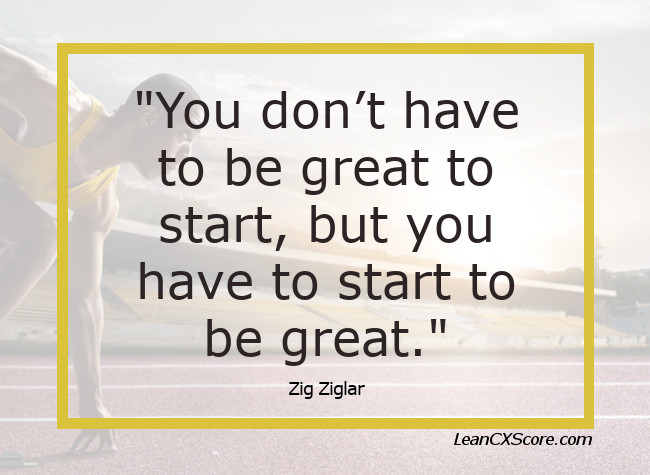
“You don’t have to be great to start, but you have to start to be great.” – Zig Ziglar
Have you heard this leadership quote?
Zig Ziglar was an American author, salesman, and motivational speaker who lived from 1926 to 2012. He recorded one of the greatest sales training videos of all time in 1982 called “The Secrets of Closing the Sale”, from which many sales teachers have since garnered their methods.
It’s Time To Get To Work
Zig Ziglar here is talking about making a start, taking some action. This is really excellent advice but, as anyone struggling with uncertainty or procrastination knows, it is easy to say and tough to do.
But there is a magic in starting, and it is this: When you start to do something, to create something or to put things out there in the world, people will respond. Maybe it’s not a lot of people at first, but even with a small few you can gather the feedback you need to improve.
By starting, you are discovering where your best results will be. You can follow the clues of what your customers respond to, what they buy, or what they watch or read. And when you adjust based on those clues, you are one step closer to success.
That is the road to greatness
Which is why Zig is saying you have to start to be great. That starting, creating, and adjusting is what leads you to greatness if you never, ever give up. But hundreds of thousands, perhaps millions of dreams have been lost thanks to people talking a good game but never taking action or seeing it through.
How many times has someone said, when talking about something at a party “I had that idea, that is now worth a million dollars (or more).” Whether it was a product, a business, a movie idea or something else, the fact that they had the idea is completely worthless unless they also had the work ethic and discipline to take action.
So what ideas do you have? And isn’t it about time you to that first, small step?

 View All The Leadership Cards (48)
 Get "The Lean CX Score" now, and start creating disruptors in your industry that completely annihilate your competition.
  PMP Exam Question Session 15
 PMP Exam Question Session 14
 PMP Exam Question Session 13
 Project Return Forecasting