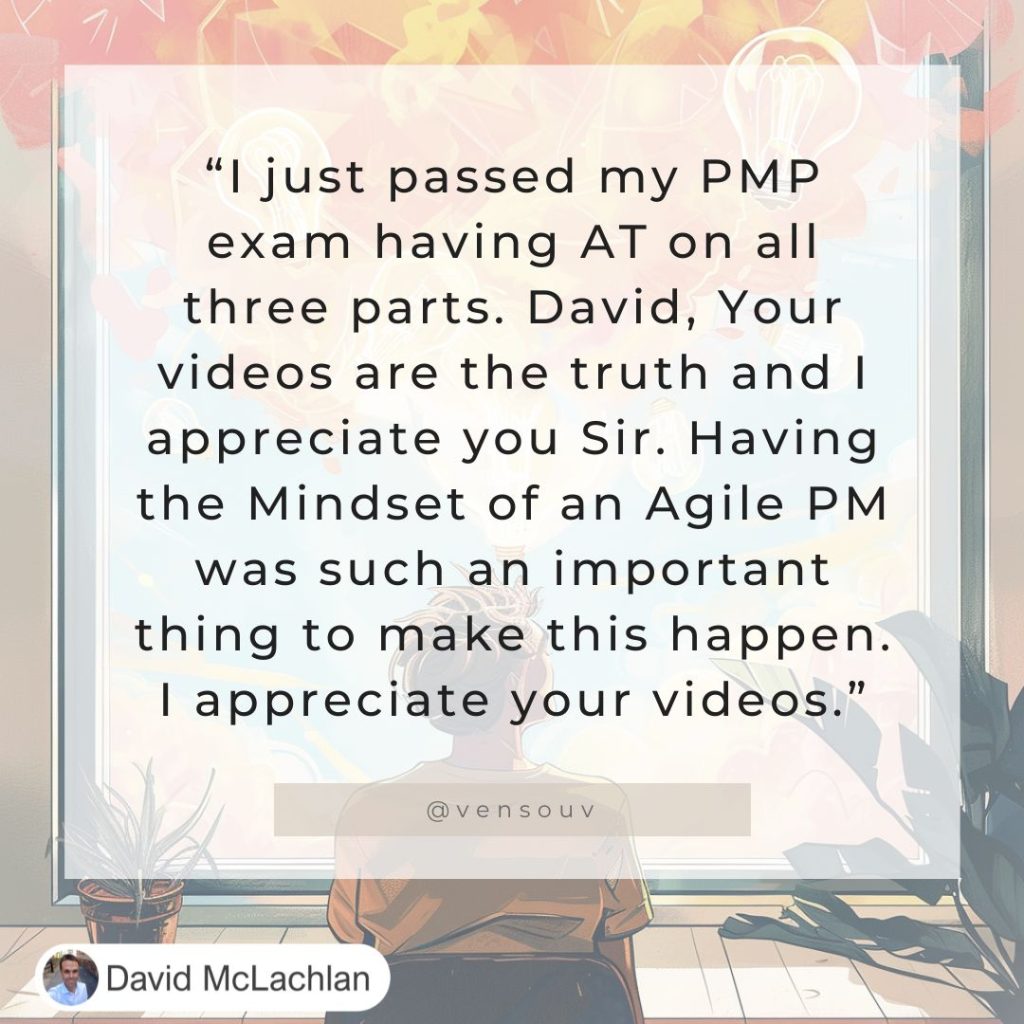
“I just passed my PMP exam having AT on all three parts. David, your videos are the truth and I appreciate you Sir. Having the mindset of an Agile PM was such as important thing to make this happen. I appreciate your videos.” – Vensouv
This is yet another person working hard and passing their PMP with Above Target results. Getting these results are not easy, but they are worth it. If you’re working on your Project Management skills this year, you can do it. I believe in you.
See live comments and reviews on David McLachlan on YouTube, Udemy and Etsy.
“Great job on the course content and delivery. The mock exams were useful to build the project mindset. I aces the PMP on my first attempt with AT across all domains. All I needed was this intense 4 day crash course and exam style questions.” – Nosakhare – PMP Course on Udemy.
No matter where you’re starting from, you can improve your life.
No matter how small it starts, each small improvement you make will build on the previous one, getting bigger and bigger like a snowball rolling down a hill. Make the right choices.
Choose the study instead of television. Choose your family instead of social media. Learn something new every day. This is another person passing their PMP – it is wonderful to hear 😊 And YOU can do it too!
See live comments and reviews on David McLachlan on YouTube, Udemy and Etsy.
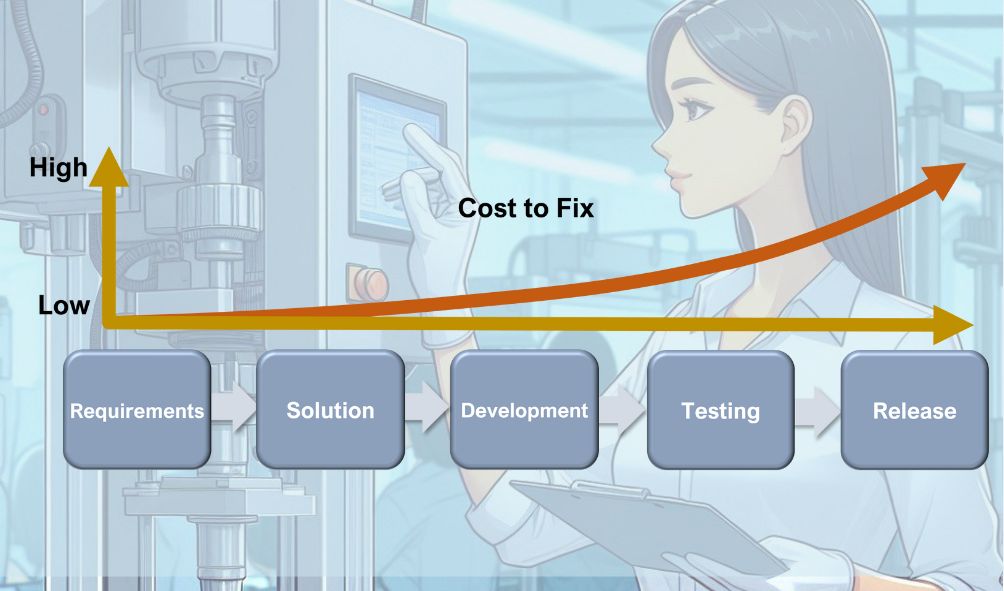
The cost to fix a defect increases as it gets closer to the Customer.
🤝 During Requirements: It costs very little to check, prototype and review requirements before we program them.
🤝 During Solution and Design: It costs relatively little to review and change a design.
🤝 During Development: It costs a bit more in time and effort to redo an item if it gets this far and there’s a defect. We may need to re-look at the requirements and design too, and re-code the solution.
🤝 During Testing: If we catch a defect during Testing, we may have to redo it in Development, or even go through the process from requirements again.
❌ But once a defect gets to a customer, we have the added cost of bad customer reviews, impacts to our brand or reputation, PLUS the time taken to review the customer complaints and address them, PLUS the waste of something we created that may have to be completely redone.
➡️ What else would you add to the Cost of Quality?
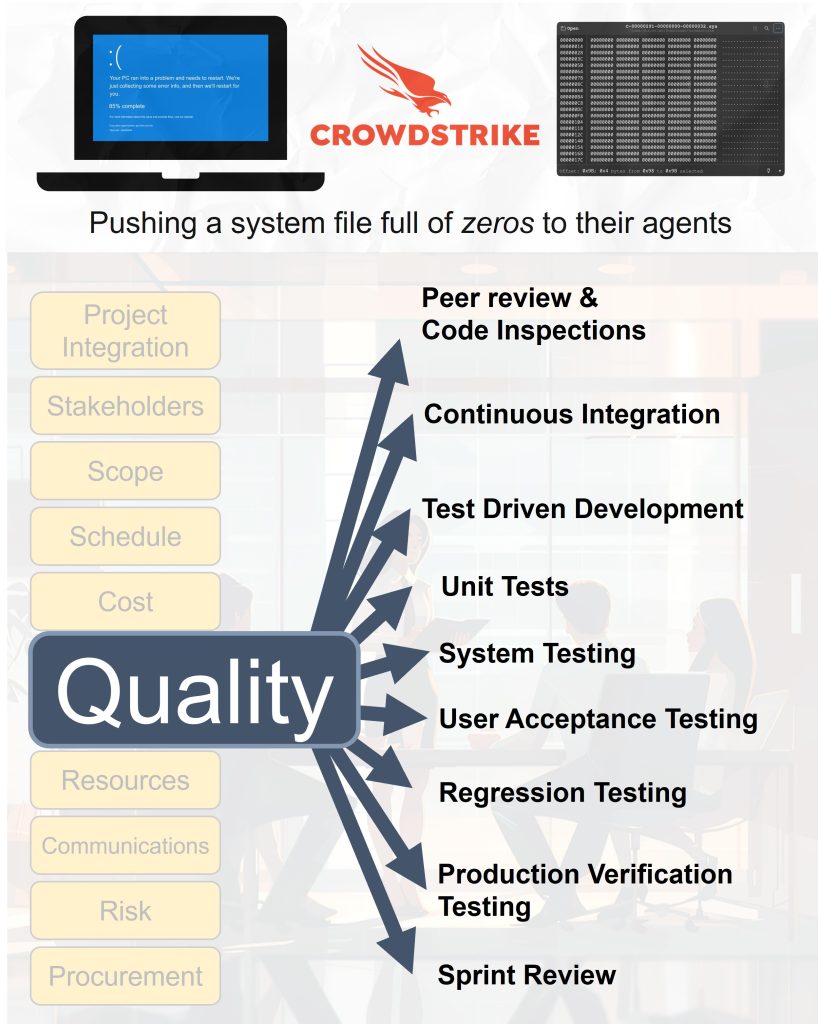
You probably heard about the Crowdstrike outage on the weekend of July 2024 that disrupted airports, banks and stores all around the world. It was caused by Crowdstrike pushing a system file full of zeros to production.
How can we avoid this sort of disaster as we manage our own Projects? There are many ways:
➡️ Peer review & Code Inspections: Checking the requirements with a user or reviewing the code with another Developer.
➡️ Continuous Integration: Merging changes into the main test system (often daily) with automatic tests.
➡️ Test Driven Development: Tests are written first, failed, then run again and passed after the solution is coded.
➡️ Unit Tests: Testing each small piece or User Story.
➡️ System Testing: Testing the integrated system as a whole.
➡️ User Acceptance Testing: Testing the system from the User’s point of view.
➡️ Regression Testing: Testing the existing system with the changes to see if they’ve impacted normal operations.
➡️ Production Verification Testing: Testing the change in the live environment after go-live then rolling the change back if it goes wrong.
➡️ Sprint Review: Demonstrating the actual change to the customer or senior users before release.
Quality is one of the 10 Project Management Knowledge Areas for a reason.
⭐ What are some of the ways you manage Quality on your own projects? ⭐
Here is what people have to say about David McLachlan:
“THE best instructor I have seen so far for the PMP, he not only gives you the information, but he TRAINS you to get into the mindset required to pass the PMP exam, and also to effectively manage your own project. Amazing course, amazing instructor, I believe in you, and so does David McLachlan.” – Xavier
“David McLachlan is one of the most sincere and personable teachers I’ve ever studied under. His positivity is genuinely infectious. It’s clear to me that what he teaches comes from a place of wanting his students to succeed, not just in the exam, but also in the corporate environment.” – Manunath
“Passed my PMP first try. In the 3rd section of the exam when I could feel myself getting tired, I imagined how you would read the question and break it down, and I heard your voice and your accent when reading the questions. I can’t recommend this (David McLachlan course) enough.” – John
“I have to say how amazing your (David McLachlan’s) video series is. Both my wife and I took the exam and we both passed AT in all areas. When I first saw your revies, I assumed they were fake because of how glowing they were. If anything, they under-report the true value you provide.” – Eric
“Hi David McLachlan, I passed PMP this week with 3 ATs. Thanks a lot for the humongous effort that you have put in to make things clear for us. You made me understand the concept so well. Thanks again David.” – Rekha
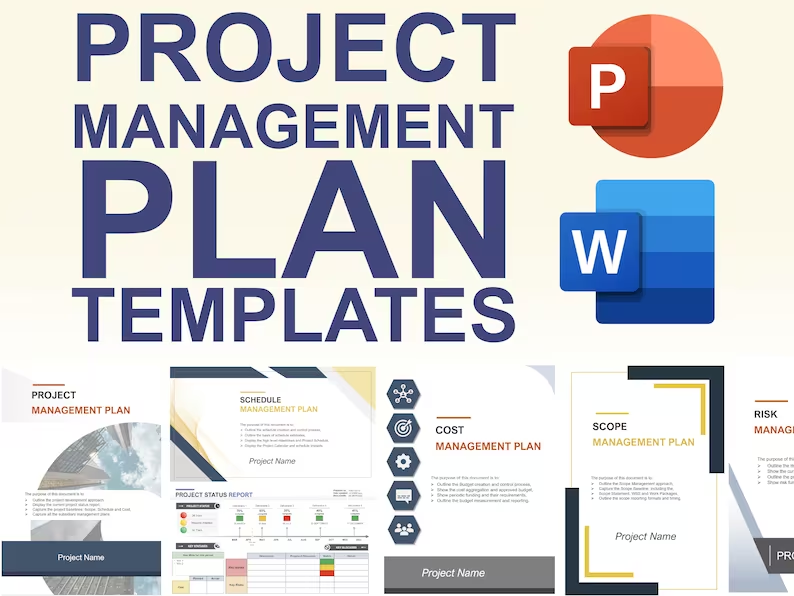
“Fabulous Project Management Plans(by David McLachlan) for any Project Management Professional (PMP). Saves you several hundred hours of work, prevents mistakes, and makes you look like a very experienced professional.” – Linda
“I took my PMP exam today, and could practically hear (David McLachlan) your enthusiastic, encouraging words as I made my way through the test. “How did you go?” “I KNOW you can do it.” “I believe in you.” I can’t thank you enough for your encouragement!” – Burt
“Highly recommend this (David McLachlan) course! The clear communication, efficient content, and handy review materials not only made learning enjoyable but also led to my successful exam outcome. Kudos to David for creating an exceptional learning experience!” – Said K.
“I passed my PMP exam today. I studied using all of your (David McLachlan) lecture videos as well as the several hundred question videos. You have a gift for explaining the material in an interesting manner with genuine excitement.” – DP
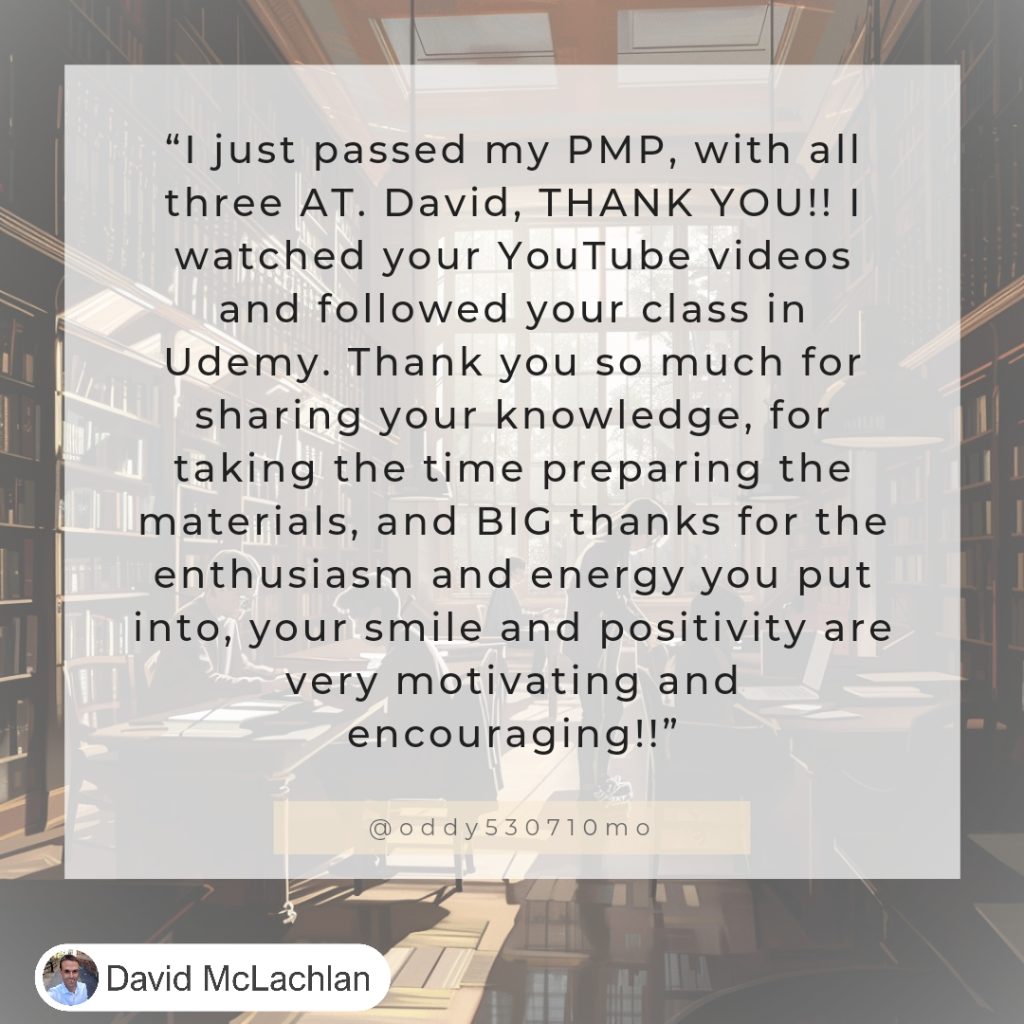
“I just passed my PMP, with all three Above Target. David McLachlan, THANK YOU!! I watched your YouTube videos and followed your class in Udemy. Thank you so much for sharing your knowledge, for taking the time preparing the materials, and BIG thanks for the enthusiasm and energy you put into, your smile and positivity are very motivating and encouraging!!” – Oddy
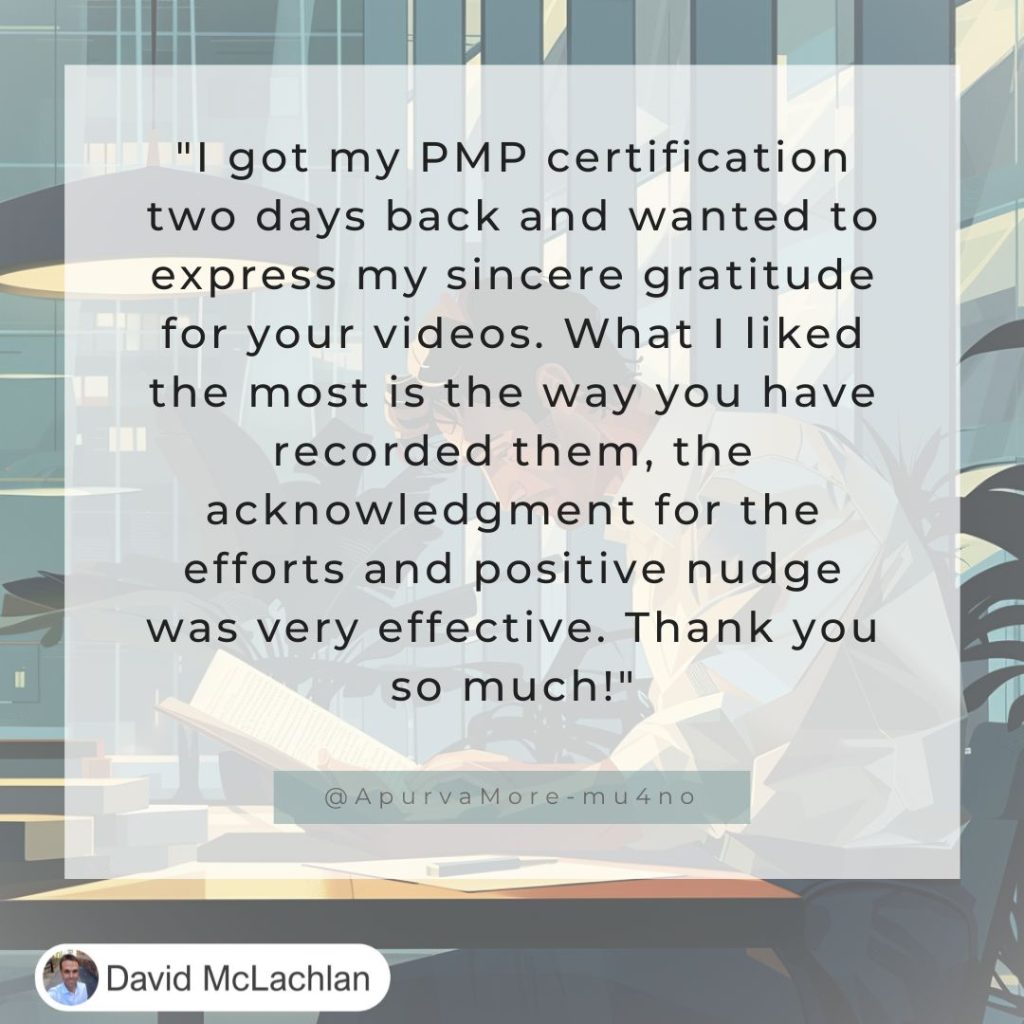
“I got my PMP certification two days back and wanted to express by sincere gratitude for your videos David McLachlan. What I liked the most is the way you have recorded them, the acknowledgement for the efforts and positive nudge was very effective. Thank you so much!” – Apurva
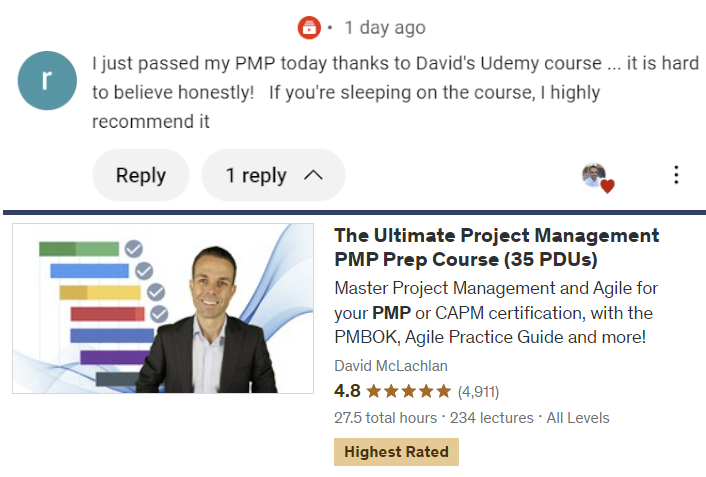
“I just passed my PMP today thanks to David’s Udemy course … it is hard to believe honestly! If you’re sleeping on the course, I highly recommend it.”
David McLachlan’s PMP Udemy Course is currently the highest rated PMP Course on Udemy.
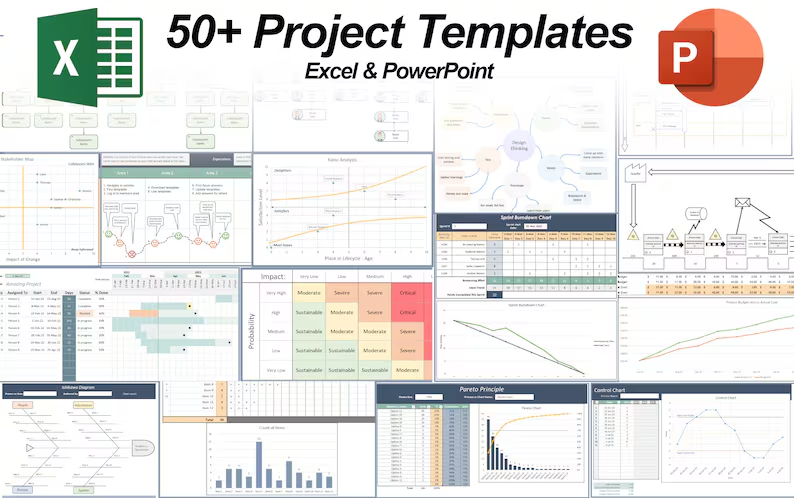
See what people are raving about! Get the Project Plans, Project Tools in Excel, Udemy PMP Course or Udemy Agile course here:
In this series we will walk through five PMP Practice Exam Questions each day – a great way to set up your morning as you prepare to pass the PMP Exam. It is also useful for the CAPM exam, as the content is very similar.
We will also figure them out together, and you’ll see the thought process behind solving these PMP exam questions.
I hope you enjoy!
Question 1
You are working through various options in your project and need to help stimulate your group towards innovation and ideas. Which of the following is a type of group creativity technique?
A) Monte Carlo Analysis
B) Regression analysis
C) Brainstorming
D) Root cause analysis
Question 2
You are working as a project manager, at the stage where you need to validate the scope and products you have created with the appropriate people. What is the output called that is produced by a project and approved by the end-user or customer?
A) Accepted Products
B) Accepted Deliverables
C) Accepted Results
D) Accepted Data
Question 3
You are working on your Project Management Plan and will need the opinion of an individual or a group who has a wide range of knowledge and experience in that specific field. What is this called?
A) Expert Judgment
B) Expert Findings
C) Expert Comment
D) Expert Decision
Question 4
You are developing a new product and decide to add three extra features that the customer did not ask for, to make the product extra special. You feel as though it will work better this way. What is this called?
A) Scope Creep
B) Customer first
C) Verified Deliverables
D) Gold Plating
Question 5
A project management plan is a formal approved document that defines how the project is planned, executed, monitored and controlled. Who is responsible for creating and updating the project management plan?
A) The Program Manager
B) The Project Manager
C) The Project Sponsor
D) The Project Team
In this series we will walk through five PMP Practice Exam Questions each day – a great way to set up your morning as you prepare to pass the PMP Exam. It is also useful for the CAPM exam, as the content is very similar.
We will also figure them out together, and you’ll see the thought process behind solving these PMP exam questions.
I hope you enjoy!
Question 1
You are working on a project and have been asked to create a plan that shows the practices and procedures to be adopted for execution and monitoring and controlling the project. What will you create?
A) Risk Management Plan
B) Project Management Plan
C) Sponsor Management Plan
D) Benefits Measurement Plan
Question 2
You have recently discovered the importance of communication in your project after one of your directions was misunderstood. What is one of the most effective way to handle complex communications?
A) Informal written communication
B) Oral formal communication
C) Formal written communication
D) Oral informal communication
Question 3
You are working in the risk area of a project. The project work is half way complete and dozens of new risks have been found that could jeopardise your project. The risk plan is not yet complete. When should risk management planning have been completed?
A) At the beginning of your project, during initiation and planning
B) In the middle of your project, during execution
C) When monitoring your project – you can analyse what isn’t created yet
D) When the project is finalised – as you will know the risks that have occurred.
Question 4
You are a project manager needing to use a project tool and technique that will inspect, clean, transform and model large amounts of data to uncover the impact of certain project risks. What technique are you using?
A) Meetings
B) Assessment Analysis
C) Information Technology
D) Data Analysis
Question 5
You are working on Risk Planning in your project and have asked one of your team to find the established records of risk categories within the organisation for you to pick from and re-use. What project management tool and technique are these also called?
A) Prompt Lists
B) Mitigation Lists
C) Issue Lists
D) Risks Lists
In this series we will walk through five PMP Practice Exam Questions each day – a great way to set up your morning as you prepare to pass the PMP Exam. It is also useful for the CAPM exam, as the content is very similar.
We will also figure them out together, and you’ll see the thought process behind solving these PMP exam questions.
I hope you enjoy!
Question 1
You have started to notice the impact that team motivation has on your project results. If you are giving your team love, affection, acceptance, friendship, you are using their:
A) Legal Needs
B) Social Needs
C) Wealth Needs
D) Organisational Needs
Question 2
You are working on a project where a strict and powerful union for the employees ensures that no employee can work more than 37 hours a week. This is an example of:
A) Project permissions
B) Project regulations
C) Project constraints
D) Project laws
Question 3
You are working on an Agile project and have been asked to create a document that lists team principles, agreements, and guidelines about the acceptable behaviour by team members. What are you working on?
A) The Team Guideline
B) The Project Management Plan
C) The Project Charter
D) The Team Charter
Question 4
You are managing a project team and need to ensure your team members are doing what is needed to get the job done. What is a project document you will use that helps you know the effectiveness of the team?
A) Team Performance Assessments
B) Team Progress Assessments
C) Team Presentation Assessments
D) Team Achievement Assessments
Question 5
A project manager will spend up to 90% of their time communicating, and your interpersonal skills will directly or indirectly impact the outcome of your project. Which of the following is a type of interpersonal skill?
A) Selling
B) Converting
C) Team building
D) Physical skills
In this series we will walk through five PMP Practice Exam Questions each day – a great way to set up your morning as you prepare to pass the PMP Exam. It is also useful for the CAPM exam, as the content is very similar.
We will also figure them out together, and you’ll see the thought process behind solving these PMP exam questions.
I hope you enjoy!
Question 1
You have been asked to prepare a document to gain the project sponsor’s sign off to access their function’s resources, that details the project goal and business case, high-level scope and requirements, high level dates and milestones, a high-level budget, and initial risk analysis. What are you creating?
A) Project Management Plan
B) Project Charter
C) Risk Management Plan
D) Lessons Learned
Question 2
You are working with the quality assurance manager of your project, where they are using a fishbone diagram to perform a cause and effect analysis for a problem you are working on to solve. What else is a fishbone diagram called?
A) Ishikawa Diagram
B) Value Stream Map
C) Pareto Diagram
D) Control Chart
Question 3
You are working in the quality assurance and testing phase of your project, where the test manager makes use of many different ways to assess project quality control. Who has the most responsibility for project quality control?
A) The vendor
B) The functional manager
C) The project manager
D) The project sponsor
Question 4
Your quality assurance manager on your project is using a technique in order to validate the scope and gain sign off on the deliverables. What is it called when they check the quality of the product against the quality requirements?
A) Checking
B) Assessment
C) Evaluation
D) Inspection
Question 5
You have noticed your project team starting to drift off, miss deadlines and make quality defects, and decide to learn a skill that will help bring the team together again. What will you research for information on how people, teams, and organizational units function in a project?
A) Organizational Process Assets
B) Organizational Theory
C) Organizational Charts
D) Organizational Structure
When you are working as a project manager, you don’t necessarily own a team of your own inside the business. Instead, you’re usually coming in and using business resources to help you deliver something, and they may not report to you on a daily basis.
Because of that it’s very interesting to look at the project manager’s sphere of influence, because it really does vary and it is different to a normal manager’s sphere of influence. For example, the normal manager will have direct influence over their team – they can pretty much hire or fire, they can tell their people exactly what to do with real consequences. Sure, a project manager can in some ways do that as well, but it’s much more prominent as a functional manager will have direct control over those people.
A project manager will need to have influence over the project team, and the managers and the resource managers for those people. But it extends out even further. They need to work with and ensure influence and responsibility for the project sponsors – who we’re delivering that business value to. There are also governing bodies around the project such as the steering committee of the project. There’s project management organizations or PMOs – all of these within an organization will need to be worked with, and you’ll need to provide information make sure that they’re working with you not against you, and ensure there’s little friction so that you can help get those things delivered nice and smoothly.
And that’s all part of being in the project manager role.
Beyond that we’ve got stakeholders of the project, for example suppliers who are supplying either resources or tools or things or information into the project. The end customer and the end users as well – all of these people will ultimately be influenced by the work that we do and so are subject to the project manager’s influence over the project.
A project manager needs to lead the project team and meet the project objectives, and meet or manage their stakeholder’s expectations. If things need to change over time a project manager will need to use their skills to ensure that stakeholders support the project instead of going against the project (which definitely can happen if things go sideways) and even to support the project decisions even when they don’t agree with them sometimes.
That can be a very challenging situation but it will be something that you do need to work through. It was noted in the PMBOK guide that the top 2% of project managers demonstrate superior relationship and communication skills, while displaying a positive attitude.
Even when things get tough, they still are able to display a positive attitude and work through those issues in a positive way. This is so they can keep those good stakeholder relationships as well, and work through those things in the future. It’s very, very important.
A project manager must also have influence over the organisation, working with other project managers in the organization. Maybe you’ve got 10 projects going on at the same time and maybe there are different resources required – this project needs some of your resources and now you have to ensure that you’re using your power and influence and your skills to make sure that your stuff still gets done at the same time as helping out other projects around the organization.
It can be a tough situation, but it is something that you will need to be aware of. Other projects may impact yours due to demands on the same resources, funding (maybe they need money and it’s coming out of the same bucket of money), impacts of the change to the business. Sometimes the business can only handle so much change going into it, such as training and communication and process changes that need to be done, and they have their business as usual work that they need to do as well, so sometimes they just run out of capacity to take it all on.
As project management capability is increased it’s also important throughout the organization that everyone is operating from the same playbook, the same strategic steps, the same tactical steps (such as processes that you go through to complete a project), so that everyone is is on the same page and knows what you’re talking about. It’s a much nicer shortcut to working with others when everyone is working from the same process steps.
But that is not all.
The project manager needs to work with the industry as well. We need to stay informed about current industry trends, no matter what industry you’re in all of these things are constantly changing and it’s up to us to be aware of what’s happening in our industry because they might impact our project. Something could come out of the blue and completely change the landscape, and we need to be aware of that.
We might have product technology development, new market niches. You might have broader economic forces, for example maybe the stock market is starting to fall, or maybe money is flowing out of this particular industry. We’ve got new tools, new skills or disciplines (for example Agile coming into IT around 15 years ago and now into project management, and also into operations management).
We’ve got new competitors, new threats and of course new laws and regulations. We seen our fair share of of regulation changes over the last few years in almost every industry.
But that is still not all.
A project manager needs to influence and be aware of their own professional discipline as well. That means continuing our professional development, continuing to learn, continuing our education and sharing that knowledge, the things that we’ve learned with others within our organization to help everyone sing from the same hymn book, to work from the same process steps. Beyond the organization is helping other organizations improve their way of work and their methods for delivering projects as well. It might include standards for delivering change around the world, whether it’s in your industry or other industries. This is a wonderful thing because now we’re not just helping ourselves, but we’re going out there and helping others where we can as well – we’re developing our project management knowledge, our knowledge in our related profession and we share that at local, global and national levels.
Lastly the project manager’s sphere of influence will occur across disciplines. And that’s part of the real value of project management because project management is a skill set that will sit across almost any industry, because any industry will require to put change into an organization or to go from point A to point B at some point, and to do that you need a project. To do that change you need to manage a project from start to finish. In using a project management process that works across disciplines we can help coach, improve and inspire others in that method to help them get the business value that they need.

 PMP Exam Question Session 15
 PMP Exam Question Session 14
 PMP Exam Question Session 13
 PMP Exam Question Session 12
 The Project Manager’s Sphere of Influence