PMP Exam Questions – Practice Session | 08

– See all the PMP Exam Questions – 

PMP Exam PracticePMP Exam Question Session 8

In this series we will walk through five PMP Practice Exam Questions each day – a great way to set up your morning as you prepare to pass the PMP Exam. It is also useful for the CAPM exam, as the content is very similar.

We will also figure them out together, and you’ll see the thought process behind solving these PMP exam questions.

I hope you enjoy!


Question 1

You have been promoted from your role of project manager into a portfolio manager role. A portfolio is work grouped together to meet a certain strategic business objective and it involves:

A)  Projects and programs
B)  Projects and operations
C)  Programs and operations
D)  Projects, programs, and operations

Question 2

You are working as a project manager and created the cost estimate to bid on a government contract, where the scope was set by the government. Your manager advises you to reduce the cost to win the contract by whatever means, but your analysis shows that reducing the cost estimate will make the project unable to meet the specified scope. What should you do?

A)  Reduce the cost estimate and submit it
B)  Formally communicate to your manager about the implications of reducing the cost
C)  Ask your manager to estimate instead
D)  Submit your estimate without reducing the cost

Question 3

Work Performance Data generally contains raw facts and figures such as start dates for various activities, the number of bugs found in the software, spent cost, etc. What is a type of Work Performance Data?

A)  Forecasted estimates to complete
B)  Implementation status for change requests
C)  Percent of work physically completed
D)  Status of deliverables

Question 4

As you work on projects they can be influenced by many different things, and many different Enterprise Environmental Factors. What sort of influence are Marketplace conditions on your project?

A)  External
B)  Internal
C)  Regulatory
D)  Public

Question 5

You have recently been promoted from your role as Project Manager to a role that manages a related group of projects, and ensures efficient use of resources among those projects to ensure they are delivered. What is your role?

A)  Functional Manager
B)  Project Manager
C)  Portfolio Manager
D)  Program Manager
– See all the PMP Exam Questions – 

Leadership Quote – Abraham Lincoln on Preparation

– See all the Leadership Quotes here –

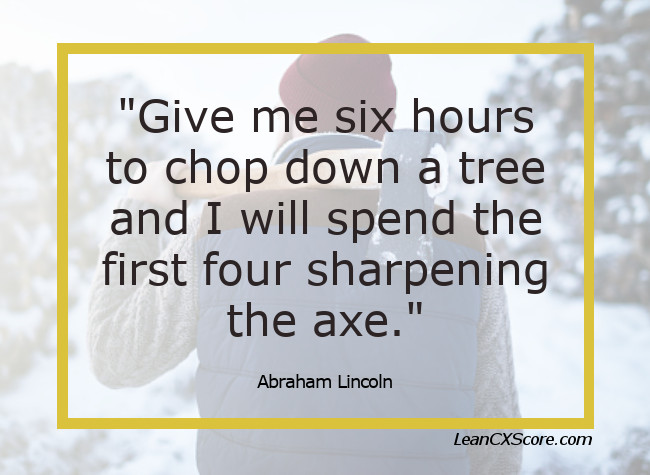
“Give me six hours to chop down a tree and I will spend the first four sharpening the axe.” – Abraham Lincoln 

Have you heard this leadership Quote from Abraham Lincoln?

Abraham Lincoln was an American statesman and lawyer, and also the 16th president of the United States (1861 to 1865). Lincoln led the nation through the American Civil War, abolished slavery, and modernized the U.S. economy.

Quote-Abraham Lincoln-chop tree-sharpen axe

Don’t Cut a Tree With a Blunt Axe

A tree, in this case, could be a metaphor for any task in your life that will take time to complete. But a tree is a nice, visual way to describe it, and it makes sense that we don’t want to use a blunt axe to chop it down. We want our tool to be sharp. And if we spend that time to prepare our tools for the job, then the job itself takes less time to complete as well.  We’re not spending the full six hours to chop down the tree, it’s now only taking the remaining two hours. The job itself will also be easier with a sharpened axe.

So it begs the question: What are the trees and axes in your life?

What tasks do you have to complete, whether they are new tasks or ongoing? Are you starting a business? Completing some study for an exam? Wanting to get married or find love? Wanting a promotion at work?

What will happen if you take an exam, but do no study? What will happen if start a business, but do no market research? What will happen if you want a promotion, but don’t understand out the area you want to work in?

Sharpening the axe is preparing for the job, and preparing for the job makes the job itself easier.

– David McLachlan

Get the Leadership Card Deck or the Lean CX Score Book:

Leadership CardsView All The Leadership Cards (48)

- or - Have the Leadership Cards delivered for your next meeting


Lean CX ScoreGet "The Lean CX Score" now, and start creating disruptors in your industry that completely annihilate your competition.

Oh and good news!  You'll be improving the speed, morale and engagement of your teams at the same time.  Get the Lean CX Score now.

07 – Project Management Office Types

7_Project Management Office Types

Project Management Office Types

The PMO or the project management office itself is quite important and there are a few different types of PMO that you will come across in your career and in the CAPM and PMP exams.

Supportive PMO

A supportive PMO is more of a consultative role. They will supply templates, best practices, and they don’t really have a high degree of control they just give people guidelines in what to do and say.

For example, “Here’s a good way to do it, but what you do is up to you.” They’re just supporting you. They’re not really directing or controlling anything.

Controlling PMO’s give more of a specific project management framework or methodology, such as the use of specific templates, forms and tools. They also ensure you use them, so they’re saying “Here are the things that you have to use, and this is the way you have to do your project.” It’s controlling the project, but through the use of templates forms and tools that the company uses. A controlling PMO asks for conformance to those governance frameworks. They might have project specific methodologies and specific ways of work.

Lastly the most controlling is the Directive PMO, which is what I personally found a little bit confusing. But directive project management offices take complete control of their projects by directly managing those projects. They have specific project managers, assigned by the PMO, and they report back to the PMO. They have a very very high degree of control in this environment.

So you have supportive, controlling (where we control through templates, governance frameworks and adhering to these) and then directive (where we’re actually taking the direction of the project through the project management office

The primary function of a PMO, no matter what type it is, is to support those project managers in a variety of ways. These ways could include managing shared resources across all projects and this is really important. You might have 10 projects but you only have enough resources for six projects, so you need to shift these around and the PMO can keep an eye on all of this. A PMO will usually have a portfolio view of things and help manage the use of those resources across those different projects.

They can help with coaching, mentoring, training and oversight, monitoring the compliance requirements and the standards and policies and procedures, helping people work with the policies and procedures within an organization, and coordinating communications across projects.

It really does come back down to that project, program and portfolio view where they have a great view of all the things that are going on. In the individual projects they can help with the communication, help with the management of it, and basically are there to support those project managers and help get the job done. And these are the Project Management Office Types.

– David McLachlan

PMP Exam Questions – Practice Session | 07

– See all the PMP Exam Questions – 

PMP Exam PracticePMP Exam Question Session 7

In this series we will walk through five PMP Practice Exam Questions each day – a great way to set up your morning as you prepare to pass the PMP Exam. It is also useful for the CAPM exam, as the content is very similar.

We will also figure them out together, and you’ll see the thought process behind solving these PMP exam questions.

I hope you enjoy!


Question 1

You are working on a project and your project sponsor asks you to contribute to a decision on whether to continue the project. The project had an initial budget of $500,000, is only half complete and has spent $1,000,000. Should the organization consider the $1,000,000 when determining whether to continue?

A)  Ask the Project Team to vote so the process is democratic
B)  No, the money spent is gone
C)  Yes, that is our money spent, we should consider it
D)  Refer to the functional manager as they own the business unit

Question 2

You are working as a project manager, asking for proposals from a Third Parties to complete the work. Your brother works for one of the vendors bidding for the contract. You are part of the executive team which will accept a vendor. What do you do?

A)  Discourage the vendor bid as it would be a conflict of interest
B)  Help the your brother’s vendor in the bid so you can work together
C)  Inform your company and the vendor of the relationship
D)  Don’t tell anyone. Why complicate things?

Question 3

You are working as a project manager in a foreign country. It is customary that gifts be made to the government to obtain the necessary project approvals, however the country where your company is based does not allow this practice. What should you do?

A)  Don’t bother with getting project approvals
B)  Ensure you offer gifts to obtain the project approvals
C)  Allocate additional hidden funds in the project to obtain the gifts
D)  Do not offer gifts to obtain project approvals

Question 4

You are working on a complex project requiring expertise from the functional manager. What is your role as a project manager in a weak matrix organization?

A)  Coordinator
B)  Administrator
C)  Supporter
D)  Functional manager

Question 5

Project Constraints are any restriction that defines a project’s limitations and is the limit of what the project is expected to accomplish. Which of the following is one of the types of competing Project Constraints?

A)  Size
B)  Sponsor
C)  Quality
D)  Location

– See all the PMP Exam Questions – 

Leadership Quote – Charlie Munger on Incentives and Outcomes

– See all the Leadership Quotes here –

“Show me the incentive, and I will show you the outcome.” – Charlie Munger

Have you heard this leadership quote from Charlie Munger?

Charlie Munger was born on new year’s day in 1924, and is a former real estate attorney, architectural designer, is the vice chairman of Berkshire Hathaway, the huge company controlled by Warren Buffett. He has long been fascinated with the psychology behind human misjudgment.

Leadership Quote-Munger-Incentive-Outcome

Business Partner to the Richest Man in the World

Charlie Munger has been business partner to Warren Buffett, at one time the richest man in the world, and it is clear in his wisdom from quotes like these that there is a very good reason why.

Before the Global Financial Crisis in 2008, mortgage brokers were heavily incentivised through their commissions to sell as many mortgages as possible, whether their customer could pay it back or not. Traders and financial houses were also heavily incentivised through their own commissions to create and sell bundles of these low-quality mortgages to other traders around the world.  And of course, people who couldn’t afford houses but really wanted one were able to do so. The result was a perfect storm that nearly broke the back of capitalism.

But when we talk about incentives, it doesn’t have to be just about money. A person might be doing something to improve their status – gain a new title or a promotion, or even just impress someone they like. It also might be how someone is measured – if you measure a team in your company as a leader and you focus on the volume of something, you can bet that their behavior will change quite quickly to push more of that thing through their process, whether it is of good quality or not.

Think carefully about someone’s incentive, and you will know them well without ever having to meet. You will also be well prepared for any decisions that may take others by surprise.

– David McLachlan

Get the Leadership Card Deck or the Lean CX Score Book:

Leadership CardsView All The Leadership Cards (48)

- or - Have the Leadership Cards delivered for your next meeting


Lean CX ScoreGet "The Lean CX Score" now, and start creating disruptors in your industry that completely annihilate your competition.

Oh and good news!  You'll be improving the speed, morale and engagement of your teams at the same time.  Get the Lean CX Score now.

PMP Exam Questions – Practice Session | 06

– See all the PMP Exam Questions – 

PMP Exam PracticePMP Exam Question Session 6

In this series we will walk through five PMP Practice Exam Questions each day – a great way to set up your morning as you prepare to pass the PMP Exam. It is also useful for the CAPM exam, as the content is very similar.

We will also figure them out together, and you’ll see the thought process behind solving these PMP exam questions.

I hope you enjoy!


Question 1

Present Value is the present day value of an amount that is received at a future date. The Present Value (PV) of $12,000 to be received 4 years from now, with an interest rate of 5% would be:

A)  $9,872
B)  $1,787
C)  $11,268
D)  $1,541

Question 2

You are choosing a project for an organization where Project X has an internal rate of return (IRR) of 8%, Project Y has an IRR of 7%, Project Z has an IRR of 9%, Project W has an IRR of 11%. Which project would be the best choice?

A)  Project W
B)  Project X
C)  Project Y
D)  Project Z

Question 3

You are a project manager and meeting the stakeholders along with your team. What is the first meeting of stakeholders and team members, which provides an opportunity to clarify roles and ask questions called?

A)  Meeting
B)  Kick-Off
C)  Launch
D)  Kick-On

Question 4

You are working in the procurement department for your project. One vendor is trying to give you an expensive gift with the understanding it would help them get the contract. What would you do if there are no rules regarding gifts in your company?

A)  Ask the vendor for an additional gift for your boss also
B)  Don’t accept the gift
C)  Accept the gift and help them, it is a nice gesture
D)  Seek advice from your boss

Question 5

You have been working as a project manager for some time, and have found different types of resistance to the change brought about by your various projects. What is the main source of resistance for any change in an organization?

A)  Project
B)  Process
C)  Technology
D)  People

– See all the PMP Exam Questions – 

PMP Exam Practice Questions – All

PMP Practice Exam

You can pass the PMP Exam.

Below you will find links to hundreds of PMP and CAPM practice exam questions for you to test yourself on and practice before you take the real thing. Each session has five questions, where we go through and solve them together.

If you study hard every day, and take practice exams every day, I absolutely believe that you will gain the skills you need to pass the PMP Exam. I believe in you, and I know you can do it!

06 – Project Management Data, Information and Reports
Project Management DataProject Management Data, Information and Reports

Within your project there are three types of data that you’ll come across.

The first is the most raw type of data, things such as raw observations during activities performed to carry out the work. For example, how many times did you do “X”? It’s also called work performance data and you’ll come across this in your CAPM and PMP exam. There’s data, there’s information, and then there’s reports. Each of these feed into each other so it’s quite important to take note of.

Work Performance Data

Data is the raw stuff, raw observations such as a count of “this many actions” or “this many dollars”. Project Management Data is often captured in your Project Management Information System, which is the overall process and software you use to capture and hold project information. Examples include:

1. Work physically completed
2. Quality and technical performance measures
3. Start and finish dates of schedule activities
4. Number of change requests submitted, or approved
5. Number of defects
6. Actual costs or money spent
7. Actual durations of activity

Work Performance Information

We analyze the work performance data to turn it into work performance information, analysing against other information it to give a status, such as estimates to complete on the project. This is where we turn it into things like variances, percentages or charts and information that people can use more readily than just the raw numbers. It’s things such as the cost performance index (which you’ll come across) or the schedule performance index which we’ll need to calculate to see how a project is going.

It also includes things such as:
1. Status of deliverables
2. Implementation status for change requests
3. Forecast estimates to complete

Work Performance Reports

This is where we put all of of that information into a nice pretty document, usually that someone can read quite easily and we turn that into our work performance report. Another way to look at this is we’re executing the processes and physically doing them that’s the work performance data. As we’re controlling those processes we need to analyze them and see how they’re going maybe they’re 80% complete for example that’s our work performance information. Then when we’re wanting to report on our overall project and control that within the business and maybe report up to our executives, managers, sponsors or the stakeholders who are involved then we’re wanting to do a work performance report so they can see how it’s tracking as well.

This really feeds into our project change control and our project communications that help us to show how everything is going.

– David McLachlan


Leadership Quote – Amelia Barr on Simplicity

– See all the Leadership Quotes here –

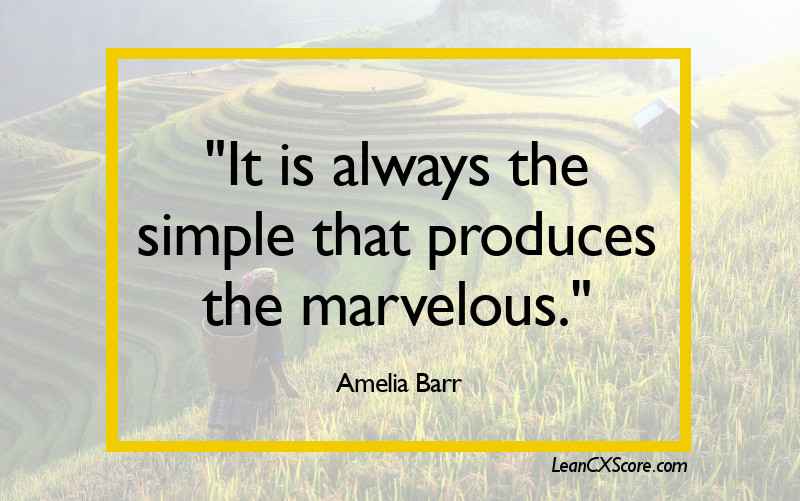
“It is always the simple that produces the marvelous.” – Amelia Barr

Have you heard this leadership quote from Amelia Barr?

Amelia Barr was a writer and teacher from Britain who lived in the late 1800s to early 1900s. When she was only nine years old she had to read for her father, and developed her reading and comprehension well beyond her years. As an adult she learned the Stowe teaching method, whose principles are based on morality and lifelong learning.

Leadership Quote-Amelia Barr-Simple-Marvelous

Simplicity is a Powerful Thing

People often get simplicity confused with ease. the two are not the same. For something to be simple, often we have to cut things out of it, and reduce things to their essential form or qualities, and this is actually quite hard for human beings to do.

But the power of simplicity is that fewer things can go wrong, and there are fewer things to overload our senses or confuse our target audience. When you are able to focus on just one thing, there is a much higher likelihood it will get done, as opposed to switching tasks and having to get up to speed on each task again.

The iPhone made things exceptionally simple for its users. It famously only had one button, and the rest was a simple touch of the screen. Before this it was computers with full keyboards and often complicated navigation.

Amazon also made things simple, when they were the first company to patent the “One Click Buy” button, which had all the relevant customer details saved so a customer only needed to focus on the thing that made Amazon money – the point where the customer bought it.

Ask yourself – “How can I make things more simple in my life, in my organisation, in my team and in my product?”

– David McLachlan

Get the Leadership Card Deck or the Lean CX Score Book:

Leadership CardsView All The Leadership Cards (48)

- or - Have the Leadership Cards delivered for your next meeting


Lean CX ScoreGet "The Lean CX Score" now, and start creating disruptors in your industry that completely annihilate your competition.

Oh and good news!  You'll be improving the speed, morale and engagement of your teams at the same time.  Get the Lean CX Score now.


PMP Exam Questions – Practice Session | 04

– See all the PMP Exam Questions – 

PMP Practice ExamPMP Exam Question Session 4

In this series we will walk through five PMP Practice Exam Questions each day – a great way to set up your morning as you prepare to pass the PMP Exam. It is also useful for the CAPM exam, as the content is very similar.

We will also figure them out together, and you’ll see the thought process behind solving these PMP exam questions.

I hope you enjoy!


Question 1

Two team members in your project are having issues working together. You discuss this problem with the functional manager and jointly agree on a solution. What type of organizational structure are you working in?

A) Project oriented
B) Strong Matrix
C) Balanced Matrix
D) Weak Matrix

Question 2

A project management office (PMO) is a group or department that defines and maintains standards for project management within the organization. What is the primary objective of a PMO?

A) To support the customers receiving the product
B) To support the project managers
C) To support senior management
D) To support the industry

Question 3

You are working on an agile project as a project manager and performing sprint planning. You are planning the work in detail to be completed soon, and long term work is planned at a high level. What is this called?

A) Detailed Elaboration
B) Waterfall Planning
C) Agile Planning
D) Rolling Wave Planning

Question 4

At what stage of a project is a project manager typically assigned to a project?

A) The very beginning, during project initiation
B) The beginning to middle, during project planning
C) The middle, during project execution
D) The middle to end, during project monitoring

Question 5

You are in the process of identifying the methods your company uses to accept third party vendors and procure their services. What are you looking for?

A) Rating Selection Criteria
B) Source Selection Criteria
C) Scoring Selection Criteria
D) Proposal Selection Criteria

– See all the PMP Exam Questions –